“What? You’re serious?” her hands stopped mid-snip, trying to grasp what I’d said, and looked at me in the mirror.
“The cows ate your house?”
“Yup.”
She stared at me in the mirror for a second, probably trying to decide whether I was messing with her. Then she resumed her haircutting, laughing at the absurdity. Pretty much the same reaction I get from everybody. At first they are incredulous and then have to laugh, usually apologizing for their apparent insensitivity at my dwelling disaster.
She cocked her head to the side as she clipped away and said, “Well, I guess it seems only fair, though, right? I mean, you eat meat, right?” squinting at me in the mirror, her nose stud glinting in the afternoon sunlight.
I started to nod, then remembering the scissors, just mumbled an “uh huh.”
“Well it seems only fair that they should eat your house, right?”
“I suppose.”
After the initial horror of discovering that herds of open range cows had eaten the beginnings of my off-grid straw bale house, the results of a long, struggling hot summer’s work, I, myself had to laugh a little at the image of these cows partying on my land all winter, probably mooing paeans to my name for my generosity in leaving them such a winter feast.
I still think they owe me a barbecue.
Now, more than a decade and many episodes later, I was heading back to the place to see what I could salvage. So much had happened since I first set out to create my “dream home”.
The Plan
It all began just after the turn of the century with that letter from Social Security.
As I was approaching 50, they had the courtesy to inform me that, if I continued to work earning the same good wages I had been enjoying freelance with Mattel until I was 70, I would receive a whole $1000 a month!
Wow!
Except, the thing was, Mattel had stopped calling and I was unemployed and “stranded” in Las Vegas with a mortgage and a looming credit card debt. $1000 a month wouldn’t have covered it even then, let alone in twenty years!
Uh oh.
Time for an alternate plan. I was really done with Las Vegas, having primarily been there as a support to my family. After Mom and Dad died and my brother and his daughter went to live with relatives in Michigan, I couldn’t wait to get out of that dusty, crowded oven and find a fresher life somewhere.
I have always preferred more natural settings and have spent most of my free time escaping the dense confusion of the urban experience by camping in the mountains or the desert. While I was in college in the early seventies, I came across a copy of Mother Earth News which is a wonderful pictorial monthly handbook for people wishing to “get back to the land”. Off-gridders.
I was hooked. It became a dream of mine to someday have a self-sustaining homestead somewhere, to “live off the land”, to get my power from the sun and my water from the rain. The dream had been set aside for practical life reasons, but now it looked as though it might be finally the time.
Taos
I took a couple of road trips, exploring some options but nothing felt right. Then I got a call from an old friend in Taos, New Mexico. I had helped him and his first wife move there back in the eighties and was delighted by the spacious beauty of the high mountain valley and the rich and complex culture of the peaceful town.
He found himself in a rather desperate situation and was calling all of his friends for help. He was going through an inequitable break-up with his second wife in which she got the house with the attached furniture workshop and tools (which, shockingly, her new boyfriend was using to make his living) and he got the two young kids with nowhere to live and no way to fill the Southwest furniture orders he had with the galleries in Santa Fe. I saw it as an opportunity to check out Taos as an option for relocation and jumped in the Jeep to go help him knock out his orders.
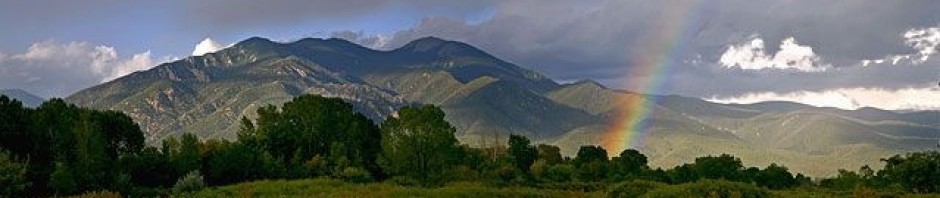
After a seven hundred mile drive, all the way praying for guidance and some sign about Taos as a choice, I drove up the pass and rounded a corner to suddenly find myself looking up the length of the spectacular, 1000 foot deep, Rio Grande Gorge, the low sun sharply defining the steep cliffs.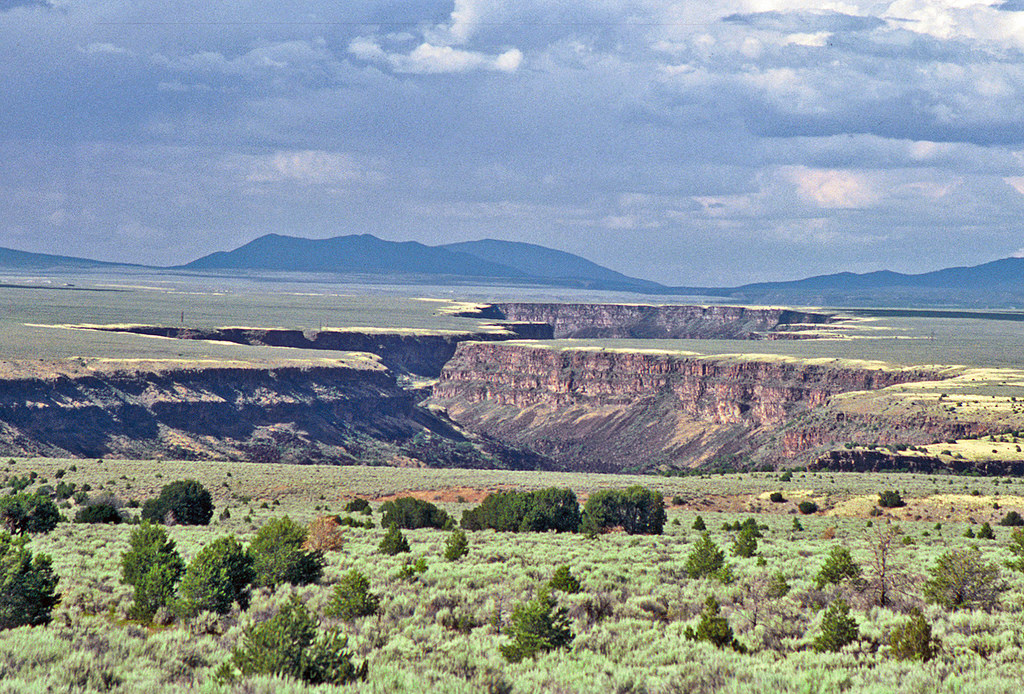 A warm, monsoon thunderstorm had just passed through, casting the valley in dark, shifting shadow. The Sangre de Christo range ran north to my right and there, at the base of Taos sacred mountain, was the town, shimmering white in a golden patch of sunshine, sitting at the end of the most brilliant rainbow!
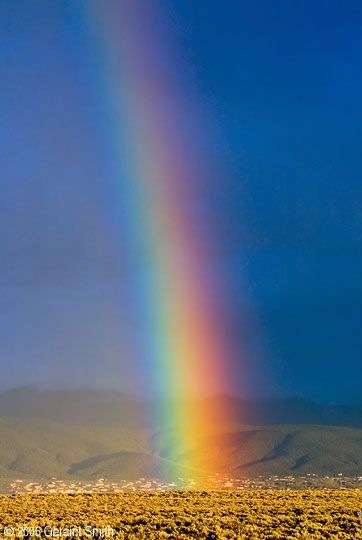
You asked for a sign?
Taos Pueblo dates back at least a thousand years and is considered to be the oldest continuously inhabited settlement in the United States. Coronado came up the Rio Grande in 1540 in his quest for the fabled seven cities of gold bringing the Spaniards to the area. The name Taos comes from the Pueblo people meaning “place of the red willows” and the present town was established in 1615. A true old west setting with folks such as Kit Carson living here, it actually was Mexico until 1848 when we “won” it in the Mexican/American War.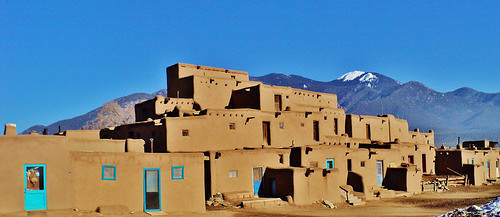
We lucked into a perfect workspace which was free in exchange for some improvements to the place, and knocked out those furniture orders while I considered whether Taos was the place for me or not.
At first I rented a room in an old, historic adobe from an acquaintance of my friend. Let’s call him Trip.
The arrangement didn’t work out very well for several reasons and so I wasn’t there very long, but I mention him because he figures into the story significantly later. I was there only a week when Trip came in to tell me that his son had called with the news of the Twin Towers disaster. It was September 11, 2001.
While he was on the phone with him, the second plane hit. I had to drive to town to the satellite TV store (we didn’t have TV service at home) to get the details. You know how that all went.
When it was “revealed” that the “terrorists” had all met in Las Vegas the week before, I decided that the time was right to be getting out of the city, went home for the holidays, and then put the house on the market in January, 2002.
It sold pretty quickly and by late spring I had disposed of a huge portion of the stuff in the house, only keeping what seemed to be core essentials of my family’s things which I put into storage, (No small task since Mom’s house also held Dad’s stuff, my niece’s and brother’s stuff and by then, all of my stuff, too! Initially it took three units! Mercifully, I had a few loyal friends who helped me through the process.) and moved back to Taos.
The die was cast and I didn’t dare look back.
I had found a tiny garage-conversion studio apartment in a newer, adobe-style house and scrounged around for work. I got some gigs as a house painter, mostly just standard stuff, but occasionally lucked into more creative projects involving faux treatments, something I picked up during my Mattel days.
The Land
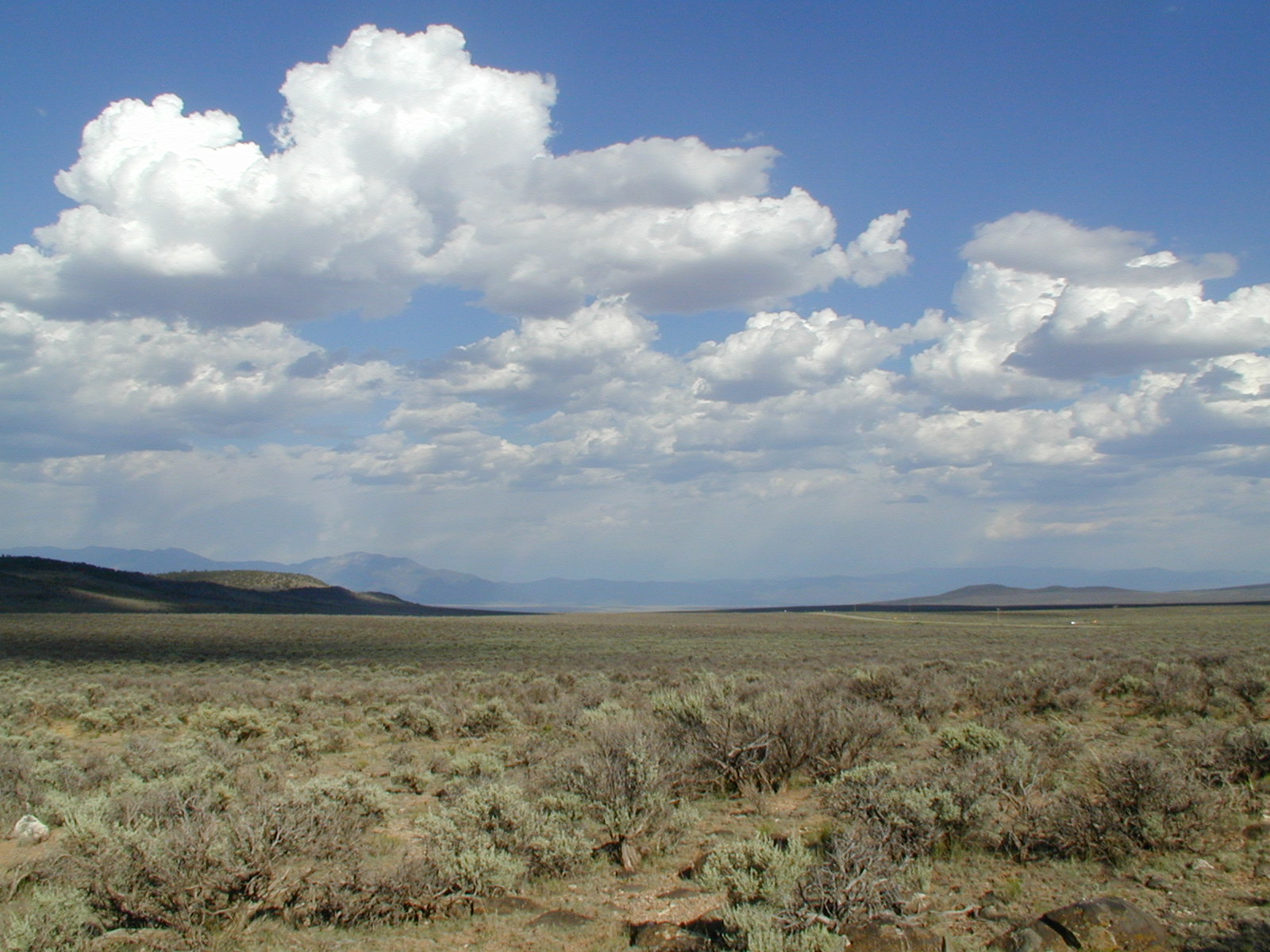
In my free time I would drive around the area, exploring the various settlements in the outskirts of town, looking for an area that felt right before actually seeing what was available on the market or comparison pricing. I just wanted to get a feel for the whole region before bringing my left brain into it. I’d originally hoped to find something with water and greenery, but water being such a scarce resource in the area, all of those places had been spoken for for generations and had high price tags attached to them. There were many dwellings out on the Mesa and lots were available, but because of the wide open nature of the place, you could see all of your neighbors scattered across the scrubby plain. I figured that if I was going to go to the effort of having an off-grid spread, why would I choose to have neighbors in an area that was developing fast?
Going farther afield brought me to Carson National Forest, which, though still beautiful, was mostly deadstand as a result of a bark beetle infestation caused by the ongoing drought. Too tindery, limited sun, and too far to town, I thought.
On the way back to town I made the turn in Tres Piedras onto Highway 64 east which takes you across the Rio Grande Gorge Bridge on the way back to Taos. A short way along from the intersection there are a number of small, half and one acre “developments” littered along the way and extending back into the low hills in places. They were mostly decrepit mobile homes and various bodged together shacks with a scattering of derelict cars, outhouses, weathered hippie school buses and junkyards creating the sense of a shanty town intruding on the otherwise uninterrupted blanket of sacred sagebrush stretching to the distant horizon. I shuddered at the unkempt quality of the area and shut down my “feelers” as I hurried past. (karma alert-“judge not…”)
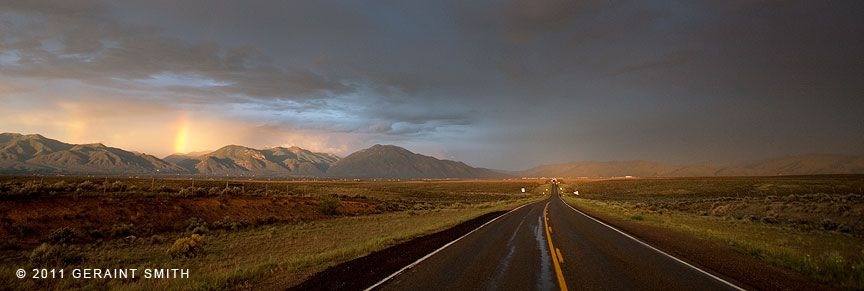 Some miles down the road the development abruptly ended, though, and the wide pristine expanse and opened up again. Taos sacred mountain was directly ahead, on the far side of the Gorge. The sea of featureless sage spread into the broad receding distance where triangular cinder cones stand sentinel, pointing to the vast, encompassing sky. The whole area felt special to me and I made a mental note of it as I drove back to town.
One day in late April, I found myself high on a cold, windy scaffold outside of a large new home perched high in the foothills, affording a glorious view. I was painting vigas, the roof support beams jutting out of the walls in adobe construction, and canales, the traditional water drainage spouts. Around the corner from me, out of sight on another scaffold, worked another guy whom I had only just met. As we were casually swapping stories while we worked, I mentioned that I was looking for some land for an off-grid homestead.
”No way!” he exclaimed, sticking his head around the corner. “I have 17 acres that a group of friends of mine and I invested in that I need to sell. We wanted to set up some kind of retreat space but it all sort of fell through. You should come and see it.”
I have always seen surprising synchronistic situations as a sort of message from God or the Universe that I should pay attention. This was one of those. After work when he drove us out to see the property, I was not overly surprised to find that it was right where I had gotten the “hit” in terms of attractiveness. It had some real drawbacks such as no water or trees, making it visible from the highway passing ¼ mile away and it was twenty miles to the nearest business in town. It was a breathtaking spot, though, and you couldn’t see another house anywhere. I decided to give it some thought, despite the synchronistic circumstances urging me to be impulsive.
With my 50th birthday looming in a couple of weeks and not wanting to spend it lonely, I decided to drive to Michigan to instigate a “surprise” party and discuss the land decision with my relatives. The reception was positive and my construction skilled cousin Monroe even offered that he maybe could come out that summer and help.
I had decided, after much research into alternative construction methods, that a modest, two room straw bale house would be the best place to start for me, offering the most for my dollar. They are both inexpensive to build and about the best insulation around, an important consideration for a region that is hot in the summer and very cold in the winter. I like their sculptural quality and once stuccoed, they have the appearance of the local adobe construction. Diverse and imaginative architecture is a local hallmark. Taos is the home of Earthships, dwellings earth-bermed to the north with south facing glass walls capturing the winter sun in the thermal mass floors, and roofs which harvest solar energy and rain. Driving across the mesa, one can see a range of Earthships, geodesic domes, straw bales, yurts and various imaginative hybrid structures incorporating non- traditional building materials, such as vehicles, wooden pallets, and other scavenged materials.
Trying a new construction technique appealed to Monroe and stacking a few bales sounded like it could be fun. (who knew)
So, I decided to go for it.
I went back and paid the guy cash, making sure the deal was on the up and up first, of course, and sidestepped paying for an agent. What I didn’t do was comparison shop. I don’t know how to evaluate property, one location to another, or even how big an acre is, let alone 17, when it’s plopped in the middle of thousands of featureless others. The price seemed fair, though, so I went for it. Probably unwise but I thought I was on a cosmic roll.
After buying the land, there was precious little money left from the sale of the Las Vegas house and I set about immediately to secure some of the essentials that I knew I would absolutely need, before the money ran out. Things such as solar panels, batteries, and an inverter panel, a water tank, pump, and pressure tank, and a composting toilet took most of the money remaining. But at least I had them.
The First Summer
Winter leaves late at 7600 feet but as soon as it was warm enough, I got started. My first task was to pick a site and set up temporary quarters. My good friend Ken drove down from Seattle with the shell of his pickup truck stuffed with assorted doors, windows and hardware left over from his recently liquidated door business.
We walked the land and I picked a site for the straw bale house and then chose another site up the hill, closer to the “road” for a temporary bathhouse/wind and sun shelter for those I hoped were coming to help in the construction. 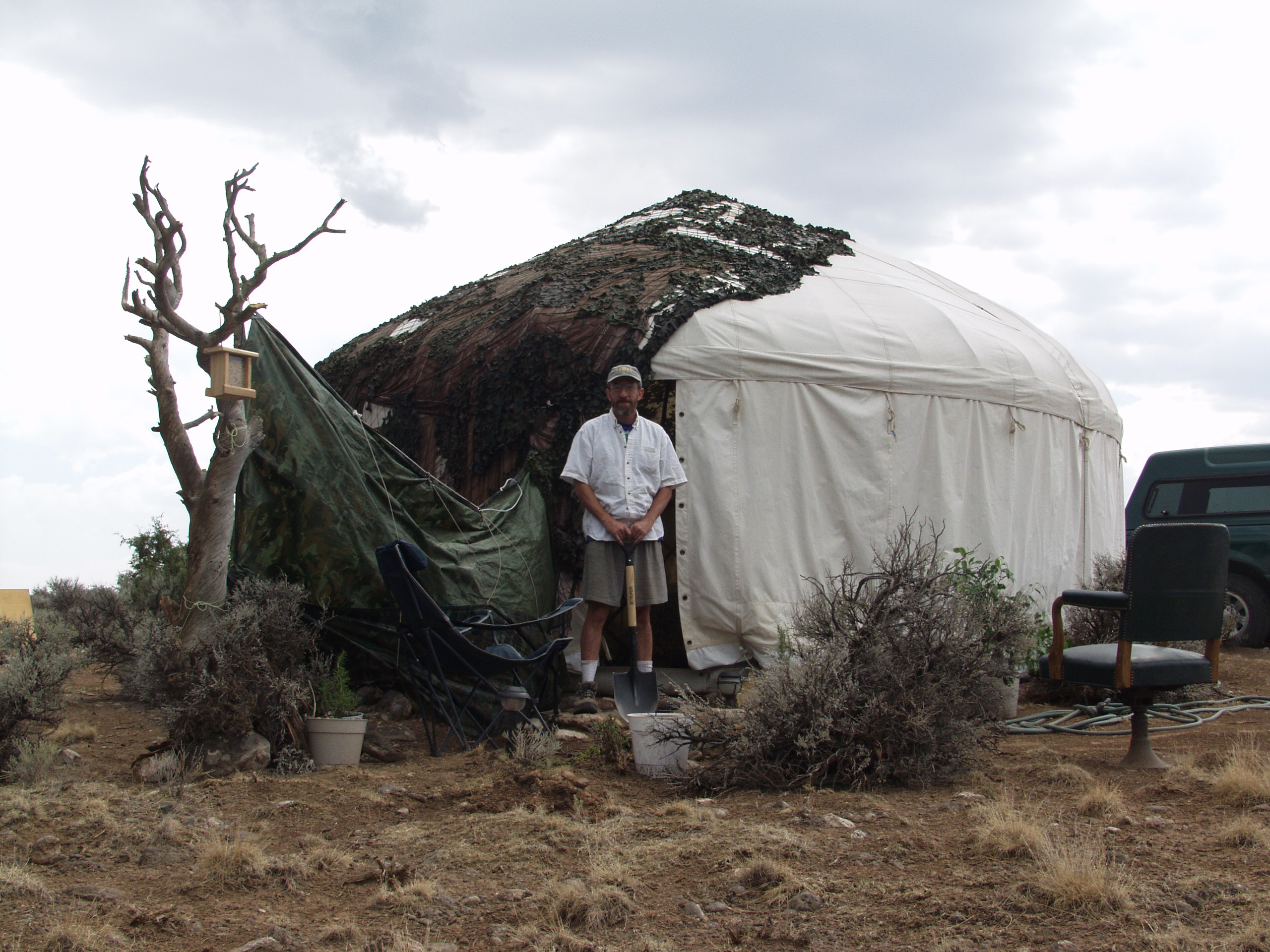 I rented a summer yurt from an acquaintance in town, a bright, white circular canvas tent affair, maybe 18 feet in diameter and 12 feet high at the center, with vertical walls and a shallow, rounded, conical roof.
 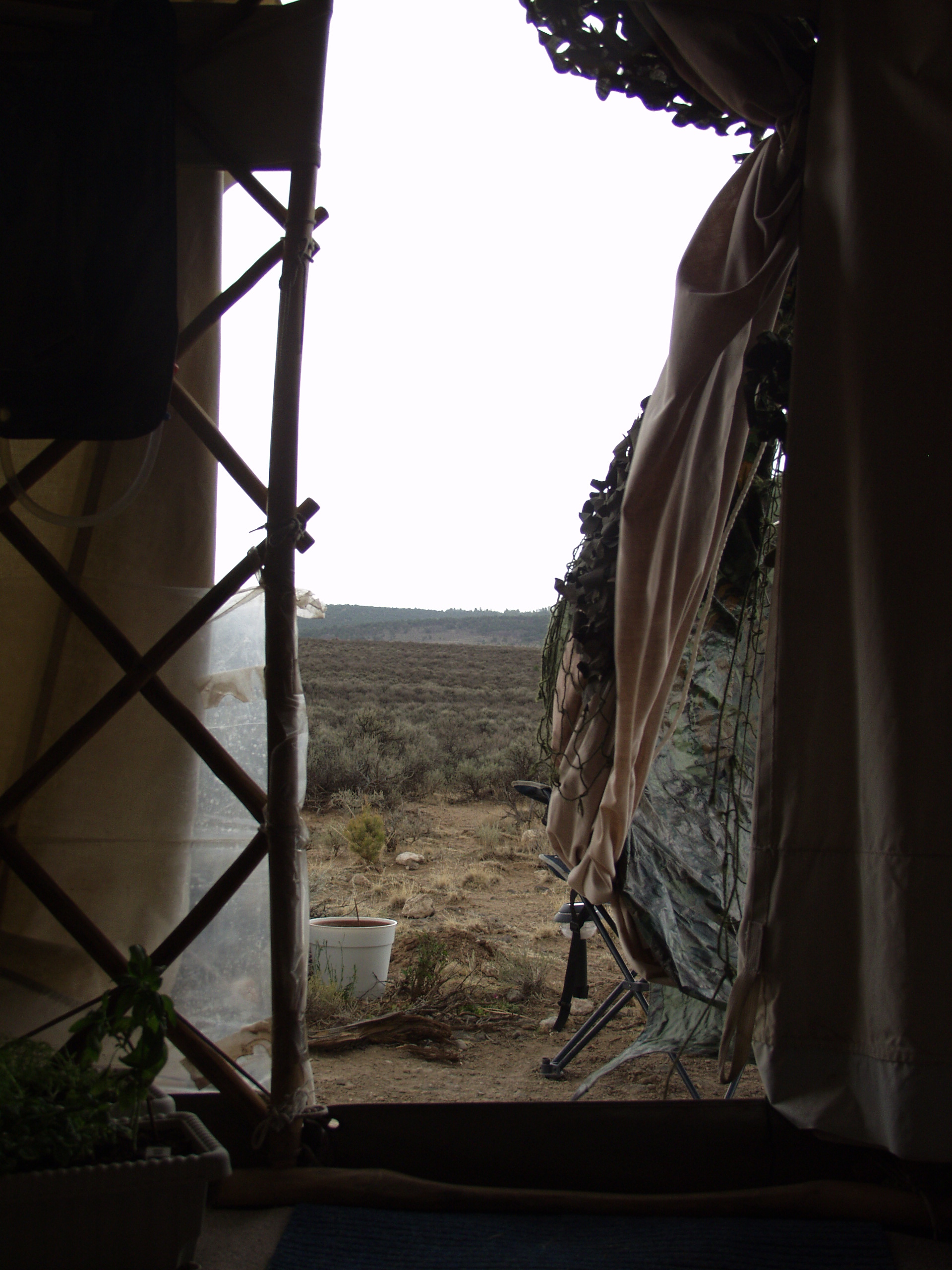 It’s an ingenious, surprisingly sturdy structure, lightweight and portable, composed of poles and sections of folding scissor-fence construction wall framing. In Mongolia it would be covered with insulative panels of yak wool felt, but this was only flapping canvas, sufficient to keep out the summer monsoon rains but not the billowing dust from the frequent dust devils. The walls offered enough rigid structure to resist the persistent wind and larger animals such as coyotes, but I had only a canvas flap for a door and despite the canvas floor piece tied around at the base, did little to deter the smaller scampering, crawling and slithering critters.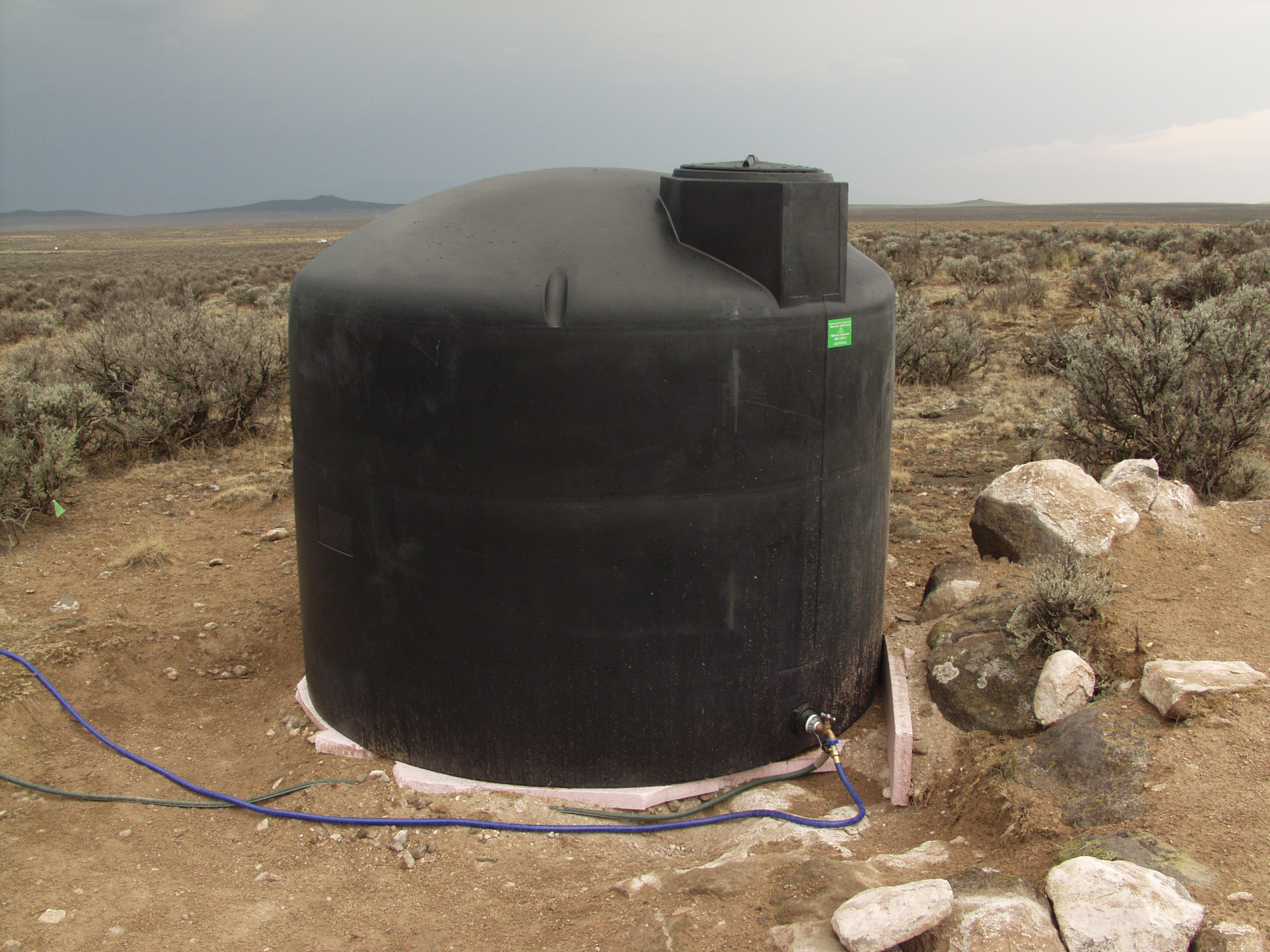
On one of my 60 mile trips down to Espanola to the hardware store, I passed a place that had a new, large black plastic water tank sitting out front with a price written on it and a phone number. I think I got it for about $600, delivered. I leveled a space a little way up the hill from the bathhouse and accessible to my road for filling, and put down a pad of 2 inch insulation foam to set it on. The plan was to eventually build a straw bale shed around it to keep it from freezing and to house the pump and generator. Then I found an ad in the local nickel saver paper for a guy who does water delivery. He had a 2000 gallon tank strapped to the back of his truck which he filled with treated city water, and a gas powered pump with a large hose that moved the water quickly. My tank only holds 1700 gallons but I had to pay the $100 for the whole load anyway.
Worth it.
Having water is so very essential here in the high dry lands that it was a top priority. I priced a well and, as the water table was about 1000 feet down, it would have cost more than the land. Maybe someday. Meanwhile my intention was to take advantage of the monsoons and catch my rain water in cisterns, but for now, having treated water delivered would do nicely. 
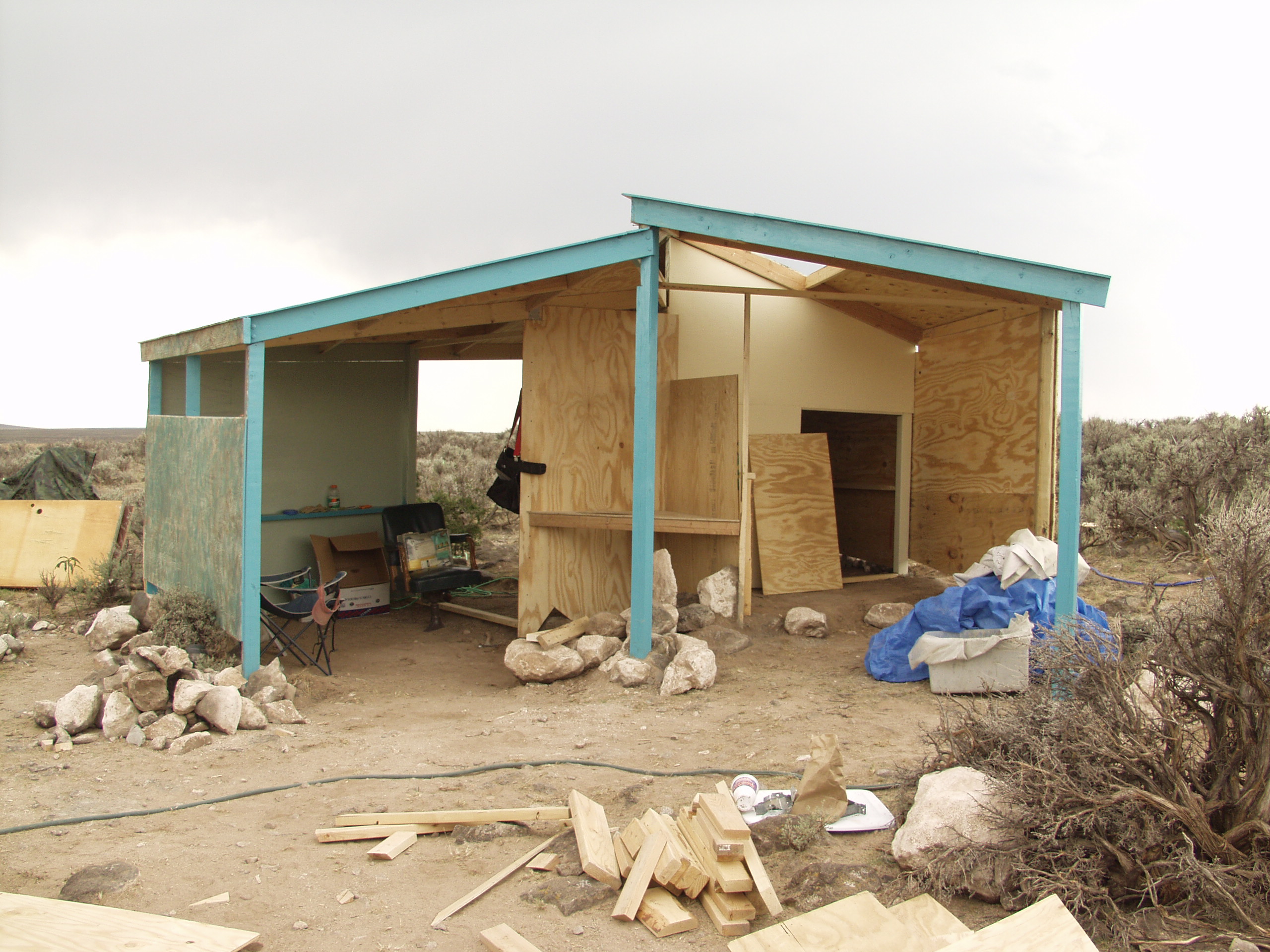
Ken and I set to work building the bathhouse, a deliberately temporary structure intended to provide shelter from the steady wind and sunshine. It was to include a space for the composting toilet and a solar heated shower which I expanded to include a sheltered cooking area. Using post and beam construction, we followed the terrain and created an irregular structure with dirt floors that wandered down the slope, encompassing boulders too big to move. There were no right angles and the roof had oddly shaped segments and slopes. At one point Ken ran out of plywood before finishing the kitchen roof, leaving a triangular space near the peak looking to the sky which I decided would make a nice skylight and stapled some heavy-duty clear vinyl across the opening.
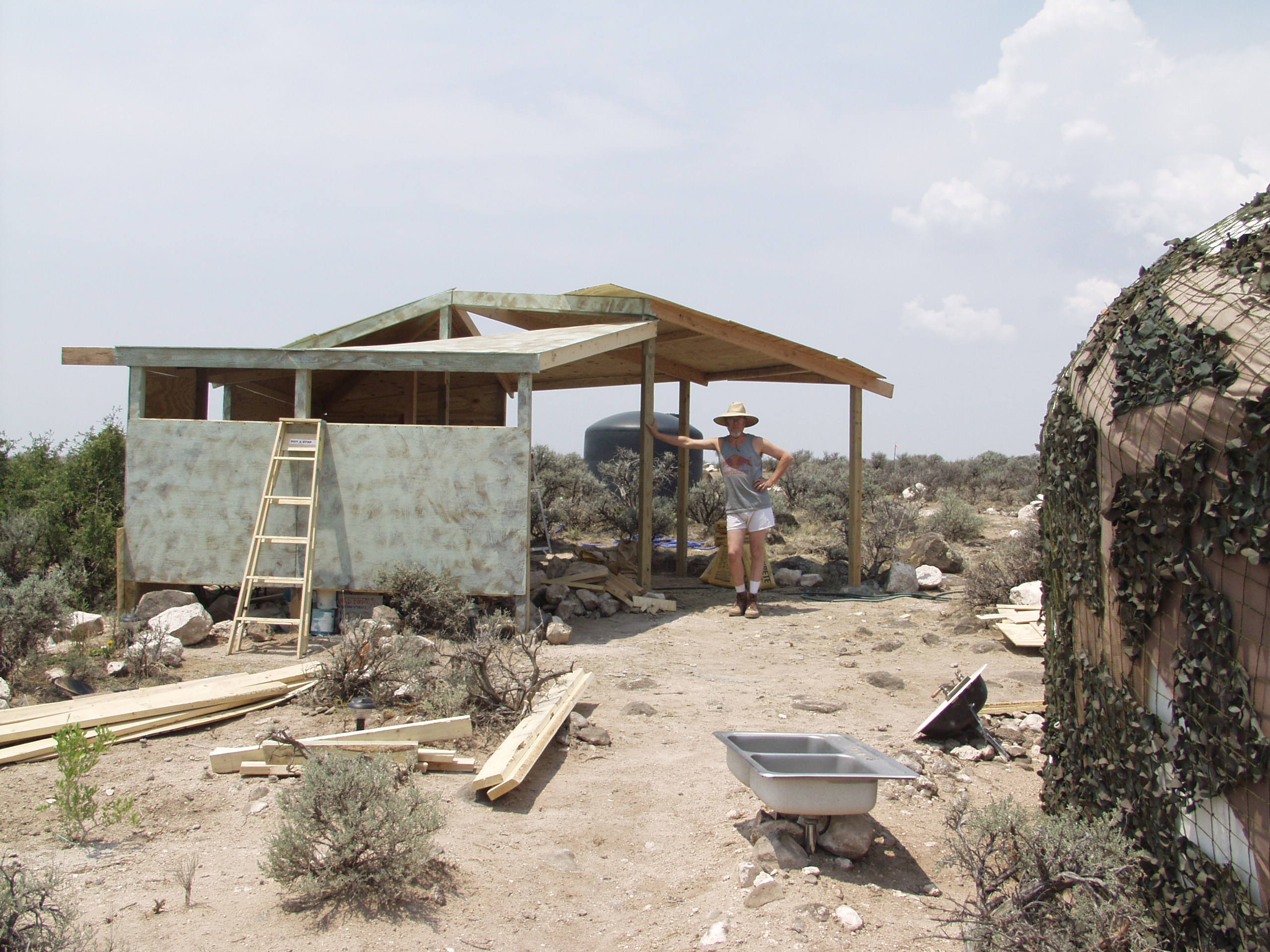 We ran the 4 X 8 foot, ½ inch plywood sideways about a foot off the ground leaving an open space at the top and bottom for airflow. As an afterthought we did incorporate a solid wall “hidden” room behind the “kitchen” area to use as a lock-up for tools and other valuables as I acquired the components. It had a plywood wall section that screwed on making the access invisible. (I hoped)
The northeast side of the building was wide open to the elements as the prevailing weather usually came from the southwest. Dirt floors would have to do, although I had plans for something for the shower area. Except for the ½ inch plywood roof, it was less shelter than the burlap booth we had at the Renaissance Faire which only had to last six weeks.
 I found a guy from town named Joe with a backhoe for hire.He improved the “road” from the highway, really more of a rough firebreak defining the western edge of the property, featuring large, oil-pan puncturing rocks and ragged run-off ruts, and then carved a road down to the main house site and trenched out the sandy clay for the concrete foundation.
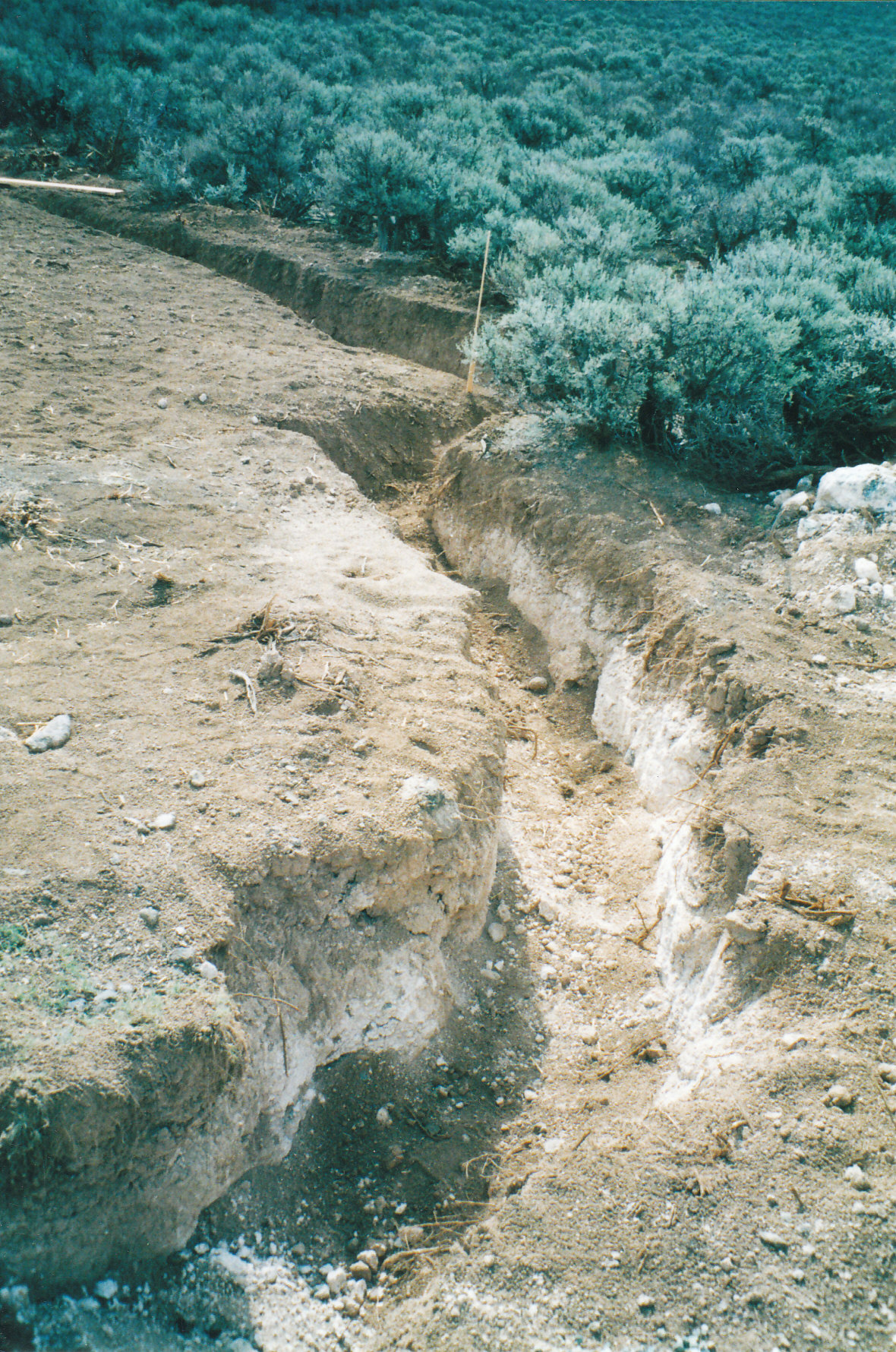
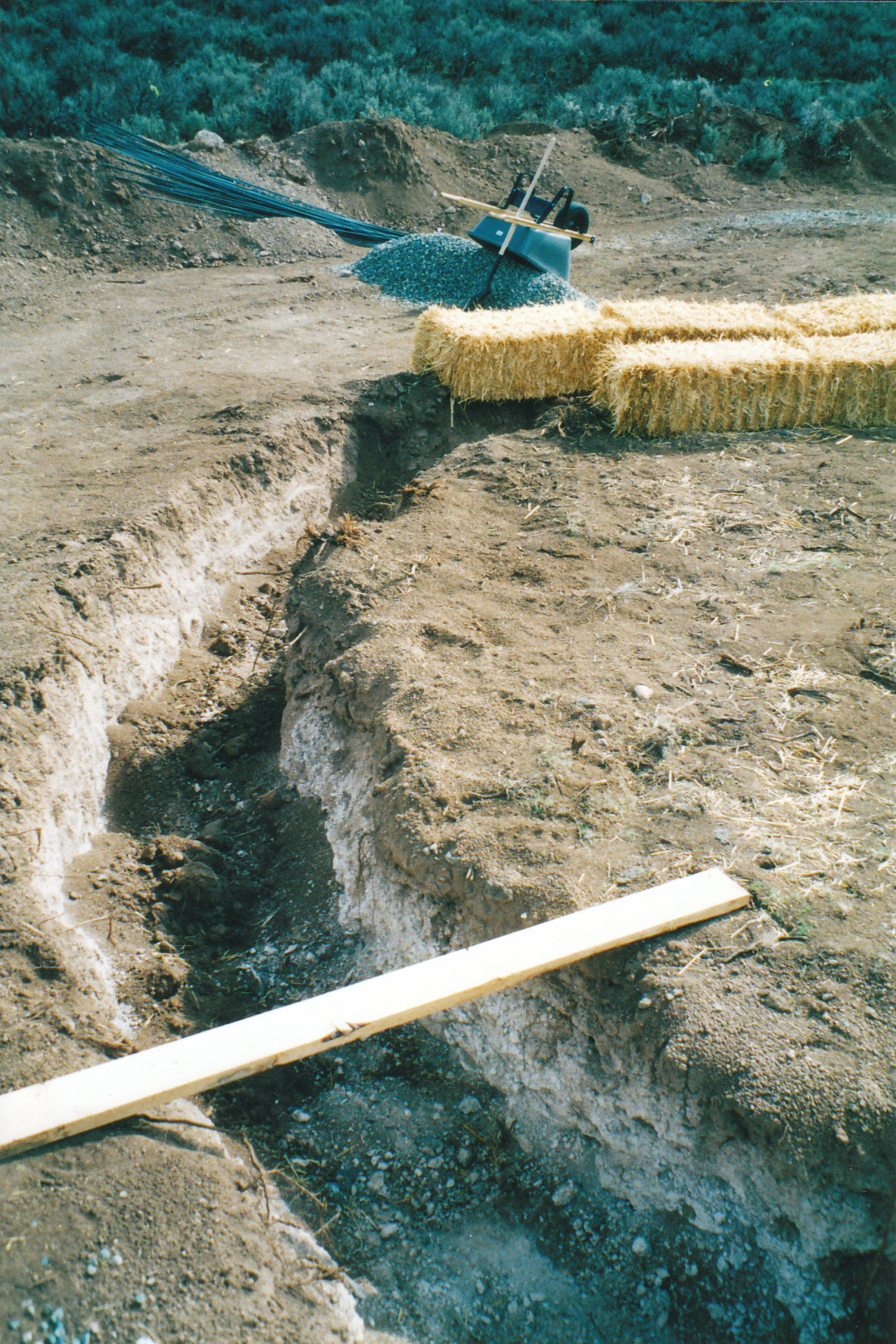
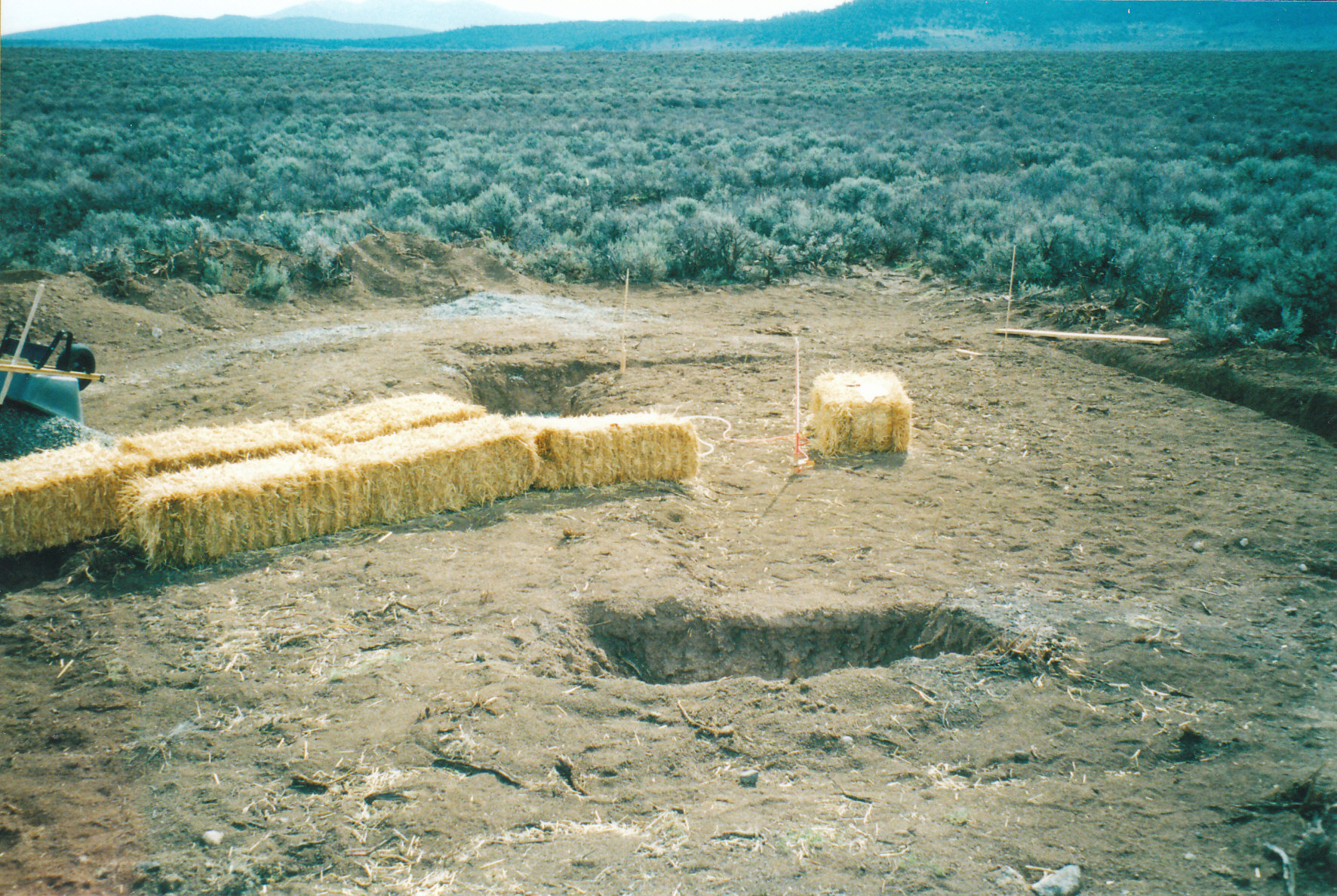
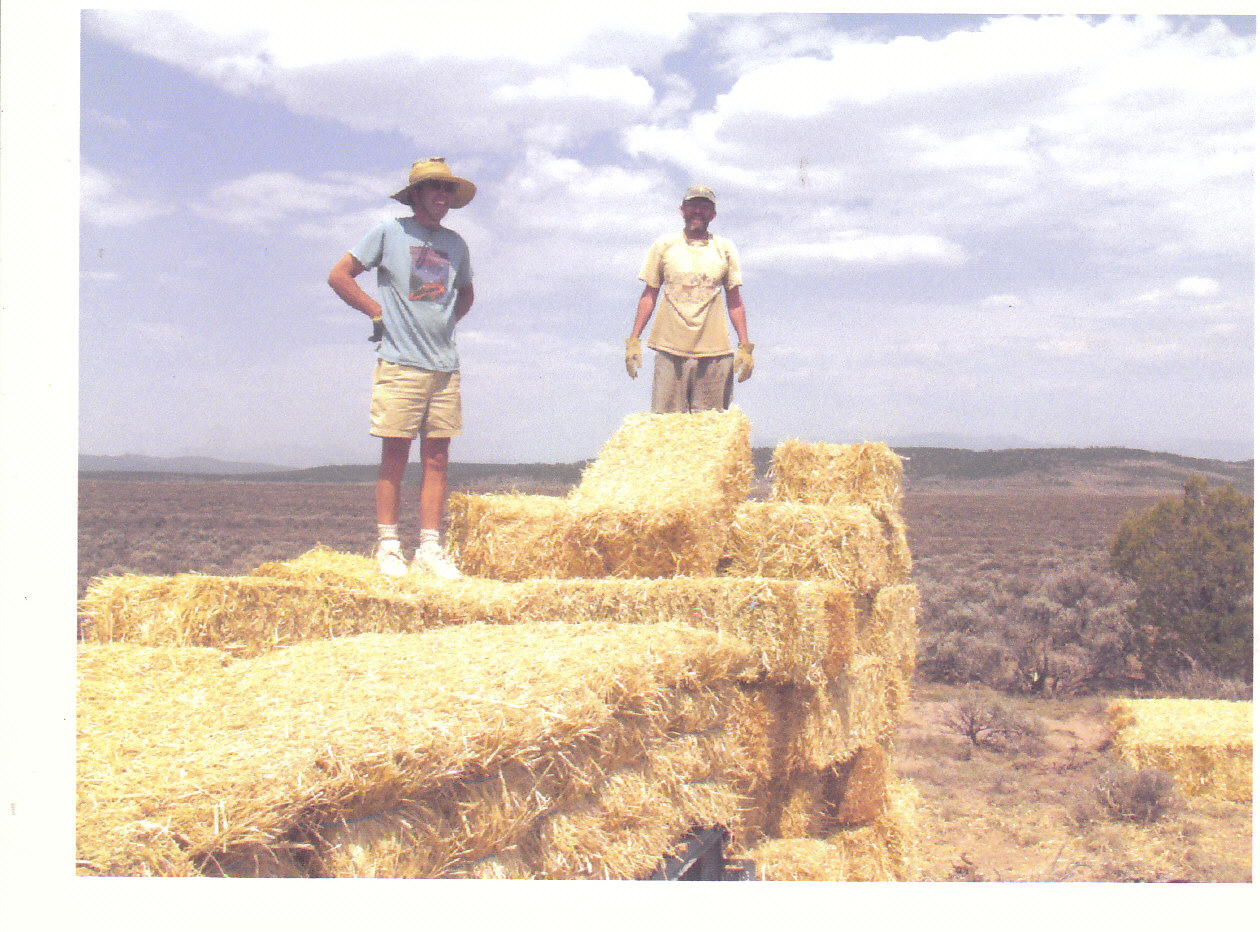 The drought had made local straw bales scarce and had driven up the price so I found a cheaper source in Colorado and hired fellow off-gridder named Chuck who had a big flat bed trailer which he hitched to his old Winnebago and brought down my first hundred bales. I wasn’t sure how many I’d ultimately need, but I figured at least another load. New to the bale thing, at first we tried handing them down from the trailer and stacking them but after a few fumbles, we discovered that they will usually just bounce, if you toss them right.
Unless of course they explode.
After stacking, I covered them with a large clear plastic tarp until we were ready for them as the monsoons had commenced, bringing refreshing daily afternoon thunderstorms.
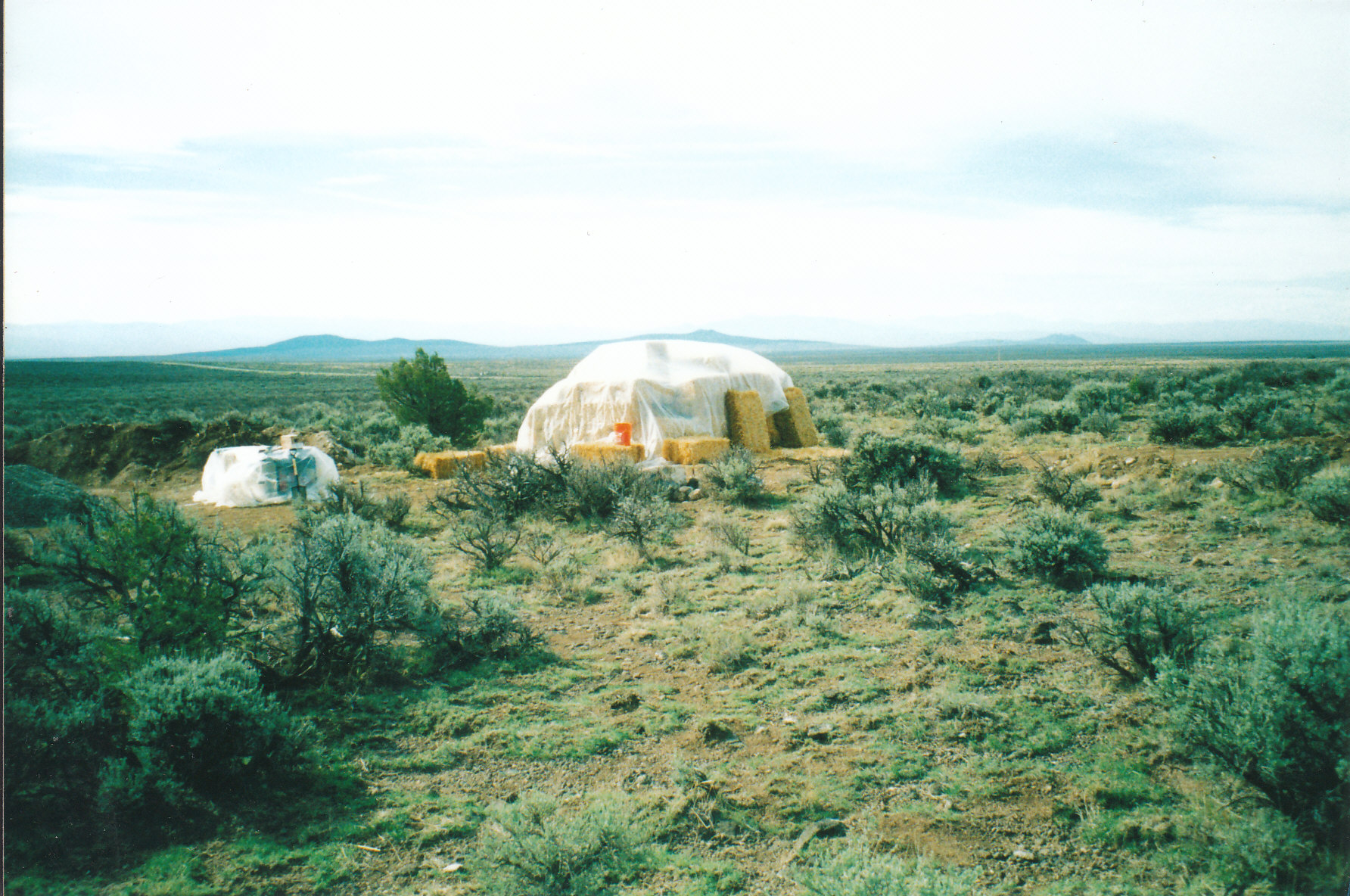
Wouldn’t want anything to happen to the precious bales after all.
Solar panels are expensive new but I found a posting on the board at one of the local markets for a set of four with a Zomeworks tracking rack (a clever system using migrating solar-heated fluid that mimics the movement of flowers as they track the sun) from a couple who had built their dream off-grid home, an Earthship, only to lose it to the bank. They were selling off their components to recoup enough to move on. Their inverter panel was built in and had to stay with the house so I ordered one from Trace online. I got a top-of-the-line one costing several thousand dollars with the expectation of upgrading my system with more panels and batteries. Then I got four deep cell batteries for about $80 bucks apiece from Walmart to start out.
I also had to order the composting toilet online. Since I lived in the middle of nowhere, it had to be delivered to a hardware store in Espanola, 60 miles away. It, too, was several thousand dollars. In the meantime, Ken knocked together a box on legs with a toilet seat attached on the top, a toilet paper roll attached to the side, and set it over a hole in the gully.
The gully which turned out to be the old road, the stagecoach route, connecting Taos to Tres Piedras where the Chili Line (so named for the primary cargo it carried) narrow gauge railroad connected to Antonito and Denver to the north, and Santa Fe to the south. The train ran from the 1880s until 1941 and the Tres Piedras watering depot was the closest supply connection to Taos. The road from the train crossed my land and then the Rio Grande Gorge, crossing near the hot springs, now called “Stagecoach”. I discovered it cutting a diagonal across my land when I was looking at it from space via Google earth. Cool history. I should walk it with a metal detector sometime. Meanwhile, it’s the latrine.
I found an ad posted on the board at the market for a generator at a really good price. I went way out on the mesa to the woman’s new but incomplete Earthship. She had lost her house to the famous Oakland, California fire and had used the insurance money to finance her dream retirement home, only to have the bank take it. She was devastated and heading back to California, I think. I also got a brand new small cement mixer and an on-demand propane water heater for a very good price.
To help diminish the spectacle quality that the place was taking on, what with the white yurt, black tank, and fluttering plastic bale tower, I painted the south, road facing wall a mottled camouflage incorporating the colors of the sage the whole mess rose from. Don’t need any unwanted attention when you don’t even have a door to lock. A later encounter with a local indicated that it made an unexpected impression. When Ken casually mentioned to the storekeeper that he was helping a friend build his place a few miles down the road, the guy kind of blinked, eyes widening, assessing us differently, and said,
“Oh. You mean the one with the camouflage?” scrutinizing us warily, wondering if we were from some survivalist cult or something.
 I suppose that might be another deterrent, if they thought I might be heavily armed. Not my intention, though.
The time came for Ken to leave and my cousins to arrive. Monroe, Sandy and, then, young grandson Zachary arrived before any of the amenities I had promised did. The bathhouse was incomplete, the toilet and the inverter panel hadn’t arrived yet. The best solution was for them to use my apartment in town and I would stay on site in the yurt.
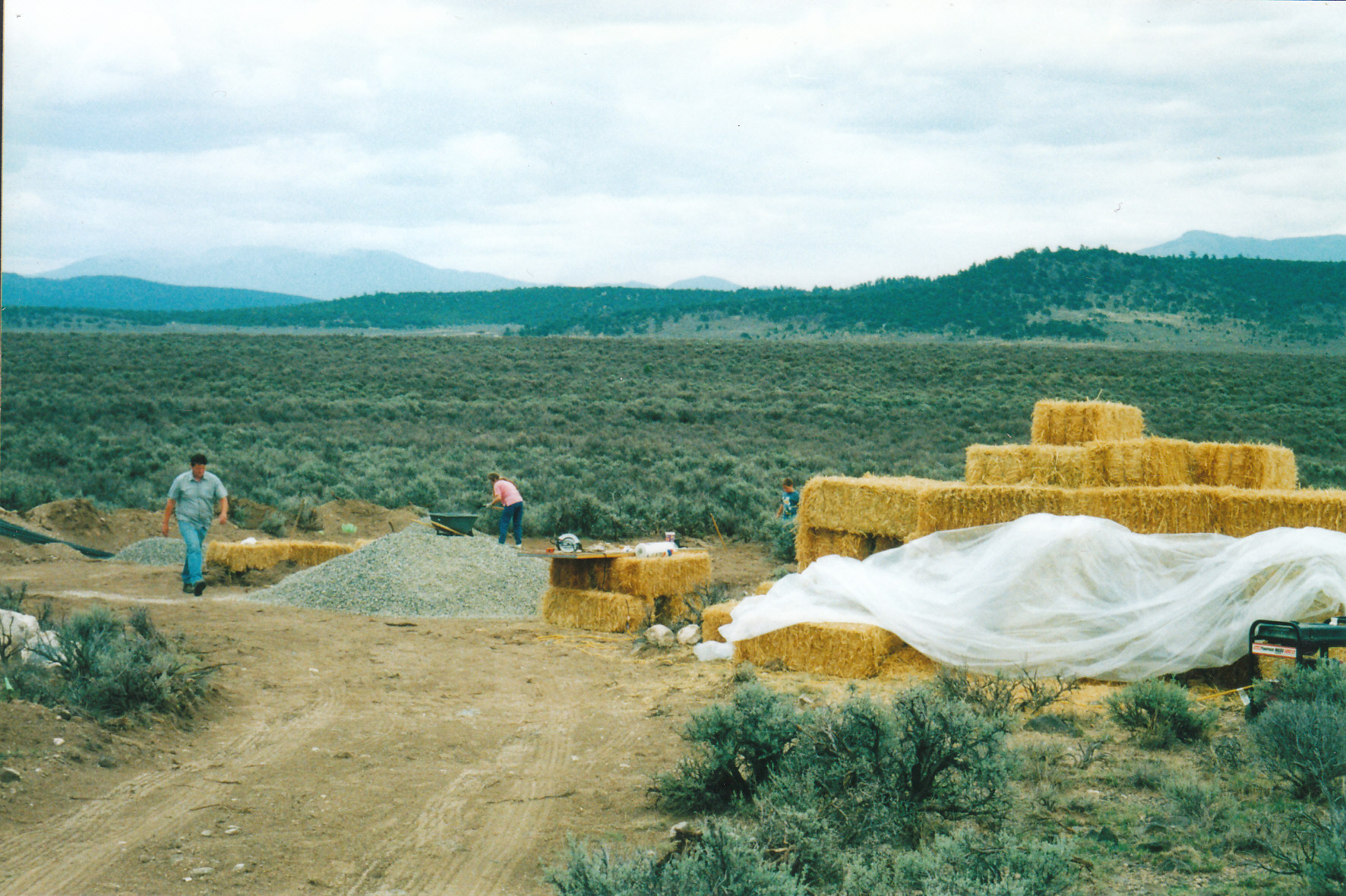
They had imagined coming out to do the “fun” stacking part where you immediately get the sense of a dwelling. What they got was hot summer days in merciless sun lugging heavy bales from the stack to the site, gasping from the elevation, and staking them into the hard clay with lengths of rebar and a sledge hammer. (Luckily the days were usually cut short by a passing monsoon thunderstorm.) 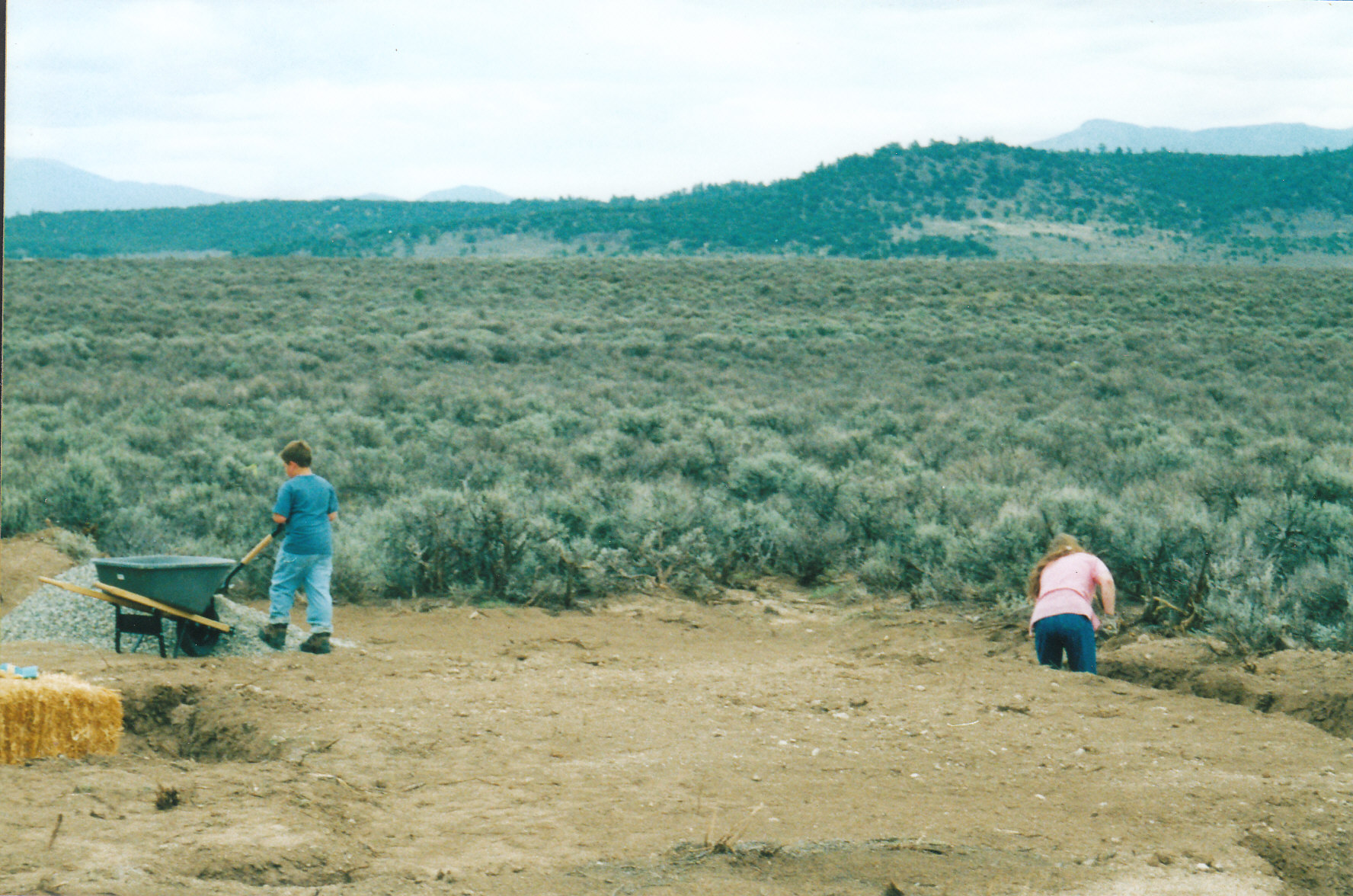
Before you can do the “fun” stacking part, you have to pour a foundation which I hadn’t completed yet because I was busy getting the components and building the bath house. I had decided to use the bales as the pour forms and then re-use them as wall infill later. We lined the trenches that Joe had carved with 2 inch insulation foam and scrap plywood and framed the bottom with rebar. I hadn’t figured out a couple of details yet, such as where and how to place access for drains and utilities and I had hoped to install some kind of piping for solar heated and powered radiant floor heating. A grand idea, but I hadn’t had time to research it yet. Once you pour the concrete floor, that’s it. I postponed the concrete truckload twice before my cousins had to leave.
The solar inverter panel, a cumbersome, heavy thing, arrived at the Espanola True Value hardware store just in time for Monroe to help me heft it up to mount on the wall in the “hidden room”. Then they were gone.
I hope they all had a good time, anyway.
Lonesome
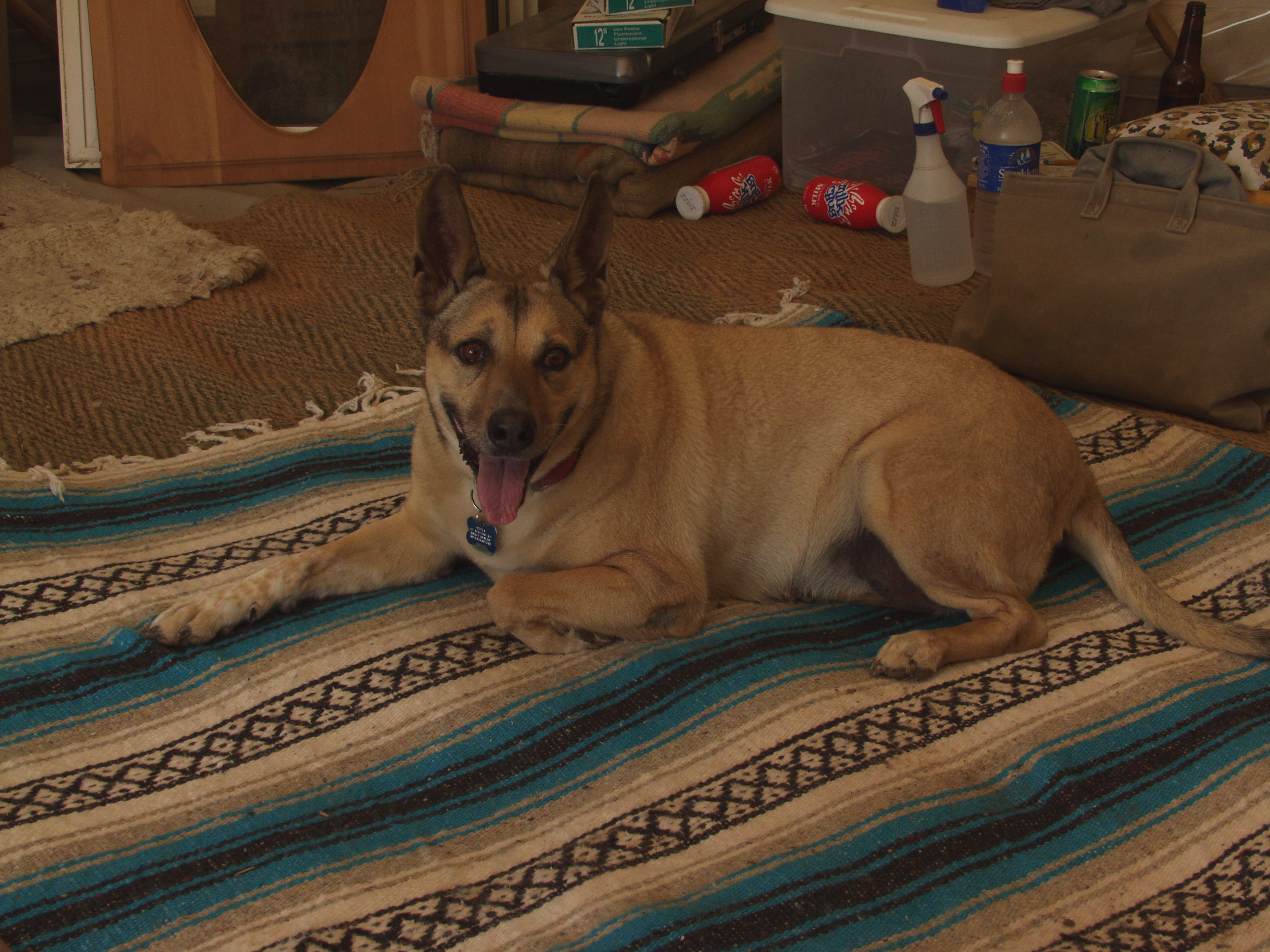 Then it was just me and Sheila, my faithful companion since my neighbor brought her to my door as a squirming puppy she had rescued and thrust her in my face. I was especially glad to have her around after everyone left as I faced some quiet, lonely, and spooky nights in the yurt. There were probably several different packs of coyotes living on my land. I would hear them calling to each other at dusk, gathering the tribe, but they never marauded my camp or bothered Sheila. As a matter of fact, she used to play with the coyotes at Lake Mead when we were staying there and there were times when I wondered if she might even be part coyote herself, so I never worried much about her and the locals. I probably should have but she was never bothered, even when she got old, blind and deaf. Naturally, she was always by my side and in the yurt with me at night.
I decided that the bath house needed to be a more secure and sheltered area and set about trying to enclose the deliberately open space. Talk about a challenge. Having dirt floors and no right angles or consistent slope makes for some imaginative carpentry. The more materials and systems I acquired, the more insecure I was about leaving the place to go to town, even for a short time.
Taos is dubbed “the solar capital of the world” and the local radio station, KTAO, is billed as the world’s most powerful solar radio station. With no electricity yet, I depended on a tiny solar powered emergency radio for my connection to the world and KTAO was the only station I could get. Luckily it reflects Taos’ people and offers an eclectic array of diverse styles and cultures, playing different programs featuring everything from Classical, Country and Native American music to Pop, Reggae and Jazz. (Very like KBear on the TV show Northern Exposure) It has a program called Trash and Treasures where people call in with things for sale and such and one day I heard a guy offer a front door for free! I called him and raced down the canyon to Pilar to get it. It was an old, beat-up thing but it was heavy solid wood, and it was free.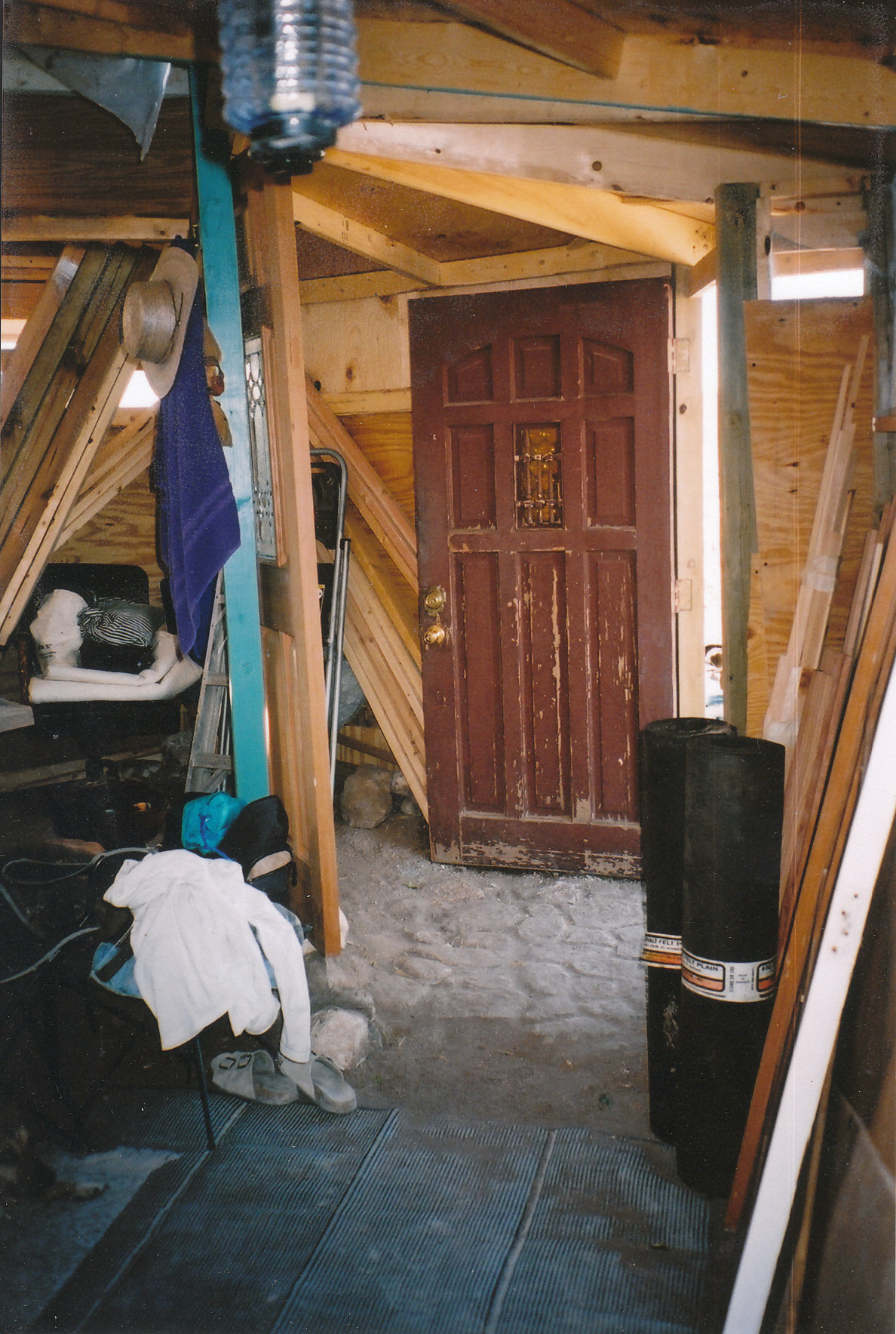
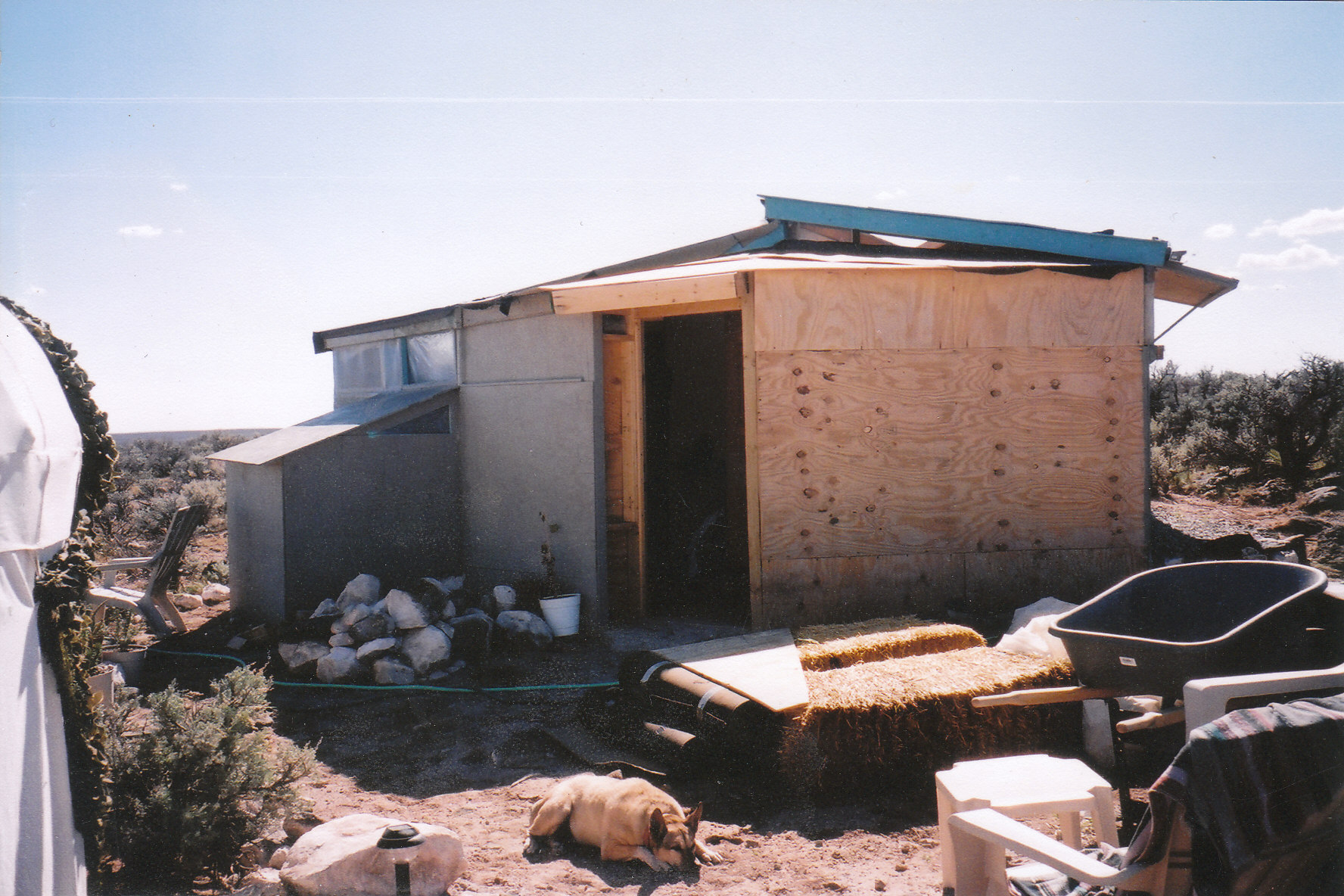 I finally had a front door I could close and lock when I was gone and built the north end of the house around it. The place still had no windows since it was now primarily a storage shed, but I did install two long hinged shutters on opposite walls which I could prop open for light and cross ventilation on those hot summer days. These I screwed shut from the outside any time I left.
Now that there was a door, suddenly the bathhouse seemed like the more secure space, and more effective at keeping out the wind and other intruders and we began to spend more time inside, eventually sometimes even sleeping in there.
The many irregularities of construction, however, had left abundant access for the mice. At first I was trying to be respectful of them, me being the intruder to their domain. I got some little clear plastic cube traps that had a swinging door that would trap them alive. The first night I set them out, I immediately caught one. I patiently walked him out across the access road and freed him, returning to the house a little proud of my humanitarian deed. By the time I got back, another mouse had entered a second trap. Again, after re-baiting the first one, I walked the little beggar out across the road and released him, returning a little less proudly. Upon my return I found two mice in a cube.
OK, now this is getting old.
Pretty soon I took to emptying the caught mice into a large clear plastic storage bin and carrying them out a half a dozen or so at a time. The really disturbing part was when they would jump up, Speedy Gonzales style, and hit the lid of the bin in an effort to dislodge it. It sounded like popcorn in a microwave as they took turns jumping.
New Mexican Jumping Bins.
Eventually, I figured out that these were probably some of the same mice, beating me home from the releases.
It was shortly after that that I revised my stand on co-habitation and began to set out poison bait. Sorry. It was them or me at that point.
I had a cell phone that only got occasional signal if I stood on a rock about 100 feet up the hill, south of the bath house. Sometimes, especially if there was weather, I could actually receive calls inside and one day I was surprised to receive a call from Nobu, a Tokyo designer friend living in New York with whom I used to work there while doing Toyfair for Mattel. A lifetime big city dweller, he was planning a trip out to see the “Wild West” and wanted to include Taos and Georgia O’Keefe’s Ghost ranch, not far from here.
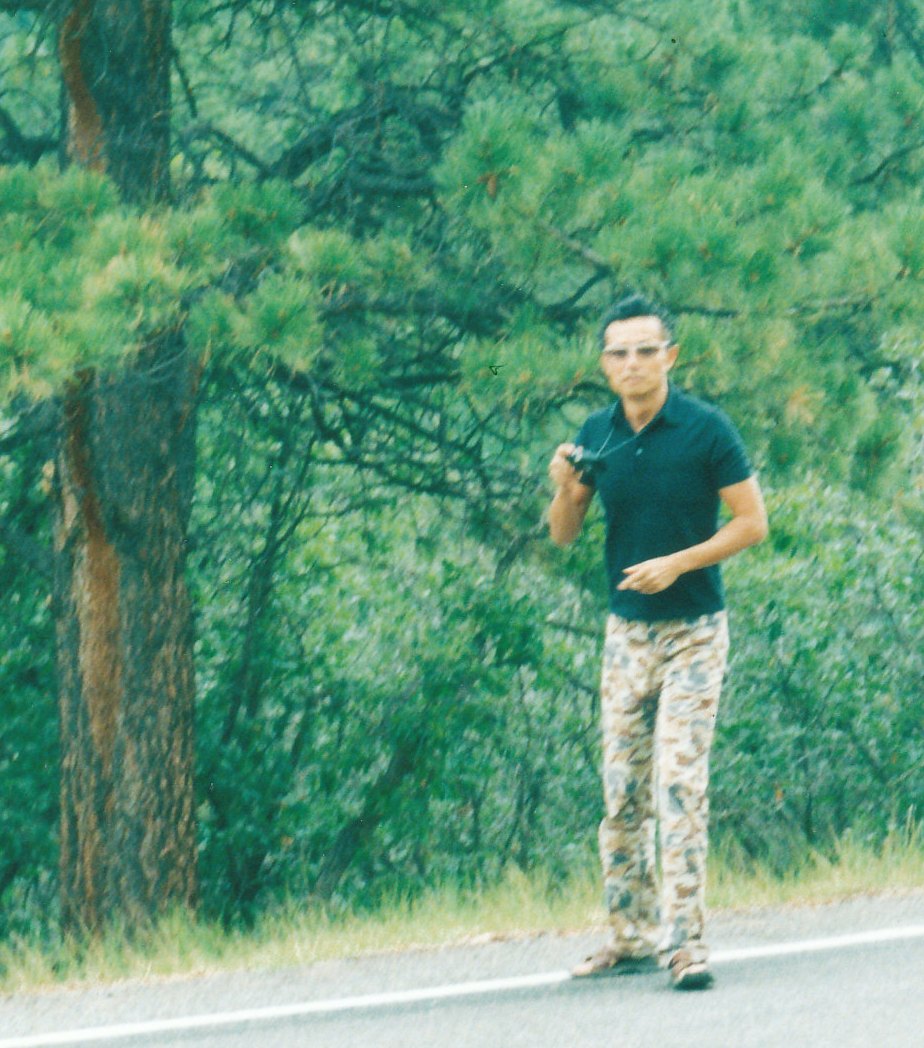 He arrived sometime after that by rented car and stayed at the nicest hotel he could find, as was his style, and we dined at the best restaurant for which he could find an online review.
The next day we took my Jeep and drove all over, including Ghost Ranch, eventually winding up at my place. I could see he was having trouble comprehending many aspects of my spare circumstances, such as the toilet al fresco, but, being a designer, I’m sure was filling in the future details in his head. (probably far more stylishly than I was)
He was intrigued by the yurt and we entered the east facing door through the flap of canvas that tied to the door frame. There were no furnishings except for a folding camp chair, many mouse-proof plastic bins containing clothes and food and such stacked along the walls, and a low futon mattress on a wooden frame jutting into the room from opposite the entrance.
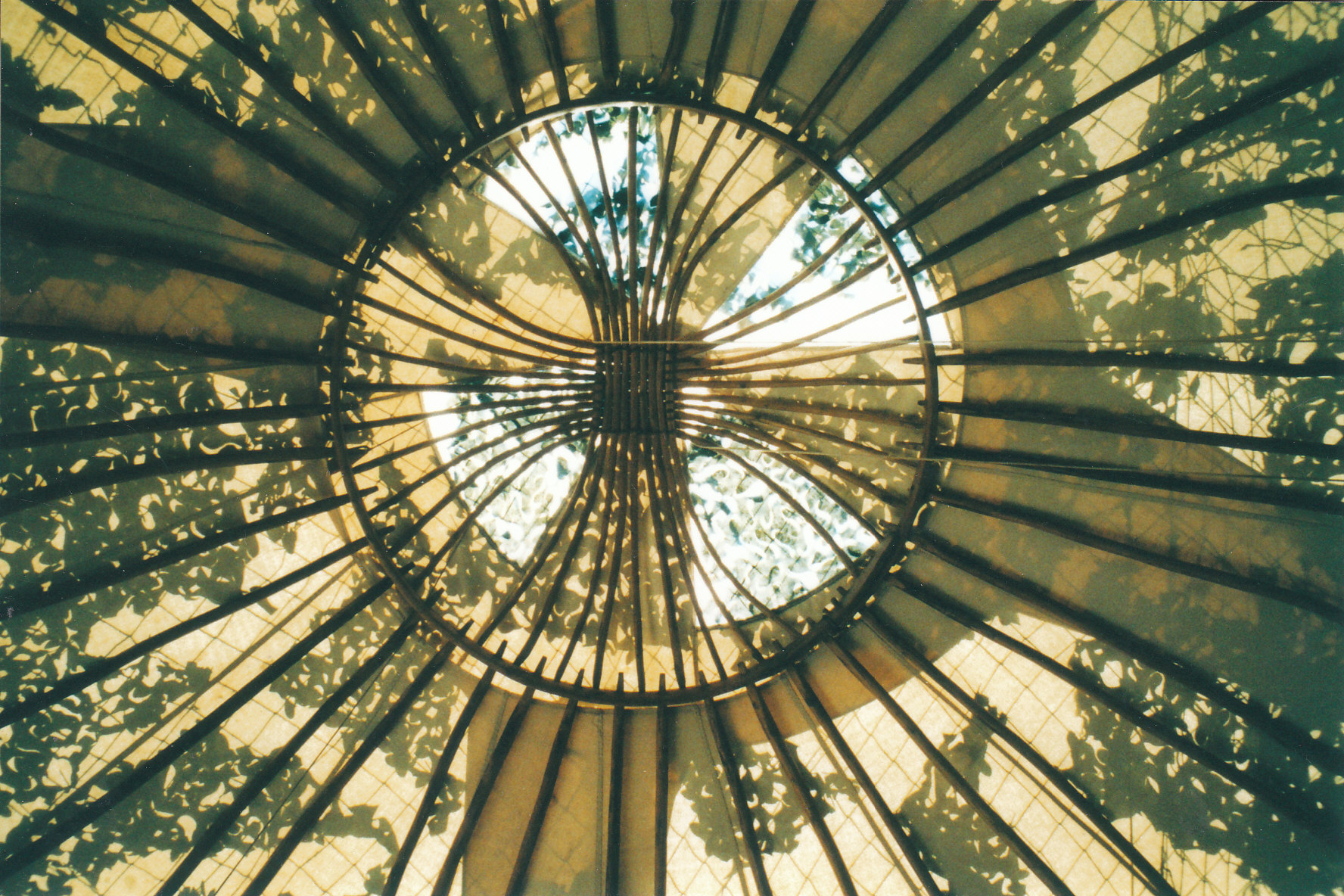 Standing in the middle of the room, we were looking up at the arcing dome with the clear plastic window in the center, when a sudden motion on the floor caught my eye. A small rattlesnake was meandering out from under the bed and right past unsuspecting Nobu’s besandaled foot! We both leapt back as it slithered for cover at the wall, only to find it impenetrable, and curved. While it sought a way out, I grabbed an empty ice chest and scooped the frightened thing in and slammed the lid. Then I hiked way out in the brush and set it free, with an admonition to never return. (not sure if that was worth much)
You can imagine Nobu’s reaction to the whole episode. You just can’t buy Wild West episodes like that! (Come to think of it, I never heard from him after that. Coincidence? Hmm.)
A Change of Plans
Winter comes early at 7600 feet and I still didn’t even have the foundation poured yet. The money from the sale of the house had long since run out and I had a sizable credit card debt, …again. I knew the yurt wasn’t remotely an option for a Taos winter, plus it was only rented for the summer anyway. I knew if I didn’t get work soon, I’d have to give up the apartment in town, too. And I was still paying rent on three storage units in Las Vegas! What to do?
Once again, Ken to the rescue! (I mentioned he is a good friend.) He had gotten a temporary job in a high rise condo complex in San Francisco and could use an assistant! Of course, I had to be there the very next week!
I gave up my apartment in town and loaded whatever I wasn’t taking with me into the bathhouse, now more accurately called the storage shed, and nailed everything down as best as I could. I realized that the bales would probably suffer exposed to the harsh winter but better them than me, I thought. I could always replace a few bales if I had to. Ha.
I loaded the trusty old Jeep with some clothes, tools, Sheila, and some of the irreplaceable things to drop into the storage in Las Vegas, and we were off. The journey took two, full, 12-hour driving days, not counting the day lost in Las Vegas. 
We pulled into San Francisco in late October to a city hosting the Giants in the World Series’ final week. The high rise condo complex that was to be my home and workplace was situated directly across the street from what was then Pac Bell Park in South Beach and the neighborhood was mayhem with celebration! 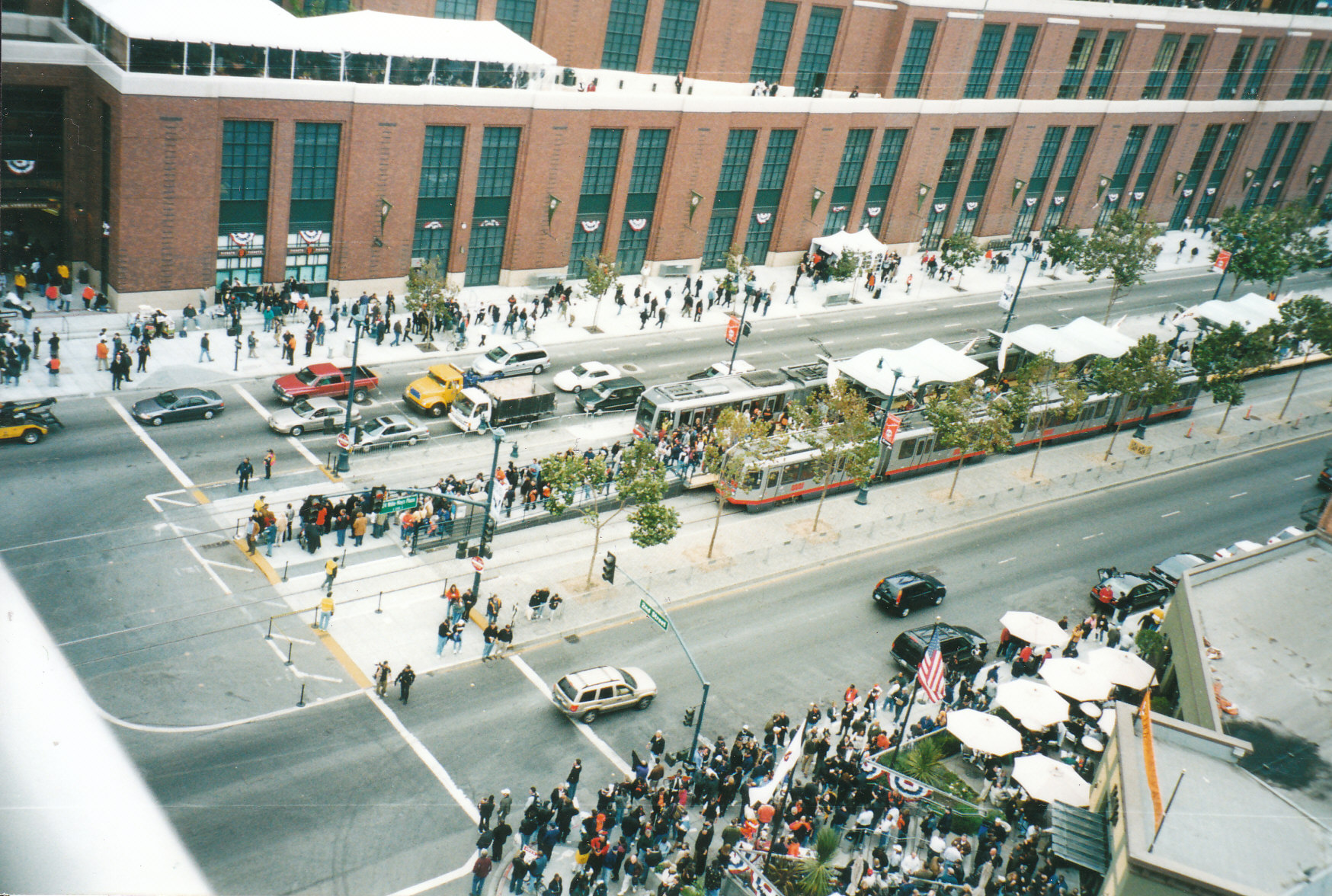 On the other corner was Momo’s, a restaurant with a large, open-air cocktail patio jammed with noisy, drunken revelers, and overhead the Blue Angels buzzed the top of the park and our building!
 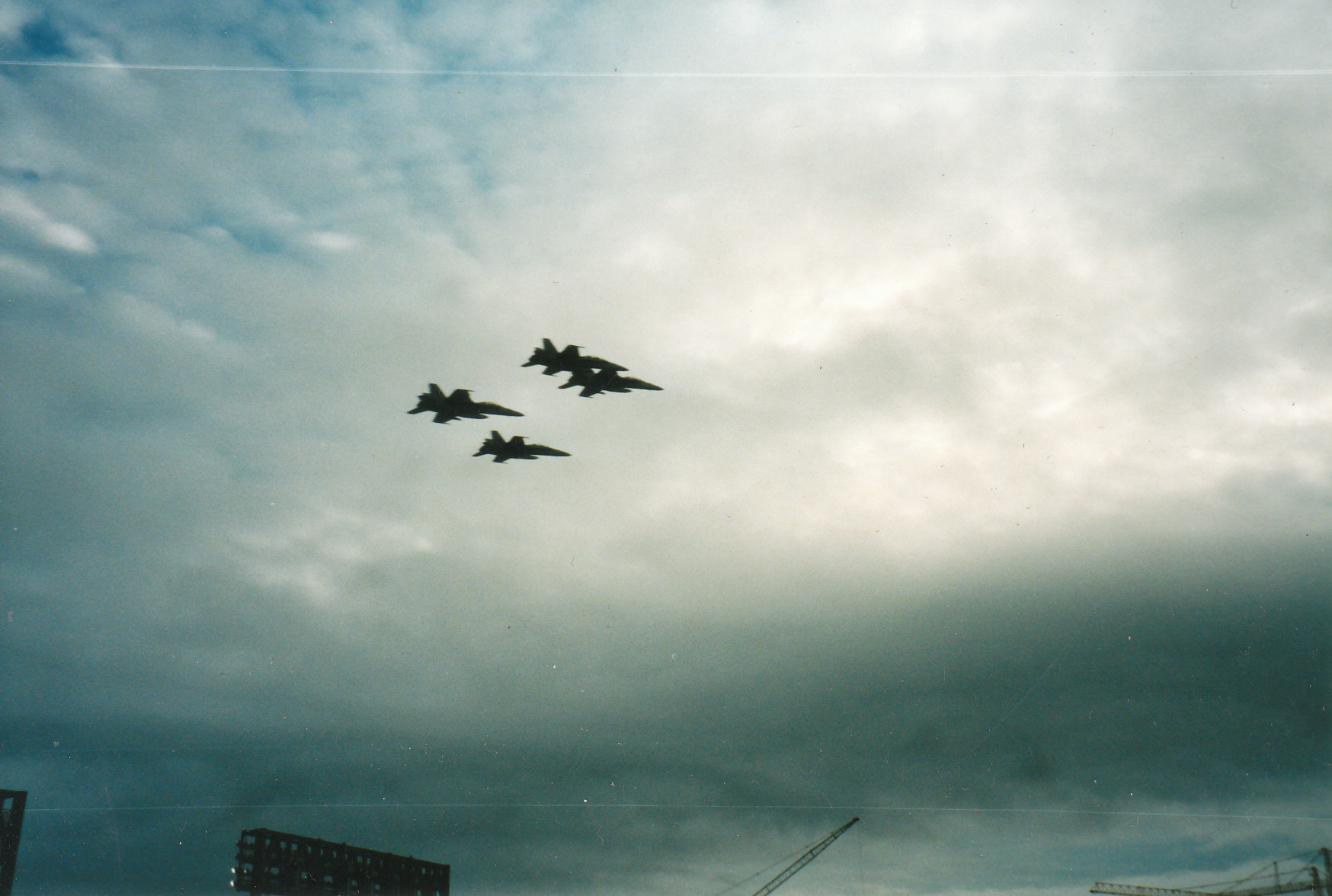 Fortunately there was an underground parking lot for me. As a result of the upscale development in the area including a new college campus, the new complex was being upgraded to high end properties boasting security, concierge service, and an ideal location.
 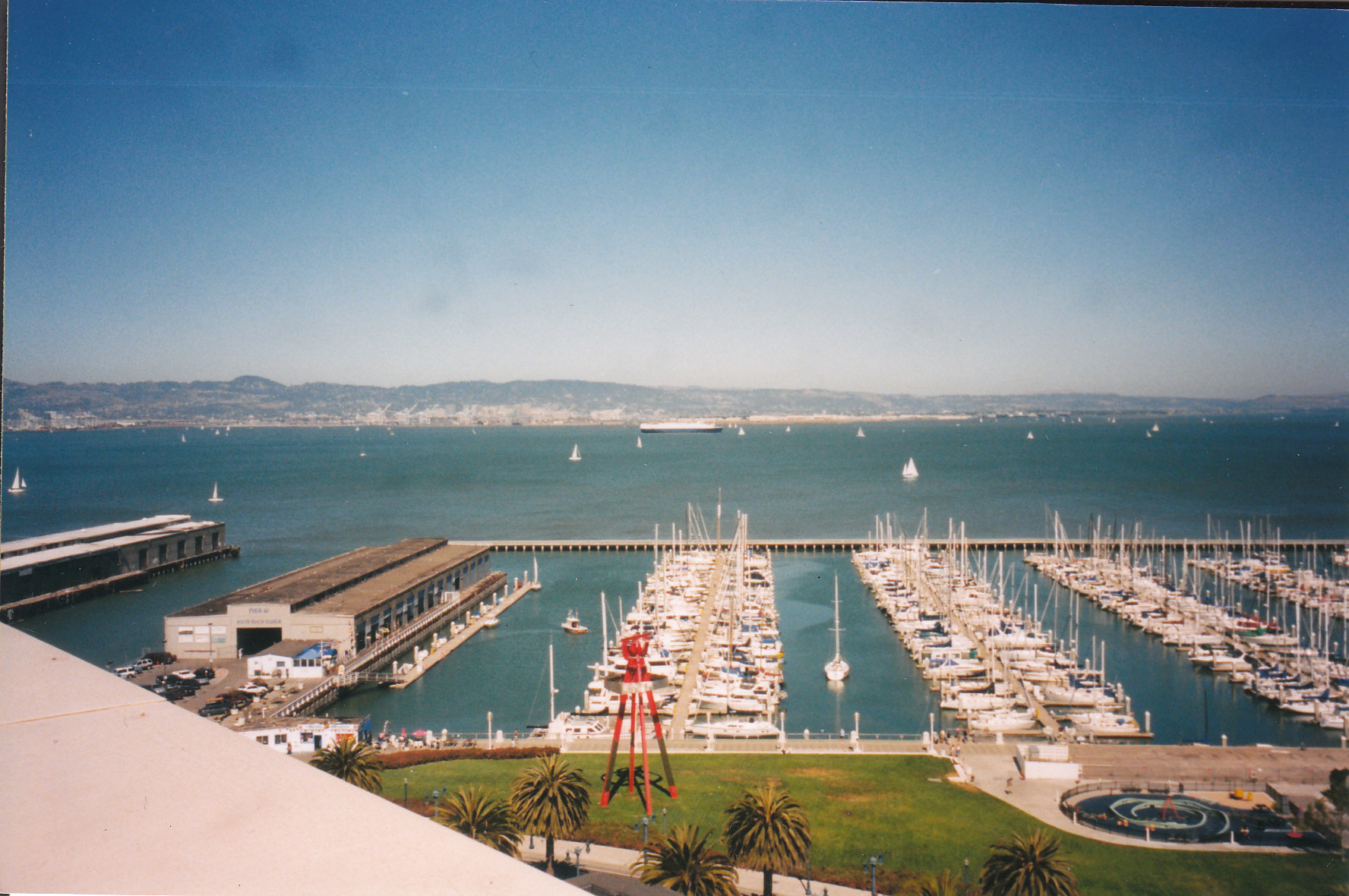 In addition to the new ballpark across the street, there was also the South Beach Marina and a grassy dog park boasting a massive, bright red metal girder sculpture by Mark di Suvero called “Sea Change”, and the Muni train stopped right in front of our building, connecting us with the world. Formerly a warehouse district built largely from landfill produced from rubble from the 1906 earthquake, South Beach is more sheltered from the fog, being situated on the east side of the peninsula, and gets more sun from across the Bay. The complex has a pool a spa, sauna, gym, and a spacious community building with a business center.
The job involved addressing warranty and basic maintenance issues with the new tenants as the units sold and they moved in. Basic handyman/P.R. stuff. It helped them to have us onsite and available for any situation that might arise so we got to stay in one of the unsold units rent free, on the top floor at the corner of the building with balconies overlooking the Bay and the City. My commute to work was a mere elevator ride. The building was wired for cable and internet so I got my first computer and went online.
This place was about as opposite from my land as it gets: Elevation (sea level vs. 7600 feet), population density, atmospheric pressure, humidity, solar exposure, Pacific Ocean vs. Continental Divide, freezes vs. just freezing, green vs. gray (well, admittedly, they’re both gray a lot), skyscrapers vs. sagebrush, people vs. cattle (OK, I also admit the jury is still out on that one.) and proximity to services,…services! Not only was I back to civilization, it was uber-civilization! It took some adjusting, but come on. It was worth it just for the indoor plumbing.
By January, I began to worry about the state of my spread. (why does that sound rude?) I managed to get some time off and flew to Albuquerque, rented a car, and drove out to inspect things. I was concerned that in my absence, marauders could break in and take their time carting out all of the components I had accumulated but didn’t have a house to attach to yet.
When I arrived, I was relieved to see no evidence of tracks in the few inches of new snow. The little economy rental car slithered and bumped up the frozen, rutted road to the site.
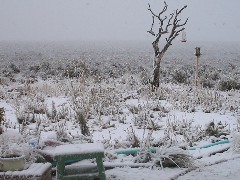 Everything looked so different with the smoothing effect of the snow layer. As I walked to the door of the former bathhouse, now storehouse, I noticed straw strewn underfoot. I had been using a couple of bales with a plywood board across them as a sawhorse/worktable. The board was now flat on the ground, resting on a frozen mat of straw. While I puzzled at how the bales could have exploded in such a fashion, I suddenly recognized an abundance of desiccated platter-sized disks of bovine origin littering the area.
…Uh oh.
I looked down the hill to the house site and the bale stack. Yes, the smoothing effect of the snow…. But this was just a little bit too smooth. Picking my way around hefty, straw-enriched treasures and past broken solar-powered garden lights and the nubs of all of last summer’s starter planting, I made my way down to The Scene.
Apparently the imported bales were oat straw, rich in previously unwinnowed oats. What had once been an interesting sculptural work in progress was now a carpet of golden disarray, studded with countless cow cookies.
Not a single bale survived.
Aargh!
Home on the range, indeed!
Nothing to do but go back to San Francisco and wait for warmer weather to regroup. At least the two legged varmints hadn’t broken in.
The job continued longer than expected which gave me time to pay off the credit card and save a little to take back with me, too. By October things were winding down and I was getting anxious to get back to the land. Sheila, now 13, had rather abruptly developed a widespread cancer, probably from a lifetime of drinking polluted, radioactive water from Lake Mead, and I had to put her down. Absolutely heartbreaking.
And that meant going back to my place alone. A lonely prospect, to be sure.
Another problem was it was winter coming on again and I had even less to work with out there than when I’d left. So after checking in to the place once more, I decided to winter in Tecopa, California, near Death Valley.
Tecopa 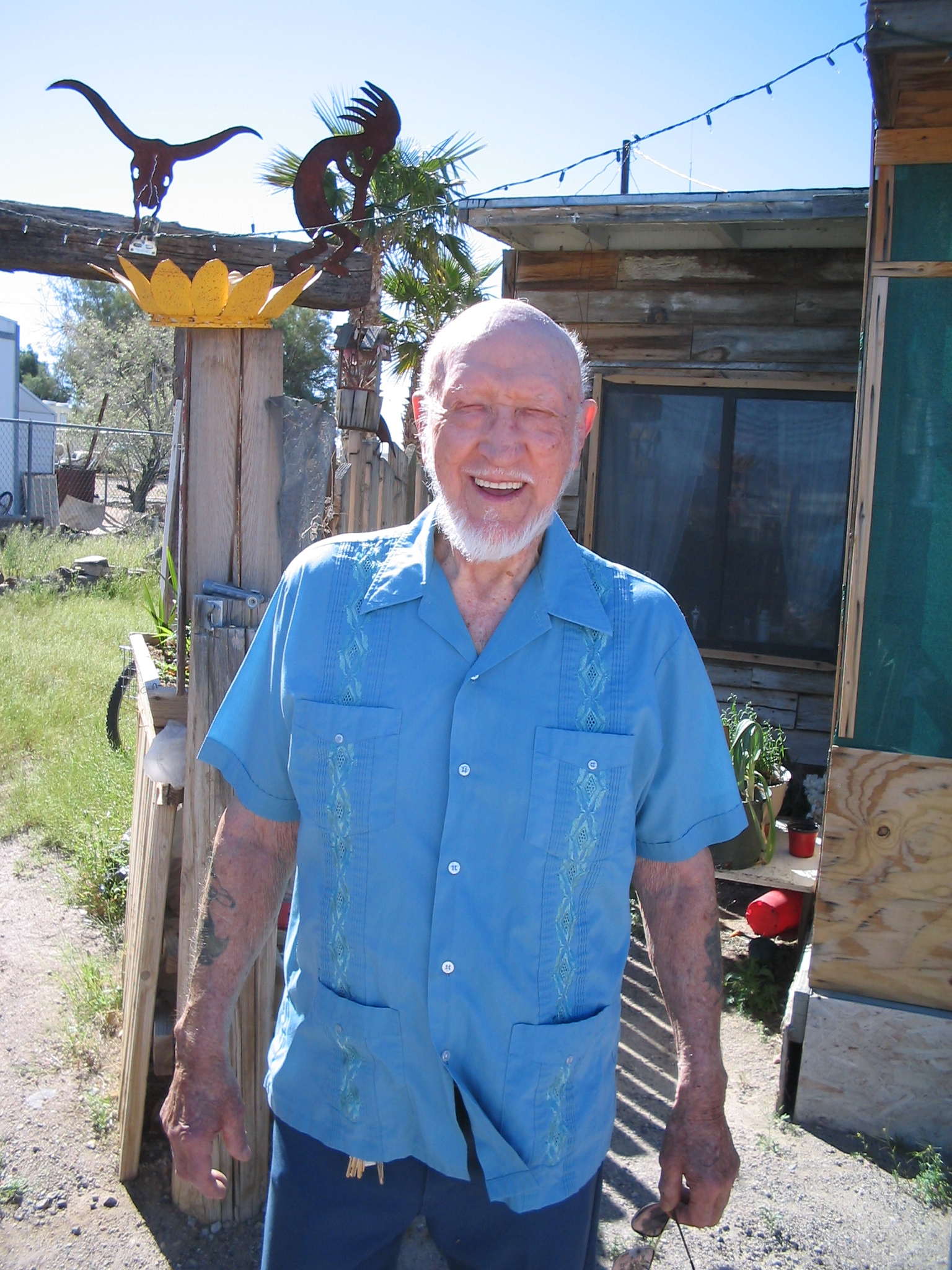
I met Burl “Andy” Anderson sitting chest deep in the clear, hot water of Tecopa Hot Springs while I still lived in Las Vegas, 70 miles to the east. At 83, he was remarkably alert, strong and agile, though his faded blue eyes and battered body attested to a lifetime of physical abuse and neglect.
“Howdy, podnuh.” he greeted me with a broad grin offsetting his crooked, broken nose. His shaved head glistened with water droplets from the pool which he squeegeed off with his strong, gnarled hands. We exchanged pleasantries for awhile until he felt comfortable enough to tell me his story while we relaxed in the healing waters.
“My wife and I moved here from Nebraska to do healing work but she died last spring, so I guess I’m a gonna jus’ keep on a doin’ it myself.” he pronounced bravely with a smile, though I wasn’t sure if all of the water on his face was from the pool.
He was staying alone in a small, loaned vacation trailer parked on a friend’s lot while he figured out what to do next. I had never met anyone more deliberately optimistic. For him, every day was a gift and he was determined to do Good with the time he had remaining.
Now, three years later, he was sharing a tiny, two room shack with Cora, an 89 year old widow who had gotten too blind and deaf to live alone in her old school bus camper, which sat unused at the side of the house.
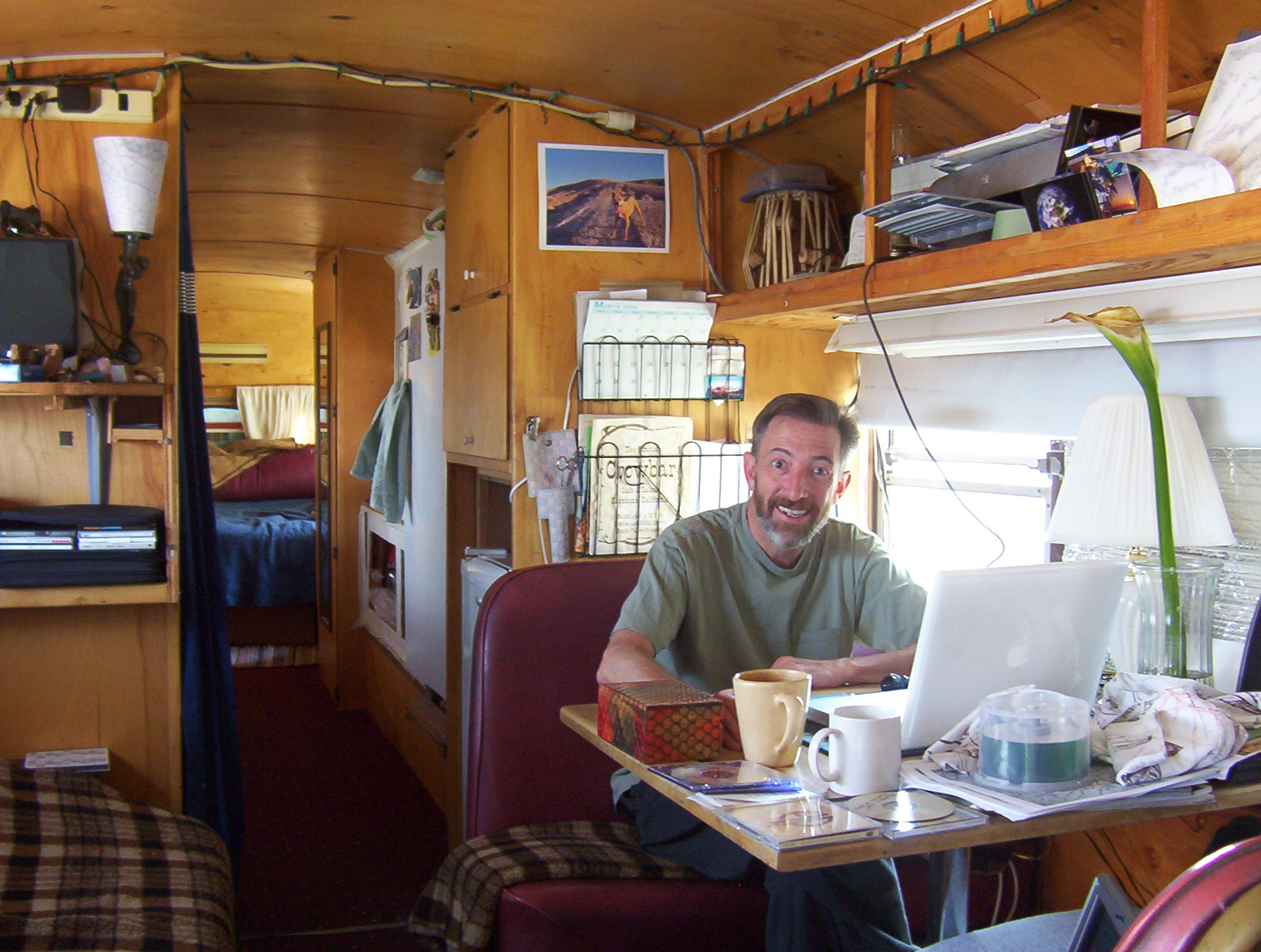 So I rented it for the winter until it was warm enough to go back to Taos and try again. They ran a power cord out to the bus and hooked up an extension to their land line which I could use to go online with a dial-up service. (remember those?)
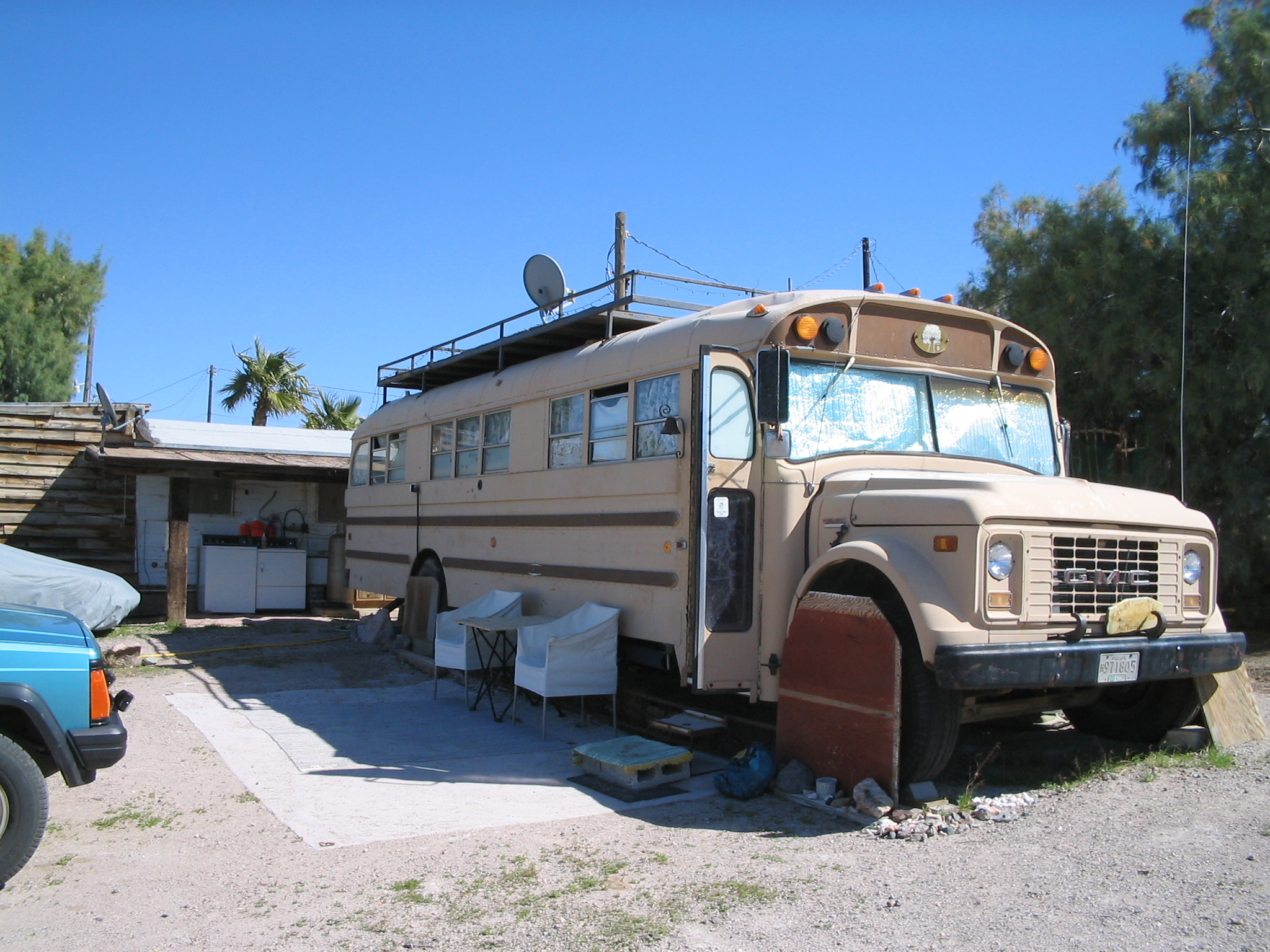
My time in Tecopa and my exchange with Andy and Cora was rich and warrants its own story so I will cut to the spring. I will say that the Death Valley area gets a lot colder than one might imagine and old school buses are not known for their insulation rating. Thank God for the hot springs.
The Second Summer
About the beginning of May, I decided it might be warm enough to go back. The days were certainly sunny and warm enough but the nights still dipped to freezing.
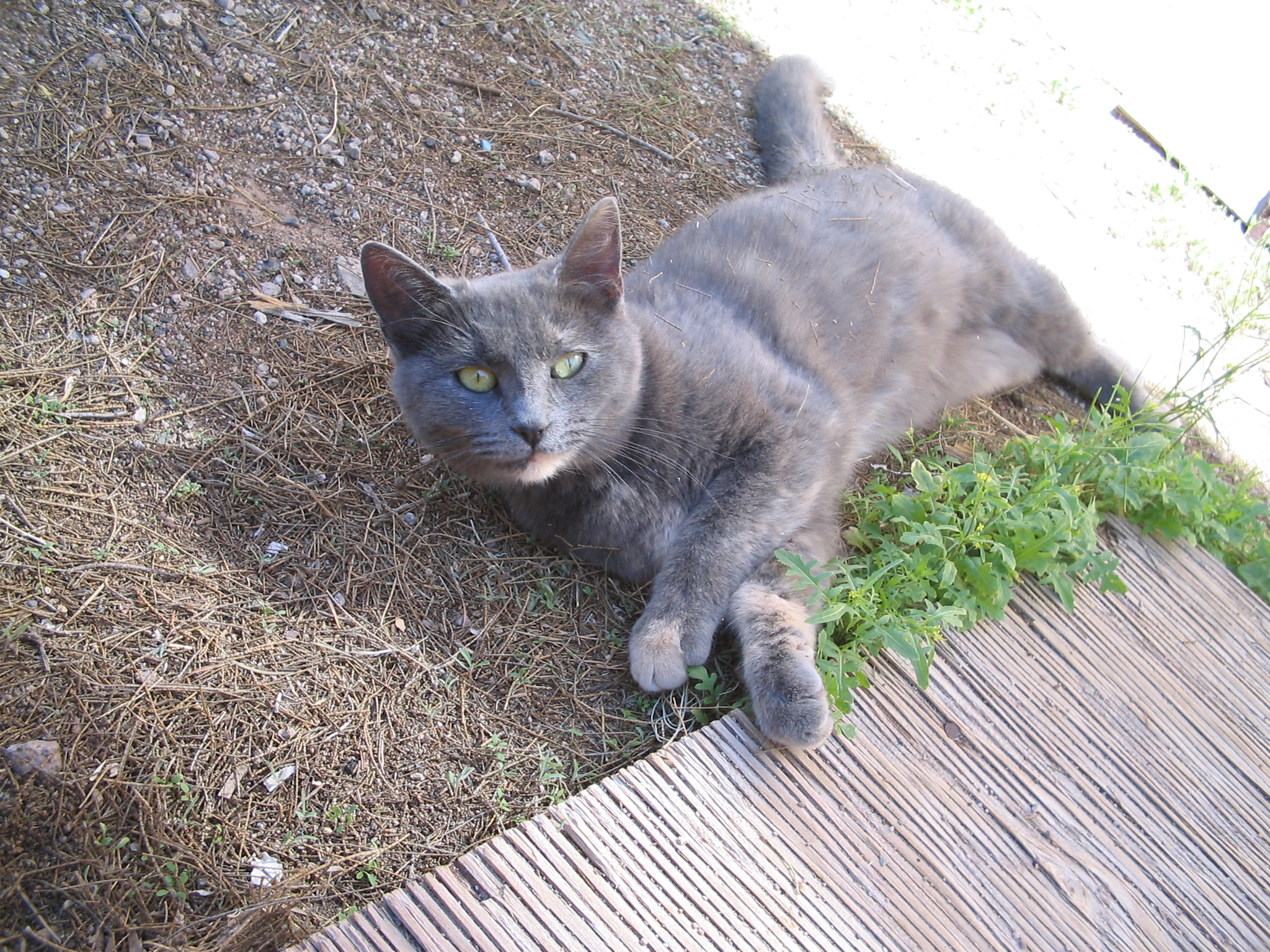 While in Tecopa, I befriended a feral kitten, a female, who I named Gracie (for Gray “C”at) but I pronounced it to her like another cat might, ”Grrrrrayce” purring the “R”s. I started feeding her and eventually she would come right into the bus, though she’d never let me pick her up. When it was time to leave, I decided it would be a good idea to have a natural mouse hunter on premises and started feeding her in a cat carrier until the day came to leave and I just shut the door on her. You can imagine her response and the unpleasant growling all the way to Taos. I chose to do the trip all in one day to spare her any longer confinement than was necessary. That, unfortunately, put us in near dark.
I was relieved to see that the place looked intact as we pulled up. The inside was a different matter. The mice had moved in and pretty much destroyed everything not in bins. The stench was overpowering and I had to sleep in a tent the first night, the poor cat stuck inside with me. Though I had brought her to address the rodent problem, it seemed cruel to lock her in there alone with them. I envisioned them taking her hostage, or worse. Too many cartoons, I guess.
The next morning I set to work clearing out the mouse debris and airing the place out. Gracie was grateful to be free but knew she was in foreign territory and nervously stuck near me and the food and water. Even though she was still pissed at me, I think she was pretty freaked out and knew she needed me. After cleaning things up and airing out the place, I set to creating a safehouse for Gracie. Still feral, she preferred to roam outside, but the sagebrush offered little in the way of protection from the monsoons or the coyotes and owls. I made a loft space that she could access through a sliver of a window on the roof that opened to the windowless “hidden” store room. It was screened in on the inside so there wouldn’t be any unauthorized visitors in my house. I got her accustomed to her space by feeding her there and installed a self replenishing feeder and water dispenser for the times when I wasn’t around. She took to it readily and soon began stocking it with dead mice that she caught. Well, sometimes they were only mostly dead and sometimes they were only portions of mice. Unfortunately she would bring them in from the fields, rather than culling the house mice as I had intended. The stench of rotting mice in that room was overwhelming and I routinely had to climb up there and clean it out. The best laid plans…
I covered the dirt floors with sheets of plastic topped with rugs from Mom’s house that I had brought from Las Vegas which helped to hold the dust down. There were myriad holes and cracks which admitted wind and creepy crawlies that I made my next priority. Since I was going to be sleeping in there, it had to offer at least as much shelter as a tent.
At this point I had to decide how to proceed. The original straw bale site was a disaster, all of the trenches caved in with bits of plywood and foam insulation poking out here and there, and a short forest of standing rebar, all that remained of the staked bales. After paying off the credit cards, adding the extra six months stay in Tecopa had drained my saved cash and I was returning with precious little to work with. It made sense to me at the time to try to turn the bathhouse/storeroom into a “cabin” to live in until I could afford to start again.
At least the land was paid for.
Now what I needed was shelter. Then I could look for work. First I had to have a place to stay. Can’t go to work from a tent, especially in the winter.
So, I set about to converting the deliberately temporary structure into a more permanent dwelling, suitable for winter habitation. Unfortunately, the only way to do that was to go back into credit card debt,…again.
Oh, well. Gotta eat, gotta have a place to live. Right? So, that’s how the summer commenced, with a resignation to yet another set of changed plans, and a scramble to beat the ticking clock as the debt increased and the summer waned.
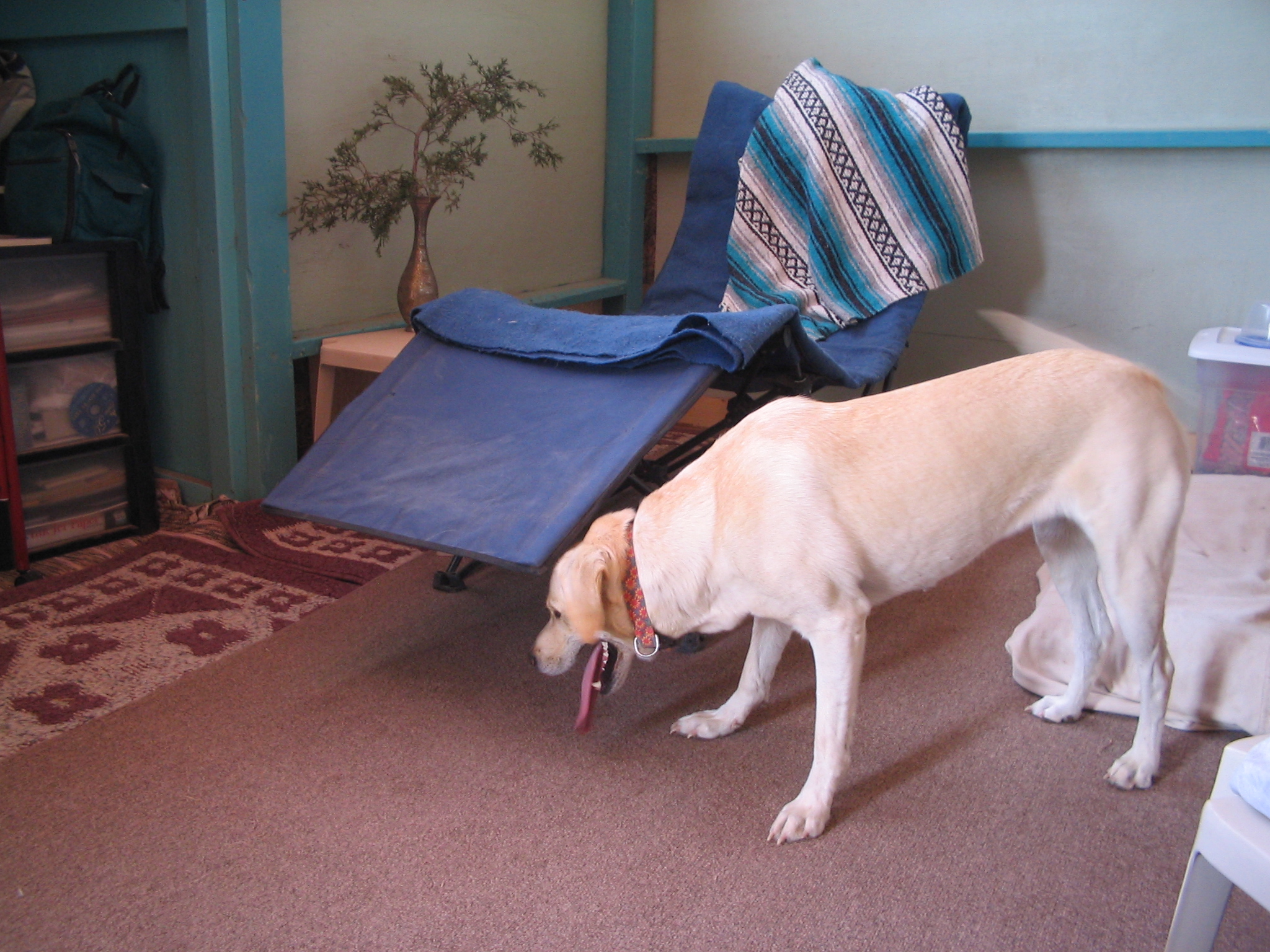 In July, on one of my return trips to Las Vegas to my storage, which I had managed to get down to one very full unit, I went to Tecopa for a visit when I ran into an acquaintance from my time there. He brought me out to his truck to show me Maggie, a dog he had rescued but could no longer keep. She was an absolutely beautiful golden labrador desperate for affection. Identifying with that feeling, we immediately bonded and I agreed to take her with me, grateful to have a dog again.
Unfortunately she was too needy for affection and clung to me, underfoot all of the time. I kept tripping on her every time I turned around, often falling with armloads of stuff. She just wasn’t cut out to be a wilderness dog, cowering at everything. The more upset with her I got, the more insecure the poor thing became until one day she just took off.
I was crushed. I felt so guilty for not being more patient and not helping her to adjust but was distracted with my dash to finish. I walked all over, calling for her, but never glimpsed her. By morning, though, she was back, timid, thirsty and hungry. I was so relieved to see her and vowed to be better with her.
The work continued and by the beginning of August I took a break and drove to Michigan to attend my niece’s surprise 16th birthday party, bringing Maggie with me but leaving Gracie to defend the place. With her loft set-up, being feral, leaving her for extended periods was no problem.
When we walked in to my elderly Aunt Ellen’s house, she exclaimed, “Oh, look! It’s Goldie! She looks just like Goldie!” Goldie was their golden retriever who had just recently died of old age and they missed her terribly. Naturally, Maggie took to her immediately and I made the decision to let her live with them and be doted on in their beautiful lakeside home in the woods of Michigan.
A happy ending! We like those.
In my absence, Gracie had proudly stocked up on some fresh (and not so fresh) mice in her clever loft. I was glad to see that she had the smarts to avoid the local predators.
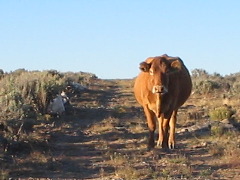 Cows again!
It can get pretty hot in the daytime during the short summer season, usually mid eighties to nineties, though it cools off considerably at night due to the high elevation. My little uninsulated, unventilated shack got considerably hotter and I eventually took to wearing only my shoes as I worked to expand the space somewhat. The north wall that I had hurriedly enclosed two years before created an irregular sloping passageway between the upper area with the kitchen and the lower area that was now my main living space.
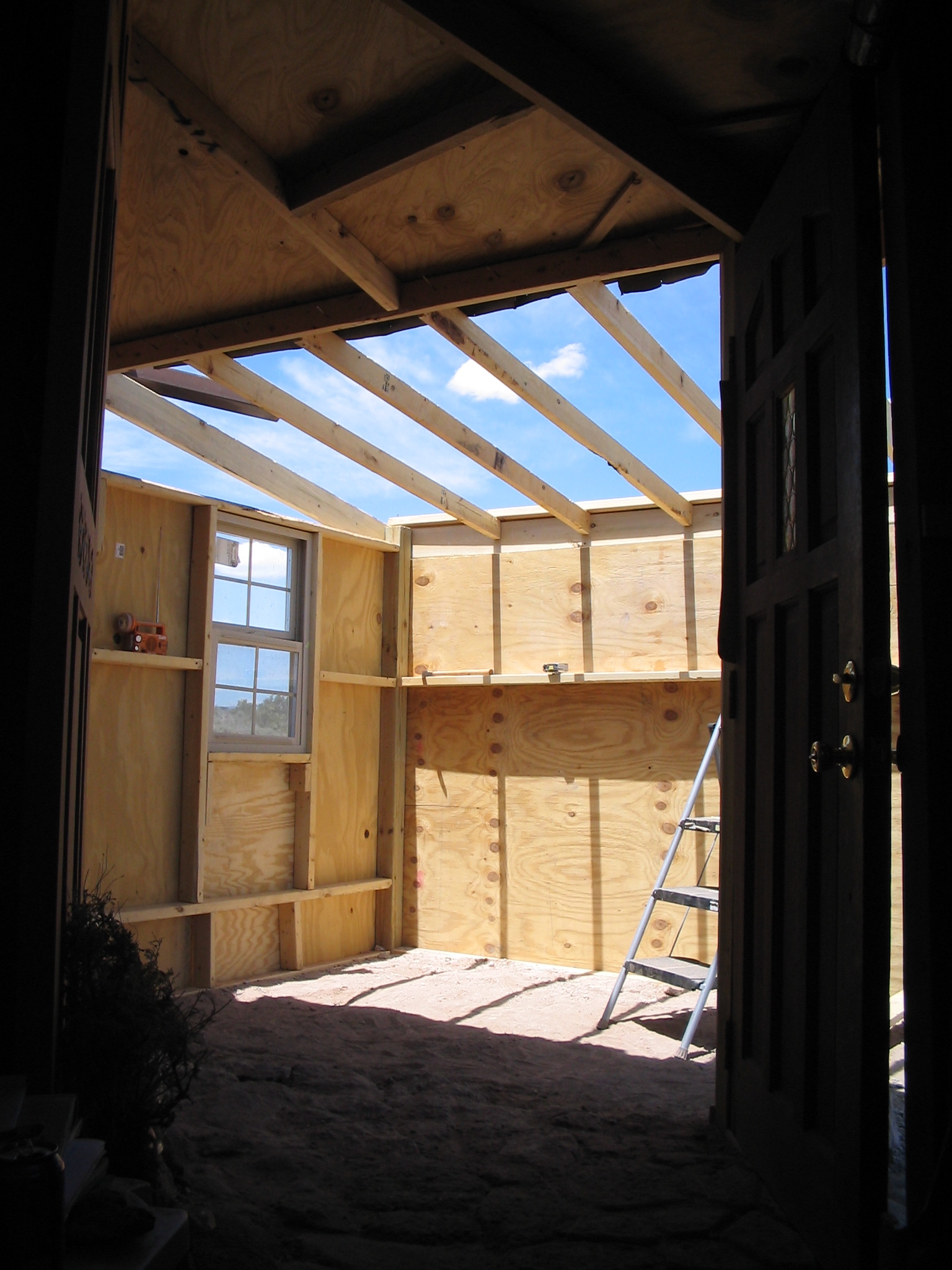 There was a levelish spot beyond it and I decided to bump out the wall and create a small, (about 6’ x 8’) but intentionally built room. This I planned to skin with ½ inch plywood, and then stack bales around the outside and stucco, starting a hybrid approach to the dwelling.
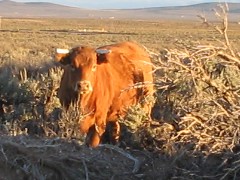
One day as I worked, I looked out the open front door and was surprised to see a small herd of cows right outside, tromping through my garden, grazing on my plantings and breaking solar lights as they went. Charging through the door in an outrage fueled adrenalin burst, I came screaming at them, equipped only with tennis shoes and an eight foot length of one inch PVC pipe I had grabbed on the way, as I chased the startled cows into a stampede down the hill and beat on the sage brush and ground with the pipe, shouting to frighten them away, doing my best Neanderthal display to drive home my point.
Until they stopped and turned to face me.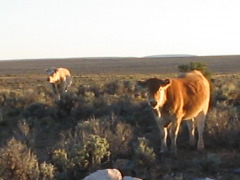 Only then did I realize my impulsive folly. Pausing to catch my breath, gasping and weak, like a fish on the dock, oxygen debt from the elevation, and the post adrenalin sugar drop, I noticed that several of the cows turning to face me were young bulls, standing their ground, stamping their hooves in the dust.
Uh oh.
Looking back to the house, I realized that my fury had carried me downhill about a quarter mile.
Uh oh.
Here I was standing naked in the middle of a wide open space armed only with tennies and a long piece of hollow plastic, standing up to some perturbed bulls, too far and out of breath to make a run for it back to the house.
 Uh oh.
Following the rule “never show fear”, I backed up the hill as quickly as I could, stopping occasionally to give another noisy display as I beat a hasty retreat and slammed the door, hoping the flimsy construction would keep them out. They, of course, just stood there, watching with bewilderment, not sure what to make of the episode.
I have to say, though, I never saw that particular herd near my house again. Or so I prefer to believe.
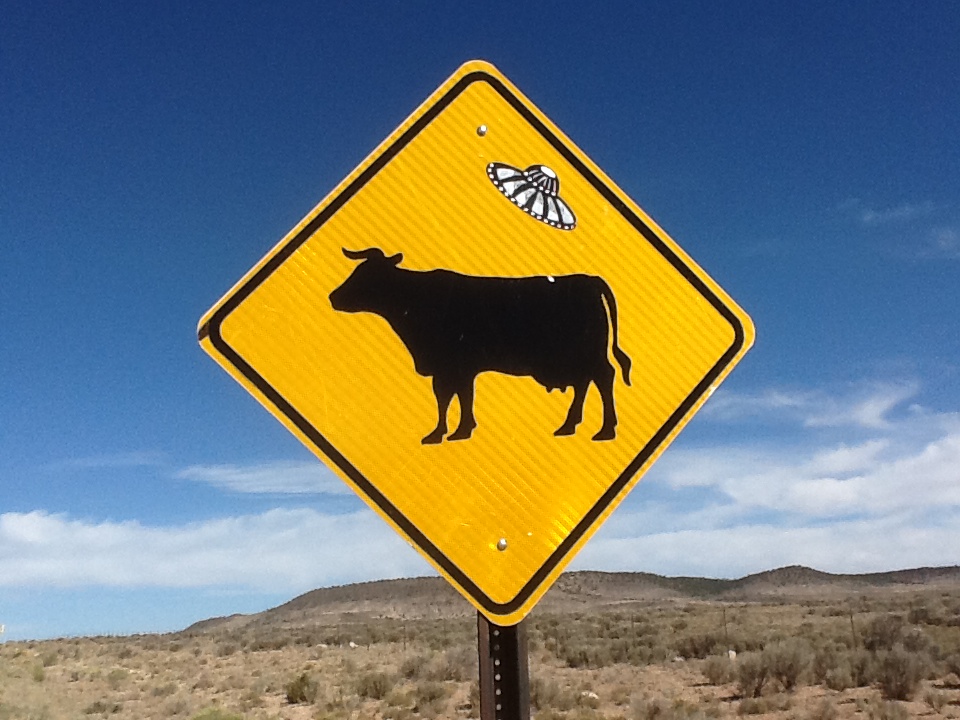 On balance, I must relate a brief, but disturbing moment regarding the local cows. At the beginning of September, I was driving on Highway 64 through the mountains of Carson National Forest, headed for Burning Man in Nevada. Not ten miles from my land, I saw several cars pulled off to the side and a few people out and walking to examine a dark mound at the side of the road. As I cautiously slowed, I could see that it was a dead cow, bloated from the heat. The most disturbing aspect was it was one of those mutilations that have been in the news for the last thirty years. The head was facing away from me but I could see a large, perfectly circular hole where the rectum had been excised.
I didn’t stop.
A Change of Seasons
By the end of October it was becoming apparent that I wasn’t going to make it. There were still too many things left undone for it to be viable for the winter. There was no insulation, save for the partially insulated new room, and no source of heat; not airtight, with plastic stapled over some of the openings. The solar panels weren’t hooked up, the water tank was freezing, and I still had no income and a burgeoning debt.
I rode the barge of denial for awhile, so determined was I to succeed this time. As the days got shorter and the nights grew colder, I withdrew into the new little room. 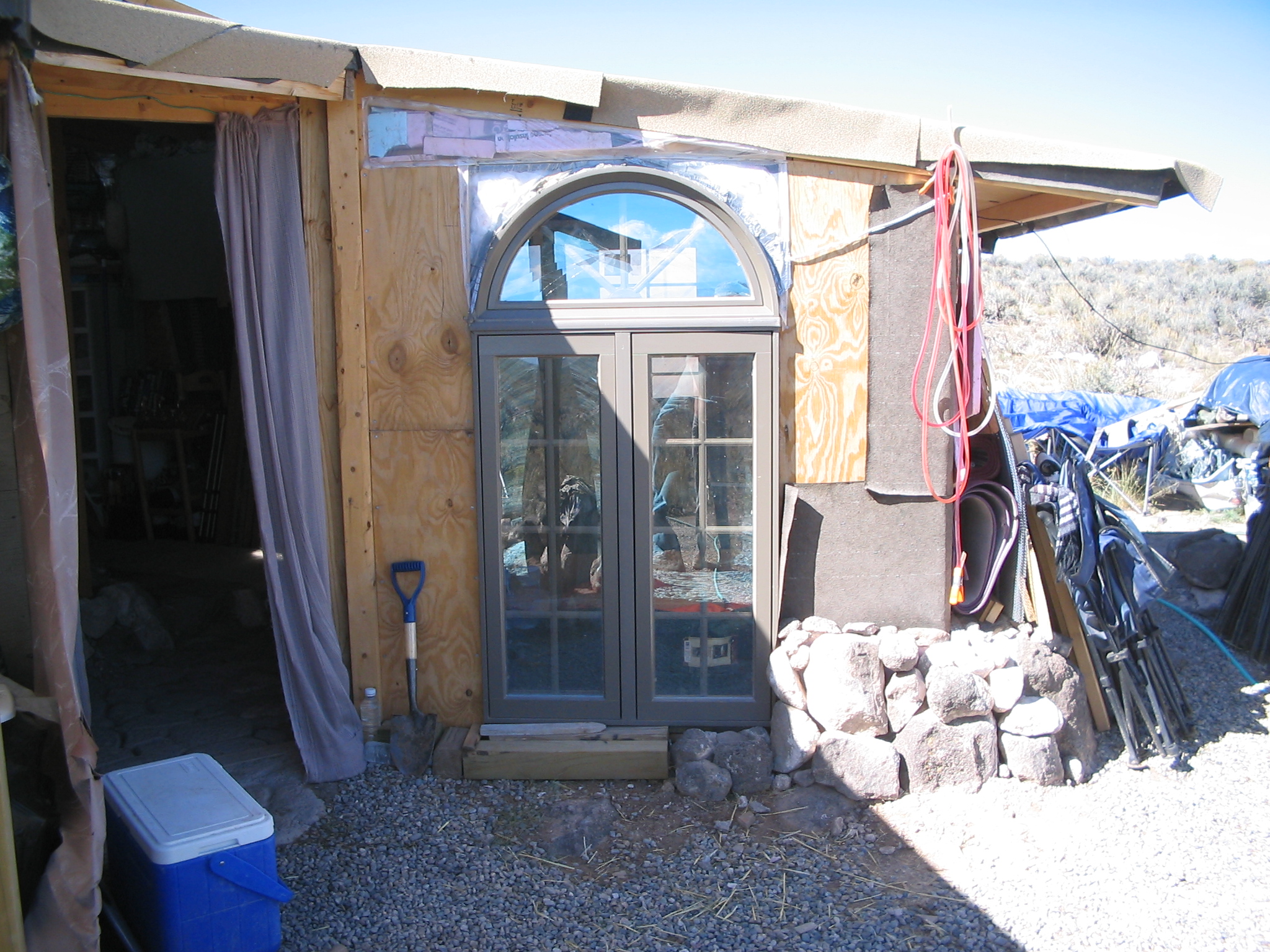 I excavated down at the demolition site, mining for intact pieces of insulation foam and stuffed them behind the space blanket I had stapled to the ceiling, shiny side down, thus approximating an insulated roof. Then I stacked bales around the outside, taking care to stack plywood pieces, also scavenged from the trenches, against the bales as a cow deterrent. A heavy drape hung across the opening to the rest of the house created a sheltered 6×8 space big enough for my desk and chair and not much else. I found that the Coleman lantern gave off enough heat to bring the space up to almost 60 degrees. Of course it consumed much of what little oxygen there was, too.
For light, I had a tray of solar yard lights that I would set out every morning, and then bring in every night, suspending them from the ceiling in little bent wire cradles. The little yellow LEDs cast a cheery, warm light around the room for awhile, but as the night wore on, they faded to a dim, sickly glow,… and there was no off switch.
I hooked up the five watt solar panel that came with the composting toilet vent system to one of the deep cell batteries I’d gotten for the system which gave me enough power to run the laptop or my little 12 volt DC TV/VCR combo for almost long enough for a whole movie, though not usually.
I had purchased an ancient Chevy cargo van while in Tecopa to use to shuttle things from storage in Las Vegas and haul construction supplies such as concrete, lumber, and bales. It also turned out to be a comfortable entertainment lounge. On the warmer nights, I would load all the pillows and blankets into the back, creating a snuggly nest and bring in some solar lights. Then I would plug the computer or TV into the cigarette lighter, start the engine and turn on the heater to warm up the place and charge the battery while I watched a movie.
But by mid-November, my denial voyage ran aground. It was time to face facts. One night as I lay in my bed at only eight o’clock at night, zipped up in my mummy bag in a fetal position with just enough of an opening to breathe and peek out at the mice scurrying around the room along the walls, barely visible in the fading yellow glow, it sank in. It was usually about 15 degrees warmer inside my house than outside. Since it was 20 degrees inside, that made it 5 degrees outside. The bottled water I had inside with me had frozen, the toilet was that frozen seat out in the gully, and the food was running out.
And it was only November!
You mean winter isn’t even here yet?!
I had this horrible, creeping realization that if I stayed I would surely, literally, freeze to death. And the worst of it was, no one would notice. I was so isolated and incommunicado, no one was looking for me. I wondered how long it would take for anyone to notice. “Say, has anyone heard from Dave lately?” And of course the rotting carcass would probably prompt them to bulldoze the place and it all would have been for nothing.
That snapped me into serious survival mode, strong among my people, and I resolved to find alternate winter quarters,…again.
Full Circle
My friend Mark had a non-profit organization called Earthseeds, based in Colorado Springs, and had offered to help me find a position in his project which included the goal of getting the view of the non-political globe, the view the astronauts had of the Earth from space, the Earth without visible borders or controlling powers, into every classroom in the country by some specified date. The ambitious idea was to promote a global consciousness, and conscience, about our mistreatment of our “Spaceship Earth”. His director of operations, Rob, was gracious enough to offer me floor space in his studio apartment until I could get myself established. Ordinarily one might feel uncomfortable in such a situation, but I was so relieved to be indoors in a heated space with plumbing that tremendous gratitude describes it better. While it got me indoors for awhile, it was really only a temporary arrangement and increasingly inconvenient for all.
Mid-January, I was relieved to get a call from my friend Adam, another former Mattel colleague in New York, who offered me the use of his parent’s home in Oakland, California. They had recently passed away and the house stood empty and unattended, still furnished with his folks personal things. He had a teaching schedule at FIT that prevented him from going out to handle things himself. I jumped at the chance to spend the winter in warmer California and loaded up the Jeep,…again.
Back to the Bay
This time I was on the east side of the San Francisco Bay, perched on the top of the ridge of steep hills thrust up by the still active Hayward fault. The house was a post-war modern two bedroom cottage that might have had a spectacular view of the Bay was it not for the neighbor’s roof and the adjacent trees. Though the bedding had been changed and the perishable food had been removed, everything stood pretty much as it was when his mom went into the hospital. The exception was the front bedroom which had been his dad’s and Adam had redone with new curtains and a bright yellow bedspread.
My days were spent clearing out the debris of their lives, a process I was quite familiar with by then, and made many trips to the Cancer Society Thrift Store with donations. There were years of accumulation both in the closets and drawers as well as on the stove and kitchen walls. The process took many months but finally it was scrubbed, repainted and cleared to a simple minimum. Adam still hadn’t decided whether he was planning to sell it or fix it up as a rental so I was in an indefinite holding pattern, still subsisting on the credit card but reluctant to get employment until Adam decided what to do.
I tried going back to sign language interpreting, but the very first assignment was a classic interpreter’s nightmare, featuring every possible thing that could go wrong, a harsh reminder of why I had left interpreting in the first place. So much for that plan.
This was one of the loneliest, most depressing periods of my life. With no career, dreams, hope, or people, I was in a purposeless purgatory, disappointed to wake up every morning. By November, it became painfully apparent that I had to get some income soon or lose the credit card, too. I started prowling Craig’s List for some options. After some very discouraging weeks of trying to find a fit, I found an ad in the writing category for a paralyzed man seeking a live-in attendant, hoping to find a fellow writer who would be unobtrusively present.
Matthew was a brilliant, well educated man in his 50s who had, ironically, also lost his home to the Oakland fire, nearly losing his life at the same time. He had been diagnosed at the age of 26 with Multiple Sclerosis, a debilitating, progressive neural disorder, and had experienced a steady decline, going from crutches, to a wheelchair, to then losing the use of his arms. Now he was down to being “a head on a stick” as he put it. He had lost his live-in attendant, was anxious to find a suitable replacement, and hired me that day. Though I was still tending Adam’s place, by January I was fully moved in.
Probably needless to say, my dark mood abruptly changed as my sense of purpose and practical life needs were better met. More importantly, I was seriously humbled and chastened for my sense of hopelessness and self pity in the face of someone who had much better reasons for not wanting to get up in the morning.
Like not actually being able to get up in the morning.
My seven year sojourn with Matt was so rich and complex that it must be the subject of another story. Again, the experience was completely different from my Taos world, an entirely separate bubble of life, a refuge on the way to my wilderness home situated on the old highway to…somewhere.
That summer, a friend of Matt’s took him to Santa Fe to the opera and I came along as one of two travel attendants. I managed to get an afternoon off, rented a car, and drove up to my land to check it out.
Except for the stench, things seemed orderly enough at first glance. It wasn’t until you examined the cozier spaces that the destruction became evident.
Rodentia!
As anticipated, once the poison bait was gone, the survivors thrived in the wonderful, carpeted shelter and soon it was a thriving, fecund community. While there was no food for them, they were no longer coyote food. There was an abundance of warm nesting spots, such as the shoulders of all of my clothes bunched together on hangers and covered with a protective sheet. This served them well for harvesting nesting materials as well, especially the collars, and, naturally, the toilet areas weren’t confined to any particular area and so the urine and feces were rather widely distributed.
I noticed a clutter of styrofoam chunks and bits of fabric and a tangle of what turned out to be pieces of cactus drifted under the futon frame. As I pulled a few pieces out, wondering how such items could have accumulated there, if maybe there was a wind breach in a wall somewhere, a tiny pair of hands from under the bed suddenly pushed my hand out. I was simultaneously startled and amused at the comical and non-vicious way this little relative of Chip ‘n Dale made it clear that he didn’t appreciate me disturbing his home. He could have bitten me instead, after all.
Except that it was my home and I evicted him, chattering noisily at me as he scampered out the open front door. When I pulled out the futon to clean, I discovered another lodger. 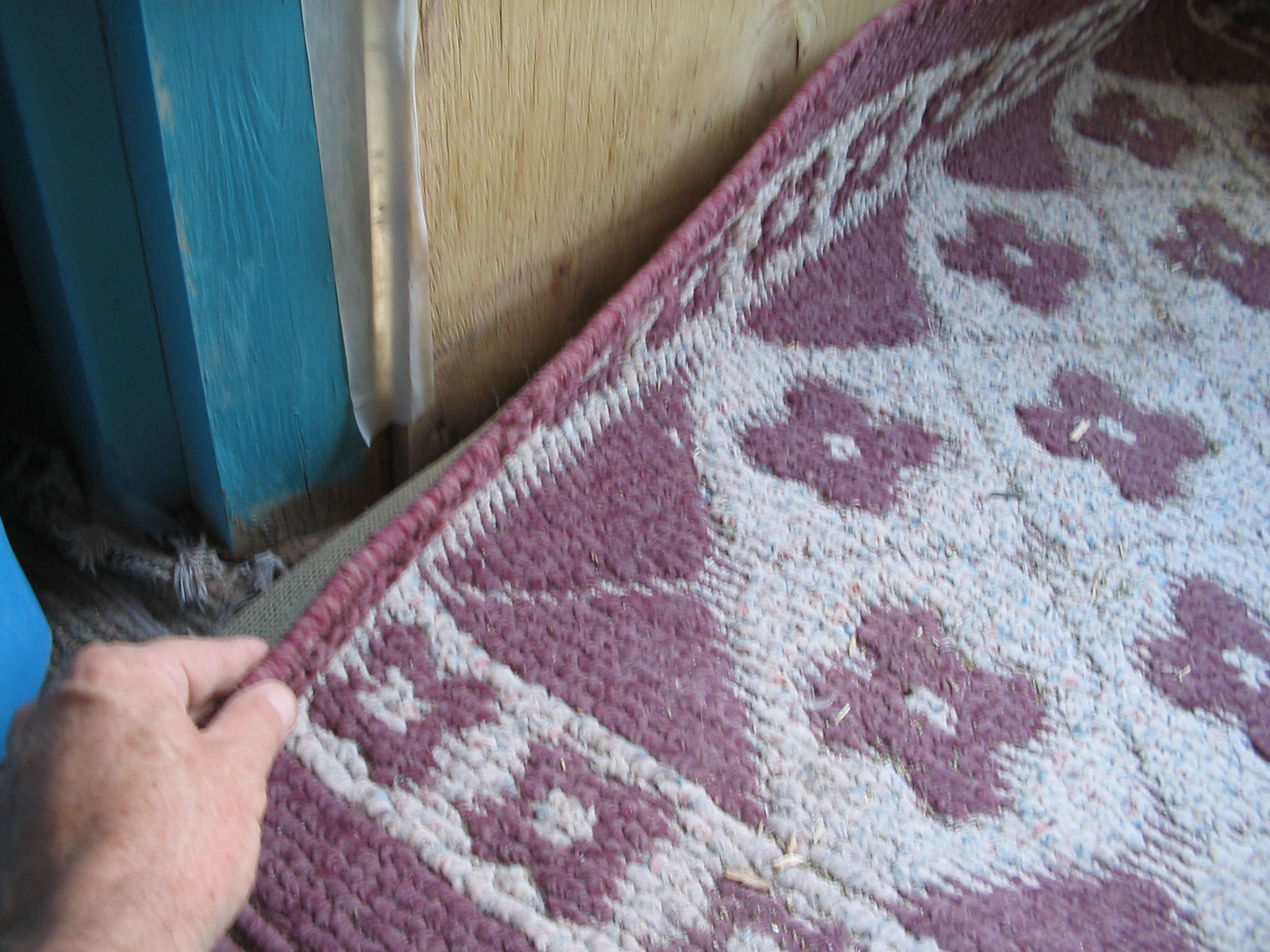
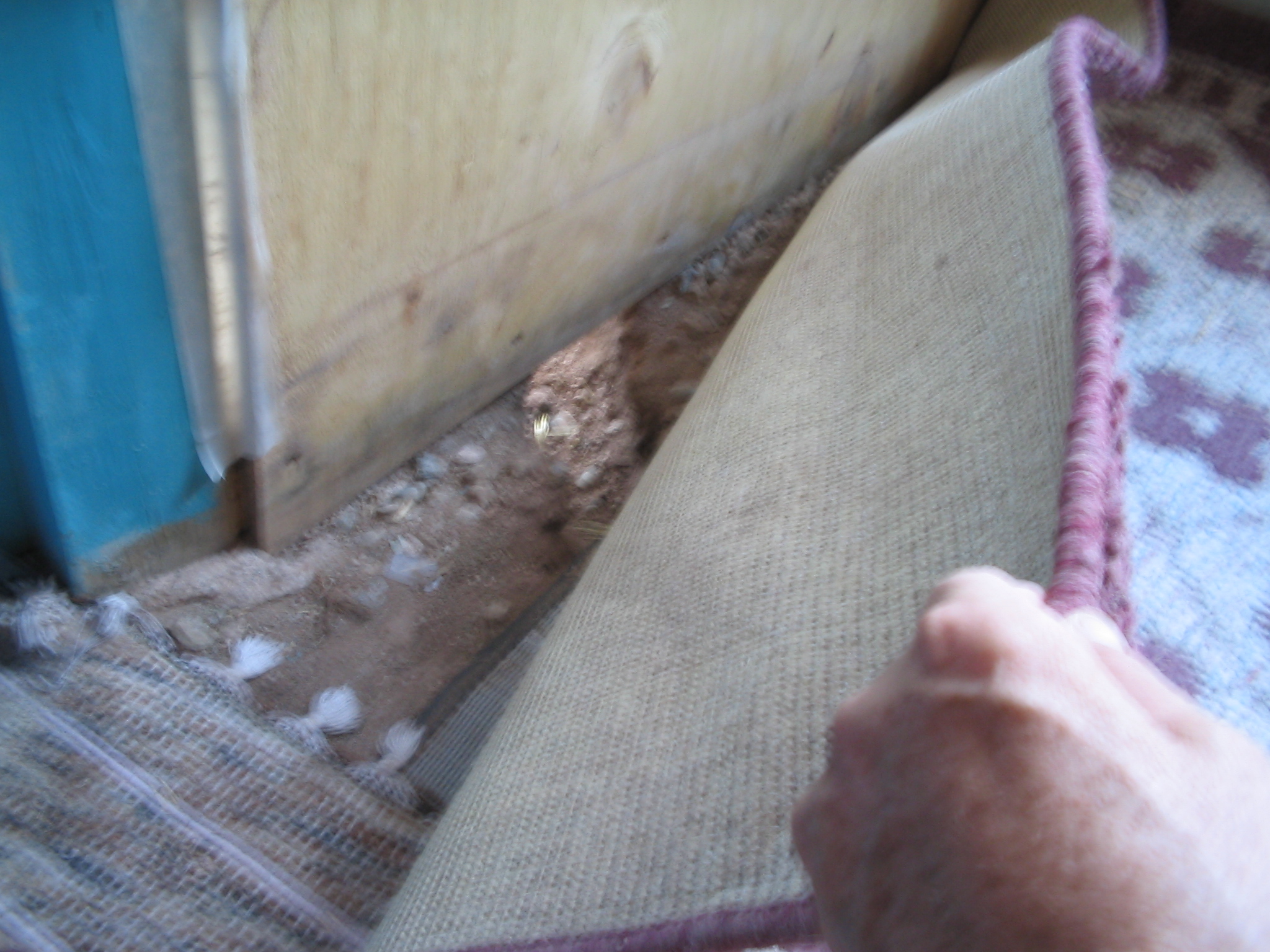
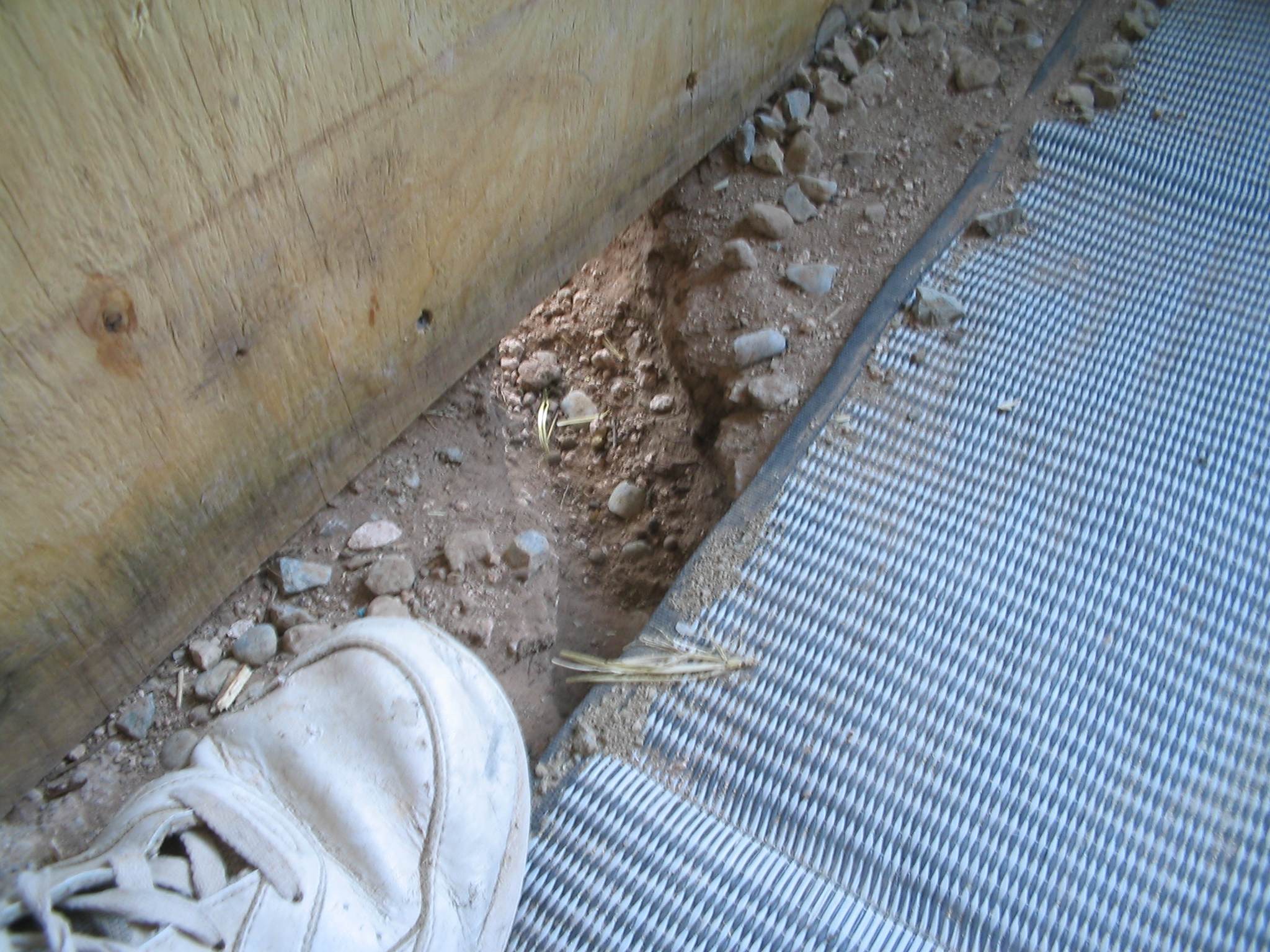
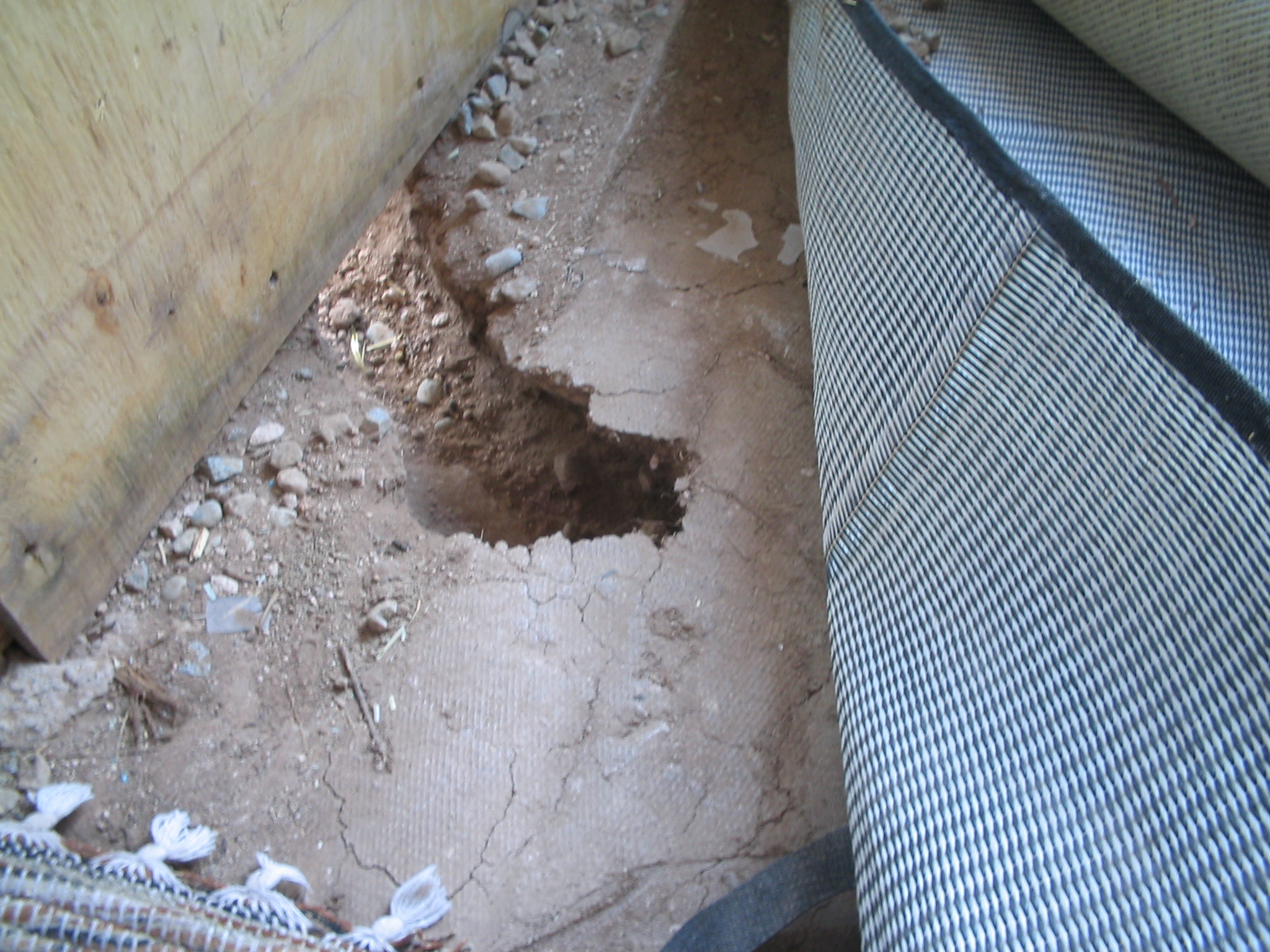
Noticing a depression in the rug, I lifted it to find a lovely rabbit warren. Digging under the plywood wall and through my dirt floor, the rug served as a fine tunnel roof. Fortunately he wasn’t home and I reclaimed my floor, plugging the entrance to Dave’s Critter Lodge.
There wasn’t time to do anything else this trip and so I headed back to Santa Fe and then the Bay.
Trip
The next year, I heard that Trip had taken a bad fall at the hot springs and hit his head, causing some degree of brain injury and disability. I called to see how he was doing and learned that, not only was he unable to work and on Disability, he had just been evicted, the owner intending to restore and sell the historic old adobe. He had lots of stuff, including many boxes of things that were his recently deceased mother’s. To complicate things he had three dogs and a cat as well. He had been in Search and Rescue and the dogs were trained in that.
Identifying with his predicament, I offered the use of my place to stow his things while he figured out what to do. As the weather was warming, I offered that he could even camp out there for awhile if he wanted to. It was rustic but he was welcome to even stay inside if he wanted. As long as he was an asset and helping to move the place forward to being a real domicile, he could even use the amenities, such as the solar panels. Just having someone present might prevent further deterioration, I thought, and told him where to find the hidden key.
It seemed like a fair exchange at the time.
When will I learn?
Late that summer, Matt returned to the Santa Fe Opera, and again I rented a car and drove out to check on things with Trip. Driving up to the place, I was dismayed to see many new unfortunate additions, including a derelict car crammed with stuff, a metal storage shed, various piles of indeterminate junk, some covered with rotting tarps, and a bright white old camper shell intended for a truck bed, now on stilts, also stuffed with stuff.
Upon entering the house, I discovered things in sad disarray, boxes stacked everywhere. Things lay right where those who helped him move had dropped them. He had done a lot to tighten the place for winter, but it still lacked insulation or a woodstove. I was pretty horrified at the mess, figuring it reflected the state of his brain injury, but more horrified at the prospect of him facing winter like that, to the degree that I flew back a couple of weeks later and worked for several days organizing his clutter, improving the road and installing insulation. When I left, I admonished him to be an asset to the place and please keep it up. I was depending on it for my future.
I didn’t hear from him much after that which I chalked off to the bad phone reception and his recovery. There were a couple of important events that he relayed, though, which have potently impacted the homestead. As often happens with life, they had mixed results, both good and bad, depending on your perspective.
The first was, on the whole, a good thing.
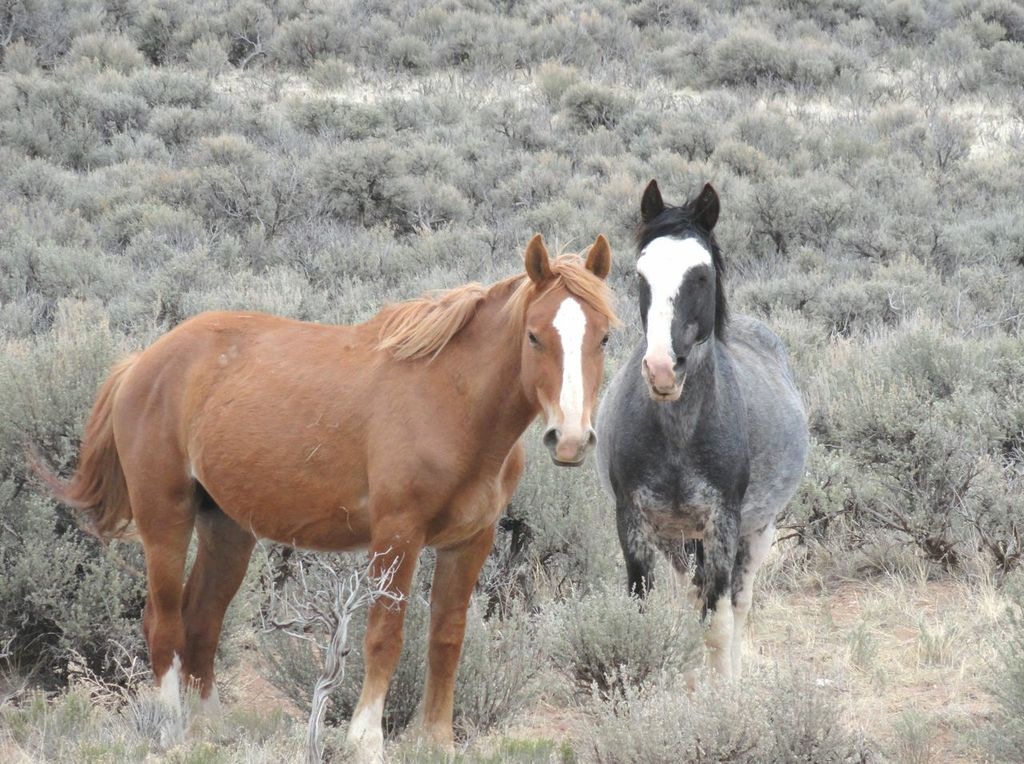
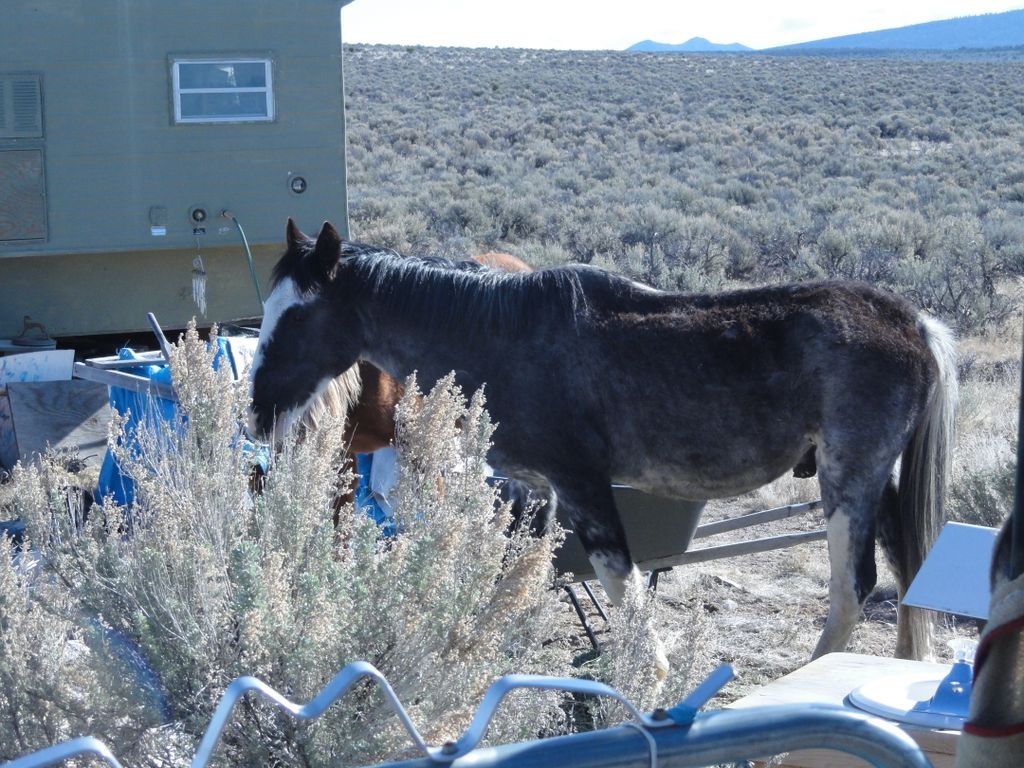 One spring, a pair of wild horses wandered in from the range, unkempt, emaciated from the winter, and parched. Trip offered them water which they drank avidly, downing gallons. Then he got some hay from town and began feeding them, watching them get stronger and filling out as the spring warmed to summer.
 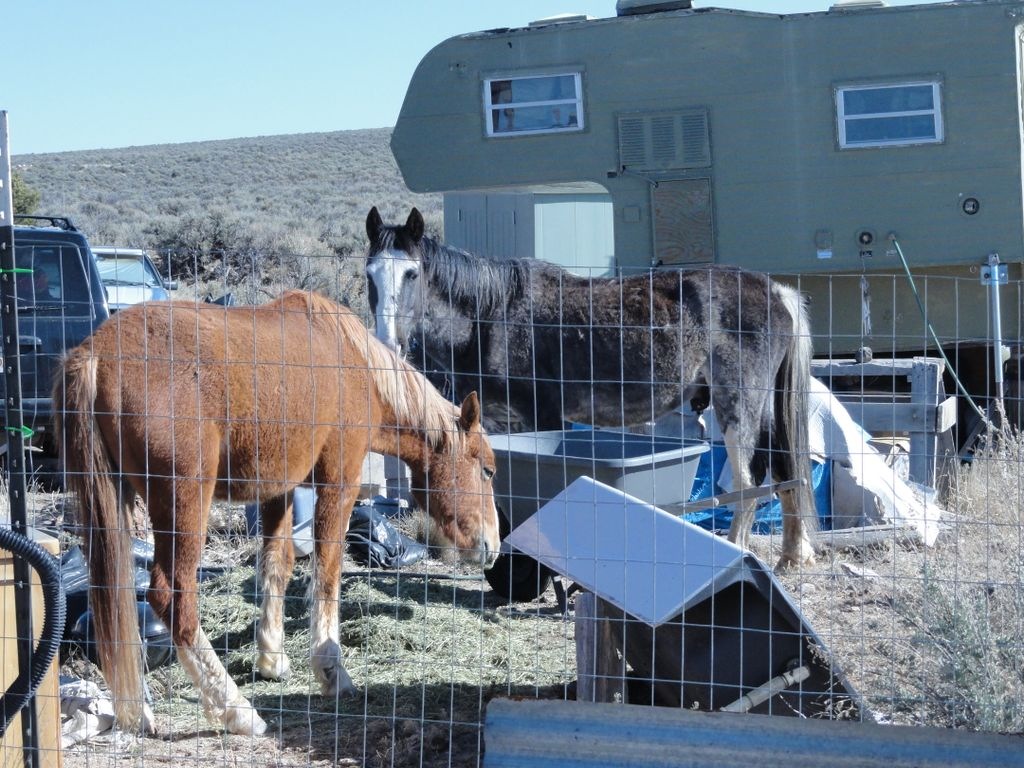 Having minimal income, he sought donations and support from people he knew in town. Someone identified one of the horses as a rare Indian Pony breed which Trip hoped would possibly garner some official support.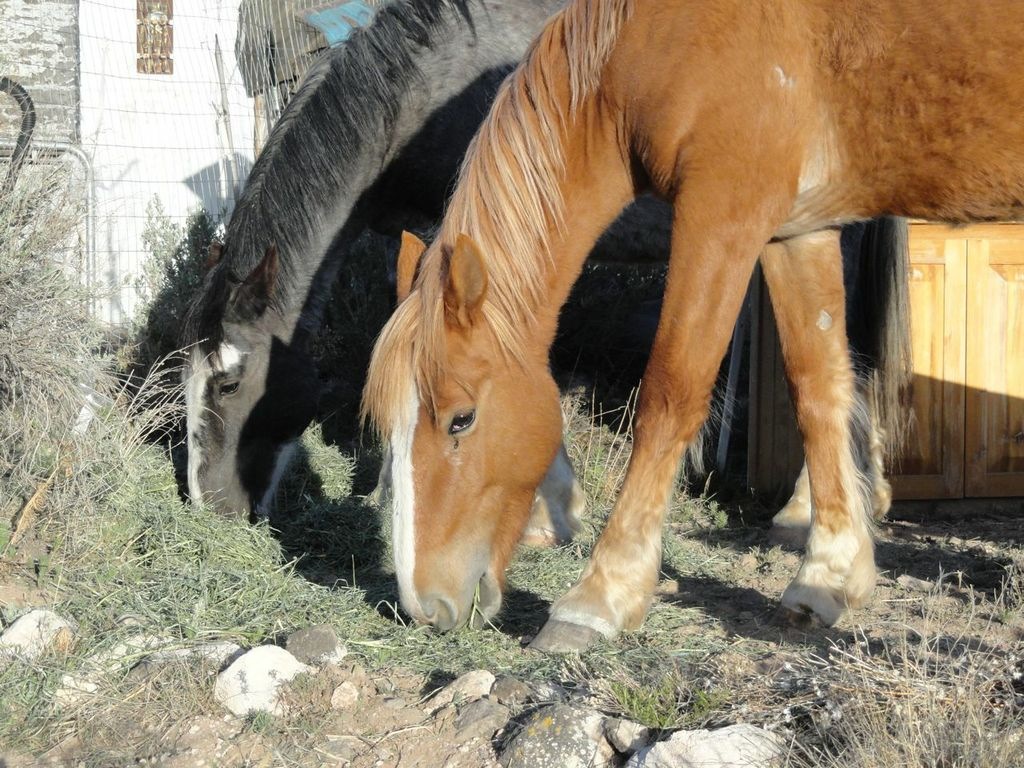
 As the summer gave way to colder weather, some guys that he knew from a local lumber mill donated some rough sawn planks, still dripping with sap, and built a large, sturdy stable, open to the east, wedged between the camper and the steel shed.
Having the horses there offered Trip a sense of purpose and the whole rescue became an effective therapy for him toward his own recovery and he found himself smiling again. 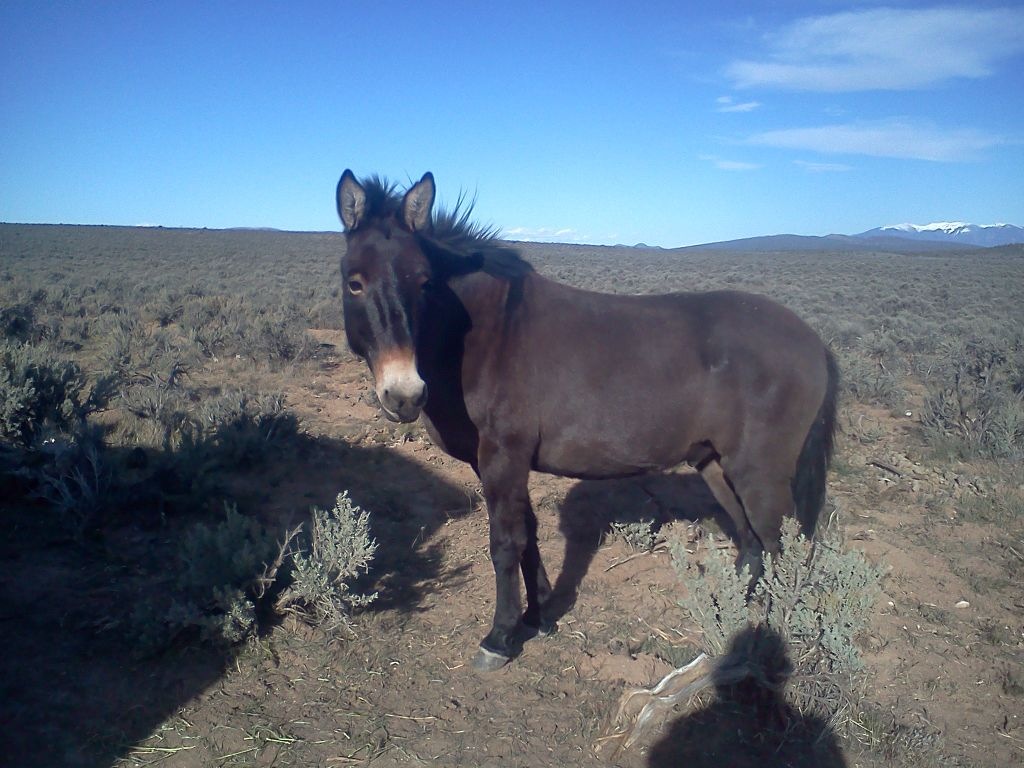
The next spring, the horses returned one day with a hinny (crossbreed of a male horse and a female donkey) in tow who also enjoyed Trip’s hospitality. Being wild they would come and go sporadically, sometimes staying away for long periods, but always coming home.
Until they didn’t.
Apparently there is a $75 million annual, federally funded program which rounds up wild horses and donkeys across ten states and auctions them, mostly for slaughter. This, they say, is to protect grazing land for cattle!
They never did come back but at least now there is a stable for the next refugees.
Killer Cattle
The second event was, on the whole, a bad thing. One moonless night late in August as Trip was returning home from town and only a few miles from the gate, he was surprised to receive a phone call, getting an unusually strong signal as he coasted to a stop at the rise of a low hill to take the call.
Completing his call, he pulled back on the highway, still moving slowly as his headlights shone over the crest and then down the hill to reveal a large herd of cows grazing in the gully, spanning fence to fence. Mercifully, by stopping to receive the call right there at that moment, he was barely moving when his headlights illuminated the obstruction and he was able to easily stop in time.
Unfortunately, the couple on the motorcycle coming from the opposite direction couldn’t.
Slamming full force into the herd, the man and his wife flew headlong into the scene backlit by Trip’s headlights, each landing too hard.
Here is the balance to the ill fated tragedy. Trip was there, on the already lit scene, a former EMT trained in search and rescue, phone in hand, inexplicably with signal in the middle of nowhere, in the middle of the night! He was able to call for the evac helicopter and then stabilize them for the hour that they had to wait, holding the woman while she quietly died.
The man lived, though, thanks to Trip’s “coincidental” presence. He never would have been found in time in the dark in the middle of the herd. As a gesture of gratitude, he and his brother came out and built an attached wood room to the house so Trip wouldn’t have to trudge out in the snow to dig out firewood anymore. An honorable ending to a tragic tale.
Another result of the accident was that a fence suddenly appeared between my property and the rancher whose cows ate my house, along with signs all along the highway saying “Keep Gate Closed”. There haven’t been any marauding cows on my land since then as far as I know.
The Third Summer
The years crashed by and in February, 2013, Matthew came out of the hospital one day and directly into hospice care. Abruptly I was out on the street, as they needed my room for the hospice worker. In a blink, I had lost my job, home, social setting, raison d’etre, and soon, most grievously, my friend to whom I’d been devoted for seven years. I had no recourse but to head back to the land and give it another go before what savings I had evaporated again.
It, of course, was still winter and therefore not reasonable to go back quite yet and so I spent three months in Pasadena, staying with Jack and Jin, dear old friends. They had recently acquired a property with four houses on the lot and planned to live in one and rent the other three for income. Unfortunately, they were rather extreme “fixer-uppers” and so I stayed in the back unit and spent my days working to make the place rentable by the time I left.
At the end of May I piled everything into the aging Jeep and headed east. After an overnight stop at my storage in Las Vegas to swap out things I was bringing for things I needed to take with me, I drove the remaining 700 miles in one day. Fully loaded with all of my most important things, some even tied to the roof, I was wary to spend the night in some motel en route. Didn’t need any fresh grief.
That, unfortunately, put me in after dark, making it harder to find.
Trip was still living there and I had assured him that I had no intention of displacing him. I had given him three months notice, however, that I was coming and to get ready. I was coming back to finish the house. To begin with, I was planning to tent it while I assessed the situation, and he thought that the stable might offer some wind protection for my tent.
Intending to take the high road, rather than send him away, I had thought I’d create myself yet another temporary structure to live in while I set to completing the original structure. I thought that maybe ultimately, Trip could occupy the new place and expand it from there if he wished.
In the course of my research, I discovered several very interesting alternative building systems that actually got me excited again.
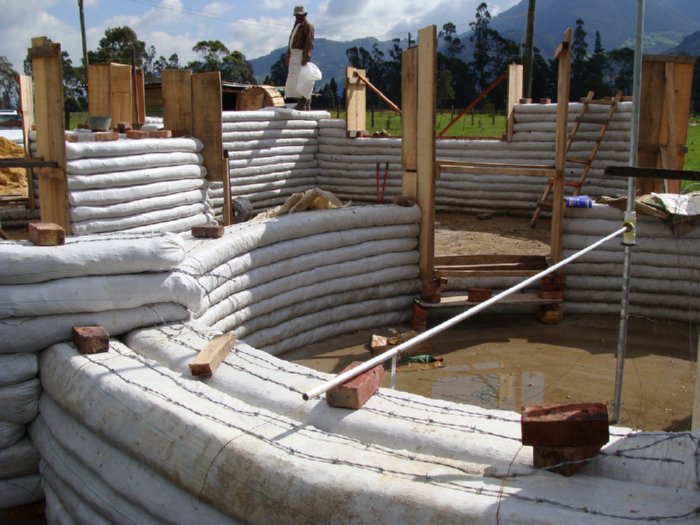 Earthbag construction involves filling cheap, misprinted polypropylene rice sacks with the local soil, stabilized with straw or concrete if desired, and then stacked as one would adobe bricks, encasing door and window frames.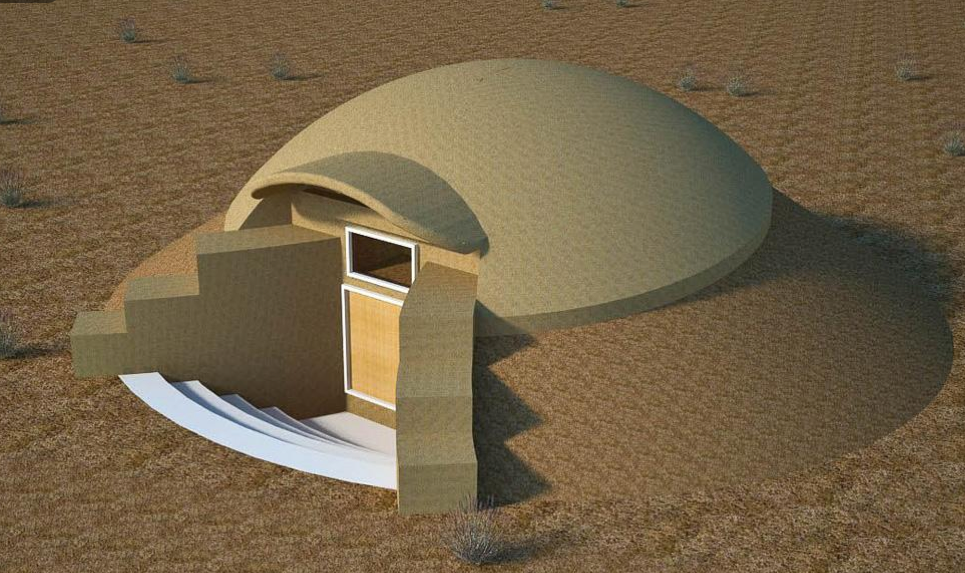
Then you can cover the walls with cob or plaster or stucco. They can be quite sculpturally interesting, quick and inexpensive to build, and provide excellent insulation. The roof can be fashioned by graduating the walls inward toward the top, thereby creating a bee-hive cone shape, or a regular beam affair, or anything really. A monsoon-catching metal one would be ideal. I drew up a plan for a single room shelter to be situated down in the more sheltered gully, the erstwhile stagecoach road.
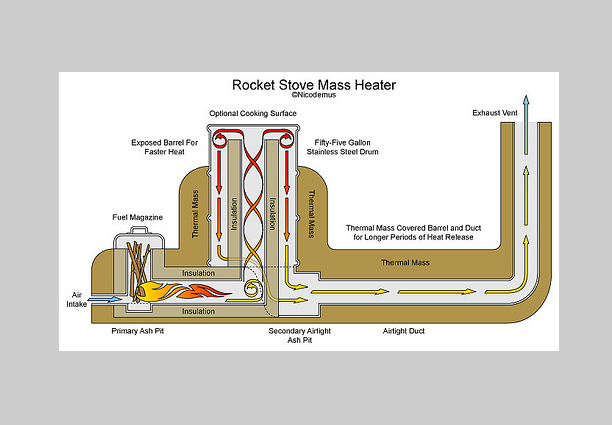 Another system I discovered is called a rocket mass stove. Not a new concept except in its fabrication. It involves a small, vertical wood feed which ignites using a positive air draw which creates a sideways flame that then rises through insulated pipe into a superheated chamber, in this case a 55 gallon steel drum. The high temperatures consume all of the fuel and the exhaust vents through dense masonry benches, exchanging heat on the way, and out of the building at bench level as cooled CO2 and water vapor. No smoke! How cool is that? (They recommend that you screen the openings as it is a perfect habitat for critters. Good to know.) Consuming only small kindling, these super efficient stoves can be used for cooking, baking and heating water, as well as provide a nice, even warmth radiating gradually from the masonry benches. Perfect in its simplicity.
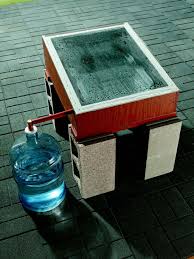 Another system I intend to incorporate is a solar still. The simplest plan uses a wide, shallow black basin filled with the questionable water covered with a slanted piece of glass. The vapor rises and cools against the glass, accumulating droplets which flow down the glass into a trough which drains into the catchment basin underneath. A simple way to harness rainwater effectively. Naturally, I have grandiose plans for catching the rainwater before it gets to the ground, distilling the water at roof level and providing gravity fed, freshly distilled water from the catch basin. Like I don’t have enough to do.
All of these discoveries activated my creative processes and I brainstormed it all the way home, psyching myself into a productive summer.
Arriving around eleven at night I crept up the rutty dirt path, carefully avoiding oil pan hazards to my heavily laden workhorse, and found my way down to the de facto parking area.
Mercifully there was no moon and it was dark and overcast.
Otherwise, I would have seen……
The dogs alerted him of my arrival and they all bounded out to greet me, until of course he gruffly ordered them back into the house and after confining them, hobbled out to greet me in the darkness. The only light shone out of the tops of a couple of the windows facing east, a harsh shaft cast by a bare bulb inside.
We exchanged a brief greeting and then I jumped to the task of finding my flashlight. We picked our way through indeterminate shapes in the dark around to the stable. He had tacked up a piece of plywood, partially sheltering the open east side, and had moved some of his storage boxes from the ground up to the shelves.
But that’s it. The horse, um, leavings were still there along with a powerful smell which included hay. Of course my asthmatic lungs immediately shut down and I gasped my way out of there. No way I was going to pitch my tent in there,…ever! So I went back to the levelish area ahead of where the Jeep was parked and found a spot that seemed suitable enough, snugged up against a cord of wood stacked near the gully which offered some wind protection. I hastily threw down a tarp and pitched my tent as quickly as I could. It was the first of June but the temperature had already dropped to the forties. Coming from Southern California via Las Vegas in June, the forties is kinda cold. First priority is to pitch camp and get in that sleeping bag before you get cold. It’s a Boy Scout thing.
It was quite late by the time I had accomplished the task to my comfort needs satisfaction. I have found that creature comforts and a well organized space facilitating finding anything in the dark, especially the flashlight, help take the rough out of roughing it.
I thought it proper to bid Trip “Good night” and found my way to the door. There was a hint of wood smoke in the air. Again, the dogs announced my presence and he came to the door, opening it only partway, blocking it with his body to keep the dogs in, barking back at them to stay.
“Oh, I’d love to say hi to them.” I objected.
“No. I don’t want them out at night. It’ll take too long to get them back in. So, are you going to bed?” he asked, still blocking the doorway.
“Um, yeah, I finally got all set up.” I said, stalling, trying to see around him, and hoping for an invitation to come in and wind down from the journey and maybe see my place again.
“OK. Well, G’night then. We’re never up this late. Glad you made it OK.”
I stood there a bit dumbfounded. Nothing. Not even a glass of water.
“OK,…see you in the morning.” I said and turned to hurry back to my somewhat warmer tent.
Too tired by then to give it much more thought, I zipped in to my tall, three man tent and turned on a few of my battery powered lights, including a string of white Christmas lights arranged at the peak of the dome as a sort of chandelier, just to “warm” the place up a bit. Then, putting on some appropriate music, scrambled into warmer sleepwear and scrunched into my down bag. Too beat to do anything else, I turned off the lights and music and had little difficulty dropping into a sound, dreamless sleep.
OMG!
The summer solstice was only a few weeks away and the sun breaks over the Sangre de Cristo Mountains sometime around six AM. Anyone who has slept in a tent knows that they get really bright and heat up as soon as the sun hits them. I awoke in that vague, where-am-I mode and looked around my bright, orderly bubble world, took a deep breath of the fresh, mountain air, stretched, and unzipped my already too warm sleeping bag. Little folding tables provided multi-level spaces that helped diminish the clutter and different bags and bins served as closets and drawers. Order is a must for the circumstantially itinerant. Sometimes it’s the only thing you can control. Pulling on my shoes, carefully placed near the door, socks stuffed in them to prevent unwanted guests, I unzipped the flap to look out on my pristine, sagebrush-flocked mesa to the new dawn.
My eyes first beheld a wide swath of seasoned horse manure, a foot deep or so, right outside my door. In the dark, I had mistakenly thought it was a mound of some kind of garden debris. Although not the most pleasant thing to be greeted with, it did remind me of the lost horses and thus seemed part of the natural, sunrise setting.
Ahhh. Made it home.
Then I looked around.
Have you ever seen those clips of those tidy trailer parks in the Midwest after an F5 tornado? Imagine if it happened in a junk yard instead. THAT’S what I was greeted with!!
I mean, for a half a mile in every direction! Ravens the size of small turkeys had ravaged the many black plastic trash bags piled up awaiting disposal, spreading the garbage everywhere while foraging for many wonderful treasures such as bloody, pink Styrofoam meat trays, still partially wrapped in shrink wrap, plastic bags, and cans of various pet and people foods. Once freed from the confining bags, the many strong “dust devils” (called tornados in some parts) were able to distribute a surprising range of debris, some quite large, such as sheets of rigid insulation foam, cardboard boxes, and tarps.
Between me and the house was a diorama of disaster, each plane of focus offering new travesties culminating in the house itself. Where to begin? 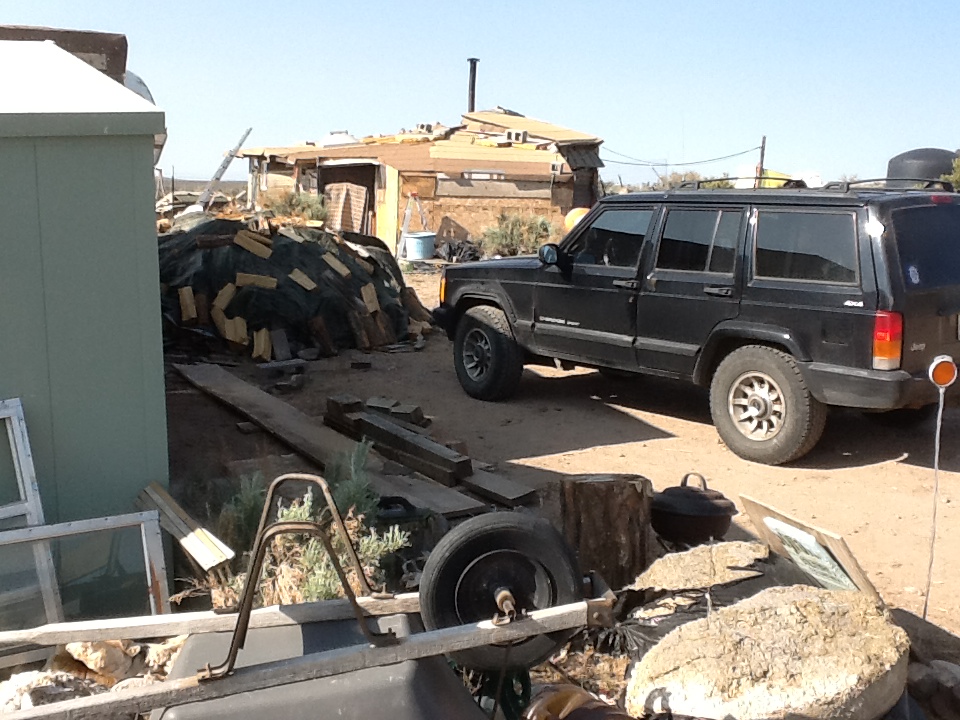 (Please note that these photos were taken after I had cleaned most of the more obvious garbage.) The immediate foreground was a stack of largish, surprisingly unrecognizable items. They were drifted up against the north wall of the metal storage shed blocking my view of much else in that direction (a mercy, I assure you). Closer inspection revealed them to be an odd assortment of things in decay. Pallets stacked with rotted black plastic leaf bags, formerly filled with what turned out to be (mostly) finely shredded paper pulp for use in his papercrete projects (more on that later) which had weathered and eroded like little mountain ranges, spreading an alluvial crust over the groundcover of empty cans and broken glass and empty engine oil bottles.
 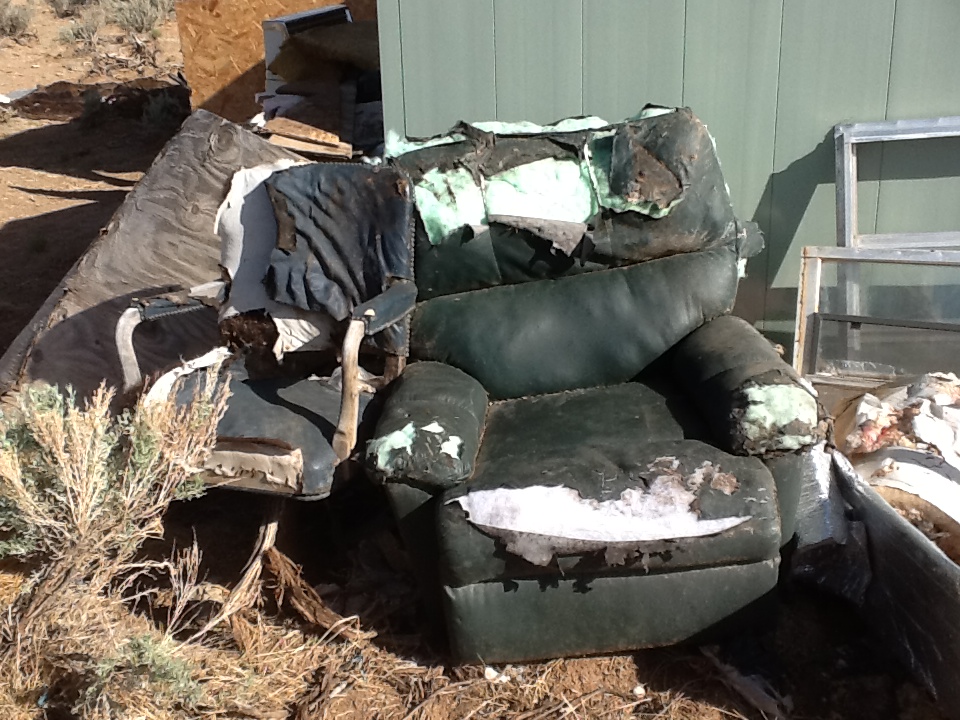 Shoved together leaning hard against the shed were two hideous, hulking shapes, unrecognizable at first, by their abusive juxtaposition and advanced state of disintegration. Rodent frayed batting dangled, brown and matted, through ragged holes in the brittle, greenish brown leather scales of what had been the comfortable green leather upholstery of the recliner chair that had been in my living room when I left here. It was intermingled in its decay with a (formerly) green leather antique barber’s chair with oak arms, now tragically broken and deformed. I couldn’t imagine that the mice were to blame for hauling them out there from the house. All about were entirely mismatched, non-indigenous things; old, rusty stove pipes, an electric clothes dryer, shoes, clothes, a frying pan, chicken wire and of course, the ubiquitous pink Styrofoam bloody meat trays, all festooned with bits of windborne detritus drifted into the snags.
It was a surreal movie. That’s it! It’s a dream sequence and in a minute I’ll wake up!
Make that a nightmare sequence.
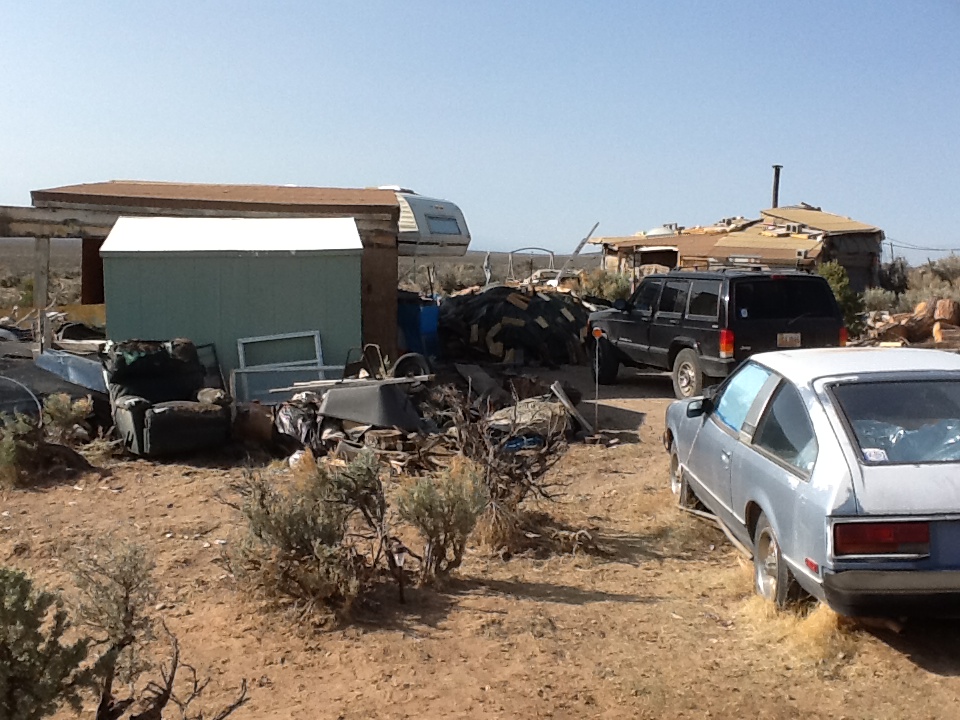
Stunned, I warily picked my way past the derelict car, mired up to the hubs in six year’s worth of erosion and packed to the ceiling with indefinable storage, heading toward the house. It was like coming upon a plane crash with debris spread everywhere and you’re afraid of what fresh horror you’ll stumble on next.
Approaching the house, I could see that the debris wasn’t confined to the ground, but somehow there was a tumble of rubble on the roof, too. Then I could make out that there was an assortment of four-inch styrofoam insulation pieces scattered all over the roof, covered in places with some kind of plastic netting and mounds of indefinable, gray lumps of what turned out to be papercrete, and weighted down with various concrete construction blocks and small boulders. 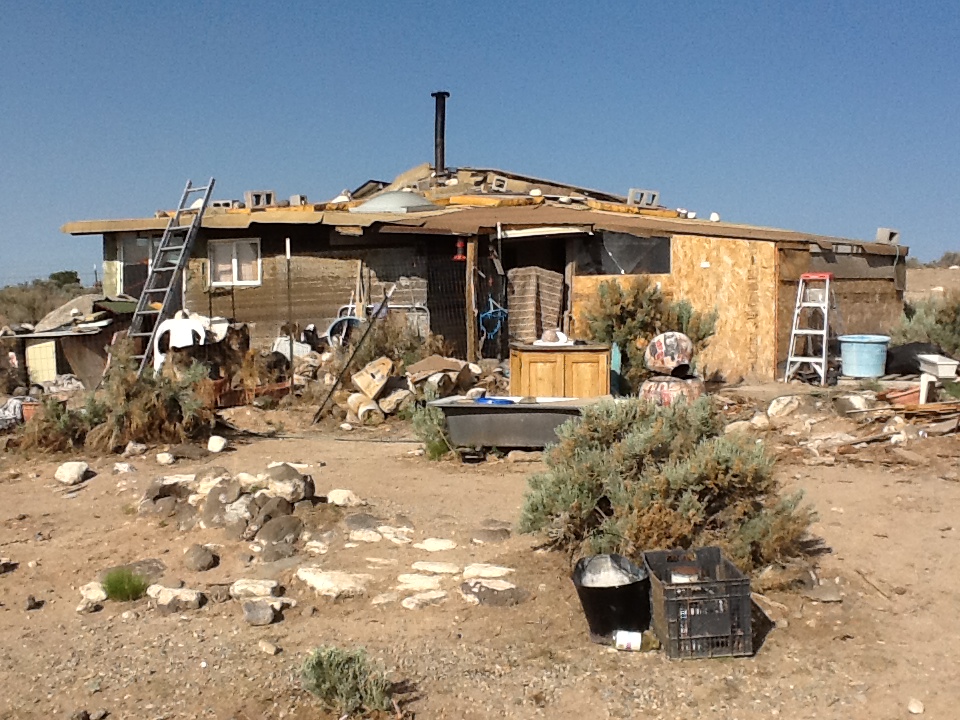
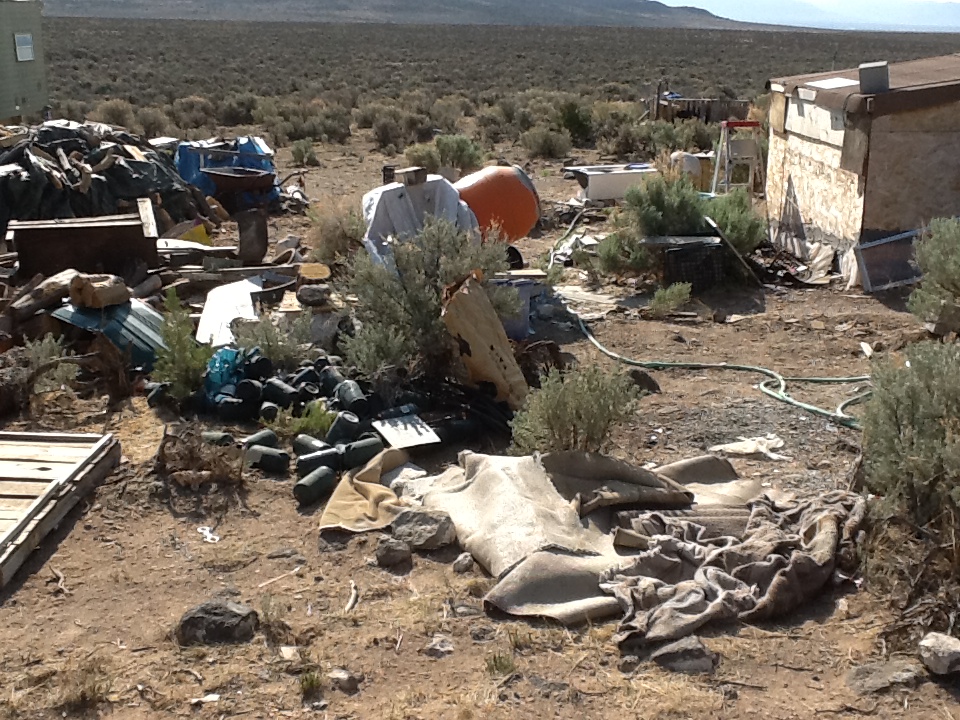 As I worked my way to the front
door, I passed the new row of mismatched structures; a metal storage shed, the back of the stable, and the truck-bed camper shell up on stilts whose windows were obscured by the boxes of storage inside. In front of the house, sitting in the middle of the circle of rocks that indicated where the yurt had stood, a space I affectionately referred to as “the sacred circle, was an old white, porcelain bathtub filled with dishes, pans and empty plastic bottles floating in a couple of inches of green water. A weathered bathroom vanity and sink sat carelessly to one side, a gravity-fed garden hose and nozzle draped over it, and loaded with mostly kitchen items. A muddy runoff gouge and the smell of mold demonstrated the lack of drainage plumbing. 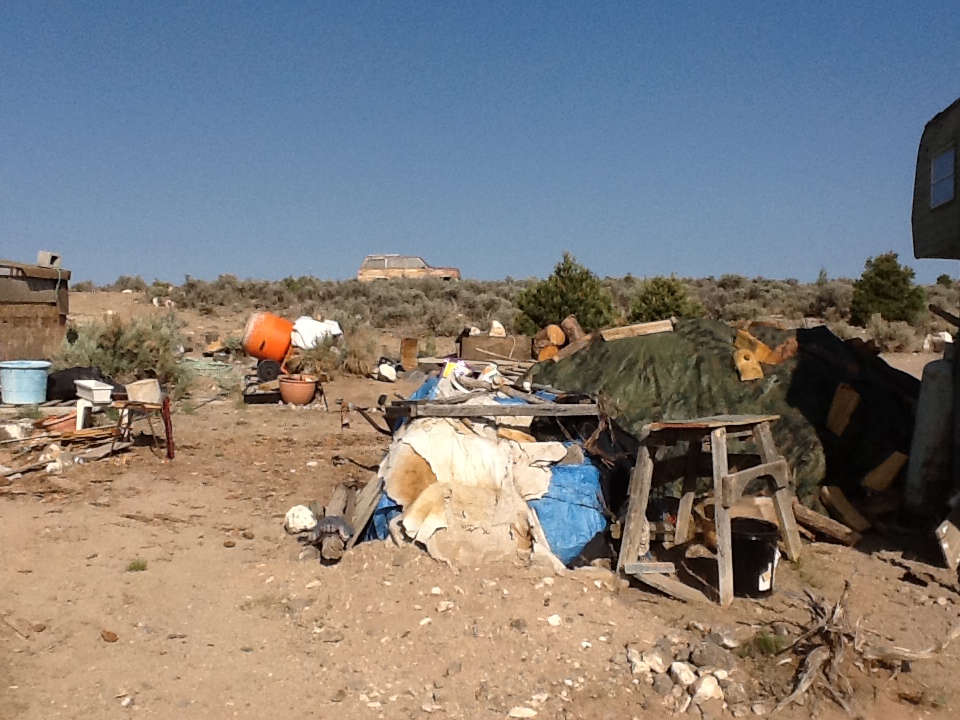
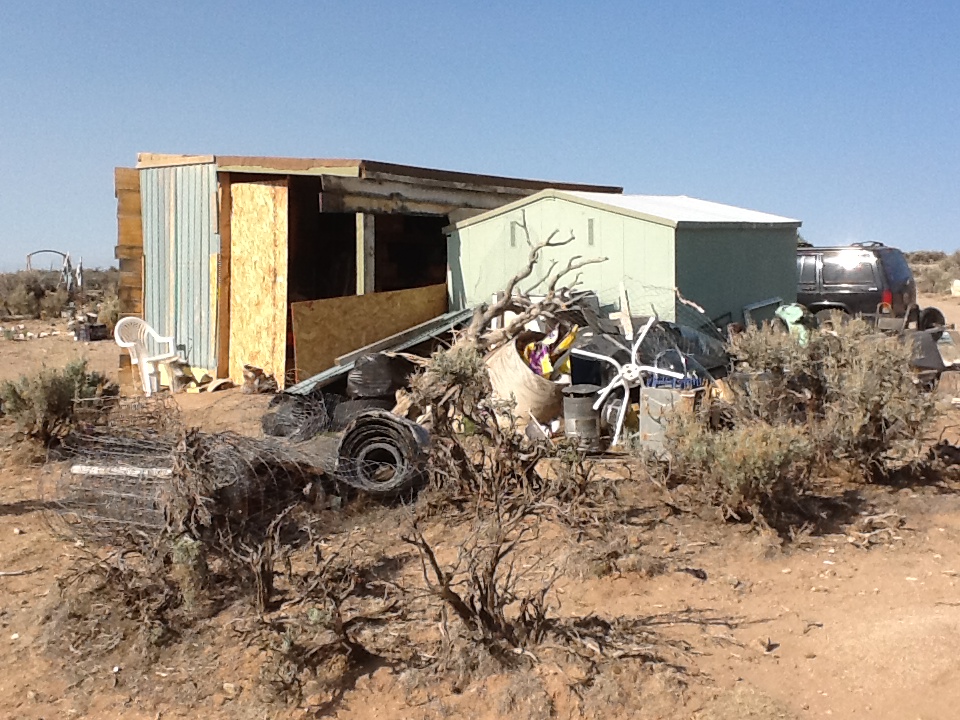
There was now a small porch overhang over the front door sheltering the new wood room alcove, donated by the survivor of the motorcycle accident and his brother, and Trip had erected a crude, fenced enclosure for the dogs that wrapped around the east side of the house. Within that area, old carpet pieces tried to cover the pounded clay dirt, barren of vegetation, and well-worn dog paths meandered through the stacks and drifts of ubiquitous junk.
Trip was apparently still sleeping and I decided to retreat to my tent for coffee to process this special welcome home.
I pitched a second tent to use as a sheltered camp kitchen, set up the propane gas stove and made myself a cup of French roast, and then sat sipping while I considered things. Seeing his obvious lack of appreciation for my place had snuffed cold any creative excitement to create a new temporary dwelling. Now was the time to restore the original structure and that couldn’t be done with him living in it.
I still hadn’t seen the interior. Maybe it would be further along than the outside suggested, I hoped. He did say that he’d gotten the solar panels hooked up and the rusty single-wall stovepipe poking out of the roof attested to a wood stove.
Hours passed and still no movement from the house, so I busied myself collecting some of the more obvious trash and piling it alongside a waist-high haphazard stack of construction rubble that served as a crude break from the persistent southwest wind. The more I gathered, the more I found to be upset about. Here were the rugs that had adorned my late mother’s house, the sale of which had financed this folly, strewn about the ground outdoors as pudding-mud abatement, so imbedded with clay as to be akin to adobe tile. There was the brand-new electric concrete mixer which I hadn’t even used yet, sitting exposed, dented and chipped, full of soggy paper pulp rusting the bottom away. And there, next to a little yellow plywood shed that someone built for him that housed his new generator, was my generator which I had left inside, now sitting out in the elements, its plastic tarp having long since rotted away.
Working my way around the building, I found that he had taken the salvaged plaster ceramics molds I had stacked into a tidy cube and covered with a tarp to preserve for some imaginative future construction purpose, and had cobbled together a windbreak wall that looked like a plaster boneyard termite mound. Speaking of bones, everywhere I went, scattered in a wide perimeter around the house, were bleached beef bones, cleanly sawn, dinner leavings presumably tossed out as offerings for the coyotes or perhaps simply distributed by his own dogs, but the more I found and noting their perimeter placement, I had to actively resist notions of bizarre ritual magic to block intrusive bad joojoo or something.
Instead of setting up the Zomeworks tracking rack, designed to follow the sun and keep the solar panels up off the ground, the four panels were mounted to the frame and set on the ground leaning against the southwest corner of the house. Two more, newer panels had been screwed into the ½ inch plywood roof of the “hidden” room. By the time I made it around the house, noting changes and collecting trash, another hour had passed and another cup of coffee called me back to the kitchen tent, now hot from the climbing summer sun. 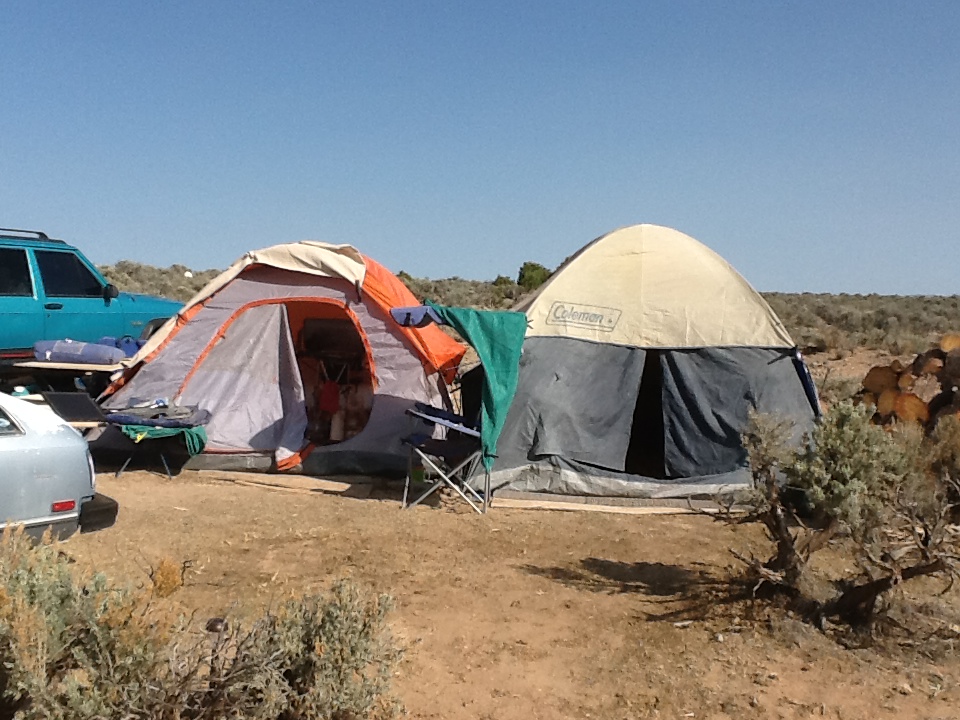
After opening all of the flaps, zipping shut the screens on both tents, I settled into the shade of the kitchen and sipped and sifted through my emotions.
I understood that Trip had sustained brain damage, but this was something else, it seemed. Disordered thinking, certainly, but also a clear disregard for me and my things. But I still hadn’t had a chance to talk to him or ask about any of this and was struggling to reserve judgement. Meanwhile it was apparent that my summer would now be spent trying to mitigate the mess and I was still seriously considering spending the last of my savings on an old, used Winnebago, just so I’d be assured of a place to live. As much as I resist such an arrangement, it still beats a tent. Since February when I let him know that I was coming, I had assured him that I had no intention of sending him away when I returned, trying to be fair and thinking that, with a supplemental dwelling, having another resident on premises might be more secure and would free me to leave for work periodically.
Now, seeing how he’d handled things, I wasn’t so sure.
My gloomy musings were abruptly interrupted by a shouted command to the dogs to go run and the squeaking of the gate, followed by the thudding of a dozen paws past my tent. I poked my head out to see Trip shuffling out of the gate, scratching and squinting and grumbling like a bear just out of hibernation.
“Good morning.” I shouted.
Just then, Max, the Jack Russell Terrier bounded up, thrusting his wet nose into my face, snuffling and licking excitedly.
“Good Morning.” he responded as he made his way out to the tent.
Not sure how to begin with my concerns, we made small talk while I pretended not to be upset, looking around as though everything was normal. As we talked, we walked around and I asked him questions about various piles we passed. He had plausible explanations for the disarray and blamed everything on externals; the ravens, the coyotes, the dogs, the mice, even the few people who had bothered to help him to move there and to survive. Everybody else had let him down.
A sad frame of mind, to be sure, and one I increasingly shared.
The day was spent trying to bring order to the area, starting with that which was in direct view of my tent door. I was still determined to be patient and kind, understanding how much my presence threatened him and sought to accommodate him while still regaining my home. The clean up process served both to give me a positive improvement activity and to assert my presence, like an animal marking its territory, only with order rather than scent. A more civilized approach to claim staking.
I spent the day mostly just collecting trash. At the end of it, though, it was hard to tell that I’d done anything. Trip had hidden out in the house most of the day and he still hadn’t invited me in. Still trying to be considerate, I decided to offer sharing a movie and went to the door. The dogs were still in the yard and while I greeted them, I called out to Trip. He opened the door slightly and squeezed out.
“Hey. I have a couple of DVDs. Wanna watch a movie? I can bring my laptop in.”
He hesitated, pulling the door shut behind him.
“No. I don’t like to let people into my house.” he said, stalling.
WHAT?
“Your house?!” I exclaimed, on the edge of losing it.
He realized how he’d said it and to whom and backpedaled a bit.
“No. You know what I mean. My space.” he stammered.
“No. I don’t know what you mean. You’ve known for months now that I was coming back and need to finish this place. And now I can’t even come in to my own place?!” I was starting to lose it.
“Now, you’ve got me living in a tent, and I can’t even come in to my own house?!”
He wasn’t sure what to say, so I continued.
“Trip. I need to finish this place. I’m not asking you to leave. I just need to come in and see what needs to be done.” and without waiting for permission, I pressed forward past him and through the door.
Gulp.
Now it was clearer why he didn’t want me inside.
There was one raw bulb throwing harsh shadows over the scene, mercifully obscuring some of the uglier details, but the smell hit you first; a full-bodied range of dog, dirty feet, mouse urine, wood smoke, and an indeterminate decaying organic matter unsuccessfully masked with an overpowering essential oil blend called “purification”.
“Putrification” would be closer.
A narrow path, an inch deep in dust, wood ash, and dog hair wandered through a labyrinth of boxes and other stacked items rising to meet the things hanging down from the ceiling, including the ceiling itself in places. Fiberglass insulation had been installed in the rafters and covered with large sheets of (formerly) clear plastic, which sagged badly, creating a sense of a cramped cave. One section had slumped so badly that he had placed a small board against it and braced it up with a 2X4.
“What’s that?” I asked.
“Oh, I don’t know. I guess the roof was leaking, so I had to prop it up.”
So many responses fought their way to my mouth, but all I could muster was, “Oh.”
Rather than endure describing the excruciating details, I will post some pictures at this point. Some horrors are indescribable. I took the opportunity to take these one day when Trip went to town, a week later, after I had cleaned up the more obvious trash. He had changed the locks on the house and not given me a key so when he went to town that day, I insisted that he let me stay and continue to clean. (It was a couple of weeks before I got that key.)
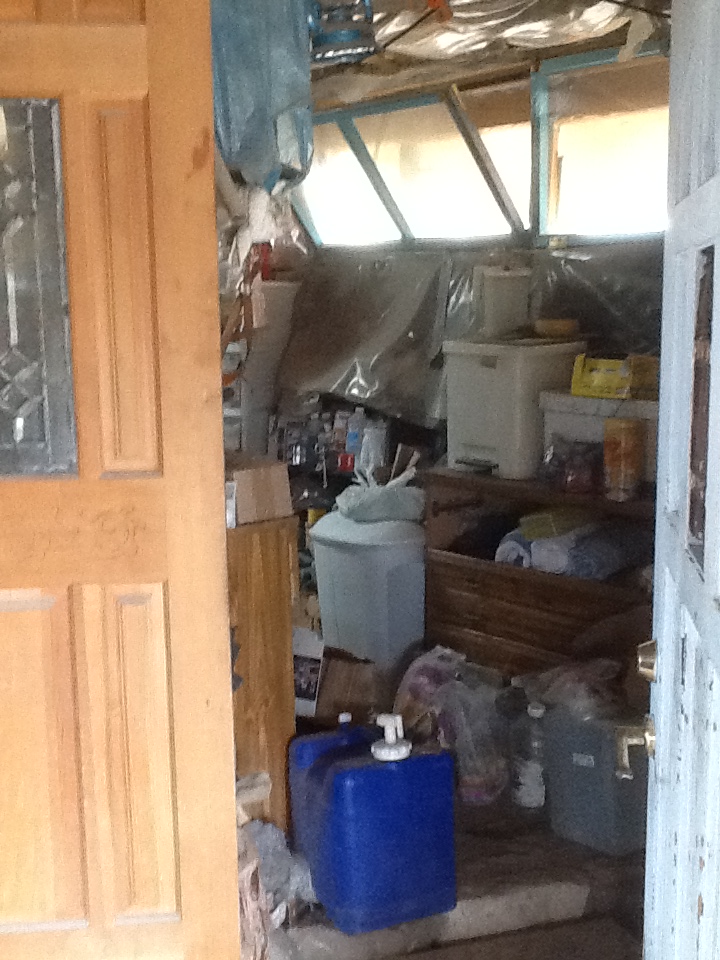
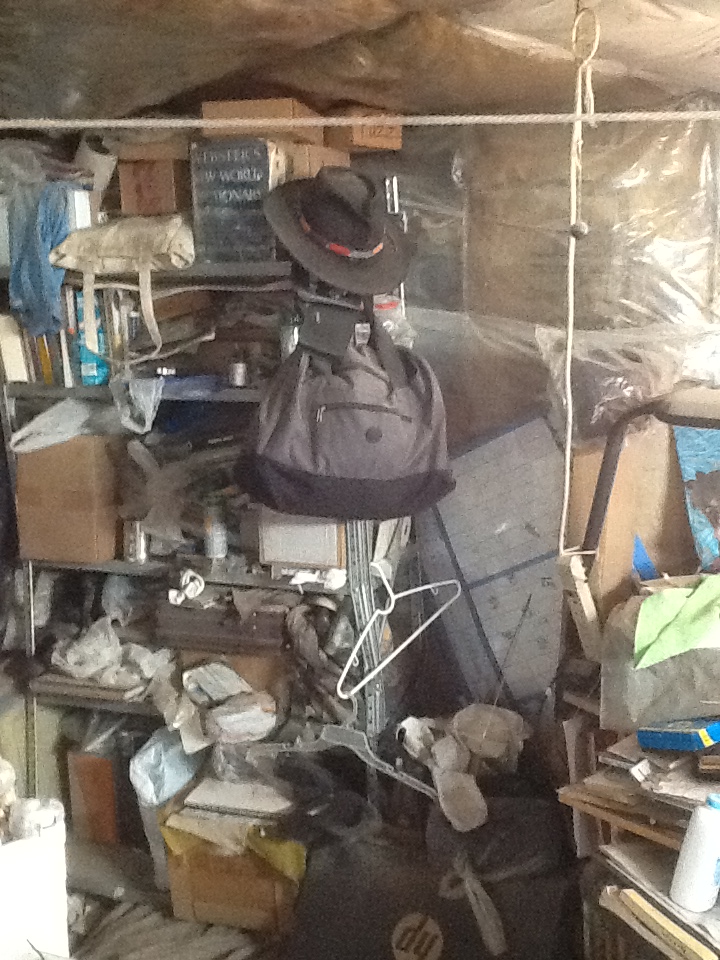
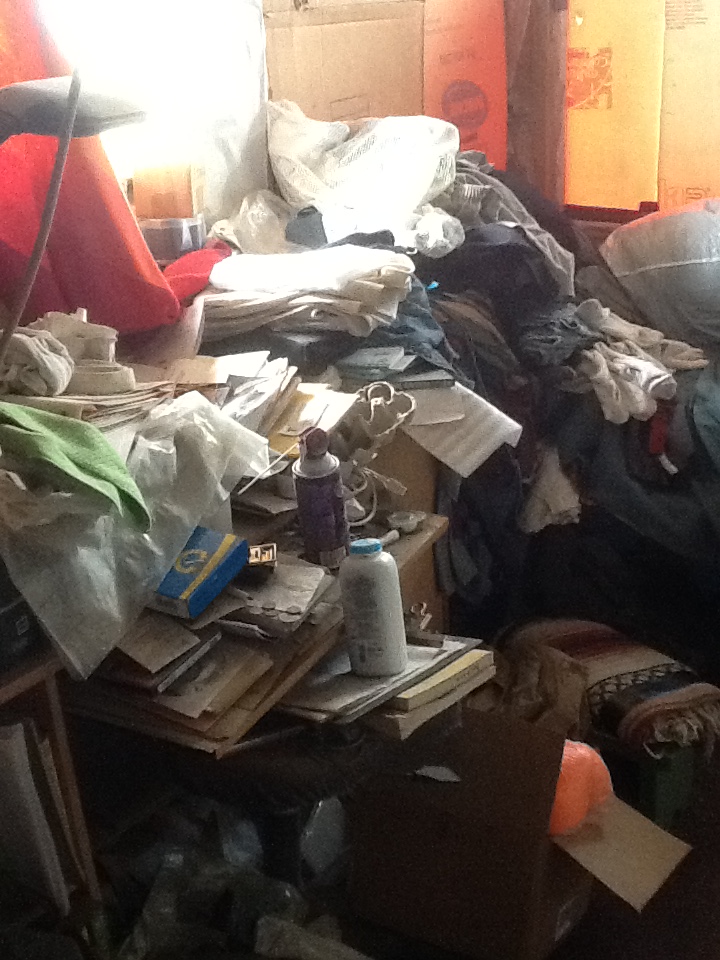
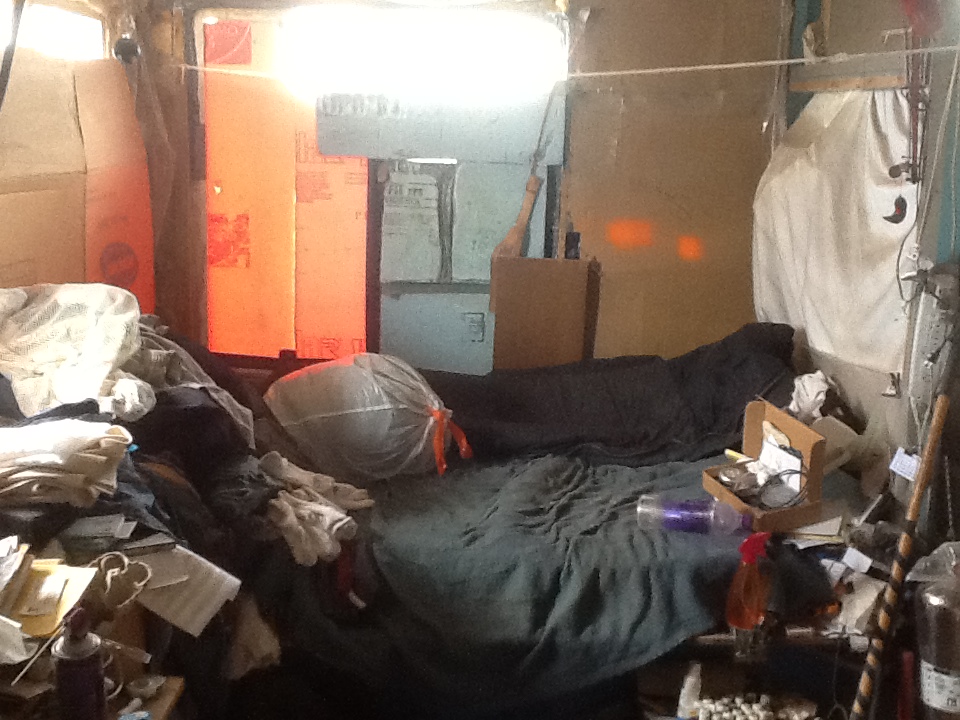
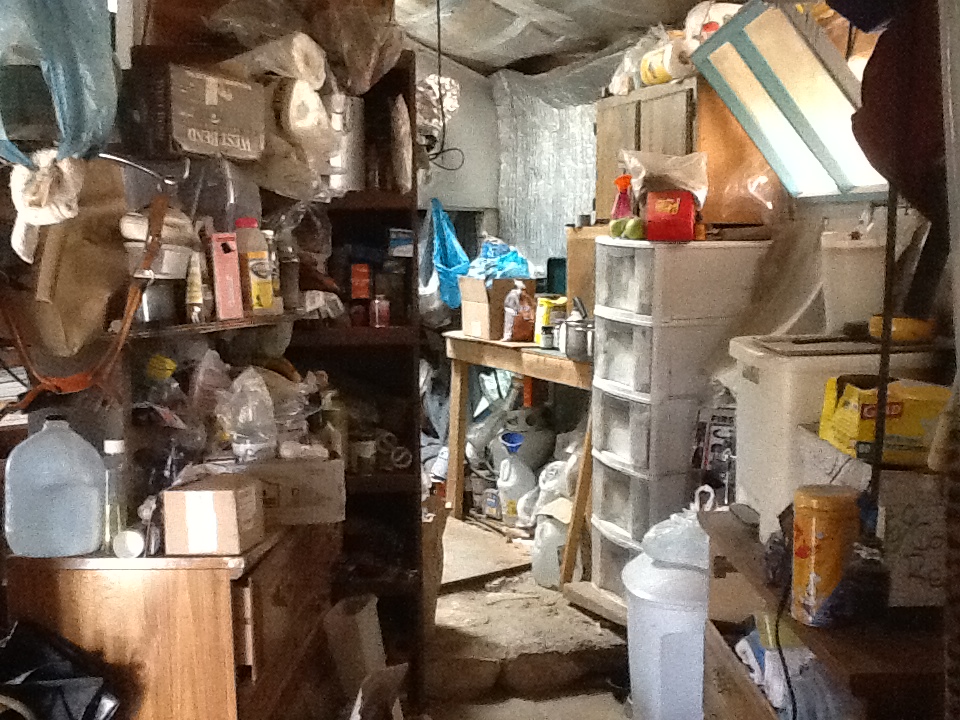
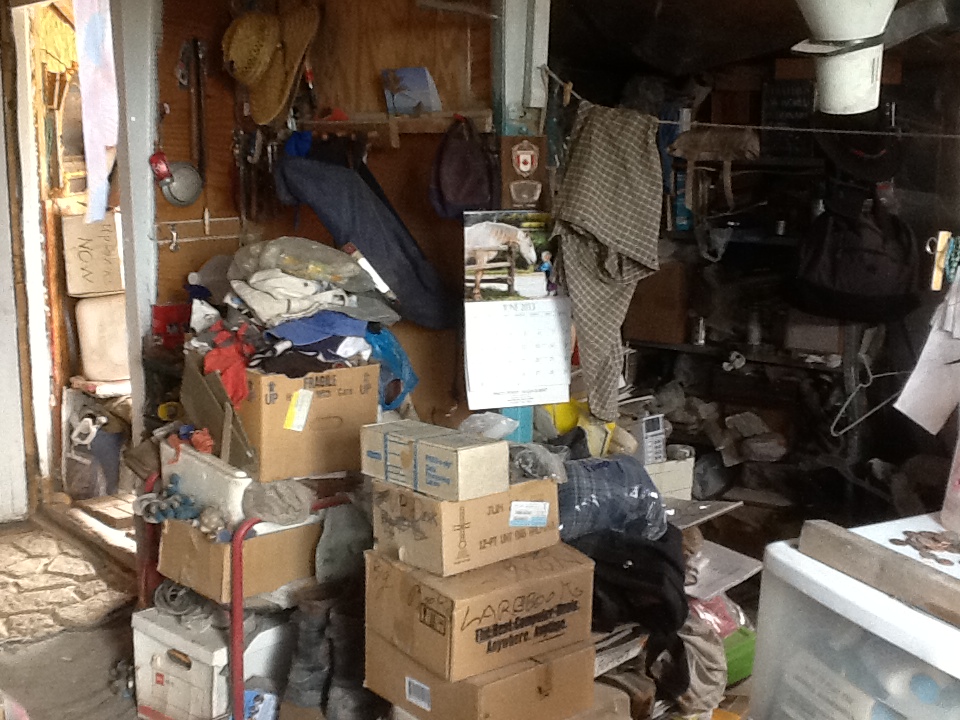
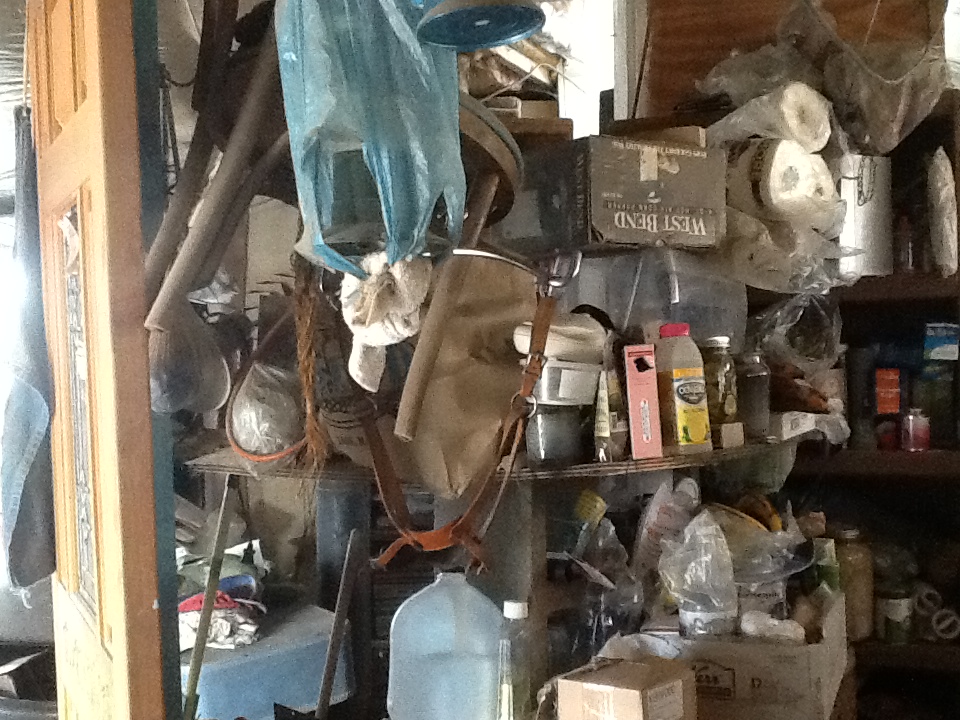
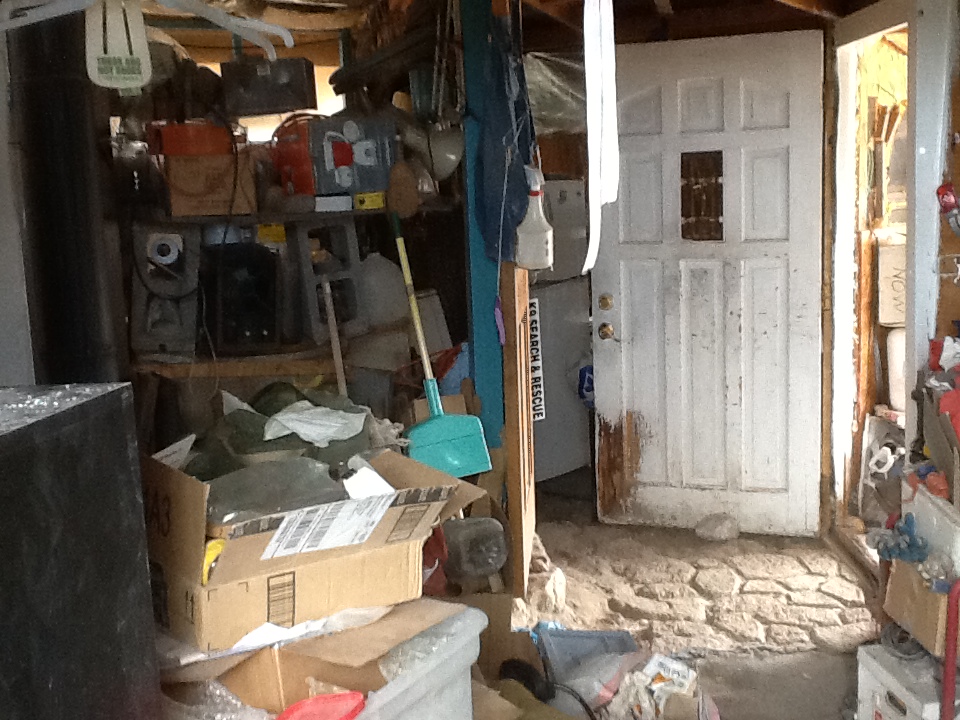
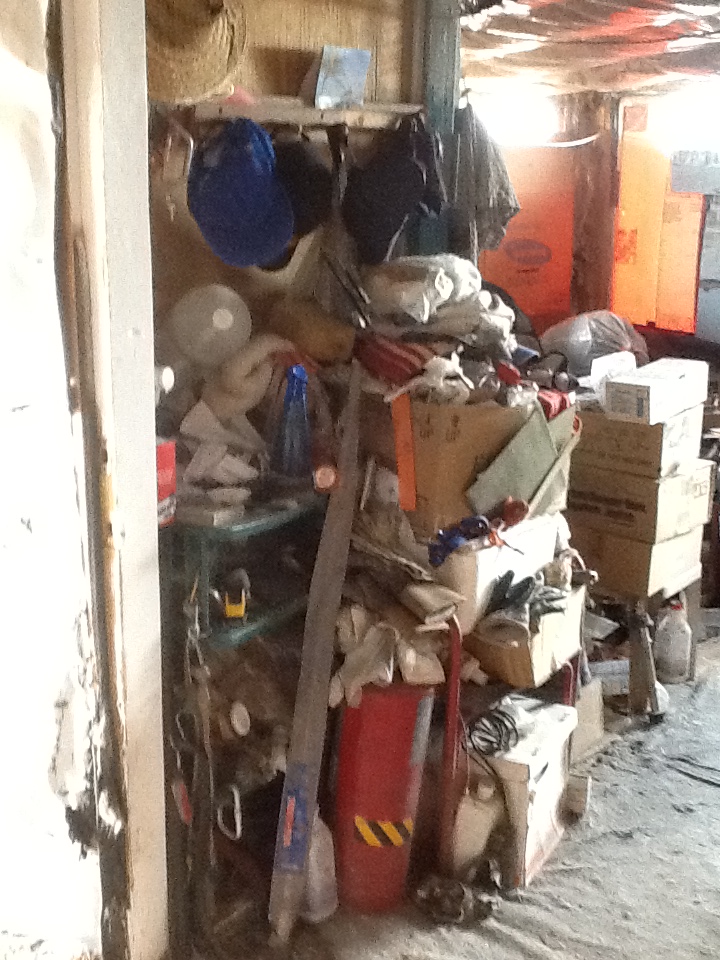
My attitude worsened as I found new things to be angry about. Every morning I would get up resolved to apologize for going off on him but by the time he’d get up and come out, I would have found additional travesties and would already be angry again.
This went on for about a week or ten days as I increasingly asserted my presence, clearing a swath through to the office area and worked my way up to the kitchen, incrementally pushing him back to the east room where he slept. The back half of my office area was largely as I had left it, now overstacked with his boxes and whatnot and then packed in with a functioning refrigerator. At first I was surprised that he had enough power to run it, and then annoyed that he’d been letting me drive to town every couple of days for ice when he could have been making some for me.
I foolishly opened it.
Well, that accounts for some of the smell in here.
Something grayish in a smeary plastic bag tumbled out, plopping loudly. Vile, rotting things in bags and containers were stuffed into every space, kindly obscuring the light from the bulb. The freezer was equally impenetrable with, …God knows what.
And so it went for a couple of weeks; me cleaning and clearing and still living in a tent and he retreating into his fallback room, feeling increasingly threatened at my increasingly imposing presence.
Then one day came the straw.
Sitting out in an open space between the camper shell and the bathtub was a chest-high mound of something on a pallet that had been once covered with a tarp that had now decayed, settling like shrinkwrap onto the irregular mass beneath, unrecognizable bits poking through in places.
“What’s under there?” I asked as he passed by.
He stopped and looked at it blankly and then at me, and then, hesitating, stammered, “Gee, I don’t know. I can’t remember.” and then walked on.
Pulling up a corner, I couldn’t tell what I was looking at, at first. Then the horror of it hit me hard. They were my things! Everything that had been in the house when I left. Lamps, rugs, a butcher block table and chairs, pictures from the walls, business records, pillows… mostly all ruined from the elements. The tipping moment was when I found a framed collage of photos and best wishes from my Michigan family, sent to me for my first Taos Christmas, now waterstained, warped and faded.
“We love you and miss you, Uncle Dave!” it used to say.
…3…2…1…BOOM!
“THAT’S IT!”
I now understand the expression “spitting mad”.
Never in my life have I been so outraged and angry in someone’s face. The spitting is unavoidable at that range and intensity.
“Why are all my things sitting out here?! It’s all RUINED!”
“Oh, is that what’s under there?”
“What do you mean? How else did it get there?!”
He hesitated, either trying to remember or think up a plausible excuse.
“Well, the people that helped me move must have put it there.” he offered.
“What do you mean? What people?”
“I don’t know, the church people who volunteered.”
“Didn’t you know them? Weren’t you here, too?”
“Well, no, I stayed home to pack.”
“But you’d been out there already to see the place, right? You knew it was furnished with my stuff. What did you think they did with everything?”
“I don’t know.” Now he felt cornered and was getting defensive.
“Let me get this straight. You sent total strangers, from a church you can’t even remember the name of, out to move all of my belongings outside to make room for all of your shit?!”
No response.
“HOW COULD YOU DO THIS TO ME?” I sputtered in his face!
And that became my mantra for the rest of the day as I picked through the rubble.
After I had finished the salvage mission and had calmed somewhat, I confronted him with my decision.
“You have to get all of your shit out of my house. Now. I have to restore it to something livable and I can’t do it while you are in there.”
“I know you are broke and have nowhere to go. You don’t have to leave yet. I have an extra tent you can set up in the stable if you want, like you offered to me, but I need the house back. I’ll still be in a tent, too, while I’m working on the inside. I’m sorry, but you’ve shown me you don’t appreciate my generosity or my place.”
Since it wasn’t open for discussion, I turned and walked back to my tent.
You can imagine the tension from that point on. I avoided confrontation from then on, continuing my cleaning, and he spent his time either inside packing or in town presumably making arrangements. I had pushed him into a corner, I knew, and he was responding in a life or death manner.
I remember one particular night being actually afraid for my safety. (though, to be fair, he had never really threatened me) Luckily I had a phone signal and I called Cynthia, a clinical psychologist friend of mine in San Francisco to share my predicament and get some suggestions about how best to handle him. I knew he had a gun in there and didn’t need any extra drama. Ripstop nylon is pretty useless against bullets and I was feeling vulnerable. It was scarier than the time the cougar yowled and pounded past my tent while I was camping in Arizona. She was reassuring and encouraged me to patiently and consistently stand my ground, that it was my house.
Or call the police. (I didn’t think that would end well for anybody.)
As isolated and remote as it is, I was strangely relieved to know that if something did happen to me, at least the story had been told. Somebody knew.
One day he came rolling in with U-Haul truck followed by a car with a couple of guys from an organization in Albuquerque offering services to head trauma victims. Judging by their attitudes, I can only imagine how Trip told the story.
They took the refrigerator, which I offered to buy from him.
They then took the wood stove, which I needed and offered to buy from him. He declined, preferring to put it in storage. Spiteful bastard. (While hunting for a replacement stove I saw an ad in the local Penny Saver running for two months for a stove matching the description for only $50 bucks. They never called back. Hmm.)
Then when they went to take the two new solar panels, I stood up to them.
“Don’t you dare disable my solar system!” I growled.
“Those are my panels and I need to sell them for the money.”
“How much do you want for them?”
He thought for a moment, weighing things.
“I paid $1500. I think.”
“You think? That’s more than I paid for my four panels and the rack, too. Do you have any paperwork?”
“Don’t know where.”
“OK. Whatever. Take ‘em. Just don’t disable my system.” I grumbled and stalked away.
Once loaded, they took it all to a storage unit in town, returning at dusk with the truck, too late to return it. Since the guys from Albuquerque had to go back, I offered to go with him to return it if we could take a load of trash to the dump on the way. It was a very full load we took, me driving the truck while Trip followed in his Jeep.
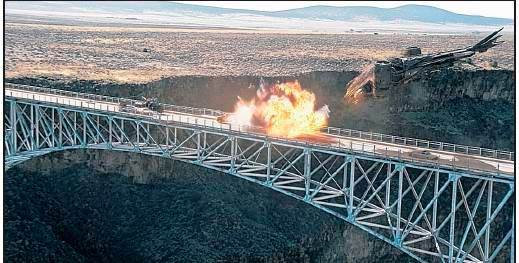 Naturally, since we were already late getting the truck back, that was the day the film crew chose for the big burning-vehicle-on-the-gorge-bridge sequence and we were delayed for almost an hour, the dump almost within sight. That delay and the ride home gave us an opportunity to talk and smooth things a bit. He had found some other dupe, I mean, kind-hearted person to let him have free use of their cabin so he had a place to go. (I resisted a fleeting notion of warning the poor trusting fool.)
Good. I don’t wish him ill, just away.
He timed his returns for things when I was away, mostly. He took all of the wood and his generator and anything of value or improvement, but left all of the junk, the shed, the bathtub, the camper and the two derelict cars. I got back on July 16 from a weekend trip relieved to find him finally, though not fully, gone and I haven’t seen or heard from him since.
Whew.
It took the rest of the summer to ameliorate the mess.
Unfortunately that means that the place is still unfinished, though much more like a real dwelling, now. Minor details such as lots of snow and temperatures well below zero, a frozen water tank, the abused and weak battery array, and the frozen outhouse in the gully have persuaded me to seek winter quarters…AGAIN. (Notice how often I use that word?)
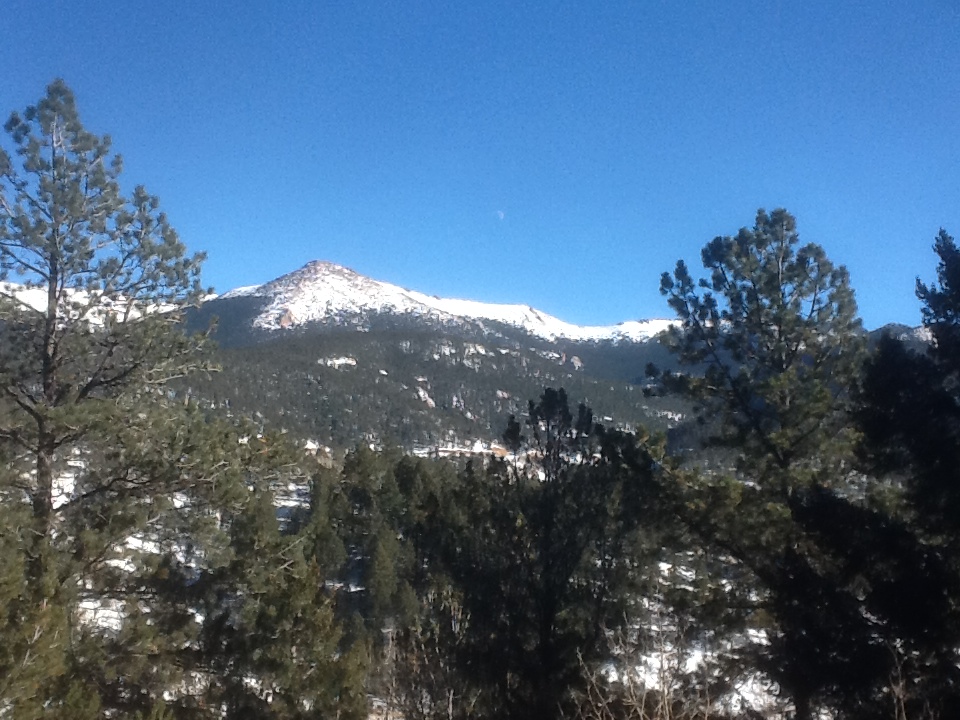 This time, for now anyway, I am wintering in a friend’s cabin at 9500 feet el. behind Pike’s Peak.
How crazy is that? (Another long story.) But it has indoor plumbing!
Once Trip was really gone, the summer became more productive and I was back to the challenge of adapting to off-grid living. This warrants a separate telling, soon to follow.
Thank you, reader for sharing my long, episodic journey to my home on the range.
And a very special thank you to all of you who have patiently stood by me during this trek, enduring my lamentation and offering up your floors, couches and hearts to this weary circumstantial nomad. Namaste.
Next: Ken flies in from Canada to help me install a wood stove, I have yard jackrabbits, two UFO sightings, and Steve Fugate, the Love Life Walk guy (Google him! Talk about stories!) walks 33,000 miles to spend the night on my floor.
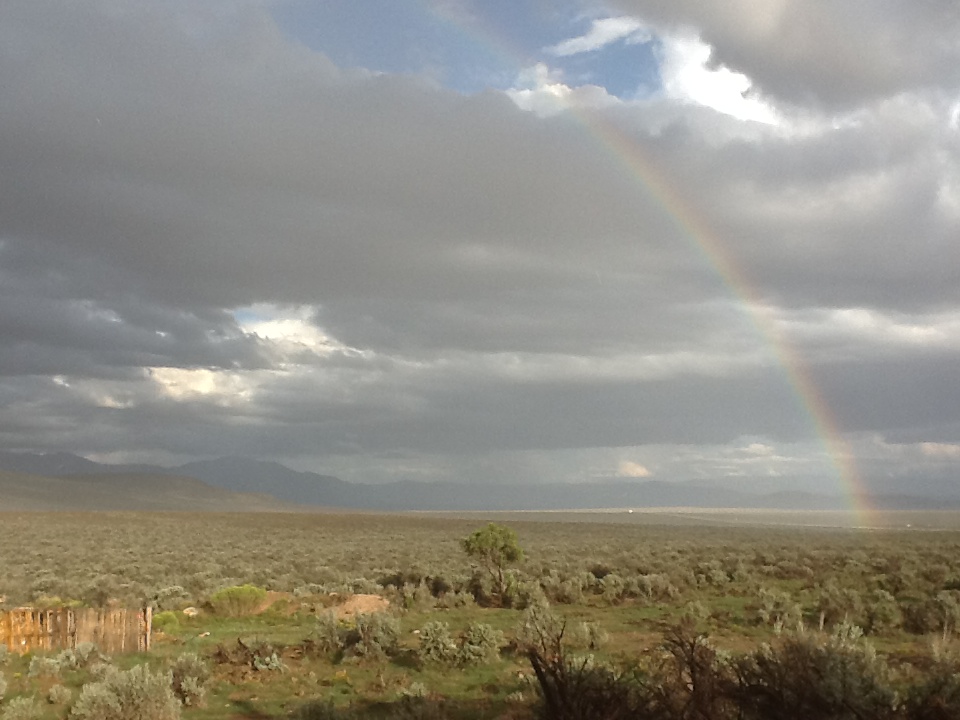
AND MORE!
Stay Tuned!
__________________________________________________________
After the Dust Settled…
(and then got swept up, and then settled again…)
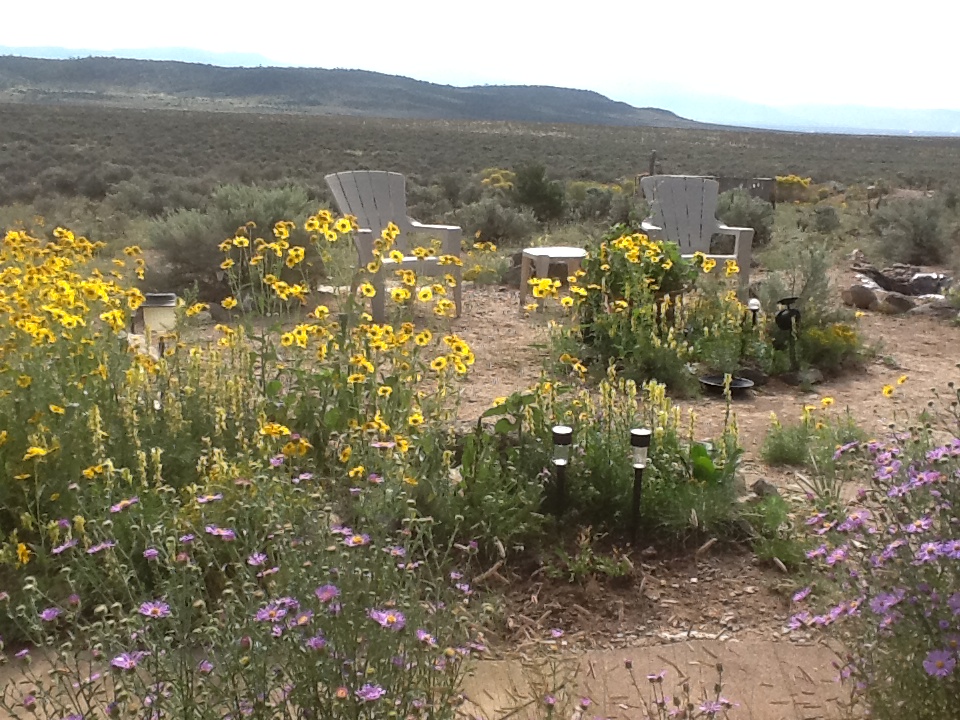 Taos is really quite lovely in July, contrary to many people’s expectations of New Mexico summers. Being high country, it always cools off at night and monsoonal flows coming up from the Gulf of California
 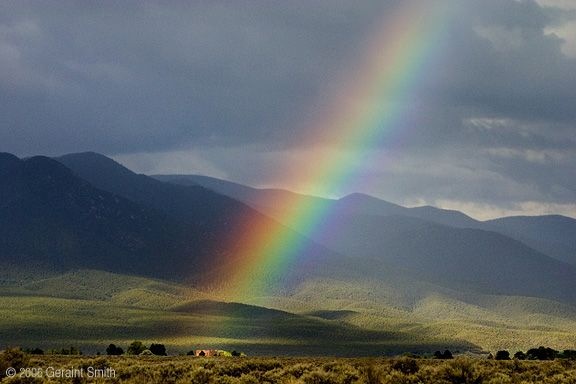 bring afternoon thundershowers which interrupt the hot, blowing dust of early summer, cooling and reviving the parched land, prompting long dormant seeds to burst into flower. Rainbows abound, piercing through spectacular cloudscapes while morphing shadows dance on the greening expanse.
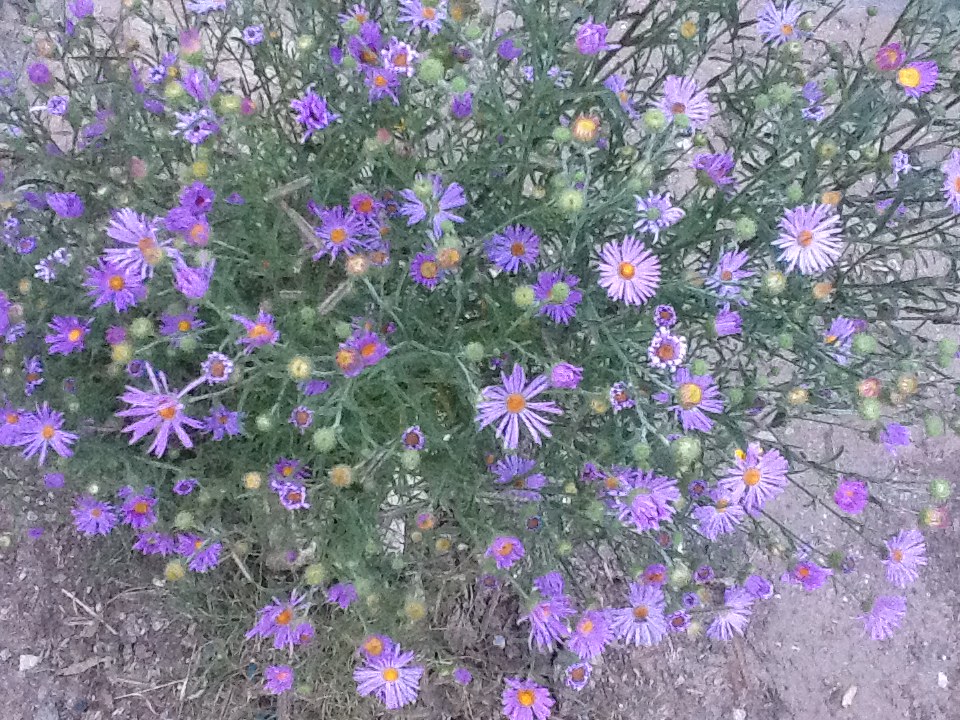
While the wildflowers and sage thrive on the daily downpours, the tent dwellers are, well,…inconvenienced.
It’s beautiful to see when the shimmering column of water advances across the distant mesa, casting spectral projections in the billowing mist.
It’s quite a different thing when it is advancing toward you, gale force winds pushing an ominous black wall across the sun and snatching anything not tied down.
Sometimes you’d get a little warning, sometimes not.
When it hits, however, you’d better be ready.
An interesting battle ensues between the air and water forces. The wind tries to lift up and rip off the rain fly while the rain buckets down with the force of a small waterfall, pushing the fly against the screened portions of the tent roof, inviting the deluge in. Of course the sudden runoff tends to flood in under the floor, all the way around, regardless of how well you may have boy scout trenched it.
Myriad rivulets of mud-rich water coalesce into deep streams cutting their way through the clay, seeking their traditional courses in their quest for the Rio Grande Gorge.
Your formerly safe, dry womb convulses and constricts, threatening expulsion into the cold, harsh outside world. The clinking of metal rings against tent stakes and the brutal flapping and hard, sawing rustle of ripstop nylon yanking against fiberglass poles is cloaked by the thunderous water and wind.
As is often the case in life, the harder it hits, the quicker it passes.
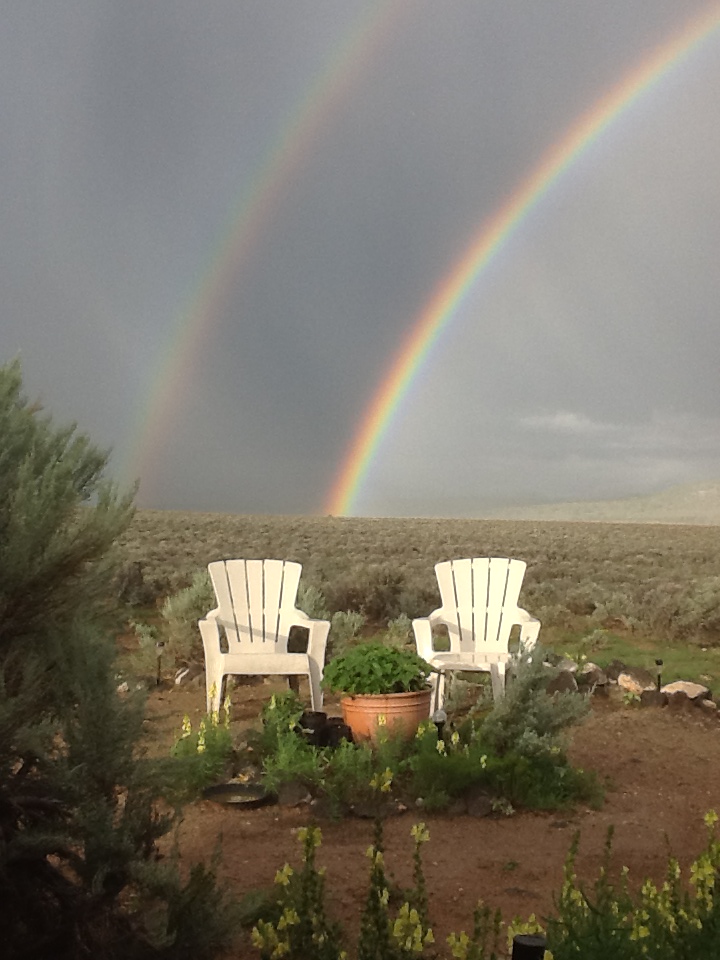 While the wind and rain may continue for awhile, though steadily lessening, the sun may suddenly burst forth. That’s the time to birth out of the sagging tent and look for the rainbow!
Thus saith the Taos TechNomad.
…who is then immediately humbled when he steps into ankle deep pudding mud in his quest for the transcendent moment.
Oh, well.
The rainbow is still pretty. And everything is fresh and dripping with promise.
Back into the House
July Sixteenth marked the end of two Trips for me. Upon returning from a several day sojourn, it seemed apparent that he was no longer staying there, though his presence lingered like the pall of a ghost town, littered with windblown debris and blanketed with an inch of dust.
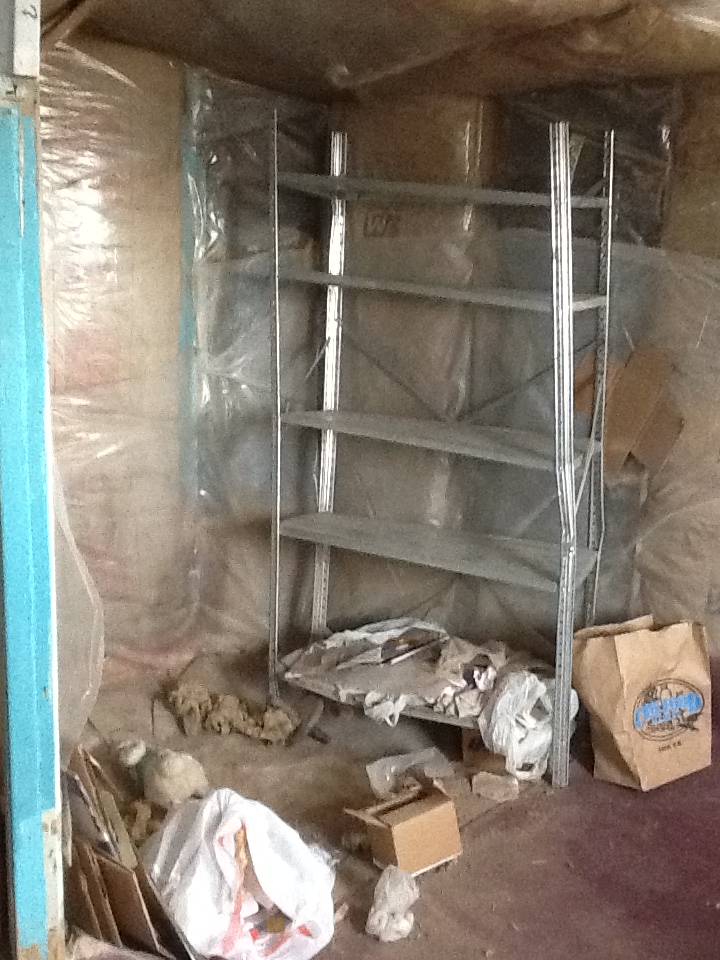 His sleeping area was mostly empty with the exception of a crippled metal shelving unit that had been wired to a nail driven into the wall stud to prevent it from splaying like Bambi on ice. At the other end of the room was the truss frame that once inadequately supported an integrated air mattress (which I found outside in tatters) that he had covered with a plywood board to support his mattress (which he naturally had taken with him, leaving me with…a truss.)
Above it was my large view window, one of three matching ones that I had picked up at the Habitat for Humanity Re-Store. Four feet square, this one had the best view in the house, looking east across the sagebrush mesa, past the Rio Grande Gorge to Wheeler Peak, the highest point in New Mexico, and Taos sacred mountain.
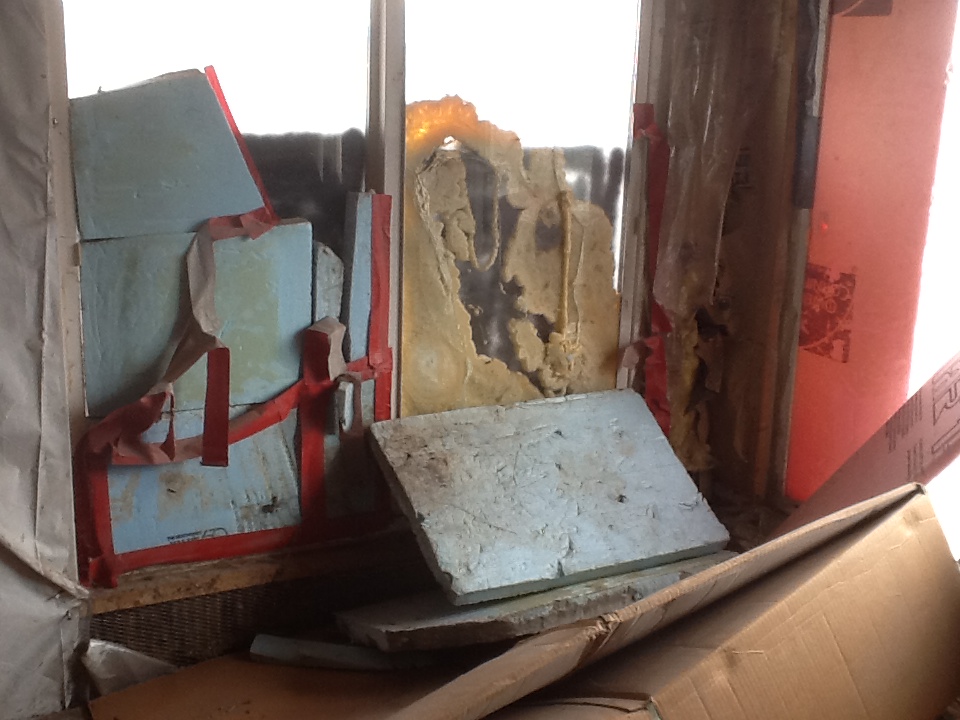
Except now you could only see out through the grimy top portion. The double paned glass had been broken on the inside and Trip had thought that the spray insulation foam in a can would solve it. (When I asked him about it, his suggested that the cows must have broken the pane. Right. On the inside.)
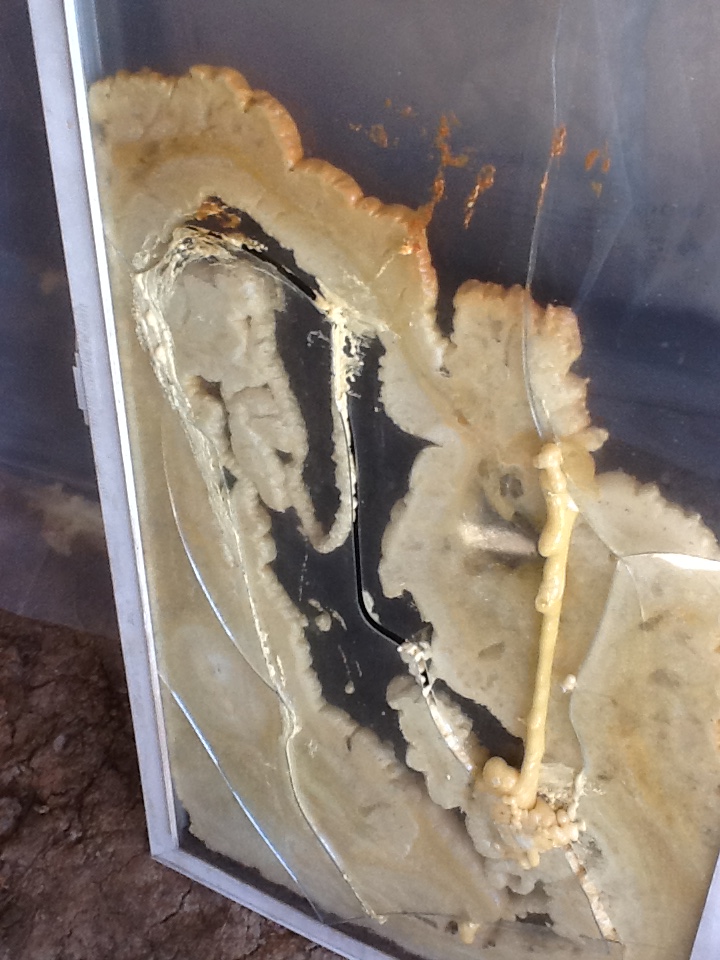
Unfortunately, what happened is as the foam expanded, it pushed all the broken pieces outward making the situation worse. So then, when that wasn’t enough, he took a can of flat black spray paint and blacked out the lower 2/3 of the window on the outside, poorly reasoning that it would absorb heat into the house,…on the outside of the insulation.
Then, when that wasn’t enough, he took mismatched pieces of 2 inch insulation foam and duct taped them over the windows. The heat from the direct sun had dangerously melted them into grotesque shapes where exposed.
Pretty.
I managed to swap out the window section with a viewless one that faced the juniper tree on the south side, and scraped off the black paint, restoring my view.
With the flurry of moving activity, the deep dust had redistributed to fill the formerly filled spaces and, without the perpetual paw perturbation, (too alliterative?) relaxed into a nice even covering over everything, even the more vertical surfaces, composed, as it was, of a complex mélange of dander, (animal and human) essential oils, mouse feces and wood ash all in a fine clay binder and electro-statically charged from the incessant dry wind. Sweet.
If you closed your eyes, though, it smelled like he was still there. Too bad I didn’t miss him. (though, I have to admit, despite the conflict, I did miss the company of him and the dogs and cat. I think I mentioned that it’s remote.)
Sweeping the floors when they are made of dirt is a tricky process. You just want to scree off the offending top layer without disturbing the packed under-layer. (A Shop-Vac would only create a basement level.) There was plastic spread over most of the exposed ground with a few rugs where the walkways had been, dust and detritus pounded into them, rendering them fused to the plastic.
These I dragged outside and swept and pounded with a broom until which of Mom’s rugs they were became evident, and then draped them over the frame of the sheltered swing I had brought from her back yard (The sheltered seat having been left out to rot in the sun and pieces of the assembly having been repurposed in his fence construction.) I found that if I hung the rugs out in the sun and monsoons, they auto-washed and UV disinfected. (Though the smell was the last to clear) They were outside a very long time.
I made my office space my indoor base, since it was already on the way to restoration, and set up my iPad and speakers for some ambient re-attunement. I didn’t trust bringing my computer out of its case in the Jeep. As it was, I kept the iPad zipped into a bag when I played music, the clouds of icky dust were so pervasive.
Probably needless to say, the disturbed dust, et al. had rather severely impaired my breathing and sleeping inside was not yet an option. That became my next priority; clearing the dust and aroma so I could escape the driving monsoons. I was finally free to move back in and didn’t want to. Criminy!
The Jeep became my “safe house” and I kept my more important things and food in there as my “lock box” figuring it was the most secure (and clean) space I had.
The kitchen area was the next most obvious thing to tackle. The west wall was the highest point of the house and proper drainage hadn’t been accomplished yet. Consequently the regular flooding under the flimsy ½ inch plywood walls had fostered a thriving colony of mold under the badly warped and stained piece of particle board he’d used as a floor. His solution to the problem involved stuffing flimsy plastic grocery bags into the crevices. Perhaps sufficient to block the wind, but not the water.
Moving it out would have freed the spores from confinement, probably killing me. So I covered the whole mess with more plastic and threw down some of the less offensive rugs to hold it all down. There was too much to do to risk contaminating the whole place. Yet, anyway.
There were other more immediate issues to address.
Like that sag in the center of the ceiling over the bed.
The futon bed fits exactly beneath the sagging spot that Trip had braced up. I re-stapled the plastic, tightening it up a bit, determining to deal with whatever moldy mess it might be on another day.
The first night I spent in the house, I wrapped the underside of the mattress with plastic and carefully positioned the bed away from the wall, feeling like an island in a sea of creepiness.
About three in the morning I was awakened by a persistent scratching noise and grabbed my flashlight and shone it all around the perimeter of the bed and then underneath.
Nothing.
So I switched off the light and settled down again, lying on my back.
There it was again! Right over my head!
I switched on the flashlight and the beam revealed the underside of a fat mouse, sliding in the (erstwhile) clear plastic depression!
Needless to say that moved that project up in priority. When I did get up the courage to finally open up that mess, I was met with an amusing surprise.
While, yes, there were the ubiquitous droppings, the heavy mass in the center was the result of an enormous food cache.
An extensive network of tunnels linked to this central repository of pilfered dry dog food and cat food, and rice and granola and almonds and sundry dried fruits, which all came cascading down when I opened it! Again, cartoon images of the mice sneaking food from the dishes of the three dogs and cat made me laugh as I scooped up at least two pounds of the stuff!
Communications
This time back, my cheap AT&T phone got no signal, regardless of which rock I stood on. Phone service was vital to my safety, my social connection with the world, and to finding work, something I very much needed.
I jumped in the Jeep to go to town to find a WiFi hot spot for a Google search. My tired, trusty Jeep that had seen me through so much. When I put the pack with the iPad on the passenger seat, I noticed that the sheep fleece seat covers had begun to deteriorate, with clumps of wool pulled away from the skin backing at the top of the seat back, drifting into little piles on the seat. I tried stuffing them back into the vacancies but they kept falling out so I just put them in the trash, shaking my head at yet another thing falling apart, and drove to town.
The Plaza is wired for WiFi and a search showed that the nearest AT&T store was in Santa Fe. Not a good sign. Ultimately I had to change my phone plans as AT&T offered no coverage in my area. So I switched to Verizon, the only service in town. “Can you hear me now?” Since my iPad was only configured to go online with an AT&T account, I learned that if I got a smart phone, it could serve as a WiFi hot spot for both the pad and the laptop. Being online dependent, I went for it despite the plan changing my monthly from $40 a month to $100 and offering only limited data.
Then, of course, when I got to my land, I discovered that I still didn’t have enough signal for consistent service. Another trip to town and $130 bucks got me a 12 volt powered antenna intended for car use. The phone sits in a cradle and a magnetic-based antenna sticks to the roof of the car, or in my case, the rafters. You have to use a blue tooth device to avoid putting the electromagnetic field to your head. (Got enough damage there as it is.) I still can’t stream anything, but can go online and usually make and receive phone calls at least.
Tent Life
An avid lifetime camper, I was accustomed to the rigors of a tent. But living in one is entirely different. One develops greater respect for those third world folks and our own homeless who know nothing else. In all, my time living in the tent was about seven weeks, longer than I had ever done and enough to cinch that I didn’t want to make it a lifestyle. Not to mention that I have kind of lost my appetite for camping.
Of course, there are the obvious things such as the cold or heat and wind and rain. But there are other adjustments as well as revelations. You are more sharply affected by the four elements.
For one thing, you develop a different relationship with the ground. You sleep on it, you crawl around on it, you wear and taste it.
Water runs down the walls and over the floors, inside and out, occasionally dripping on you. I had a lovely pond accumulate near the door. Inside.
The sun turns it into a hot sauna and the wind makes it dance and shimmy.
There is very little separating you and the vast outdoors. (See, even our expressions assume doors) You see and hear things that you might have missed were you indoors.
Phenomena
One of the more surprising observations involved a phenomenon called the Taos Hum. I had heard of it long before I moved there on a TV program back in the nineties investigating strange phenomena but hadn’t actually ever heard it myself before. The hum began abruptly in 1992 and, though studied rather extensively, has not been explained. Theories abound, of course. Everything from natural phenomena to HAARP, the antenna array using ELF waves for global communication put into operation by the military in 1991, just in time for the Gulf War.
Studies have shown that about 11% of the population can hear it and some are so disturbed by it that they are driven to move. (There are other locations around the globe demonstrating the same phenomenon, usually named for the location. E.g. The Bristol Hum.)
Perhaps it was because I was sleeping with my head on the ground that it seemed so loud. It was exactly as I had heard it described; a persistent low frequency hum, similar to the sound of diesel engines idling far in the distance, sometimes starting or stopping abruptly. I noticed there was a periodicity to the occurrences and started to keep a log of them. While I didn’t continue that practice for long I did notice a couple of things. Though it could happen any time, day or night, it usually presented itself at dawn and at sunset and frequently at high noon, lending credence to the natural phenomenon notion. The valley is actually a large, bowl shaped caldera, filled with ancient lava flow. Perhaps it’s a parabolic resonance thing.
 But then I thought I could perceive a directionality to it. It seemed to travel from, roughly, NW to SE, taking about five minutes to pass through and going both directions. Almost like a subway passing by underground. That seemed to corroborate Paiute Indian medicine woman, my friend, Coyote Woman’s tales of underground tunnel systems.
Whatever the cause, sometimes its persistence would be unnerving. I discovered that it was far worse inside the house, sometimes causing the eardrums to vibrate and shudder like they do when you are driving with the windows open just right. It got to the point where I’d adapt to hearing it, noticing it only when it would stop. That continued through the summer, tapering off somewhat as the days grew shorter.
There was another opportunity to observe phenomena that I’d have probably missed if I hadn’t been living outside.
Late one warm, clear, moonless night I was standing outside, looking up, marveling at the starscape. The thin, dry air and rural darkness makes for some amazing night skies. Stars so abundant and bright they rival moonlight. So high and clear you can usually see several planes coursing across the wide sky, and sometimes satellites, too.
As I stood there enjoying the moment, I noticed a bright light, as bright as Venus, moving slowly from roughly NW to SE. It seemed to be very high up, moving more slowly, relatively speaking, than the other commercial, high flying airliners that were also visible on the horizon. I pondered if it might be the ISS (International Space Station) as I had had the opportunity to see it pass over the San Francisco Bay area on several occasions, its huge solar panel array reflecting the sunlight, and knew what it looked like.
This wasn’t it.
While I considered what it might be, the light began to intensify and then started doing a spectral shifting, the lights casting rainbow refraction as it got brighter and brighter and then, surprisingly, still moving, faded out, completely disappearing!
Back in the nineties, my mom had described seeing exactly the same thing one night when she was out driving by Lake Mead. A brilliant light flew over her car and she slowed and looked up through the windshield to see the bright light sparkling with the colors of the rainbow, then zipped off north in the direction of Area 51.
At the time she corroborated her story with another story told by friends of hers who lived in North Las Vegas, which, in those days, was the northernmost perimeter of the Las Vegas Metro area.
They had developed an evening tradition of taking their iced tea out to sit on the deck that faced north and watch for the show. Every night, just after sunset, they said, they would observe a large, bright light rise straight up from the ground to the north, in the direction of Area 51, and then stop dead, looking just like all of the other stars. Eventually several smaller lights, sparkling with rainbow colors, would swarm out, exhibiting strange, rapid maneuvering, and disappear into the night. Then every morning, just before dawn, they would return and re-enter the mother craft which would then settle directly down and out of sight.
My next experience was several weeks later, at night, during the monsoons.
While it was clear to the south, there was a dark wall of clouds over Colorado, 30 miles north. As I was walking to the outhouse, I noticed a really bright, light to the north. My first impression was that the clouds had cleared there and I was seeing Venus or something. Then it occurred to me that there shouldn’t be any bright stars or planets in that direction. Again, while my left brain scientist tried to deduce what it was, my right brain artist was delighted to see the same bright rainbow show from the stationary object as it got brighter and then faded away, leaving only the dark, black clouds.
The San Luis Valley is famous for such sightings, though the explanations vary, naturally. Now that it is cold and I have moved inside, I haven’t seen anything more. Yet.
Grow it in the Road
In my never-ending quest to maximize my resources and turn liabilities into assets, I found a nice, sheltered spot in the gully, (nee stagecoach road) below the prevailing wind, and brought wheelbarrow loads of the ubiquitous horse manure down to it, working it into the hard packed clay and creating a series of low dams to capture the rain runoff. Then I mixed in a couple of bags of fresh manure to bring live organisms to the mix. (the other being weathered and more fiber than fecund) It worked well during the early season, many grass and weed seeds taking root. However, the first real “gully washer” did just that, depositing an inch of clay over the surface. That’s OK, though, because there’s plenty more dung to spread come spring. At least the soil is on the way to fertile.
Ken sent me plans he found online for a sheltered greenhouse that will lend itself well to the space which will (hopefully) protect crops from rabbits, ravens, and nighttime temperature drops.
Critters vs. Varmints
One morning, on my hands and knees, I zipped open my tent to come face to face with an adorable baby jackrabbit grazing right outside. She was startled at first but by sitting quietly and greeting her with little cooing baby talk, her wariness turned to curiosity. From then on she would greet me at my tent every morning. (And greets me to this day, even though she’s grown.) I found a discarded black Teflon frying pan and sunk it into the ground in a little copse of dying sage directly in front of my tent and kept it filled with water. I had run a hose down from the tank which gravity fed well enough to keep the basin filled and water the wild grass seed mix I had sown, creating a little oasis for the locals. The birdseed I put on a board on the ground was greedily snatched by the chipmunks.
There were three jackrabbits living there, taking refuge in the stable, under the pallets burdened with the dryer, and under the mired-in car, where also dwelt the big bull snake. The first time I spotted the snake, I feared for an instant that it was a rattler, being large and in the same color range, but its head was differently shaped and there was no rattle. They are wonderful mousers and I welcomed its presence. Outside.
One day I found a smaller one ascending the step into the kitchen. Without giving it much thought, I grabbed it by the tail just before it ducked for cover under the stack of bins and ran it outside before it could think to bite me. These snakes are an asset in their vermin control and I have been told they even repel rattlers, supplanting their territories. Fine with me to have yard snakes. It is the Year of the Snake, after all.
Another day, I just happened to glimpse a smaller one heading into the wood room. Again, without hesitating, I grabbed it by the tail and flung it into the “sacred circle”, perhaps a little too hard in my haste. It just lay there dazed for a second. I swear it looked surprised, but didn’t act frightened. I walked up to it and sort of apologized for my rudeness, explaining that I knew there were lots of tasty mice in there but that he was an outdoor snake. Without blinking, he dejectedly meandered away toward the stable.
Getting into the Jeep one morning on my way to town for supplies, I noticed that the sad seat cover was continuing its steady decay, finding another clump of fleece on the seat.
Then I noticed the Clif Bar wrapper on the seat next to it, chewed open, granola gone.
Uh oh.
Then I noticed how much fleece was strewn on the passenger side floor.
Oh no.
I methodically started pulling things out of the car and stacking them on the ground until I found the nest, under the folded-down back seat. A cozy thing lined with gray wool and feces.
Shit, shit, shit! How did they get in?! This was the safe place! More importantly, where are they now and how do I get them out?
After cleaning up the mess and putting everything back in, I went ahead to town, adding mouse bait to my list and put a packet under the back seat, hoping it would do the trick. I still couldn’t figure out how they got in.
Until the next time I turned on the heater.
The stench of burning wool and decaying mouse carcass gave it away.
My experiences with the local wildlife have prompted me to place them into two categories: Critters vs. Varmints
Critters: Jackrabbits– So far, they are just sweet, playful neighbors. Let’s see how it goes after the first vegetable garden.
Chipmunks- They are clever and resourceful, animated and funny.
Ravens-These shrewd corvids are considered the spirit messengers of the gods and are revered. (Unless you have black plastic trash bags sitting out, then they are destructive pests)
Bull Snakes- Great rodent abatement and beneficial. (Unless they are in your house or car)
Hummingbirds- Of course you have to feed them.
Coyotes- So far they are just mouse control and not a hazard and add to the Southwest mystique.
Varmints: Cows -Of course they would have to make the top of the list, though some of the others have been more destructive.
Mice – Really the worst of them all when it comes to destruction, intrusion and persistence.
Biting Flies- Vicious little cattle flies that won’t shoo and draw blood when they take chunks out of you.
Fire Ants– Whose hills are a foot high and three in diameter, hosting thousands which bite painfully and unprovoked. Their name says it all.
Chipmunks– You’ll notice they made both lists. Cute but too clever and invasive for their own good.
Squatters and Thieves– These are from the human kingdom and aren’t limited to the wilderness.
Undecided– Stinkbugs
Ken Returns
Ken had planned to go to Burning Man, right up to the last minute, but changed his mind and instead planned a trip to Taos to see the place and help out with some of the more difficult carpenter skills things. Stuff I could maybe figure out eventually but only after many missteps. Hooray! Not only my very first house guest and somebody to talk with, but help I desperately needed.
That spurred me to re-open the room that Trip had nested in. The smell had even permeated the plastic stapled over the insulation batts in the walls. I pulled out all of the floor coverings to find another mold colony thriving under the plastic. The volunteers who had helped to finish enclosing the room had neglected to provide any roof drainage system and water had soaked through the dirt floors, soaking the papercrete floor he had experimented with.
Papercrete, properly done, is an interesting building technique, mixing shredded paper pulp with cement to make an airy, lightweight, highly insulative rigid material. It can be cast into panels and milled like wood or used sculpturally in lieu of stucco. A proper ratio of concrete to pulp is important, especially for exterior projects and sealing the final product is vital, as the end result is highly porous, given the paper pulp.
Trip had tried to cover the section of the floor under the truss bed with the stuff. I guess the ratio was off because what he got was a crumbly, papier mache sponge, perfect for absorbing those pesky floods from under the wall. Then he covered it with plastic, holding in all of that moist goodness. I considered digging it all out but decided to let the place dry out first so I sealed the room off with a large plastic drape and opened the windows during the heat of the day. It took many weeks before it was dry enough to recover with plastic and a couple of the sun and rain cleansed rugs.
Then I set to improve the drainage. Again, choosing to turn the challenge to advantage, I trenched around the house making a stream bed leading to a plastic lined hand-dug catchment pond, a few feet in diameter and a couple deep. Why waste the water?
The first good rain overfilled it and so I dug another one a short way down the hill, connecting them with a gravel stream bed. Sage brush branches stuck into the water provided an escape route for smaller creatures, such as lizards and stink bugs, who would slide down the slippery plastic embankment and then be stuck treading water. Needless to say it is non-potable but serves nicely for the garden and for mixing concrete and stucco. Plus it looks nice having a pond and adds a primal sense of security in this barren region.
Papercrete was also spread over large sections of the roof in an attempt to seal over the many pieces of 4” Styrofoam insulation loosely held down with plastic poultry netting. Maybe if he’d gotten the mix right or sealed it, things would be different, but what we got was a large crumbly paper sponge only partly covering the highly UV sensitive and flammable Styrofoam insulation, providing no drainage opportunity. The concrete construction blocks and small boulders were to keep the whole mess from blowing away.
Great in theory, badly applied.
Another area he used the papercrete was to cover the infill bales I had used to begin the east room, Trip’s burrow. I had covered them with metal mesh but hadn’t stuccoed them yet when I had to leave so I had covered them with plastic to keep them dry. Trip had covered them with the same faulty mixture but didn’t seal them. He did cover it with plastic, but poorly and the rain rolled down the windows and under the plastic, soaking the spongecrete beneath. Yet another mold colony thrives there to this day. The solution involves removing the wall, inadvisable when it is twenty degrees out. I have since stuccoed and sealed the section, unfortunately sealing in some of the moisture. Another day’s problem.
At this juncture, I must emphasize that, despite the disastrous results, I don’t think any of Trip’s efforts were ever ill-intended. He really was trying to improve the place, at first anyway, and had put a lot of effort into the place. I also understand that he probably harbors bitterness for not being appreciated for the good things that he did do. And that’s really unfortunate, as I identify with that feeling, too. I hope he can find a better circumstance.
Me, too.
I did finally lay in a concrete floor for the kitchen, hopefully ending the seasonal seeping and forever sealing in whatever creepiness may remain beneath. What a difference! An actual, solid, level space! Once cured, I covered it with several rugs, as it tended to be very cold. Hooray! Progress.
Sometime in late August, I finally found an ad in the Penny Saver for the perfect wood stove for a very good price and I leapt on it. I hoped that I had sufficiently closed the deal over the phone, but I asked the guy to please hold it for me, sight unseen, that I definitely wanted it. I had been looking since June. If he needed me to drive to town to pay for it up front I would be happy to do so, but Ken wasn’t arriving for weeks and I couldn’t move it alone. PLEASE don’t sell it to anyone else. I really need it! Please, call me before you sell it to anyone else!
Desperate much?
Around the middle of September, Ken arrived at the precious Santa Fe regional airport, the closest commercial service to me at 90 miles away, on a tiny commuter plane linking from Denver. Coming from a gray, rainy island in British Columbia, he was excited to be back to the drier southwest and looked forward to some basking days.
I had managed to pull his room together tolerably well in time. I put down plywood boards approximating a multilevel wood floor and covered it all with more plastic and the naturally restored rugs. An extension cord to the solar system gave him a light and a way to charge his phone. Sleeping on a pad on the floor, it was still glorified camping but we were accustomed to that and his presence brought the promise of improvement.
And then it started to rain.
The next morning it was still raining. Luckily the house was more watertight now, with only small rivulets rolling down the stovepipe where it poked through the ceiling. We went to Taos and had breakfast at Michael’s Kitchen, a local landmark, and then called the guy about the stove. It was a little tricky finding his place way up in the foothills but a couple of phone calls got us there. He was really friendly and gave us a brief tour of his place and some of his improvements. Nice place. He had gotten other offers for the stove but I guess my frequent calls and fretting impressed on him and he took a chance on me. Whew.
The stove was like new and Ken and I were easily able to fit it into the back of the Jeep and get it back home.
Installing it was another matter.
Neither of us had any experience in such matters. Trip had left the rusty, single-wall stovepipe hanging down from the ceiling, suspended by wires. I figured to use it since I had it already and stovepipe is ridiculously priced. Unfortunately the pipe was the wrong diameter to couple with the stove. We figured it must need an adapter or something and the next day went to town to the one wood stove store in town to investigate.
It was still raining.
Maria cheerfully greeted us, at least until she realized there wasn’t a sale in it for her. Then her manner took on a more business-like air.
“Single wall?!” she exclaimed when I told her my plan. “You can’t use single wall for your chimney. I wouldn’t even sell you anything for that.” she stated flatly.
I looked at her dumbly, wondering why she was suddenly so adamant.
“Well, what would you suggest?” I asked, somewhat meekly from the rebuff. “I have to get this stove hooked up. I can’t face another winter without heat.”
She paused, perhaps re-evaluating my circumstance, and then took a more neighborly attitude.
“It’s just that it’s the law. You have to have triple-wall pipe coming out of the roof. What happens is, when the smoke hits the colder air in the pipe outside the house, it slows down and the creosote collects on the inside. It builds up. I’ve seen more roof fires and houses burning down from creosote fires!” She ended emphatically.
“Wow! Good to know. Thanks.” I said, “Do you have any?”
“Well, no. We only sell stoves but I can order them for you.” she offered.
“I’m afraid that would take too long. My friend just flew in to help me install it and is only here a few days.”
Now she was getting the picture and became more helpful.
“You’ll need a ceiling kit. You can get them cheaper at Lowes in Espanola.” She said, glancing over her shoulder to see if the boss could hear her.
“Great! Thank you so much.” I said as we headed out into the rain.
We drove the extra 35 miles down Highway 68, which follows the course of the Rio Grande as it drops from the Gorge, to Espanola and Lowes and found the ceiling kit. Unfortunately, they didn’t have triple-wall. Only single-wall. Figures.
So we drove through the rain the 60 miles back to my place, taking the back way, and called it a day. It was too wet to open up the roof, anyway. Maybe tomorrow.
It was really nice to have an old friend to talk with and we rambled late into the night, swapping memories and catching up.
We awoke to the sound of rain on the roof. Great!
I have found that inclement weather often brings a stronger phone signal for some reason and so we called around looking for double-wall for the inside and triple-wall for the chimney. We managed to find the latter at the Tru-Value in Espanola and made the round trip again. Still no double-wall.
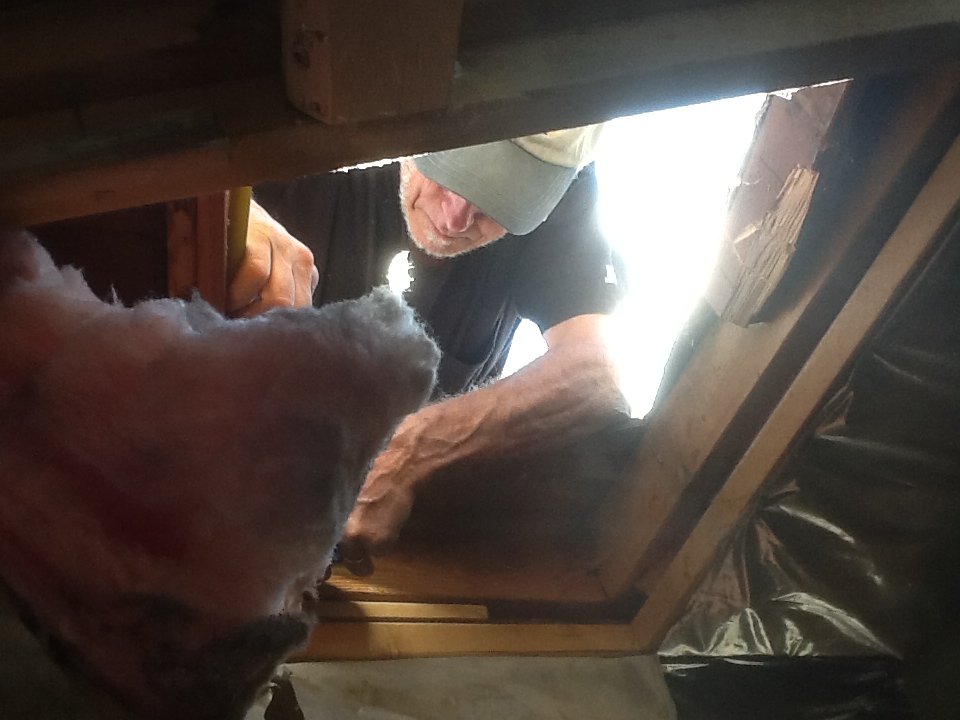 The next day started clear enough to open the roof, finally, so while Ken worked to install the ceiling box, I drove to Taos and got some new single-wall for the inside, having given up on finding the other in time. It was a long day but once you open the roof, you kind of have to finish, especially during the monsoons. Our diligence paid off and that night we built the first fire! Hooray!
I’ll survive!
The day after that it was finally nice enough outside to do some sightseeing and we drove down to Santa Fe to peruse the art galleries on Canyon Drive and did the tourist thing.
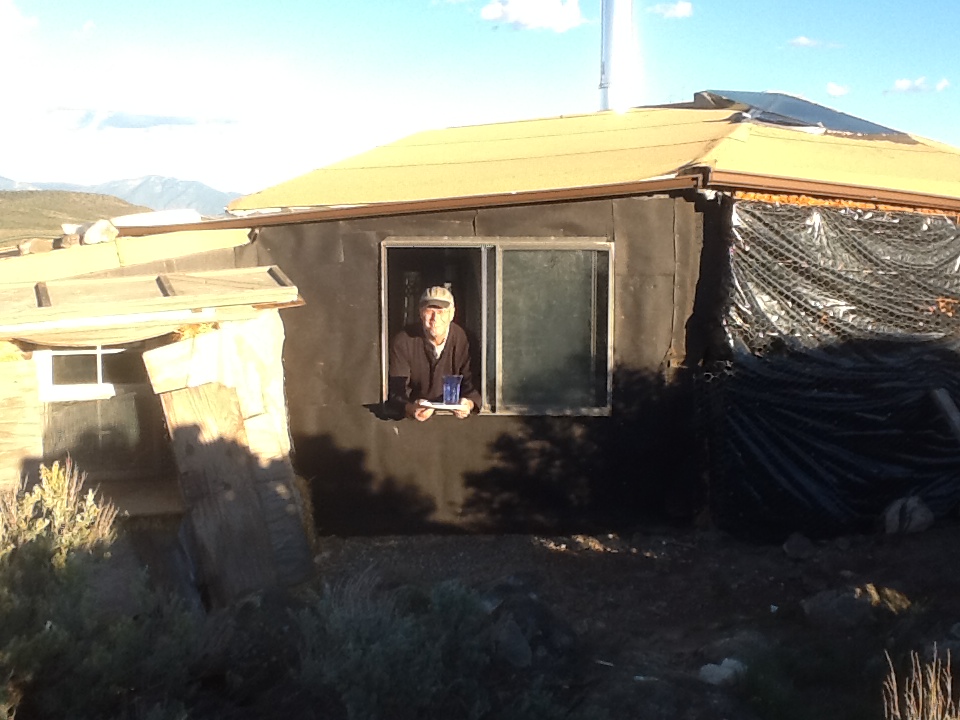 The sun finally came out the day before Ken had to leave. We knocked out the other project I needed help with, replacing the useless shutter on the west side with an actual window I had found at the Re-Store. After that, it was hurry up and relax before he had to leave. Apparently the next day the rain followed him to Denver and then on to Seattle while it cleared up in Taos from then on.
And I thought I had it bad.
Ken left on September 20 and the autumnal equinox is on the 22nd. Exactly two days later the temperature dropped to twenty degrees and never rose above freezing at night again!
Brinksmanship!
Doing Things Al Fresco
One of the adjustments one makes when pursuing an off-grid lifestyle is the number of things one does outside. Since there is no water in the house yet, for example, I use a gravity-fed hose and nozzle at the sink on the vanity out by the wood room to do my dishes, the water draining into the garden, and sun drying them on a rack.
Of course, there is the outhouse, which has been upgraded from just a box in the gully, to a pallet sheltered enclosure now boasting a tall tent, designed just for that purpose. It is camouflage patterned with zippered windows all around and can be also used as a hunter’s blind. While privacy isn’t an issue where I live, it does keep the seat dry and when it is cold it makes a tremendous difference in blocking the perpetual wind. The inside is black fabric and the little place is surprisingly warm when the sun hits it. Other times, however, I notice that my breath actually creates a tiny snow flurry. I will watch my breath fog, then rise as a little cloud, swirling down as tiny ice crystals in the still air. Beautiful, but daunting, as my ass is usually hanging out at the time.
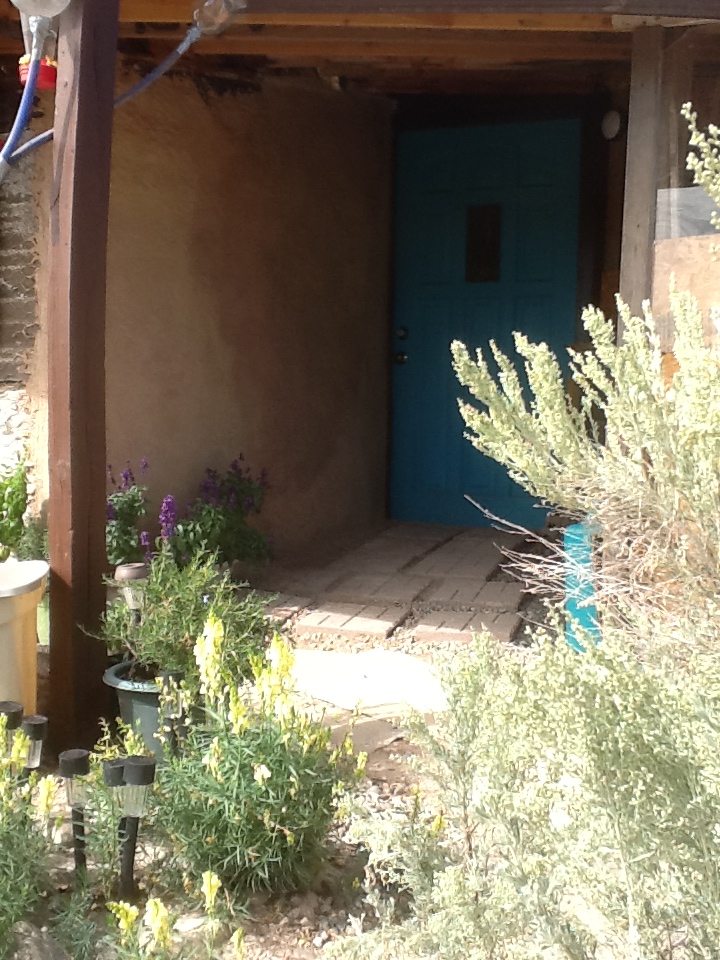 In the summer I set out a solar shower, a heavy duty plastic bag with a nozzle on a hose, clear on one side with a black lining that absorbs the sunlight and heats the water. When the water is warm enough, and it’s not too cold outside, I hang it on my porch, standing on the well drained pavers and sheltered from the wind.
Winter is another thing. That’s when the porch becomes the refrigerator. Starting September 24, I no longer had to drive to town for ice. I hung a heavy duty clear plastic vinyl shower curtain across the porch entrance which served to keep the area about ten degrees warmer than outside, creating an airlock to the house and to hopefully discourage any casual varmint intrusion. I still had to keep everything in coolers.
But to keep them from freezing.
It’s kind of fun having a walk-in refrigerator…where you walk in.
LOVE LIFE
About a week after Ken left, as I was driving to town, I noticed the traffic moving wide way up ahead to pass someone walking at the side of the road. When I got closer, I could see that it was an older guy with glasses walking with ski poles and towing a cart attached to a backpack harness which was loaded with bundles and a large orange water cooler. He had a kind of metal shed affair over his head which provided shade but still allowed for safer free head movement and attached over that was a large sign with bright red, block letters that simply said “LOVE LIFE”.
Interesting.
On my way back home a few hours later, I saw him again, further along, headed in the direction of my place.
Curious.
The next day I had to go back to town for something and saw him up ahead walking toward me, even closer to my place than before. This time I slowed some, giving him wide berth and waved to him. He raised one of his poles and shook it in greeting, never breaking his steady stride. I decided at that moment that, if he was still enroute when I returned, I would stop and get his story.
Sure enough, on my return he was still keeping a steady pace, now only a few miles from my gate, so I pulled over and jumped out to get his story. What a story it is!
His name is Steve Fugate.
About 13 years ago, while Steve was walking the Appalachian Trail, he got word that his 26 year old son had committed suicide. Steve was devastated. He decided that the simple solution was to Love Life and so took his message on the road, determined to “mend the broken heart while it is still beating”, and set out on his first walk across the country. His daughter, suffering from MS, was to pick him up at the end of it but, just before he arrived, he got word that she had died of an accidental overdose. That degree of tragedy might have broken him, but it only steeled him more to his mission. He is determinedly optimistic and actively loves his simple life.
He has continued to walk for 13 years, spreading his message to Love Life. Remarkable!
I offered him to turn aside at my place for a cold drink and a rest. He gratefully accepted, but, of course, needed to walk. That gave me time to go home and get ready for company again. I intended to offer him lodging for the night, as the day was waning and the nights were now dipping below freezing, and got Ken’s room ready for him. It was a couple of hours before I saw him cresting the hill on the highway and walked the ¼ mile down to the gate to meet him.
At first he was reluctant to make the ½ mile side trip. It adds up when you’re walking. But once decided, was genuinely glad to have a refuge and not have to bivouac under the icy stars. (He’s from Vero Beach, Florida, after all)
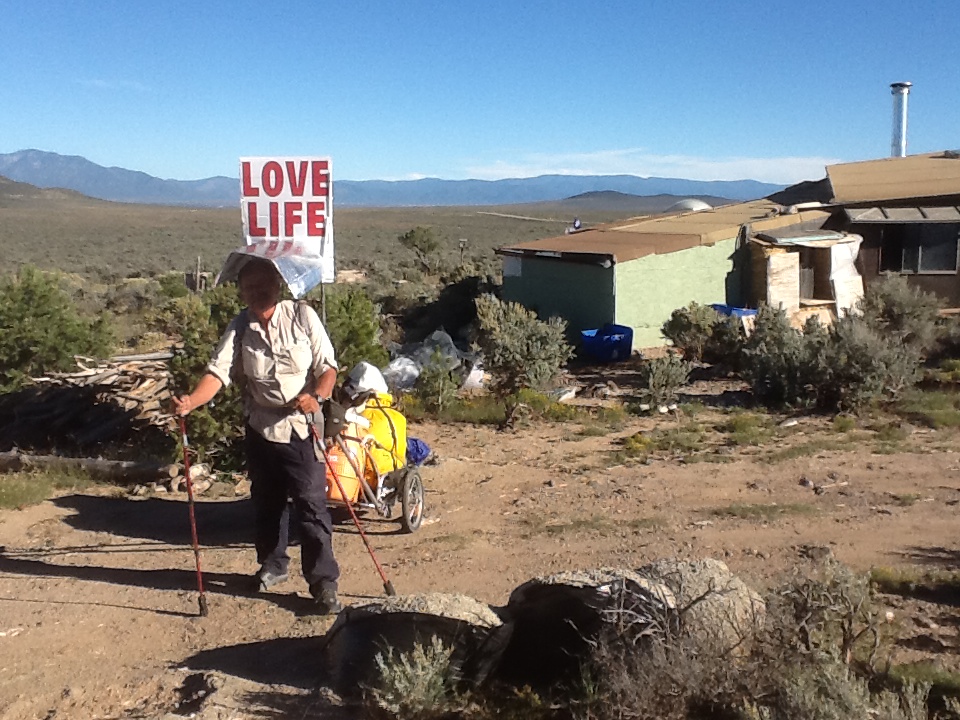 We talked animatedly, both of us lonely and with extensive tales to tell. He barely made it to nine o’clock, though, before hitting the sack (Literally, yes, that’s where the expression comes from)
33,000 miles can really take it out of you.
I took the opportunity to go online and do research about his amazing journey and found endless references to him, including his own website: www.trailtherapy.org/ and a fascinating Facebook page that he updates as he goes, whenever he can get phone signal. It was fun to backtrack a ways and see his approach to my house. All along the way, he would meet people on the road and swap stories, they often offering something he needed, food, drink, a sandwich, lodging, and occasionally a five or twenty dollar bill. Often it was a kind of memorial offering to the memory of those they had lost to suicide. Usually it was just good people who were moved by his mission. Then he would photograph them holding his LOVE LIFE sign and post the encounter on his page. It occurred to me that I would be next.
I could hear him shifting in his sleep in the next room as I went on to find the many news reports of him over the last 13 years. He’d been covered by all of the bigger news agencies, such as CNN and USA Today, as well as probably most of the communities he has walked through on his endless quest. He is now 67.
The next morning I fixed us a big breakfast on my Coleman stove and as we ate I persuaded him to let me drive him over the pass, the next leg of his journey, to the next town. Under normal conditions, it would have taken him three days to traverse the mountain range risking dangerous blind curves with no shoulders and occasional drop-offs.
But seriously cold weather was predicted, in the teens at night with high winds, and snow is always possible at such elevations. Not the best conditions for a walker who has to pitch a tent at the side of the road. Steve is a hardy man but there’s hardy and then there’s foolhardy. To his credit, Steve is wise enough to know the difference and accepted my offer, though still expressing concern that it was somehow cheating and that he’d be letting down his supporters. I assured him that they’d rather see him survive to Love Life another day and drove him the 60 miles to Chama.
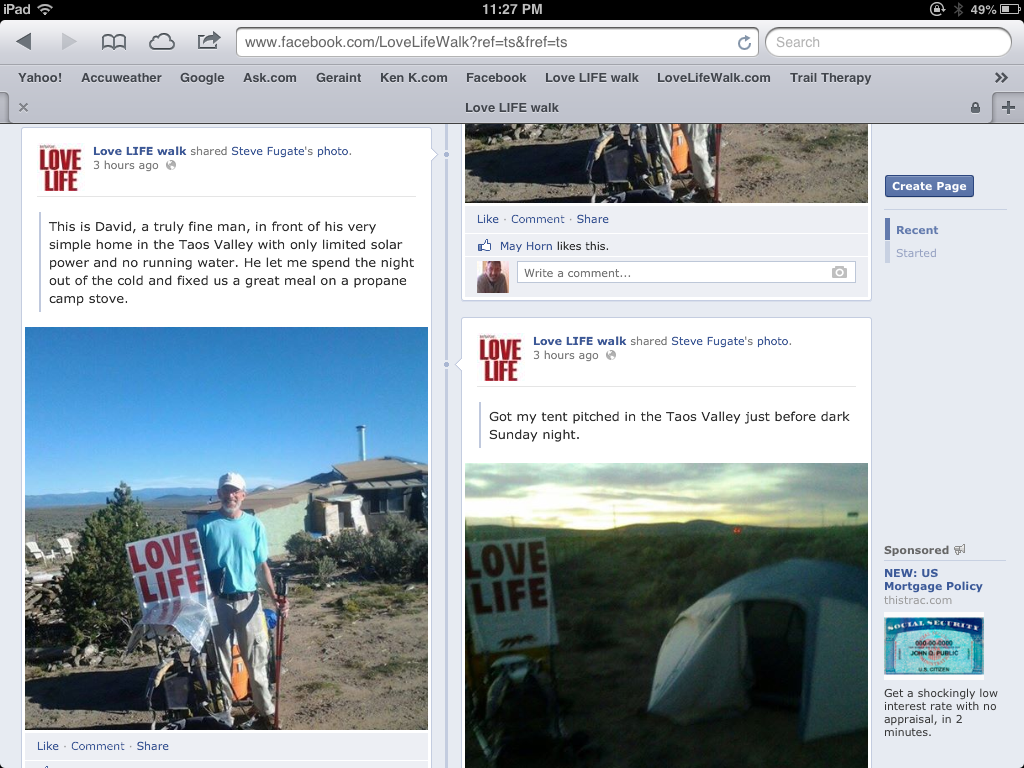
I continue to follow his trek on FaceBook: https://www.facebook.com/LoveLifeWalk
He made it to the Pacific shore on December 16, 2013. The last I saw, he has made it to Gorman, California.
COLD!
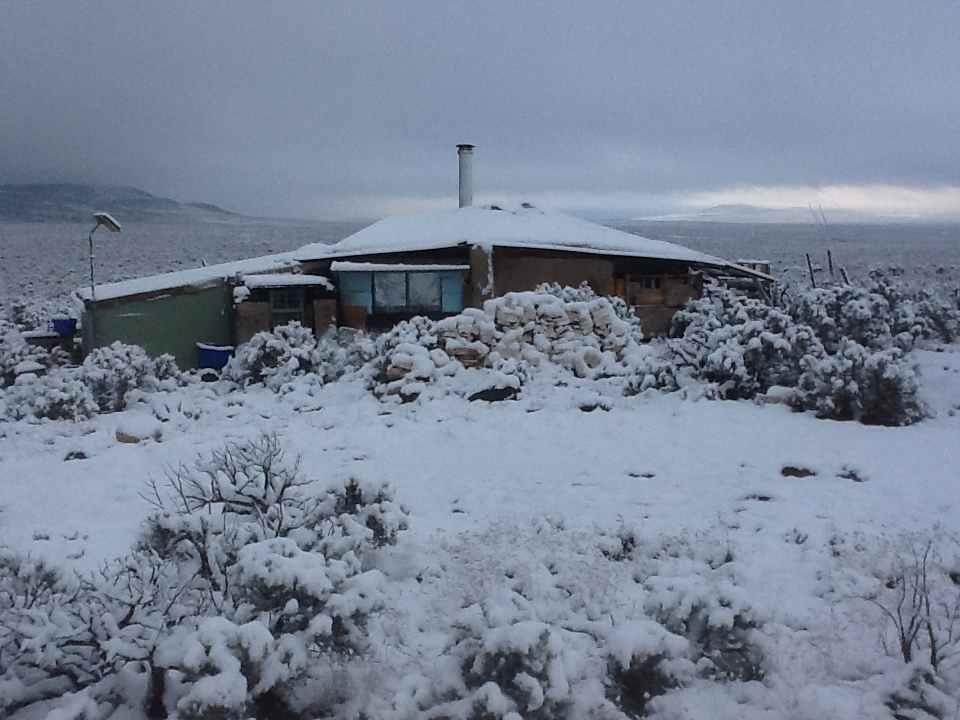 Three weeks after dropping below freezing at night, on October 15, we had our first snowstorm of the season, dumping about a foot of snow on my snug little cabin. As long as the firewood holds out, I can get it pretty cozy inside. Of course, after I go to bed and the fire dies down, it gets pretty cold, usually in the forties when I get up, and occasionally colder. I try to stay up later at night, keeping the fire going, and then hibernate in bed until the sun breaks over Taos Mountain and warms the east room.
I have found two (though presently incompleted) passive solar solutions to the cold. One is a trombe wall, a masonry wall outside, painted black and then sheltered with glass. The sun heats the masonry, cold air draws in from the house at the bottom, and the heated air rises to vent into the room. I have constructed one outside what will be the composting toilet bathroom but didn’t finish it before weather halted outside work.
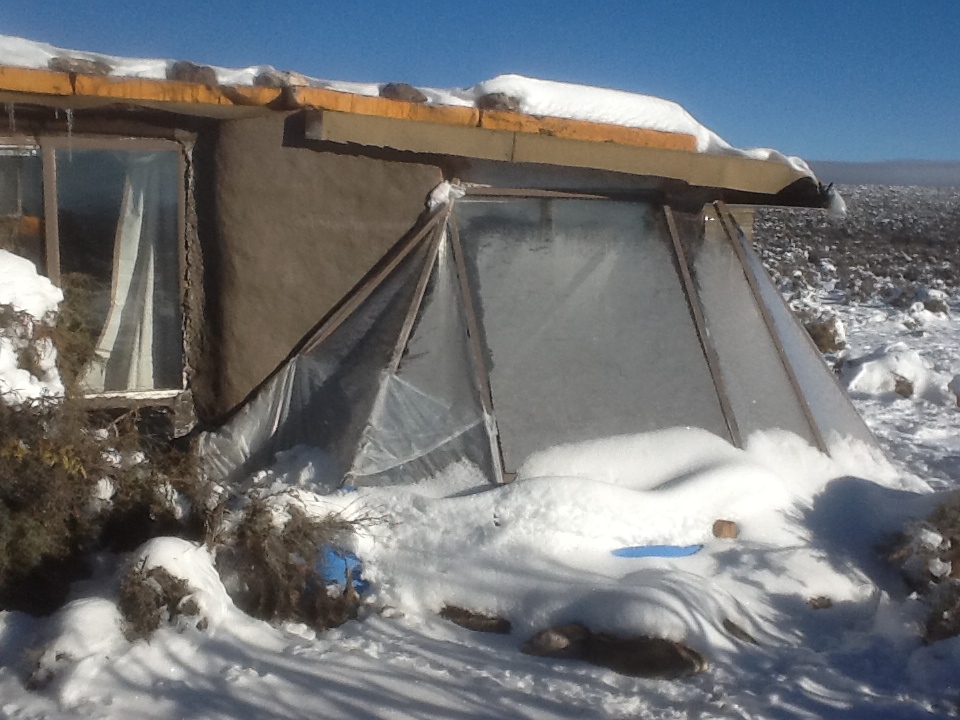 The other technique is similar, in that it involves solar heated masonry. The southeast corner of the house boasts two windows which are also the most exposed part of the house to the persistent wind, snatching precious heat. Below the windows are the stuccoed bales I spoke of previously, which I painted black and then built a lean-to affair at the corner out of 2X2 lumber, covering the enclosure with heavy-duty vinyl. I was startled to find how hot the enclosure can get, sometimes up to eighty when it is thirty outside. The black stucco can be too hot to touch. Once heated up, I simply open the window and warm air floods into the house. It has become my shower area now. A bit cramped but toasty.
FIRE!
One night in early November, I got back late from a short trip, pulling in during a windstorm sporting sideways snow flurries. I was relieved to have made it home safely and hurried to the task of building a fire. After six weeks of using it, I was finally getting the hang of how to best build and maintain a fire in the little metal box. It was different than the campfires I was adept at. A hot fire at the back of the box to start is necessary to create the updraft through the flue. Otherwise, the smoke spills into the house. Once established, you graduate to the larger, slower burning logs and close the air intake some to encourage a slow, even consumption of the fuel.
About twenty minutes into the fire, I opened the door of the stove to add a log and burned my hand in the process. I ran out to the porch to the rain barrel, busted a hole in the thin layer of ice with my fist, and thrust my hand into it. Ahh. Looking up across the yard, I was horrified to see huge flaming sparks blowing from the roof over my head, driven down by the gale into the tinder-dry garden!
OH MY GOD! NO!!
I ran out to the garden and looked back to see the top of the chimney aflame, being fanned hard by the wind and looking like an Olympic torch. Great flaming embers blew down onto the flammable Styrofoam and papercrete roof, dancing into the crevices. (for the record, properly prepared papercrete is flame retardant)
NO! NO! NO!
I ran into the house. The stove looked normal.
OH GOD. WHAT DO I DO? WHAT DO I DO?
I started by flattening the fire. The log I had added had already ignited. I shut the door tightly and closed the air intake. I didn’t dare close the flue or the smoke would have flooded the house.
I ran back outside to see if it had done anything.
Nope. Still a torch!
I had a fire extinguisher in the house but I couldn’t imagine how that would work on the roof in the wind. Plus, I didn’t know how far the fire extended down the chimney.
I ran back into the house and felt the ceiling box. It was cool to the touch. That’s good. But the fire was still going.
The fire department was 25 miles away and I didn’t have a proper address, anyway.
What do I do?! What do I do?!
Smother it!
How?
I raced to the storage room and looked around for something to use. I’d been too thorough in my cleaning and in my panic, couldn’t imagine what to use.
Aluminum foil! I’d seen a roll somewhere. I rummaged around in a kitchen bin and found it, grabbed a ladder, and charged out to the NW corner of the wood room, the lowest point of the house. The torch burned brightly, the wind scattering fireworks across the sacred circle and sending me back in for a coat and hat.
Climbing up on a slippery roof at night during sideways snow is not for the casually committed. My fear of the house burning down overrode my fear of the roof adventure. Struggling my way up the slick, irregular surface, I had to resist the urge to grab onto the chimney for support. I’d never had to unroll aluminum foil in a windstorm on a roof, either. New experiences abound!
I finally managed to wrap the top of the pipe and smothered the flames.
Maria was right! But it was new pipe! And it had only been six weeks!
That meant that I wouldn’t be able to use the stove until I could clean out the pipe. Fortunately the house had warmed enough and I went to bed when it got too cold, tired from the ordeal anyway. Luckily the sun was out and it was calm the next day and I was able to clean it out easily, no damage done. And lessons learned.
It’s a good thing I burned my hand or I might have gone to bed with a burning roof.
And that brings me to a philosophical close to the tale thus far.
The calamity was a disguised blessing. Rather than just another bad thing, it drove me to a better result.
I want to find a way to apply the principle to the calamities in this homestead adventure; to believe that there is a bigger purpose to it all.
Maybe it’s worth it just for the stories.
Anybody know a good publisher?
 Next: ?
 Change, again, probably.
Be sure to check out my other blog: Hunt Travels
http://hunttravels.wordpress.com/
___________________________________________________
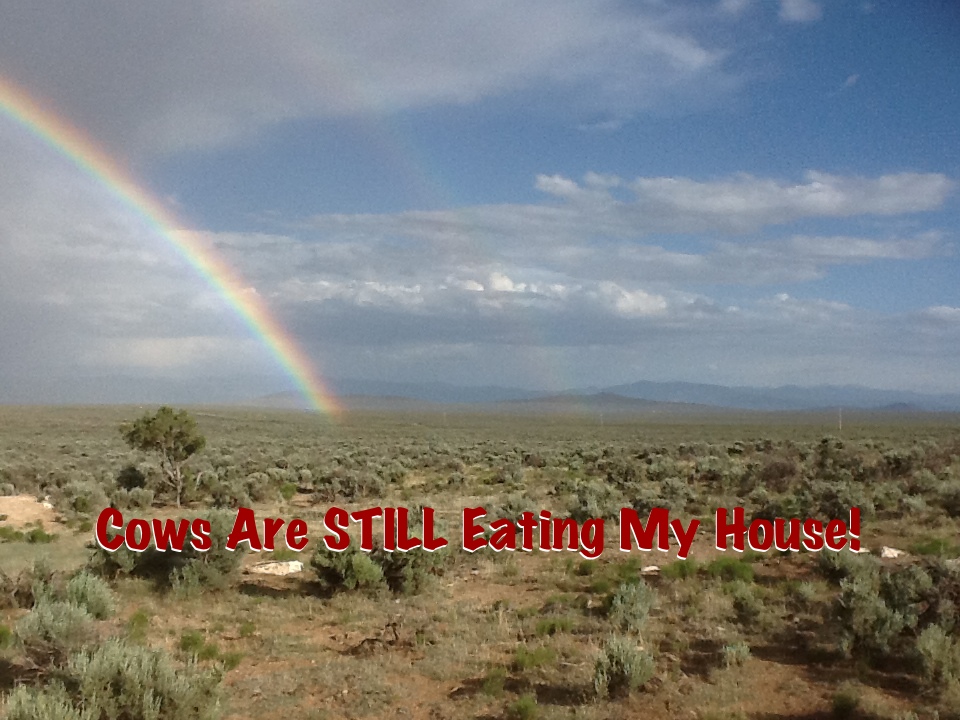
“You made it!” I shouted over the sound of the two heavy motorcycles loaded for travel, maneuvering their way down the rocky driveway. The two tall men dressed in full black leather riding gear and black helmets couldn’t hear me as they sought a flat place to park their big black touring bikes.
I walked nearer and addressed the closer one.
“Hi! Did you have trouble with the dirt “road”? I yelled.
The featureless faceplate turned my way and a black-gloved finger pointed to the other rider.
“That’s Jim.” he clarified.
“Oh.”
Easy mistake. They were both obscured, head to toe.
Jim was an old high school friend whose sister I had dated and I hadn’t seen him since the turn of the century. He had heard of “Range”, read it, and wanted to include a stop at my place on his road trip across the Southwest with his riding buddy, Gavin. Both guys are about a head taller than me and were impressive and imposing in their gear. (I flashed on the robot cops in THX 1138)
“Watch your head!” I warned as even I had to duck under the low entrance to the place, an extension of the wood room that those volunteers had installed for, much shorter, Trip.
I could see the entire place caused the guys to feel that they had to duck a little.
I showed them to their space and gave the brief hospitality tour.
“That’s the new composting toilet. Just throw in a scoop of the peat mix when you’re done. Otherwise, it’s just the same, only without the flushing. If you just have to pee, though, it would be helpful if you use the compost heap down by the gully garden. It’s been so dry and windy, it needs the moisture to keep composting and urea is good for it anyway.”
“Gully Garden, huh?’ he asked with a smirk.
“Yeah, over there.” I pointed to the old stagecoach road that was now just a washout gully. “It’s more sheltered from the wind and gets lots of water when it rains but the soil is lousy. I’ve planted green beans, several kinds of squash, pumpkins, and some potatoes that sprouted in the bag. Just subsistence stuff that I hope the rabbits won’t like that can reseed itself.”
“I filled the solar shower bag and put it on the roof to heat so you guys can have a shower. I use the porch for that. I discovered that the sun heats this porch really well and the water drains right off the pavers. The shower curtain pulls across the entrance,” I demonstrated, “to block the wind. I actually installed this for the winter. It makes an airlock of the wood room and porch and it’s at least ten degrees warmer in here in the winter. I hope it deters the ground critters from coming in to the porch and getting into the wood room, too. And it keeps out the hummingbirds. They get into the wood room and then can’t figure out how to go around the corner through the dark, to get out, so they just bang on the window. One day while shooing three of them out, the last one gave up trying to get away and just climbed onto my finger and perched there while I walked her out! It was so cool! But I’m hoping it’ll keep out the bigger stuff, too. I’d hate to open my door to a coyote or something, or come home to something between me and the front door.”
“If you need hot water for anything else, the hose from the tank gets pretty hot. It’s gravity feed, though, so there’s not much pressure. I have discovered that if I fill that black pot partway with water and put that piece of glass over it, the sun will heat it almost to boiling, but usually the hose is enough.”
The guys fished some beers from the crushed ice in the cooler bag strapped to one of the bikes and we went into the somewhat cooler house and settled down to catching up and exchanging stories.
“Did Jim tell you the story of this place?” I asked Gavin as he took in the various “irregularities” of the room. “Did you get a chance to read the story yet?”
“No. Not really.”
So I launched in to a condensed version with the advantage of being able to point to things, ending with, ”…and that’s the story so far.”
After awhile, we went out to sit in the shade of the house on the east side, facing the mountains, and enjoyed the fresh breeze and the birds and bunnies feeding while we talked. The jackrabbits had grown accustomed to me and no longer fled at my presence. Of course the seed, water basin, flowers and carrots are probably a strong incentive, too. I was glad to see that their trust extended to Jim and Gavin and we enjoyed watching them hop around while we talked. Well, mostly I talked. After a couple of months of isolation, I was lonesome and had lots to tell. It was good to have company. Ken, and Steve, the Love Life guy, had been my only other guests, ever, and that was way back in September. I got back from wintering in Colorado at the end of April and now it’s late June.
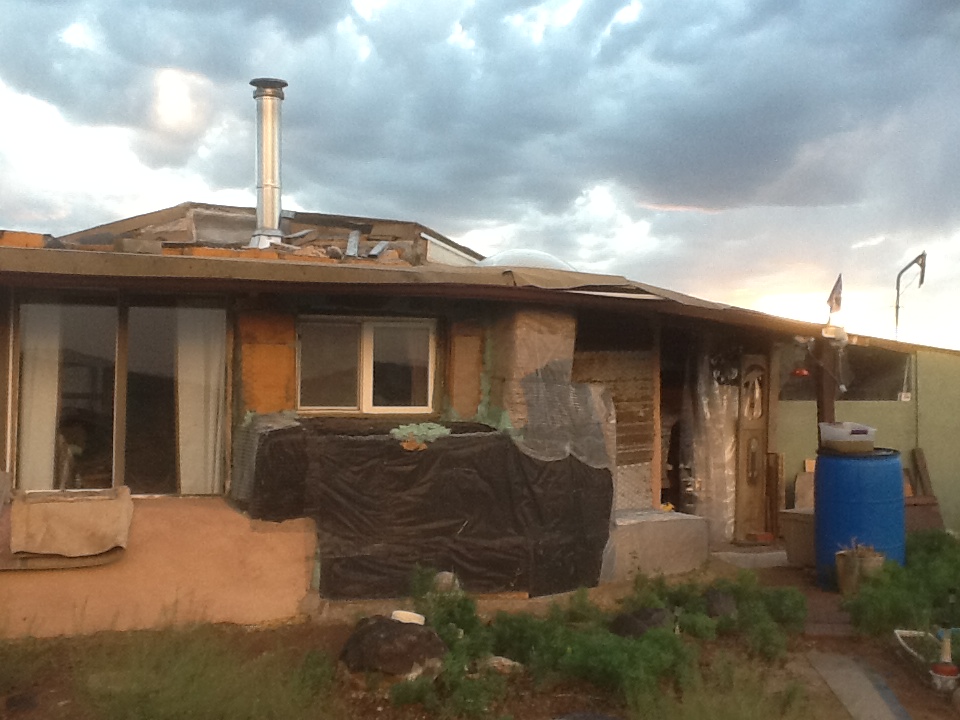 I had rushed to finish this side of the house in anticipation of their visit. I really wanted to make it feel more substantial than just a dirt floor shack. After I had finished stuccoing the bales, which had miraculously survived the winter covered only in plastic with plywood leaning against it,
 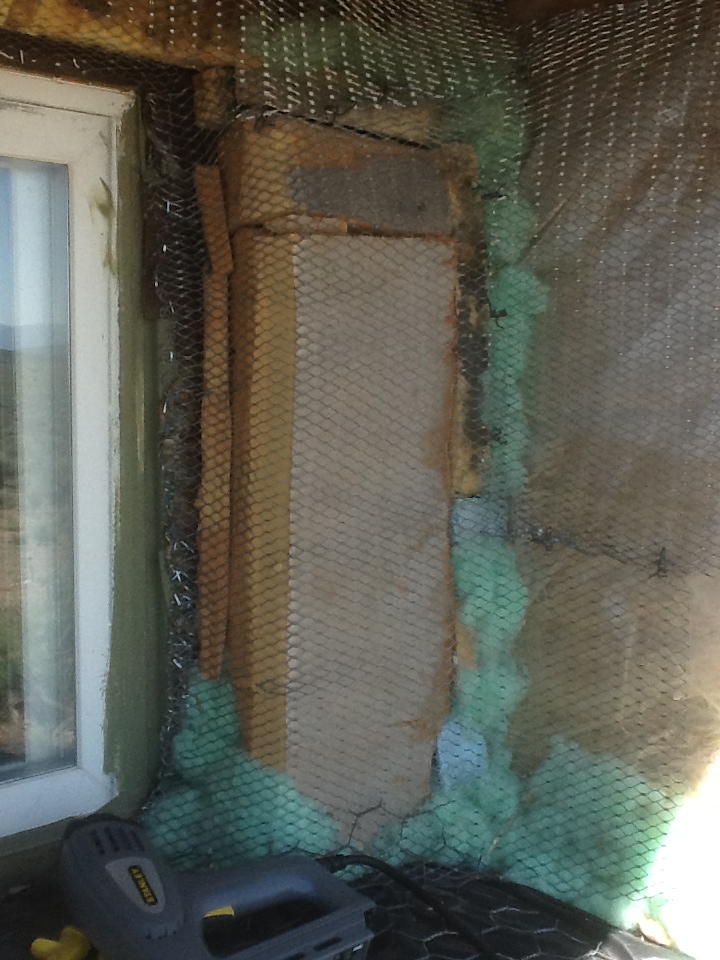 I spread some topsoil and planted a couple of varieties of domestic and wild grasses in an effort to create a small patch of ground cover to combat the wind tossed clay powder and sand and hoping for some rain to sprout the turf. The yellow flowers that the humming birds and hummingbird moths love so much are just starting to bloom and I have been watering them to encourage them as the monsoons haven’t yet begun and the days are in the eighties and nineties. I proudly noted that the sunflowers in the large pot near the jackrabbit and bird feeding area were getting taller, surviving bunny grazing inside their chicken wire protective cage, open at the top so they can grow tall. A resin Adirondack chair and table topped with a potted aloe vera plant that was still recovering from a late freeze made the area an inviting place to enjoy the afternoon shade sheltered from the prevailing Southwest wind, for humans and bunnies alike.
“Boy, you’re really out here.” Jim commented, looking out at the expanse, “ It’s totally Lonesome Dove.”
“Lonesome Dave.” I corrected.
“What’s that trailer up there?” he asked, pointing up the hill to the shiny aluminum Airstream trailer parked at the end of the road dogleg near “cow corner”, where the fence ends and the BLM grazing land begins. It had appeared during my absence last winter.
“It must belong to that biker couple who bought that lot last year. I met them last summer when they came out to check it out. I had seen someone driving in and out a couple of times in a little white car and so the next time they came by, I climbed up on my roof and pretended to be working on something while I established my presence and could see them better.”
“The woman passenger insisted that they stop to meet me, fortunately. They were definitely fringe. He seemed like a traditional Harley rider, bearded burly bear in a leather vest and she sported vivid hair, ink and piercings. But they seemed nice enough and I always try to challenge my reactions to stereotypes, having been a recipient of such prejudice. They are from Austin, Texas, and plan to build a small getaway structure. I was a little troubled when she mentioned that they may be back in a week or two with about a dozen of their motorcycle club friends to have a celebration party. It’s a good thing that she told me. Can you imagine my response if they hadn’t stopped to introduce themselves and tell me and just showed up with a dozen Harleys roaring up my private road on their way to party on my land?! Haven’t seen them since, though. Just the trailer.”
“The place looks better than I was expecting.” he complimented.
“Thanks. I finally got my storage in Vegas emptied and out here. Nice to have my personal things back. Decorating it with my family stuff has made it feel a lot more like home. This carpet was given to me by my friend in town. It really made the place feel more like a real place.” I turned to Gavin, “You know these are still dirt floors under there.”
“Really?”
“There’s just so much to do and I’ve been so tired and discouraged, it’s been hard to keep motivated. Just knowing you guys were coming gave me the incentive to get some of the things done. Like the composting toilet. I got it the very first summer, took it out of the box, and never hooked it up. You have to maintain a minimum temperature of 50 degrees for the composting to work and I just haven’t been able to do that until now. Plus I had to cut a hole in the roof and I was reluctant to invite leaks. I’ve been using an outhouse tent but the tornado winds we had this spring ripped it to shreds.”
“What’s living in those holes?” he asked, pointing at the garden.
“I think they are Kangaroo rats. And maybe mice. I had a real mouse problem last year and when I left for the winter, I put out poison bait in the house. Now that I am back, I haven’t seen any of the little chipmunks, though, and I’m afraid they got the bait, too. Haven’t heard any coyotes, either, since I got back last year. I figured that it was because Trip had three dogs, but now, with the poisoned mice, I hope it hasn’t gotten into the food chain. And of course the mice are still here. So, I have changed to traps since I am here to reset them. It was weird, though. At first I was catching them almost every night. Then suddenly it stopped. I knew I hadn’t somehow caught all of them. There are too many. But then one day, in broad daylight, I saw some movement in the weeds and went to investigate. There was a fat little mouse waddling along with his cheek pouches stuffed with the birdseed I’ve been putting out for the birds and jackrabbits. He didn’t see me at first and was just strolling along, stuffed cheeks simulating a grin. When he did see me, he acted all busted and tried to hurry but was comically obese and couldn’t move very fast. So I guess they don’t have to come in the house to forage anymore. Hope it’s not making for a population boom. Another time I saw some furtive movement at dusk and my headlamp revealed a pair of kangaroo rats filling their cheeks and running home and then back for more. They were completely unfazed by my presence. I’ve since cut back on the seeds so there’s not so much left at the end of the day.”
“What’s the deal with the bathtub?” he asked, pointing at the rectangular tub near the stable.
“Trip was using it to water those wild horses in the story. It used to be smack in the middle of the circle. Really ugly. But it’s made of cast iron and so heavy, I couldn’t budge it. Then I remembered a recent National Geographic article about how the Easter Islanders moved those giant statues called Moai or something. The legends say that they walked from the quarry to their places overlooking the ocean. They figured out that they’d get them upright and then, using ropes, “walk” them, wobbling from side to side, inching forward with each lean. So I got the thing upright and “walked” it over there. Jeez it’s heavy! The washing machine that used to be under the camper shell overhang was a lot harder. First I tried tipping it into the wheelbarrow, but it fell out when the wheel mired into the sand. So I tried to walk it, but the open bottom scooped dirt and dug in. Managed to get it around behind the stable on the pallet with the dryer, though. Times like that I wish I had help.”
“Have the cows been back since the fence was put in after the accident?” asked Jim, referring to the woman who was killed when their motorcycle slammed into the same herd on the highway a few years ago. That tragedy is still in litigation since the cow owners are not responsible as New Mexico State law decrees this to be open range land and it is the Highway Department’s responsibility. Or mine to fence them out of my property.
“Yeah, they started coming back last month. Oh, and now I have a slight Yak infestation.” I quipped.
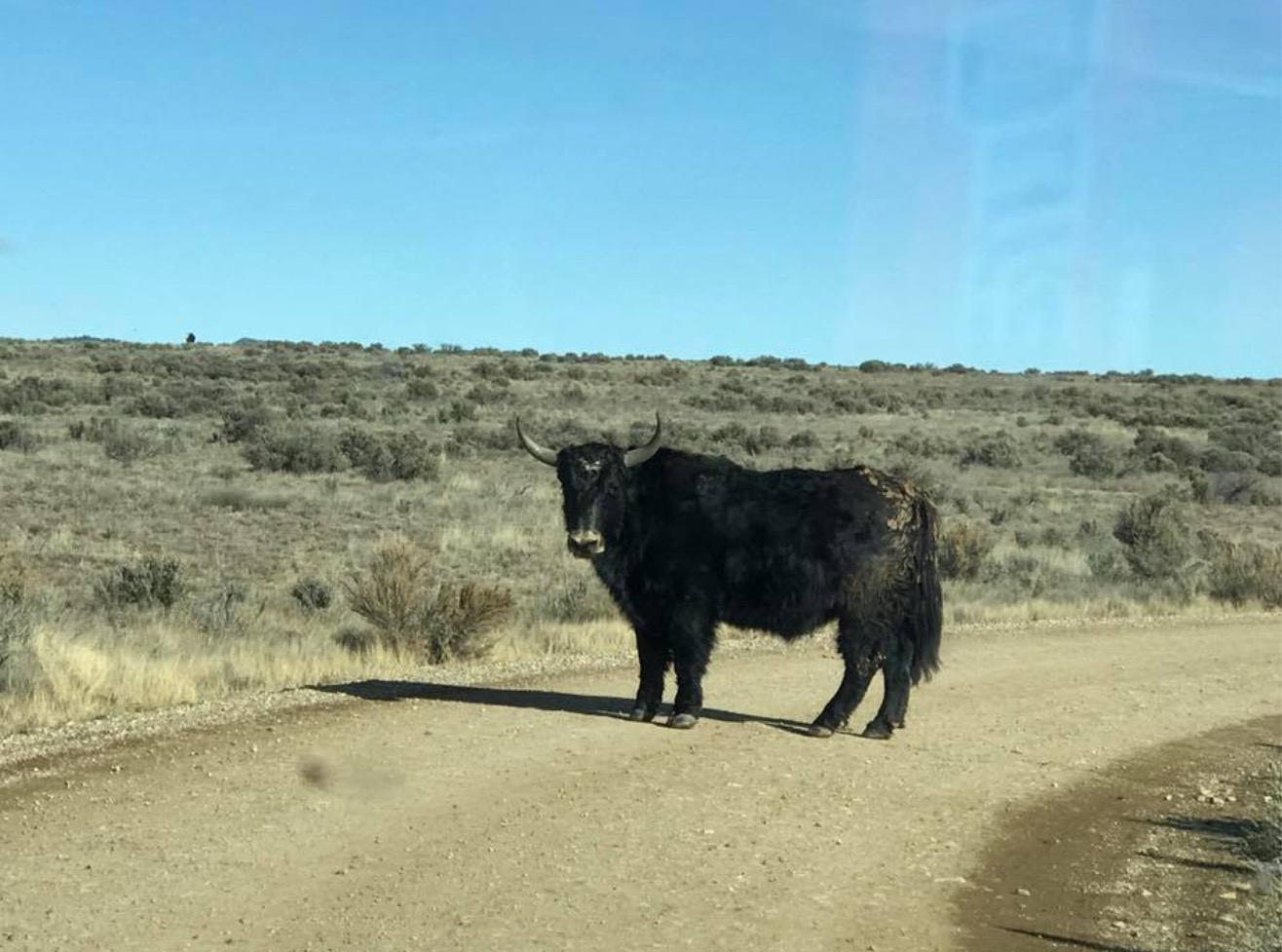
“What?”
“Yaks. Well, I didn’t realize they were yaks, at first. I was looking out of the office window at the most beautiful, orange sunset, a classic Southwest scene, like a postcard, with the foreground cast in black shadow and everything in silhouette; the bushes, the rubble wall, the Texas longhorns…WAIT, WHAT? Then they moved and I knew. So I threw on my shoes and put on my headlamp and grabbed my shrieking whistle and some claves from the musical instruments basket and came roaring out the door and up the hill at them! They took off in a stampede into the darkness. Then a few days later I saw a whole herd of them in an adjacent field. At least I think they are yaks. They have a cow’s head, like a longhorn, but with a yak body with a big hump and long shoulder hair. They’re smaller than the cows, though. They’re cool, but just as destructive as the cows.”
“I thought there was a fence now, since the accident.”
“They figured out how to go around the fence. Usually keeping to the fence line, but on my side. I have been chasing them off before they get too close, but it’s a really exhausting to herd them way up to the corner of the fence where it becomes BLM land.” I complained, “I’m walking for miles behind them and breathing the cloud of dust and sagebrush as they tromp through! I’m wheezing with my asthma all the time now and coughing up mud! I’ve got better things to do, you know?!”
“What have you tried?”
“Well, I started by banging pans and blowing a shrieking whistle, but they really didn’t care. Throwing rocks might make one jump a little but the whole herd just moseys along a little faster than I can walk. Plus I have to keep stopping to gasp for air. Between the thin air and the dust, I just can’t breathe.”
“A couple of my friends suggested a BB gun, which I really resisted, being against such things, but finally caved and got a little pistol for $15 bucks at Walmart. When I asked the woman behind the counter if it needed a CO2 cartridge or anything, she looked at me like I was from Mars.
“No. You just cock it like any BB gun.” she said.
“Well, “ I admitted, “I’ve never had one before.”
She looked at me like maybe there was something wrong with me.
“You NEVER had a BB gun growing up?” she asked.
“ ‘Nope.’ I said.”
“Then I got a slingshot to try at the same time. You know, the kind with the handle and rubber tubing?”
“Did it work?” Jim asked, nodding.
“Turns out I am hopeless with the slingshot. I can throw better than that. Yesterday I walked right up to the bull, who was the closest one to me, he was grazing just on the other side of the gully near the outhouse, and I shot him point blank in the flank with the BB and he didn’t even flinch and continued to graze. So I had to resort to throwing rocks and shouting to drive them off. I found they sort of respond better if I make, like, growling noises or like a bull. Still, I have to escort them to the fence line or they will just stop and graze some more, like nothing happened. Too bad they don’t understand my swearing or knew what I was threatening them with. “ I said with a chuckle.
“We had a nice experience with cows where we camped this morning.” Jim said, “We were on the rim of the Gorge and woke up in our tents to the sound of a whole herd around us munching on the grass. It was cool.”
“Yeah, well, wait until it’s your tent or your motorcycle,…or your house.” I quipped.
“How much damage can they do?” asked Gavin, thinking I was overstating things.
“You have no idea.”
____________________________________________________
Gavin left the next day to go on to Scottsdale to visit friends but Jim stayed on to visit more and we went to the “Ladies Night” party at the KTAOS Solar Center to hear Katy P and the Business enliven things. Consequently we were out late and didn’t get to bed until after midnight.
As the sun was coming up, around six in the morning, I heard a noise in the direction Jim was sleeping. For once there was a reason for noise to be coming from that direction and I ignored it, assuming it was Jim at first. When it persisted, I wondered if he was getting up and raised up on my elbow to see. No, he was still sleeping. I lay back and wondered if maybe the wind was blowing things around and pulled back the curtain over my bed. No, it was calm.
Then there was a sudden clatter from the direction of the office.
MICE?!
I leapt out of bed and ran to the office. Had Jim left some food out or something? Maybe it was the raven on the roof. I stood there for a moment, feelers out, listening for a clue. Nothing.
I took off the cover to the window facing the porch to find a cow’s head looking at me! She was standing inside my entry, on top of the fallen shower curtain and rod, sniffing around the corner at the unprotected bales sheltering the office wall in the wood room and beyond her I could see a herd of maybe 15 milling around in my garden!
“ARE YOU KIDDING ME?!?!!!!”
As I launched for the door, I spotted Jim still sleeping and shouted “Brace yourself Jim! They’re back!” and I burst through the door, causing a small stampede as I came roaring out shouting invectives. As I rounded the corner I could see that the whole herd had surrounded the house and the Jeep and Jim’s bike and his leather gear was lying on the ground. 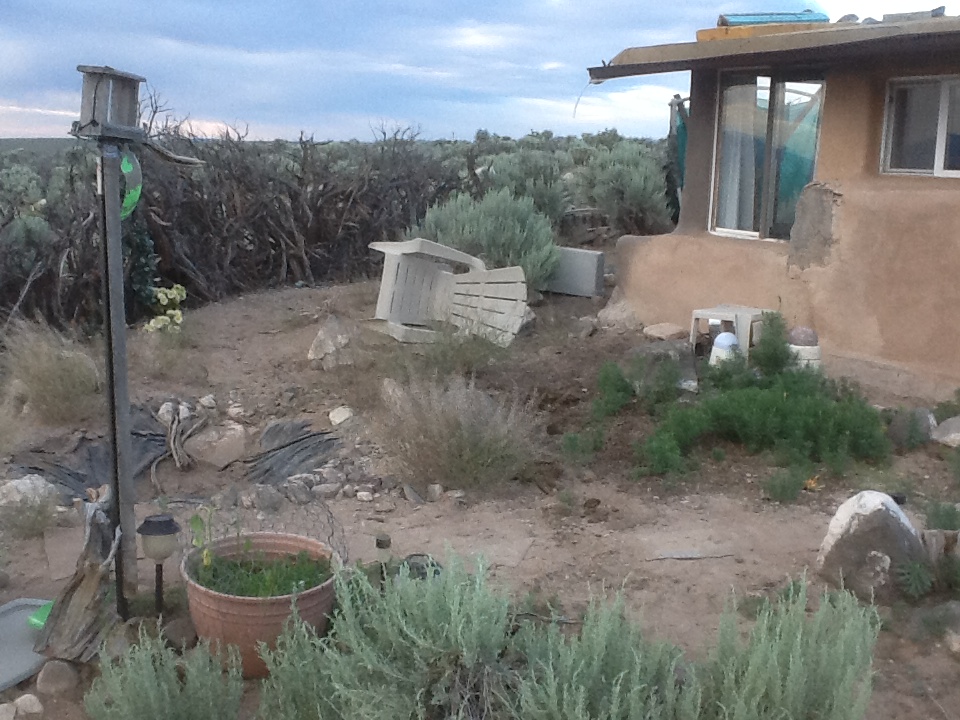 They were standing in the “sacred circle”, plants crushed, sunflowers lopped off, solar lights trampled into the dirt and fresh pools of plop everywhere.
 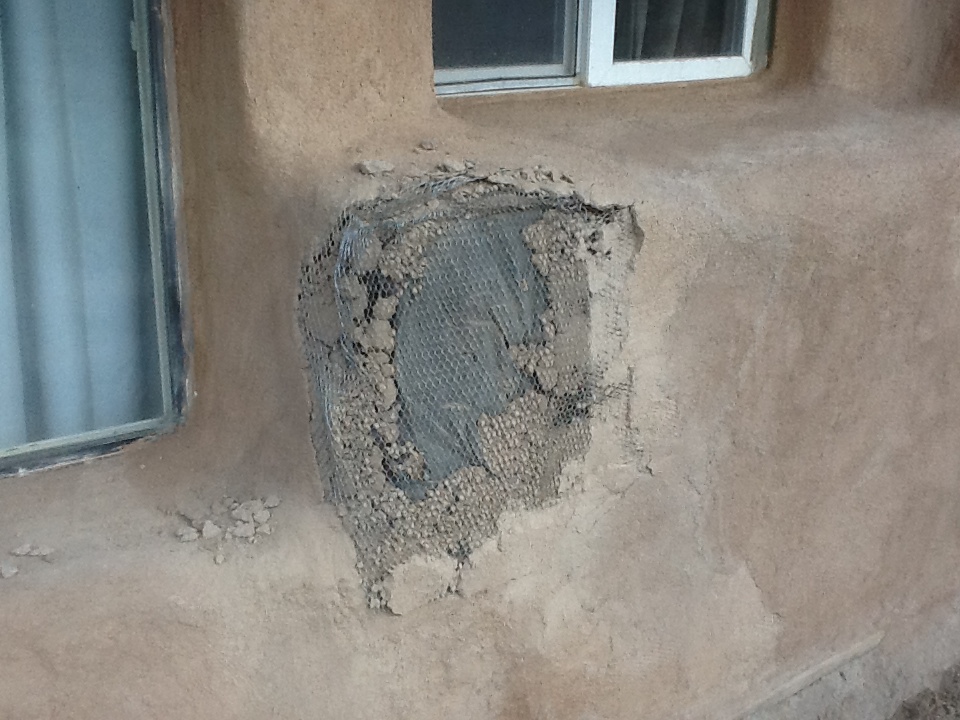 Right outside the window where Jim slept,… A COW WAS EATING THE NEW STUCCO OFF THE HOUSE!
“WHAT?!”
It’s surprising how much an adrenalin burst can disengage the rational mind and prompt impulsive feats of wonder. With unbridled rage I charged at her, screaming, “WHAT ARE YOU DOING?!?” She lurched and ran back around the house toward the solar panel rack, cornering three others as they realized there was no way out that way. 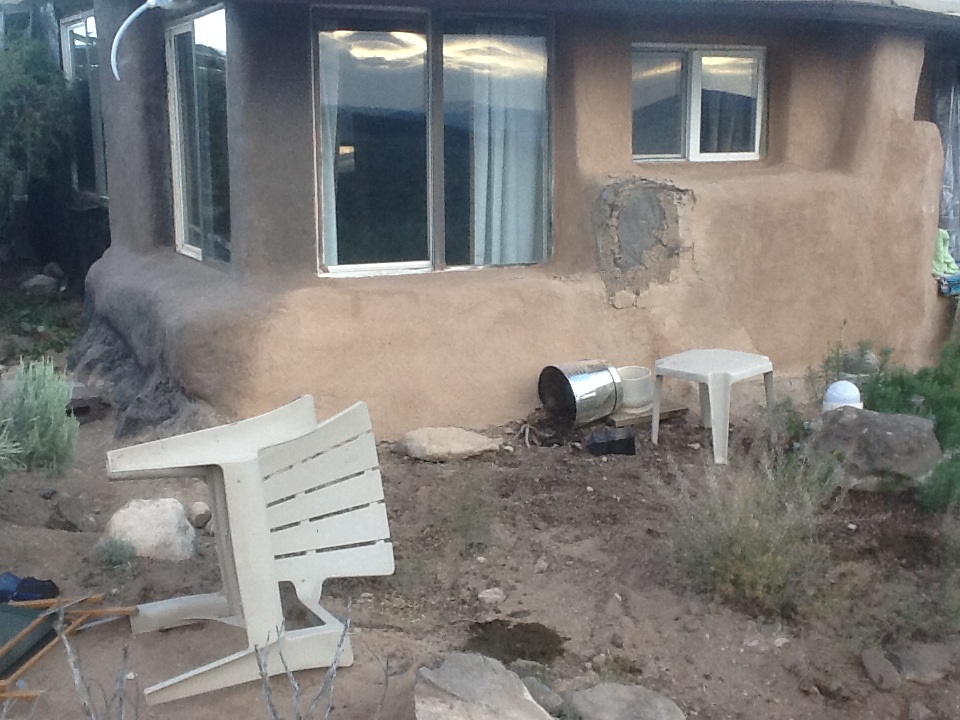 They started to crash through the sagebrush stick windbreak fence, built from the remains of previously trampled sagebrush. I whirled and leapt after the others in the circle, chasing them down the hill, leaping over sagebrush, barefoot and in my pajama shorts.
By then, Jim had come to the door to get some pictures and I ran back in to pull on some long pants and my boots and proceeded to drive them back to their own land. The return walk from those drives is getting longer and slower as I pick my way through the sagebrush, gasping from the exertion and coughing up lung mud, watching for rattlesnakes, (Now, anyway, but never when I am in outraged chasing mode. Dangerous, I know.) past large barren wallow areas dotted deeply with hoofprints and strewn with the splintered remains of former sage forests where the cows have fed and “nested”. Now and then you will see a struggling wildflower that they have missed, cowering under a bush.
“I don’t know what to do.” I gasped to Jim as I approached the house.
“Let’s go online and see if we can find some ideas.” he suggested.
I brought out my IPad and sat on my new stuccoed bale bench and Googled Cow Repellent. Many of the entries were for insect repellent for use with cattle, but there were a few chemical sprays available to spray directly on saplings and such to prevent browsing. I found a sonic repeller from China offered online which has a 30 foot sensing range and emits a high frequency tone, but it would drive off the rabbits and birds, too. Still…
My research was interrupted by a loud mooing from up the hill to the north. I could see three cows hurrying directly toward us, led and announced by the large black cow that had been eating my house.
Jim persuaded me to just wait to see what they would do, as I had been trying to keep them as far away as possible, necessitating lots of hiking and shouting through the sage. 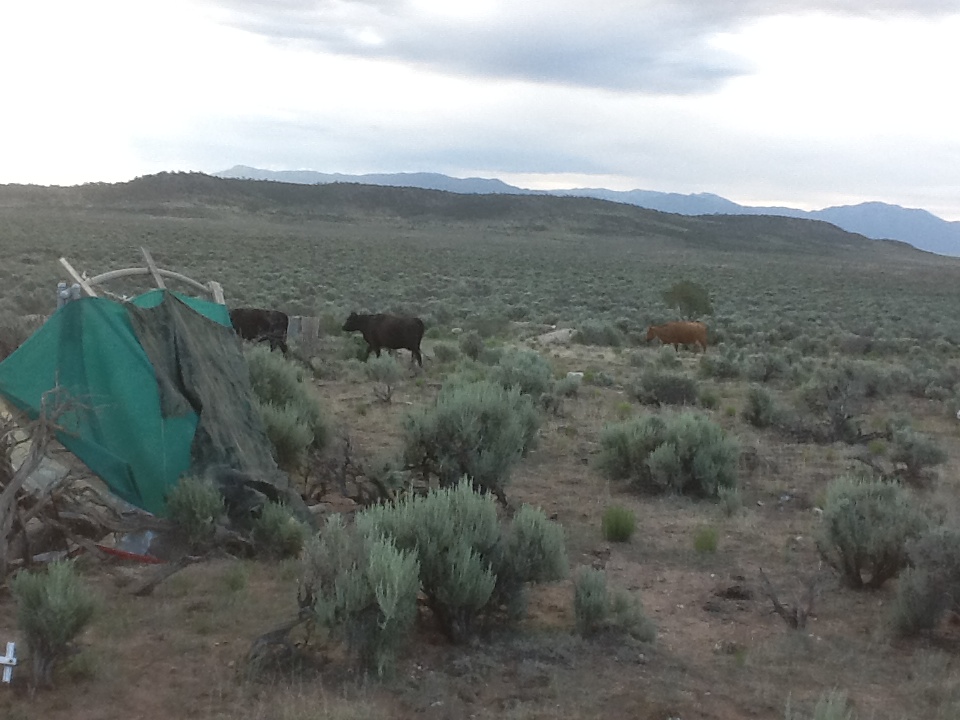 She made a beeline to my yard, followed by the other two, but stopped when she saw us. They circled around to try to approach it from the south and I followed with my IPad, hanging back and taking evidence pictures. When I rounded the house I saw Jim documenting it, too. She was wary enough that she just hung around, just far enough that I couldn’t rush her, but not leaving, so, again, I chased them off and up the hill.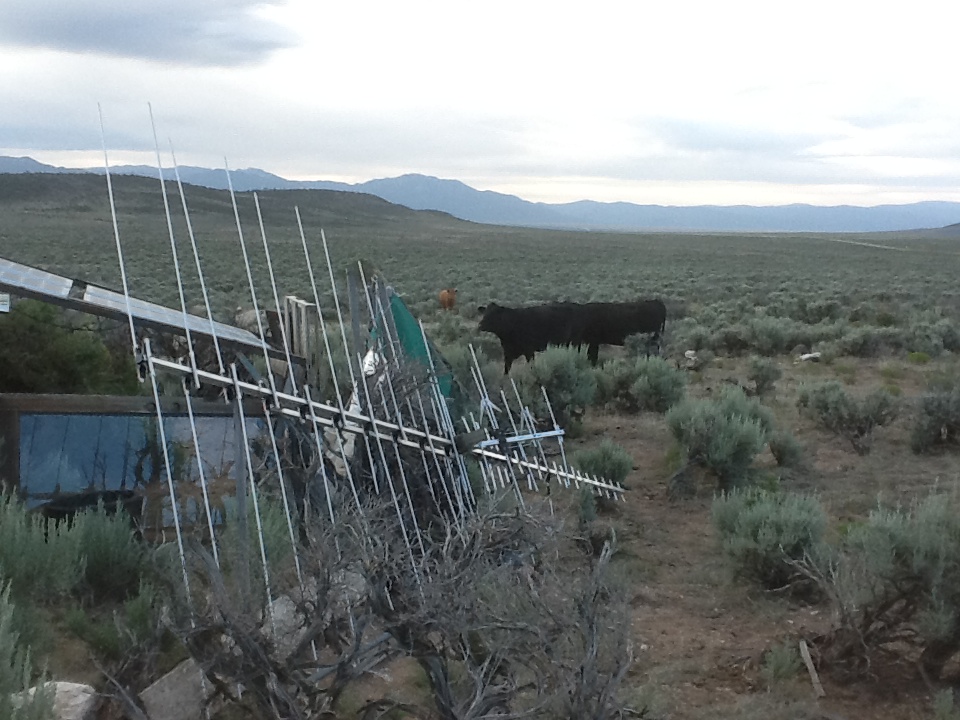
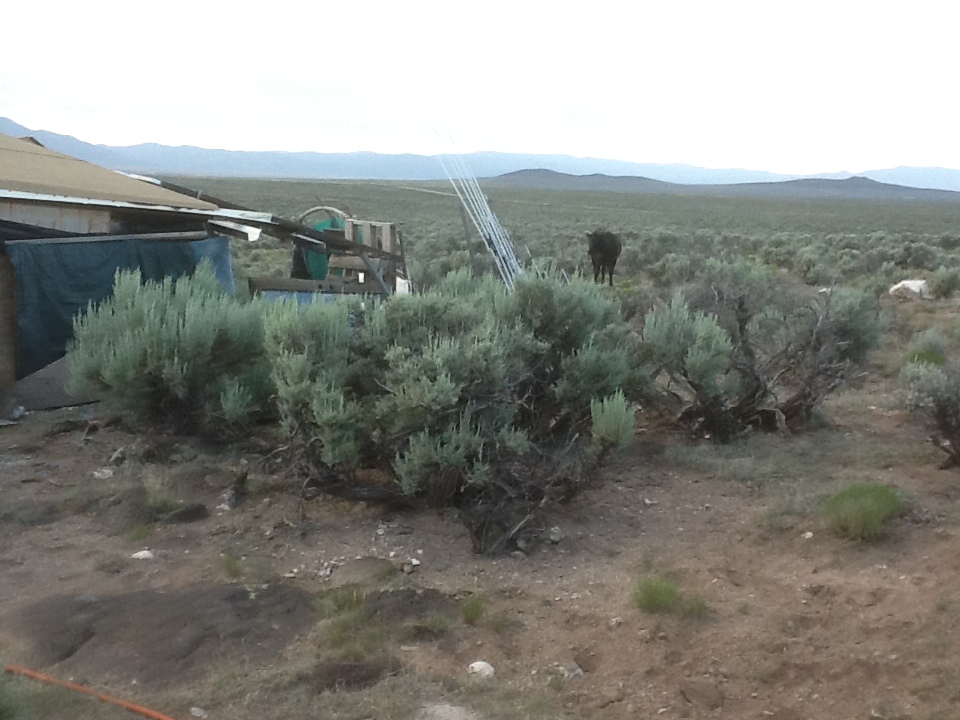
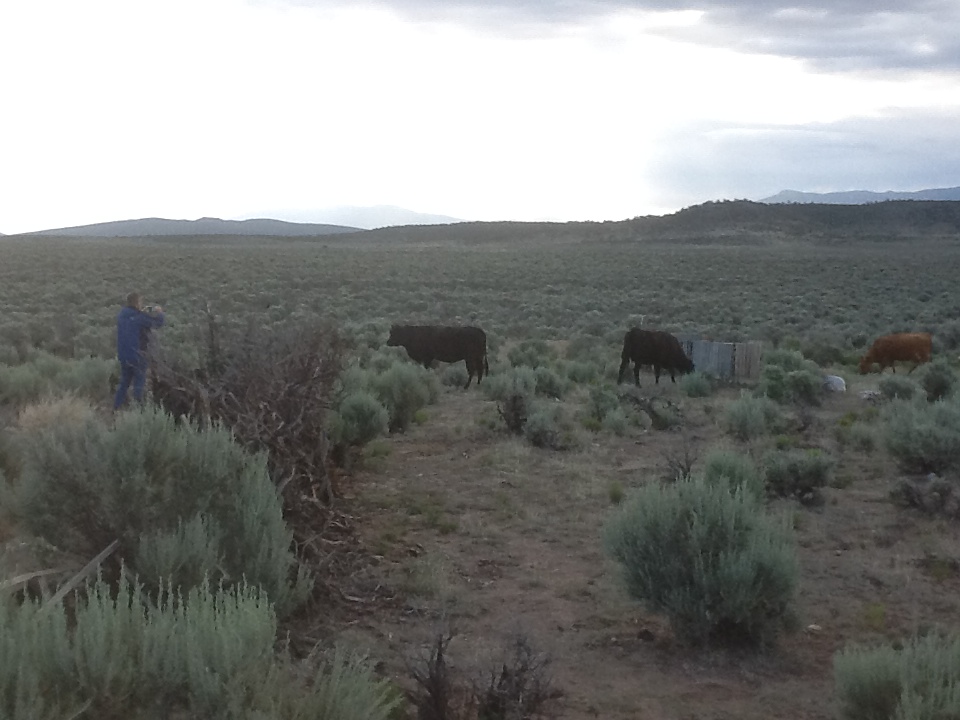
Not twenty minutes later, we heard the black one again and looked up to see her alone, literally running toward the house. Again I chased her off. This time she stampeded through the Gully Garden, mashing a potato plant and squashing two squashes.
Again, a little later she tried again.
Now I am over it and grab a length of 1X2 and chase her off, whacking at her and screaming and throwing it like some caffeinated caveman, hoping to poke her in the flank but only succeeding in making clattering noises at her feet. She didn’t come back (that day, anyway) but we delayed our trip to town for sightseeing and replacement stucco shopping until four o’clock, for fear of her return.
She has me trained now. That’s not right.
I woke up the next morning with no voice at all. Couldn’t even croak.
And some fresh bug bites. Not sure if they’re fleas or spiders as I can’t find anything.
What’s with the plagues? Is it the end times already?
After morning coffee, I set about to mixing up a batch of vinegar pepper, a hybrid approach to some suggestions I found on a French site. While in town, we had picked up a Super Squirter toy that promised a stream range of 30 feet. The model name, The Eliminator, was a hopeful sign. I thought if I could get close enough to douse them, they might associate the stinging with the smell and then I could just spray my perimeter.
I had no sooner begun breakfast when Jim came in from loading his bike to say they were back. I turned off the stove and threw on my boots. Grabbing the bucket and squirter, I strode deliberately toward them on the other side of the gully. Unfortunately, they are learning that they just have to stay a little ahead of me while they continue to graze, making it difficult to get close now. I ducked down in some tall brush as I tried to sneak up on them but a little calf was startled, alerting the herd which started to move off. I saw one with her back to me who hadn’t seen me yet and tried for her. The squirter made a noise and she lurched, most of it missing her. The aim isn’t precise and the stream tends to break up into spray.
A major drawback is that it takes two hands, requiring setting the bucket down when I give chase, then returning to refill each time. By the time I caught up with them and tried again, the wind gods thought it would be funny to blow the spray back in my face. At least I knew it wasn’t like real pepper spray and stunk more than stung. When I got back I sprayed around the perimeter of the house, leaving the bucket by the door for easy grabbing.
After awhile, we took a chance that it had worked and left for the afternoon, Jim traveling on from our lunch engagement 60 miles south of here. I returned at dusk and found no evidence of their return. Good, I thought. Maybe I’m getting the message across, I hoped.
When I woke at 6:30 this morning, I still had no voice. I have an upper respiratory thing going on that has the area inflamed. Probably from breathing cow dust. That and all the shouting. The first thing I did was to look out the window for cows. Nothing as far as I could see.
By the time I had made my coffee, grabbed the IPad, and settled in my comfy chair by the front window though, the entire herd had surrounded that compost compound made of wooden pallets that Trip had left which you see in the pictures.
I calmly took a sip of coffee and laced on my boots with the air of a warrior going to battle. You could hear a Clint Eastwood theme in the background as I snugged on my cap, and strode out the door, picking up the bucket and squirter on the way. The old bull had his back to me and I quietly walked up to him, (no voice anyway) loaded the soaker, took aim, and sprayed, just as he turned to see me.
Again, the wind thwarted my aim but some spray did hit him in the nose and flank and he snorted and his nose dripped a little. While I reloaded, they began to move off. I followed them, spraying at them, trying to saturate the area with the tart smell, until I ran out of solution and hiked back to the house to my coffee.
I noticed as I drank that the herd had simply stopped where I had left them and were continuing their damage. Finishing my coffee, I grabbed the BB gun and the 1X2 and headed out to drive them off. They know the way by now. I ran up on a straggler, possibly the stucco muncher, and whacked her on the rump with the stick, breaking it in two and eliciting only a little lurch to distance us. I lost the BB gun somewhere in the sage during the melee.
When I got back to the house, I did some more research and found the one consistent suggestion is a fence. Since that is not economically feasible for me right now, I researched cattle prods and found one for thirty bucks on Amazon that makes a scary spark and electrical noise and packs a wallop. (It’s called a cattle prod, but it’s only 18 inches long and I get the impression that it was designed to use on people. Hmm.) Now that they are entering my front door and I have pissed off the bull, the stakes have raised and I feel a need to defend myself, in a very real way. An English post I read gave the local statistics of cattle encounters as 18 people killed and 481 injured and he closes by saying, “The best way to repel a cow is to stay out of its way.”
How do you do that when it’s on your porch, chewing its way through your house?
So I ordered it.
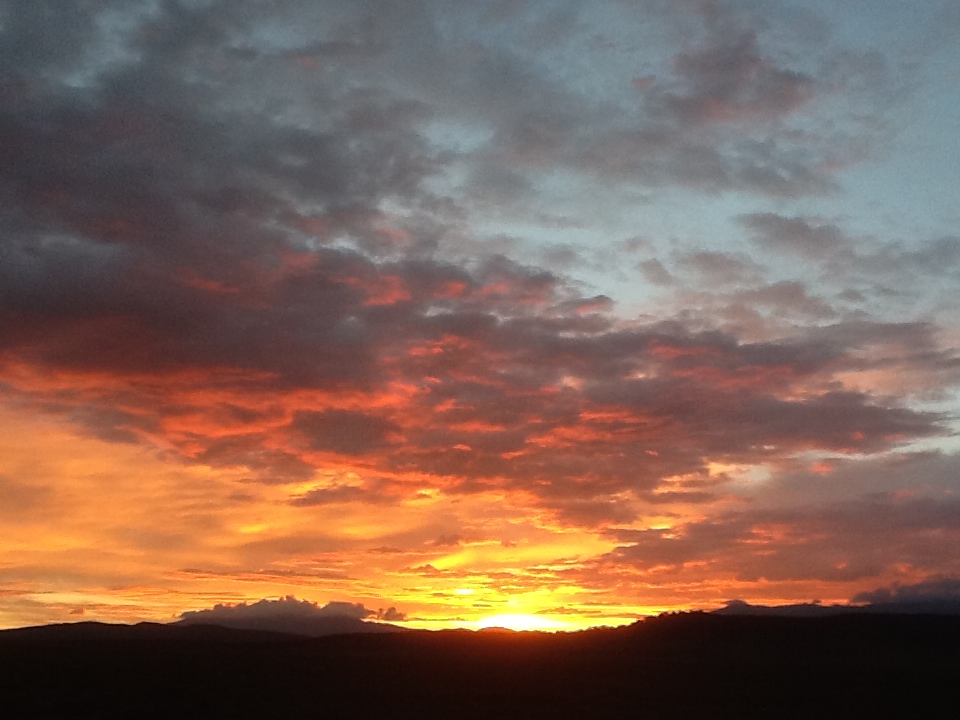
I’ll let you know how it goes in my next post.
If anyone has a question, suggestion, or solution, I’m still daveintaos@yahoo.com
Life on the Range
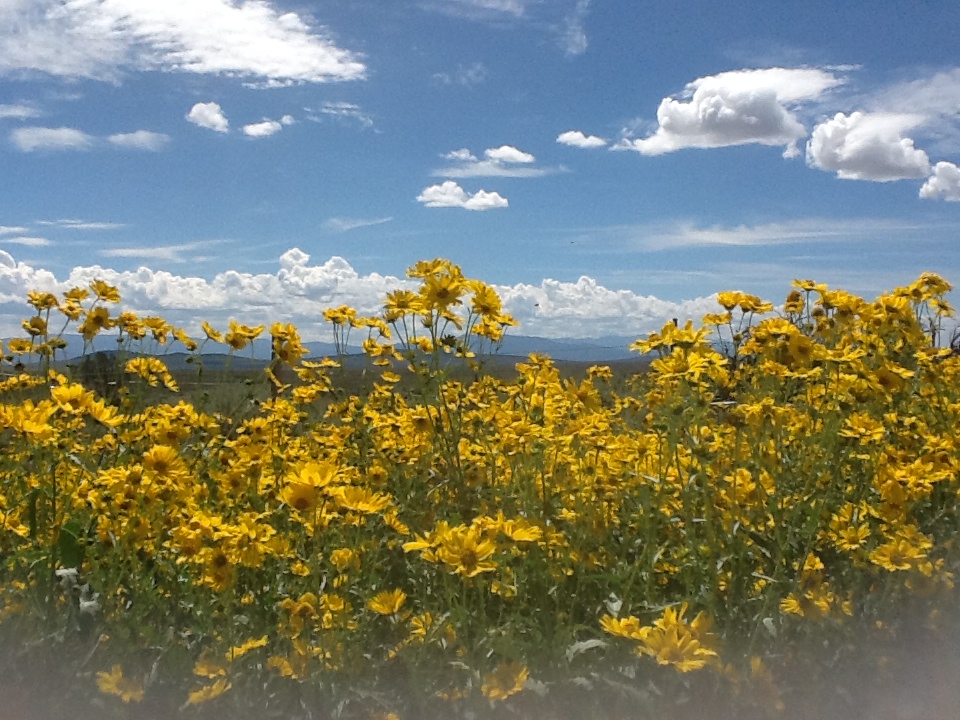 “I’m really new to all of this.” I awkwardly confessed, a little embarrassed to admit it to the younger blonde woman standing before me.
“Put a little jam on it.” she said leaning close, almost in a whisper, a mischievous smirk tugging at the corners of her mouth and glancing sideways to make sure she wasn’t overheard.
“What?” I exclaimed, not sure I had understood her right, still embarrassed by my naivete.
“Put a little jam on it and they will lick it.” she confided, a little louder, demonstrating her experience in these matters.
“Oh,…I get it.” I said as what she meant sank in.
“They’ll lick it and get a shock. They’ll learn what the fence is, faster!”
“Right.” said the helpful lady at the feed store who was selling me the solar powered electric cattle fence system. “They’ll ground it better with their wet mouth than if they just accidentally graze it with their hide.”
“Got it. Makes sense. Thanks for the tip. “, I added.
I had finally caved in and moved an electric cattle fence to the top of my priority list. A house and pet sitting opportunity would have me away for a week and I couldn’t bear the thought of what mayhem would ensue in my absence. I was pleasantly surprised that the whole system was only around $300, much less than I had anticipated. Of course that was without fence posts or any other fencing more than a single, snapable wire, but I managed to enclose the most vulnerable area near the house sufficiently using scavenged posts and existing structures.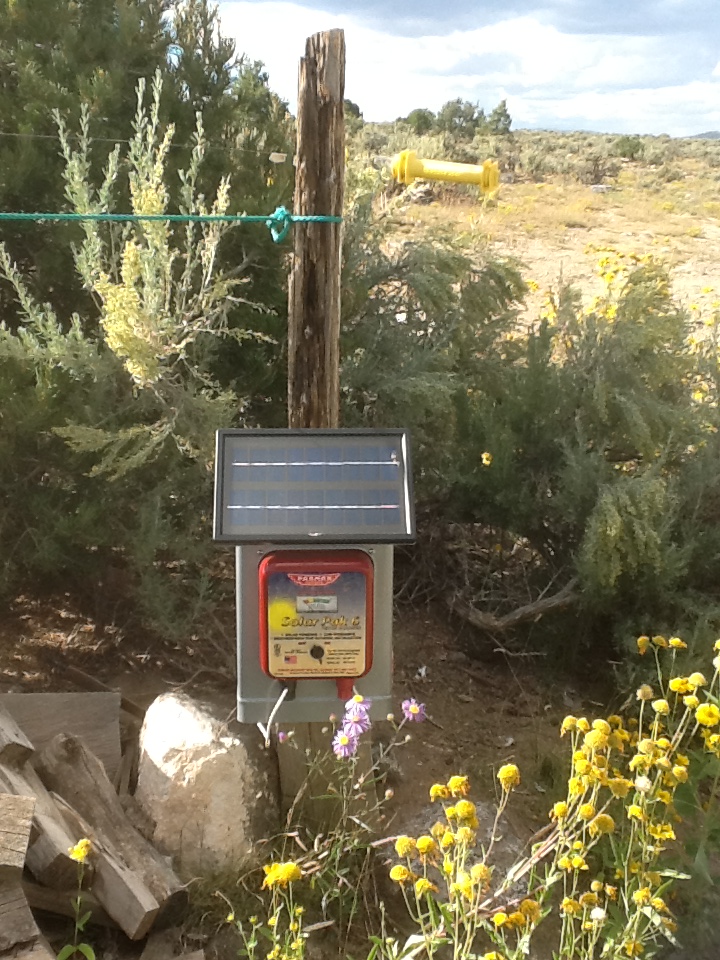 The whole system has a range of 25 miles, way more than I need, and is powered by a small, self-contained battery/solar panel control panel unit that mounts to a post. I added a bright green poly rope tier to make the “fence” more visible and perchable for the birds, and then added little shiny aluminum foil tabs on the wire, swinging in the breeze and baited with jam. Mwahaha.
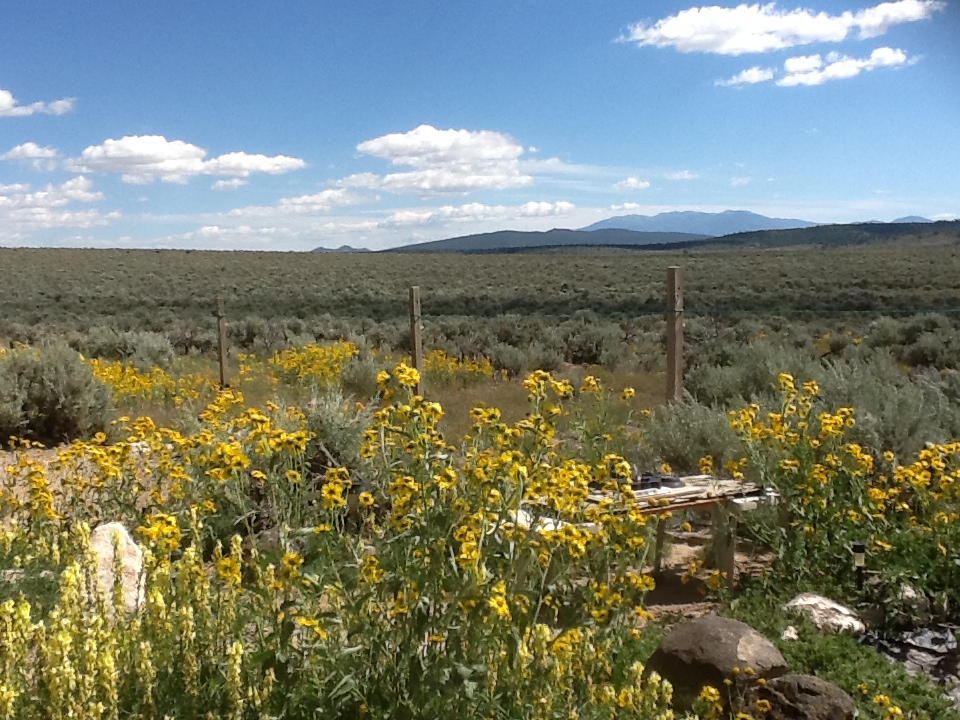
The next problem was, I had no reasonable way to test the system to see if it indeed worked. My resignation to faith in the manufacturer gave way to a personal demo one day, though, as I leaned under the wire to turn the unit off, and my short shirtsleeve merely brushed the wire as I reached for the metal box and sparks leapt ½ inch from three of my fingertips. Mercifully my autonomic lurch didn’t throw me back onto the wire and I laughed at both my clumsiness and with relief that the system actually worked. Quite well.
Rather than use the stretched wire insulated handle latch every time I wanted to enter my area, I installed a low, temporary, pi-shaped gateway using the last three 4X4 posts I had scavenged. Too short to sink into the ground for sturdy support, I braced them in a cairn of heavy rocks, and ran the electric wire over the top. A suggestion of a gate consisted of an aspen branch on pegs, horizontally blocking the entrance, which I could easily set aside without having to disengage the entire fence.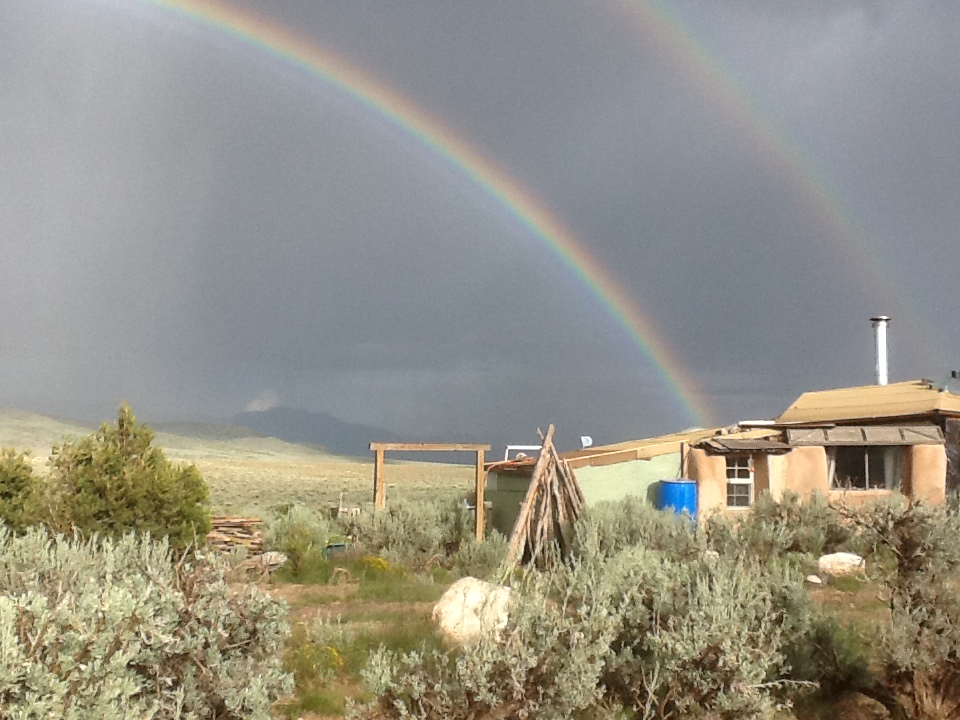
The next evidence of the effectiveness of the fence came in my absence. I returned to find the herd had been back and tromped all around the perimeter and destroyed the compost compound down the hill, but the fence was intact except where one or two of them figured out how to push through the gateway and were INSIDE the fence, trying to find a way out. The damage was mercifully minimal, involving mostly hoofprints, ample plop, and the lopping off the last surviving sunflower and leaving it on the ground to die. They also drank all of the water from three rainwater catchment bins! I have since run a wire across that entrance, too. Better to duck under the wire than suffer further intrusion.
My cattle prod, the Stunmaster 7 Million (or whatever), had finally arrived after misrouting, and, though ultimately impractical, was instrumental in my decision to get the fence. I found it after a Google search for cattle prods took me to an Amazon page depicting it. After it arrived, however I was amused (not) that it was actually designed to be used on humans for home defense. Seven MILLION volts! Do you have any idea how long it took to charge with my meager solar panels? I still don’t know if it is fully charged but, how to test it…?
NOT ME, thank you!
But it does make a very scary electric arc and noise that the cows seem to recognize because they stampede away if I get too close to them now. The last time I was here to chase them off, I decided that I’d had it and herded them miles, all the way back to their own pasture and figured out how to close the gate. It is one of those flippy-floppy barbed wire things that are loosely supported with vertical sticks. It had been tossed aside because it is difficult to wrangle and it blocks their road entrance. How inconvenient for them.
Too bad! These are the same cows that caused that woman’s death on the highway! These are the same cows that have inflicted damage on my place for 12 years! And the state law is on their side!
So, I was hoping that finding their herd back in their own pasture, gate closed, would be noticed, but the cows have been back since then. 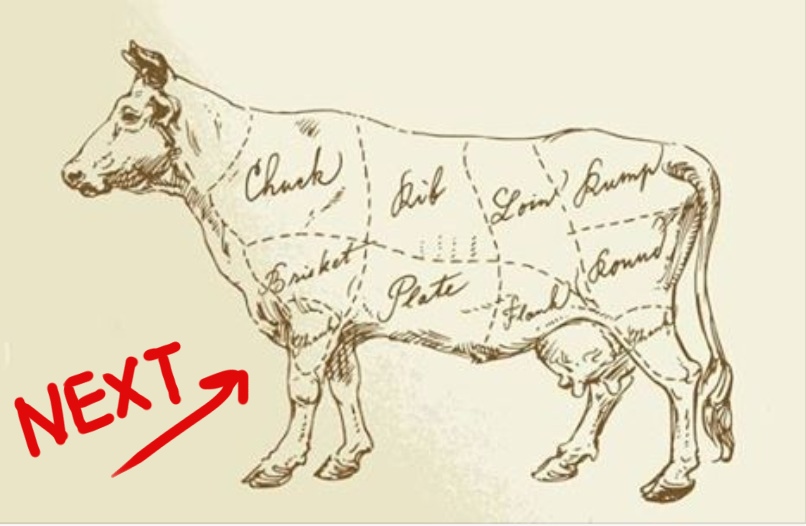 So now, the next time I have to herd them home, I am considering tacking this to the gatepost.
Hope they saw “The Godfather”. (snicker)
Another idea is to bill them for damages and herding services. Retroactive for 12 years!
A neighbor of mine has the same problem (different herd) and has just bought a paintball gun. It would both frighten them and identify them as repeat offenders, and be a message to the owners. Hmmm.
I also saw a gun advertised that shoots rock salt.
But, c’mon! This is ridiculous! My homestead tales shouldn’t always revolve around cows! I’ve tried pepper/vinegar spray, BB guns, and abusive language and nothing seems to deter them. 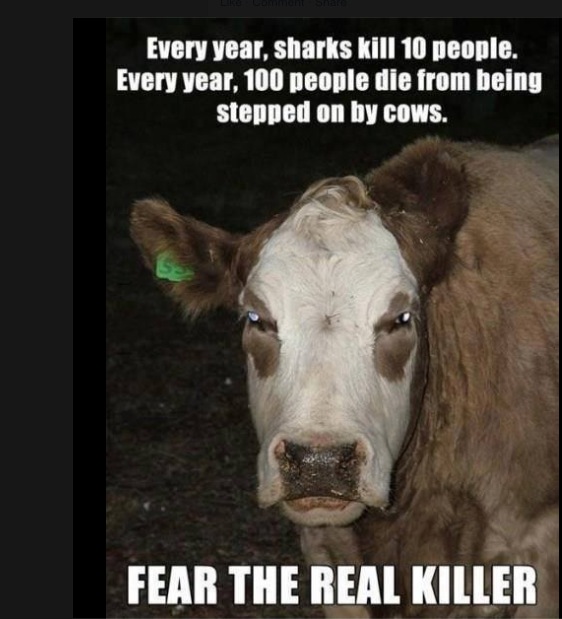 Not to mention the actual physical threat a herd of cows can be. According to the statistics I have been finding, they can be killers. I have visions of performing the ancient feat of Minoan bull leaping, grabbing the horns and catapulting over the bull when they charge.
Right. As if…
Summer Highlights
My new neighbors up the hill managed a brief visit to their land but as they were entertaining guests and making day trips out, we didn’t actually see each other. A couple of calls and E mails reassured me, though, that contrary to my initial trepidation, they aren’t with some scary Texas biker gang or something. Whew. She wanted to clarify that she is an established therapist in Austin and he rides a vintage BMW and would never ride a Harley or wear a black leather vest.
My bad. Good reminder to never make assumptions. They plan to wait until spring to make the move.
Jim and Gavin had timed their bike trip well as the monsoons hit full force right after they left. July 2014 turned out to be the 4th wettest month on record for New Mexico. Now, don’t get me wrong, we’ve been in drought in the Southwest for too long, but all at once?! My already badly eroded “road” eroded further as it became a raging tributary for the Rio Grande, and the gully…?
The rainy season started normally enough and by the second week of July the consistent afternoon thunderstorms had brought enough moisture that seedlings had popped up everywhere and had begun to bloom already. 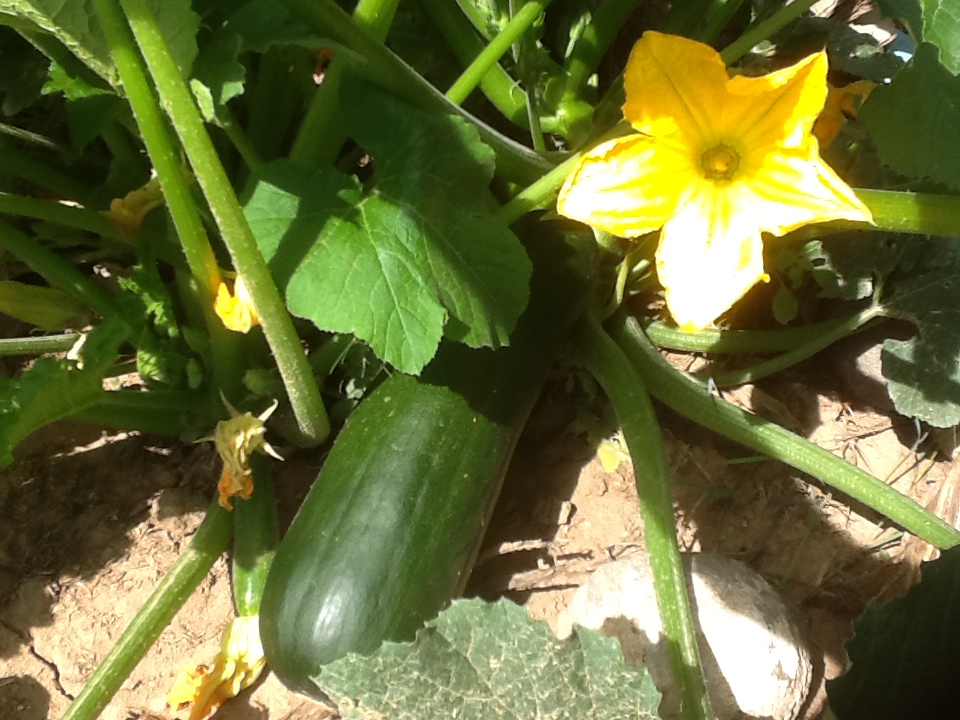 My Gully Garden was flourishing with young plants of zucchini, potatoes, squash, and green beans coming in nicely, thanks in large part to the rich compost resulting from the manure I’d collected from the bovine intruders in my ongoing effort to transform disaster into opportunity.
 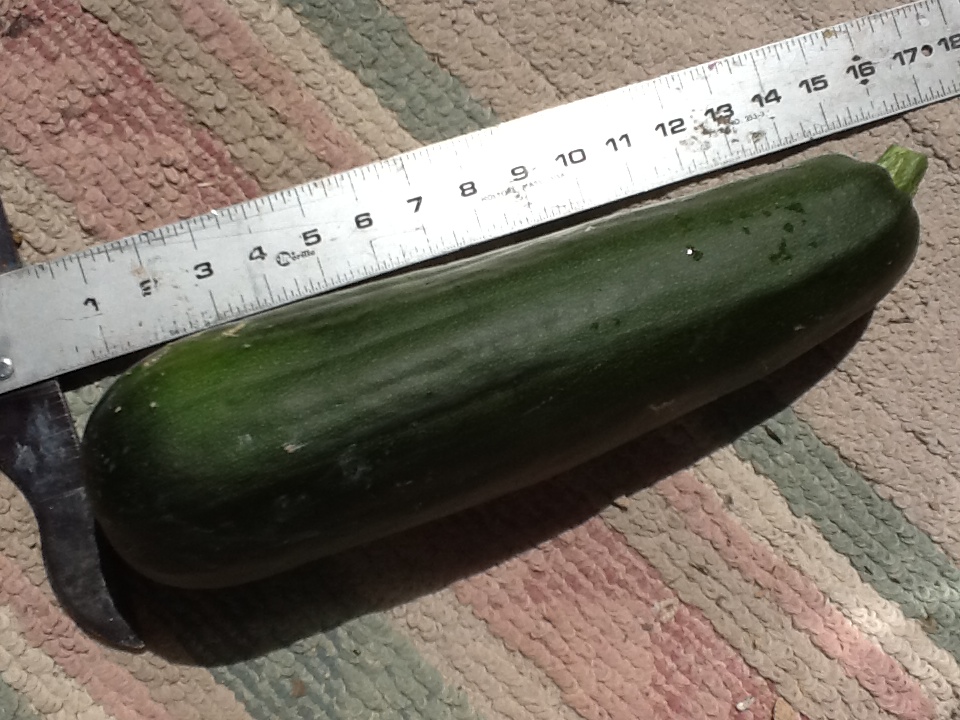 The yellow stocks had just begun to fully bloom and the hummingbirds and hummingbird moths were back in force.
Then it was as if somebody turned up the volume, literally. When it rained, it came with such force and volume that it couldn’t drain off fast enough and the cabin was an island in a churning sea.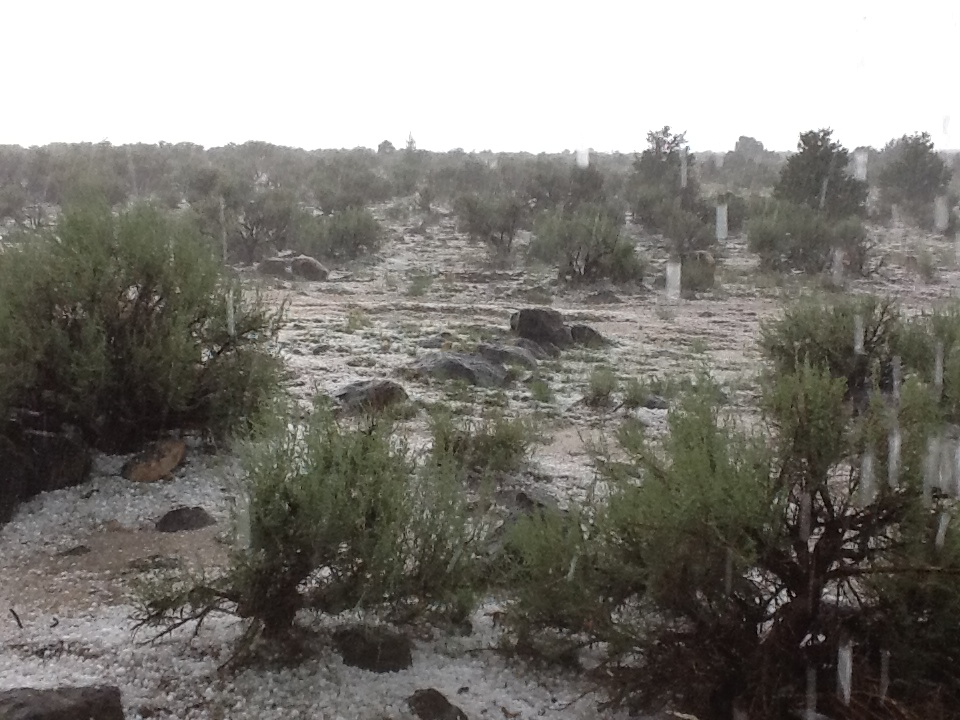
The flooding was bad enough, but then came the hail!
July 16, I spent the morning trenching the Gully Garden, fixing a rain gutter, and digging postholes for the electric fence. Then a huge afternoon thunderstorm brought a massive hailstorm and flood.
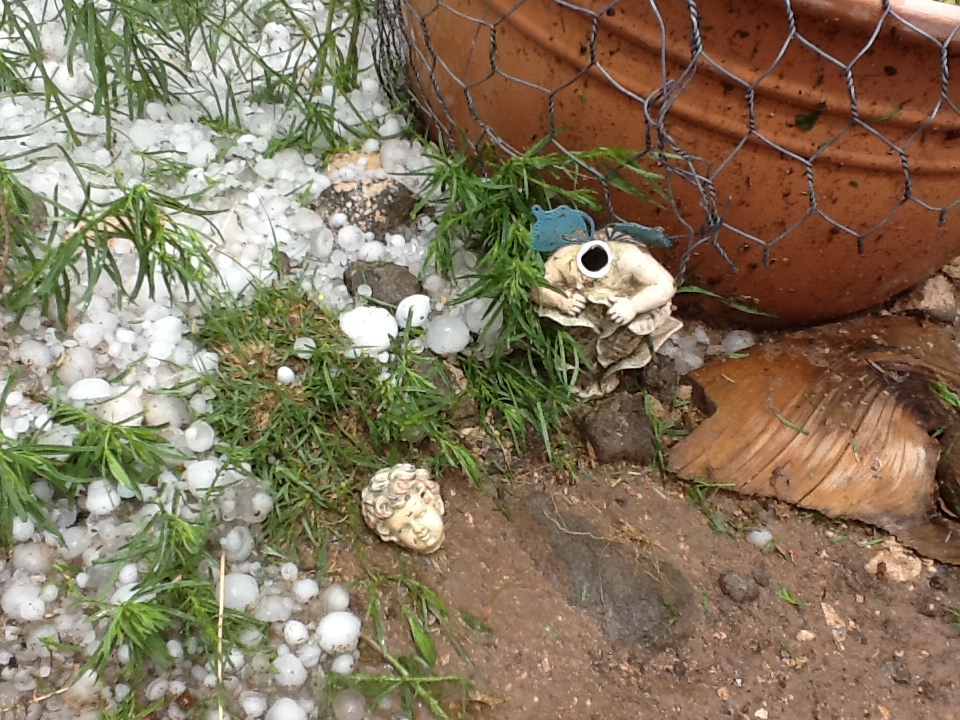
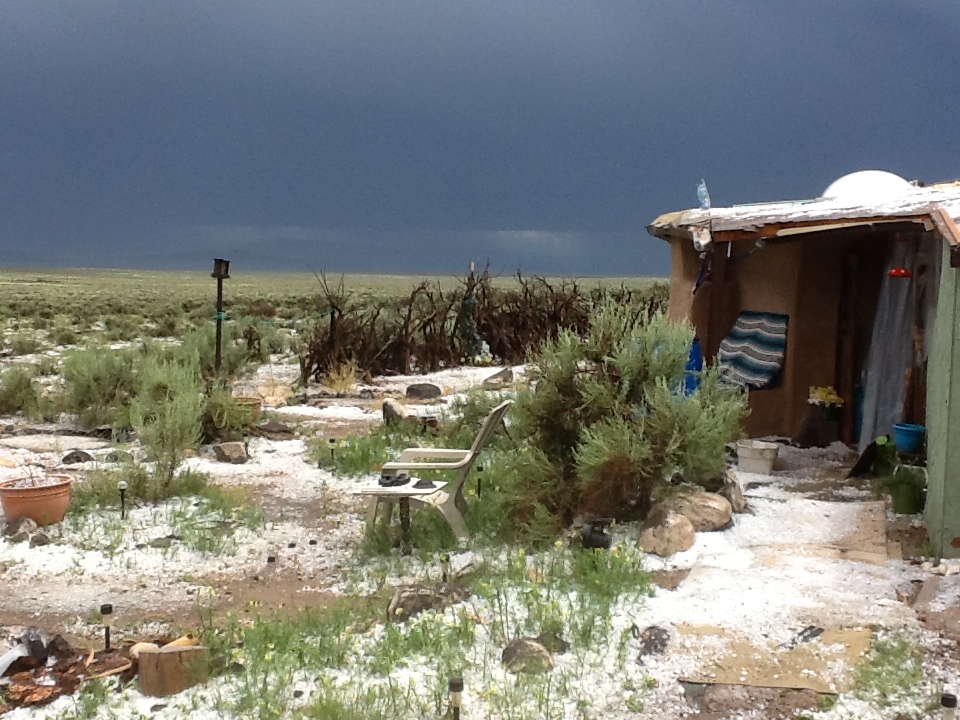
By the end of the day all of the plants in the garden were destroyed, holes punched through their leaves, stems broken, and raging rapids gouging my channels, creating the lovely sound of a mountain stream as it filled in my postholes and now tattered outhouse, spreading to create a small, running pond around the erstwhile loo. Thank God I now have the composting toilet in the house since the tent is shredded and the pit is filled. I figure it’ll make a perfect site for a tree, maybe next spring.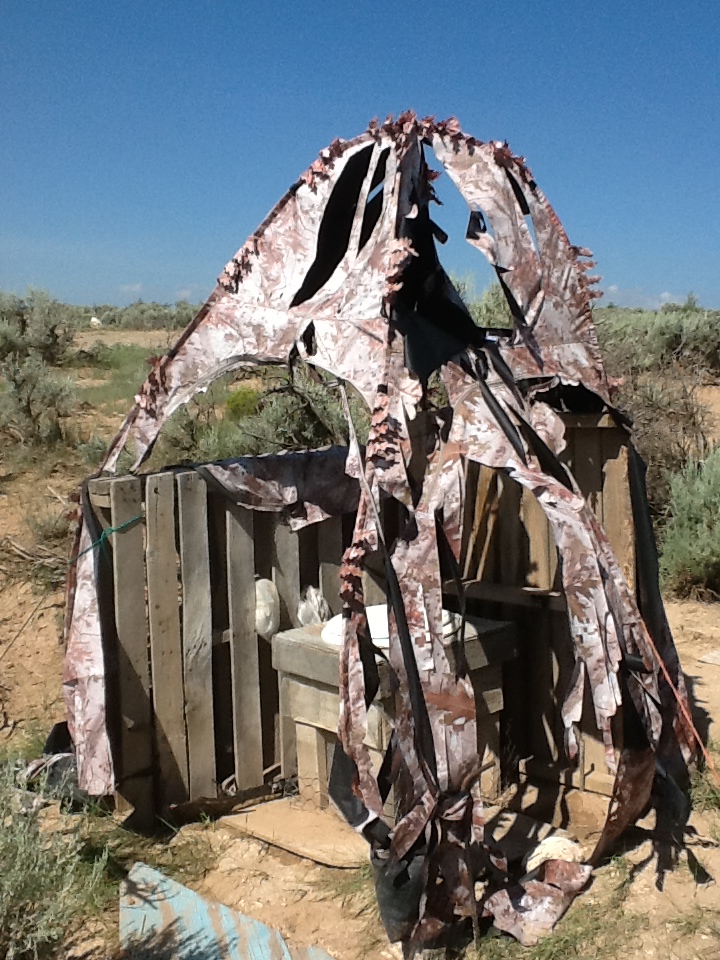
The old and brittle plastic rain gutters remaining from the first season were lacy with punctures from the brutal hail. Even the hardy, ubiquitous sagebrush took serious damage and the air was pungent from their bruised and broken branches, and everything was buried in ice. Christmas in July indeed!
The largest section of roof had 4 inch insulation foam sheets, also old and brittle, were lying exposed to the elements and held in place with various boards, concrete blocks and small boulders that Trip had assembled in a miserable attempt to insulate the house better. 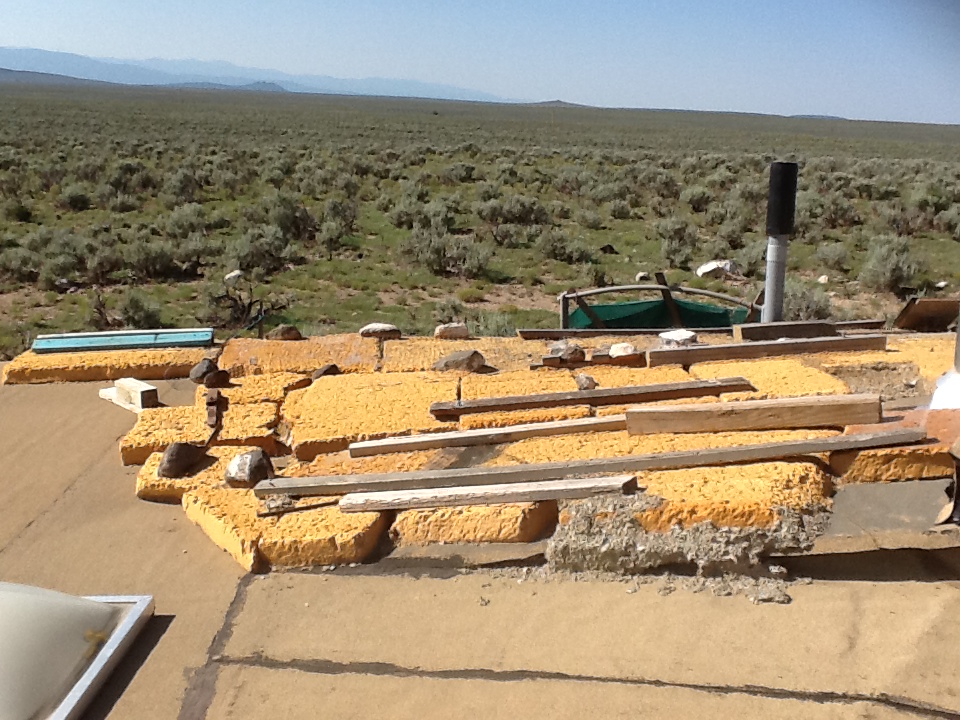 He had a misguided notion to cover everything with papercrete, which not only became a sponge when wet and an ice sheet in the winter, but also served as an ideal habitat for termites, it turns out. At least that’s what they looked like to me when I pulled out some of the soggy papercrete and discovered the nests.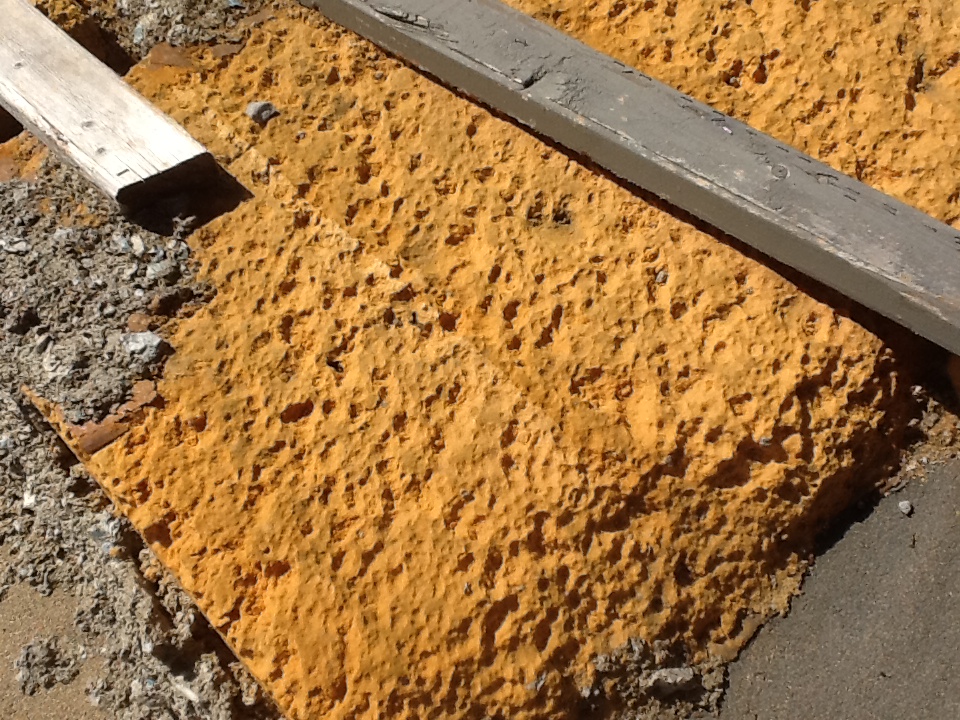
I had gone up to the roof to survey the hail damage. I had intended to cover the whole mess with a new tarp, but I was waiting for it to dry first. Sadly it never had the chance to before the hail turned the whole roof into a “craters of the moon” exhibit, exaggerated by the many actual rocks scattered about to prevent their wind migration. When I pulled back a crumbling chunk of papercrete, the swarming ensued.
My friend Geraint says that we don’t have termites in this area, that they must have been flying ants. Whatever they were, they swarmed all over me when I exposed them, flying into my eyes and ears and under my clothes, and then spread everywhere looking for new spaces to invade. Total creepshow!
I managed to persuade them to move along, (it was a bloodbath, don’t ask) and have covered everything with a large camouflage plastic tarp weighted down with, somewhat more orderly wooden pallets, eliminating the rock and masonry rooftop garden altogether.
The abundant moisture precipitated further summer plagues. Tumbleweeds, those evil interlopers from Siberia, are masters at reproduction. At the first rain, the seeds, which are actually tiny proto-plants, burst into being and grow at an alarming rate. Once matured, the taproot stem shrivels and snaps and the plant bounds into the spring winds, each scattering literally millions of seedlings in its mad journey of invasive domination. Many hours have I spent yanking out seedlings with my gloved hands, determined to stem their proliferation, at least on MY property. The weed stops here! Sisyphean self-delusion, I concede, but try I must!
Another special challenge is the abundant range of flies. Some are fat and stupid, noisily and relentlessly thumping into the glass next to an open window. Some execute complex aerial dances with each other in shafts of sunlight, never alighting anywhere and impossible to swat. Others display vivid and unexpected colors in their bodies and eyes. The worst are the little cattle flies which are fearless and extremely predatory, unshooably going for the eyes and nose and quietly sneaking unseen onto the back of your leg or arm to secure a painful bite out of your flesh. They cover every surface of the house, leaving little dots of…excrement, I guess. I have a flyswatter in every room of the house for easy access. They’re hard to hit unless they land, though. Then I noticed an interesting thing. While the flies were everywhere, when they got into the C/C (just made that up- composter closet vs. W/C -water closet) via the louvered door, they couldn’t figure out how to get out and would congregate at the window. I must interject that the toilet offers no smell at all as it is well ventilated, though the room does have a peat moss aroma from the adjacent bin. At any rate, I discovered that the little room served nicely as a walk-in fly trap. A borrowed mini Shop-Vac works brilliantly to suck up the literally hundreds of flies swarming at the window every day during the summer. (Replacing all of the screens that Trip destroyed has been pushed back until next spring.)
The most troubling plague, though, are the mold colonies which continue to thrive despite my persistent efforts. The many years of drainage neglect allowed the dirt floors to maintain the perfect dampness under the plastic dropcloths and the mold is deeply entrenched, despite repeated efforts to eliminate it. The concrete floor in the kitchen seems to be a successful solution, though, and I hope to extend that to other areas soon. Unfortunately the mold has also invaded some of the already sealed straw bales and so far my attempts to both eliminate, or at least seal it in, have been fruitless. Another thing that will have to wait until warmer weather as a fresh air supply will be essential as I open the wall up, freeing the spores, and the lingering smell of the mold spray. My best defense now is eliminating the supporting moisture and holding my breath until spring.
The Locals
My life on the open range involves interacting with locals other than the villainous cattle. There are a number of good neighbors, too. I was pleased to hear coyote song back this spring. It was also a relief to see some ground squirrels. I was afraid that my poison bait for the mice had gotten into the system. Once I was back to monitor the traps, I stopped setting out bait. I am getting fewer mice in the house now, and want to believe that the house is becoming less accessible for them, though it may just be that they are sated on the birdseed I put out and just aren’t as tempted. I have stumbled on another effective mouse trap technique, though completely unintentional on my part and probably terrifying to the mice. I regularly find mice, and an occasional lizard, drowned in the rainwater catchment basins. Sometimes their expressions are tragic as you realize their terror as they swim, trapped, until exhausted. Not my fault and helpful to my situation, but still I have to resist the urge to install an escape ramp.
The Ravens have become interesting visitors and for a time in the spring I set up a feeder for them on the compost compound. Once the trash was put out of sight, they no longer were a raiding threat. They are really smart and I wonder what interactions I may yet have with them.
All summer I had droves of hummingbirds of about five different varieties, necessitating two feeders, placed on opposite sides of the house to lessen territorial conflict events. They sure do get busy on sucrose. It adds a buzzing excitement to my sparse region.
My favorite critters, though, are my yard bunnies,. Last spring I started to set out seed for the wild birds and discovered that the rabbits love it. At first they were wary of me but the new generations are so accustomed to me now that they will come running when I come out in the morning and evening and some will come right up to me. There are probably at least 7 to 10 regulars. They look too much alike to differentiate or name but some have distinct behaviors which set them apart, such as fearlessness. Since my circumstance is still too uncertain to take on the responsibility of pets, it’s nice to have a herd of yard rabbits to greet me.
Autarky
The word autarky is from the Greek word meaning “self-sufficiency”. (not to be confused with “autarchy”, the idea of rejecting government and ruling oneself and no other.)
Autarky perfectly describes the goal of off-grid living; not intended as an escape from a beleaguered society, but rather functioning as an independent unit within the system, thus relieving stress and offering a new paradigm in cultural aspirations.
Unfortunately, too much my tale so far has been one of absurd misadventure, unanticipated challenges, and side trips into the unknown; Uncle Dave’s Calamity Roadshow, a chatauqua on the road to independence, albeit a cautionary tale.
NOT what I was going for.
My off-grid plan was instigated by necessity, but had a loftier trajectory. I had envisioned a cozy straw bale home, a workshop/studio space, financial independence, and an eventual community of imaginative dwellings created and shared by artists and healers and such seeking retreat from urban madness; a magical place away from the confusion of the city, with shady, green spaces, trickling water sounds, and maybe even a Hall of Wonders featuring a camera obscura or singing plants or something. “Shoot for the moon and at least you’ll land among the stars.”
What I got was decidedly something else.
But it’s always going to be something, right? It doesn’t matter whether you’re in a city or in the wilderness. Life has a special way undoing plans and offering no end of challenges and detours. Case in point, I am back to writing this after an almost three week hiatus when my charge controller and inverter panel suddenly went haywire and shut down, leaving me without the ability to charge any of my tools or electronics. It made for some very quiet nights. It is working again, for now, but they are still not sure what caused the problem. Maybe wonky batteries or a power surge from a solar flare? Who knows?
Despite all of the absurd challenges, I am still here and still determined to abandon my Sisyphean beginning and embrace my Promethean dreams again.
To that end, a review of what I have learned from the journey thus far, what works and what doesn’t, would be useful.
Off-grid Life Lessons
Something that we all have in common is the need for a place to live. Consider, though, what proportion of your day, of your energy, of your life, goes to securing this most basic human need. While some are adept at living al fresco, such as my jackrabbits and a few homeless people I have met, such as Steve Fugate (Love Life), most of us need a dwelling to feel secure. (Plus there’s all your stuff, right?)
But if all of your energy and waking hours are dedicated to securing that, when do you get to enjoy it?
Dedicating your waking life just to secure a place to sleep is an avoidable fate if you can change your assumptions about what you need and how to obtain it.
So what do you need?
Land
A place to put the dwelling. Where do you want to be? Close in or out in the boonies? Consider the climate, the view, the neighbors, the local cultural resources, and whether it has features which suit your plan, such as level building space, water, trees, access both to your property and to important resources such as groceries and gas. Budget may affect your choices, but once you own the land, it’s yours! Done! No bank. No mortgage. No homeowner’s association rules and fees. Now you can take your time with the next step.
Also be sure to visit the place during ALL the seasons to avoid nasty surprises and unexpected challenges. Consider issues such as flood zones and temperature extremes. I had only visited Taos during the warmer months and never expected such complications as being snowed in or cloudy days with snow accumulation on the solar panels preventing charging. Coming from So. Cal and Las Vegas, keeping cool and water resources were at the top of the list. Having no water because the tank had frozen wasn’t even imaginable,…yet.
House
Dwelling styles worldwide are so varied that the Frank Lloyd Wright approach of “Form Follows Function” would be a good guide for selection. (Another would be, “Don’t build it out of food for the local animals.” Sure! Obvious now!) I have been approaching my place with the intention of maximum dwelling for minimum cost. By maximum dwelling, for me, I embrace the philosophy of the Earthship: a self-sustaining living habitat. You harvest your power and water from the sky, manage and re-purpose your waste by growing your own food, and heat and cool using simple, natural earth-based methods. A wise culture would make all of their new dwellings self-contained units this way, eliminating the need for massive civil engineering grids and systems or dependence on a central “authority” for one’s basic living needs.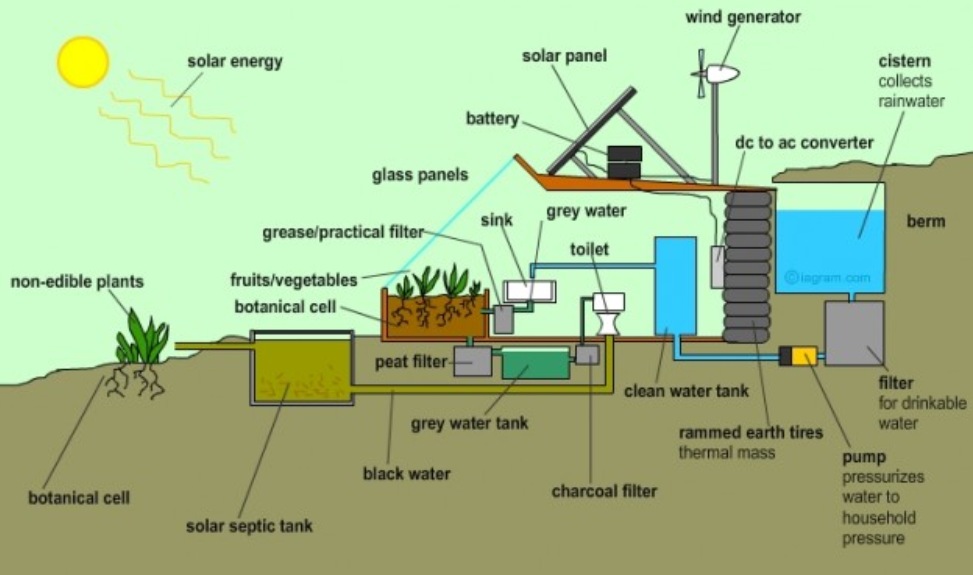
My original plan to build a straw bale house was thwarted by the insidious cows, et al., but offers a lesson for choosing the proper construction technique for your location. Using local materials makes very good sense. Locally, adobe has served well in this arid region for more than a thousand years, and the Earthship technique developed here by Michael Reynolds also takes full advantage of local and recycled materials to craft a home that addresses the demands of weather and terrain. The extremes of weather here demand good insulation year round and water catchment for the seasonal monsoons can solve your water needs.
Another method of building I have discovered that I still hope to try is earthbag construction. The calcium rich, sandy/clay soil I have here is perfect and would set up like concrete eventually.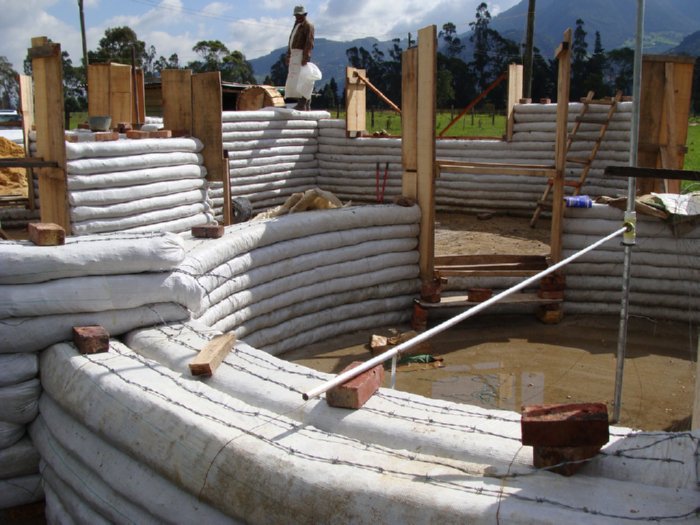 A popular method to finish them is cob, essentially dried mud, like adobe, but I think I want to experiment with something more durable and refined. Properly done, they can be built fairly quickly and affordably, are durable and can be quite refined.
Floors
The original plan for the original strawbale was to have concrete floors which offer thermal mass, storing daytime direct solar heat and releasing it slowly at night, with piping embedded for solar heated and pumped radiant floor heating. I had stalled the concrete delivery for the floor and foundations until I could figure out the details of the plumbing for the floor and gray-water drainage which, once done, is done. No turning back. Unfortunately that left me abandoning ship that first winter, and you know the rest.
The default dwelling started out with the original slope and had to be terraced out, occasionally dictated by immovable boulders, which became incorporated into the indoor terrain, the largest outcropping of which now offer thermal mass to my Kent woodstove. Earthen floors are a common choice in this region, especially with the traditional adobes, but they require some kind of binder. Currently, boiled linseed oil is the preferred choice but traditionally ox blood was used. Neither appealed to me; the former creating fumes, unacceptable for an asthmatic, and the latter being just creepy. Plus, you can’t walk on it for weeks while it dries and cures and that was wholly impractical. For now, at least until warmer weather, the plastic/plywood/carpet over dirt must serve. Then I hope to install the radiant floor heating in a concrete and local stone floor for thermal mass.
Water
Having water is obviously a vital, necessary resource. Most of us from modern cities are so accustomed to ample water access that we have casually wasteful habits. A longtime camper, I was prepared to change those habits, but I sure do miss some of the simple basics, such as turning on a faucet.
That’s it.
No gotta get your water tank filled by someone you have to pay to truck in from town. (No bringing 5 gallon water containers into the house having to be filled by me in town because that tank froze around mid-fall, either.)
While the composting toilet eliminates the need for flushing, plumbing, and a septic tank, I do miss being able to take showers and do laundry. For now, I have a camping solar shower bag that heats nicely hanging in my well drained sun porch which can get up to 100 degrees in full sun and makes a cramped but serviceable bathing area for now, even when it’s 30 degrees and blowing outside. (The laundry goes to town.)
In addition to the solar shower bag, I maintain a supply of hot water by placing a large black metal pot with a glass lid (or a sheet of glass), half full of water, on the sun porch. I just scoop out as much as I need for dishes and such. As long as there’s sun and I remember to replenish the pot, I always have hot water waiting. During the summer I simply coil the hose on the roof of the wood room and the sun heats it nicely, offering limited pressure from gravity. This works well for basic washing but by the end of the summer I noticed occasional bits of green stuff from something flourishing in the sun heated hose. Perhaps a black hose will solve that problem.
Someday I will implement my plans to enclose the 1700 gallon water tank up the hill with an insulated shelter that will serve as a utility shed, housing the water pump, generator and tools. The store room in the house will have the pressure tank and on-demand propane water heater I purchased twelve years ago hooked up and I will enjoy the pleasures of hot and cold running water again!
Gray water will drain to a natural filtration area and be used for the garden. With an improved rainwater catchment system, including a large tank and filtration system, the monsoons can bring enough rain to provide for all of my water needs. A solar still will keep me supplied with freshly distilled drinking water and a roof-mounted solar water heater will supplement my hot water needs. Perhaps someday I will invest in an expensive well and get a windmill to pump it, but I suspect it will be unnecessary.
Power
Living in the great American Southwest as I do, the most obvious alternative power source is solar, but the home consumer can readily supplement their power needs with wind turbines. Although the sun comes out here a lot, we do have a number of short, snowy winter days that seriously impair the solar system. Such days, however, tend to have abundant wind which could supplement my power needs by driving a wind turbine. People already hooked up to the power grid can sell their surplus power as a supplemental generating plant, thus offsetting their power bills.
The biggest drawback to such systems is the need for power storage during the sunless or windless periods. Deep-cell batteries work well but are expensive and have a limited life. There are newly developed solar panels that store energy and other improved battery systems, such as those being developed by Elon Musk for the Tesla electric cars, but for now standard batteries must suffice. I do all of my charging and power consuming activities such as running the sweeper when the sun is out and providing ample current to minimize the strain on my battery array.
For my evening lighting, I still use solar yard lights. I set out a tray of about 20 of the little cylinders every morning and then place them about in various imaginative lamps in the evening. I have the option of regular lighting when I need it, but my battery bank is weak from years of use and abuse from Trip so I am tapping them frugally until I can replace them all. (It is important to note that the batteries should all be replaced at the same time since they are all interconnected and will only function as well as the weakest one.) I am considering a redundant, separate system with its own panels or wind turbine and battery bank to spread out the demand and stagger the replacement times. The batteries don’t tend to fail all at once but, rather, weaken as they go. I hate to get new ones when the old ones still have life, but won’t hold a long charge. A secondary system would be a practical solution to avoid inconvenience.
Heating
Unfortunately, electricity is a poor method for heating. My wood stove is a good, basic solution, but obviously requires a lot of physical energy and adds to the air pollution. Propane is a popular alternative in this region, but, again, has to be purchased, delivered, and subtracts from the air quality.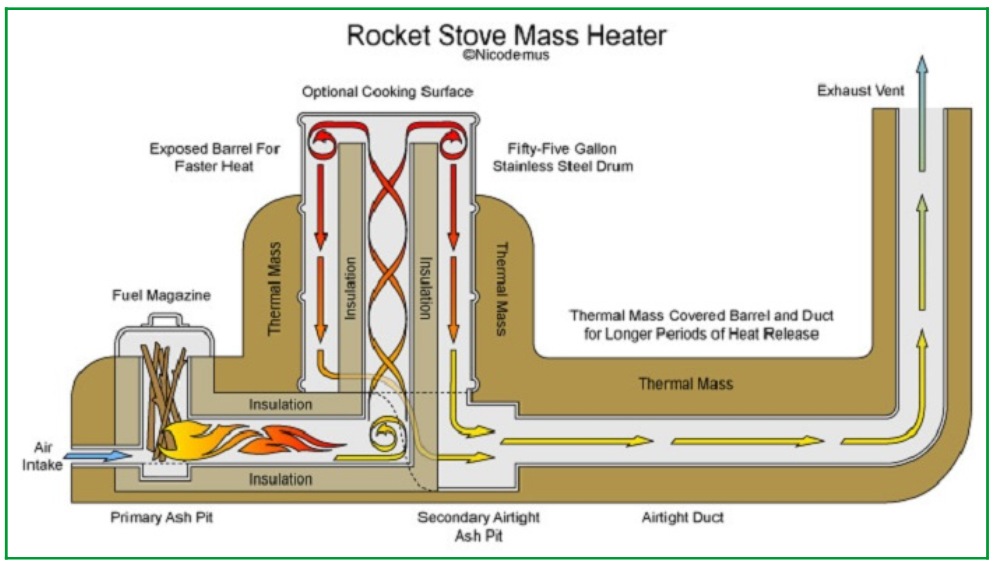
Rocket mass stoves are an excellent improvement over an ordinary wood stove. The kindling sized fuel is completely consumed, venting as CO2 and water vapor, and all of the heat is stored in thermal mass for slow release into the house. The can be constructed with a cooking surface and an oven, too.
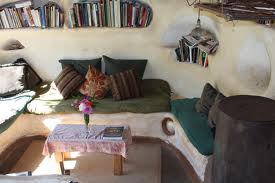
I am especially pleased with my solar porches and use them as heaters for the house. The black painted stucco covered bales can radiate enough heat to bring the enclosure up to a hundred and more on a sunny day.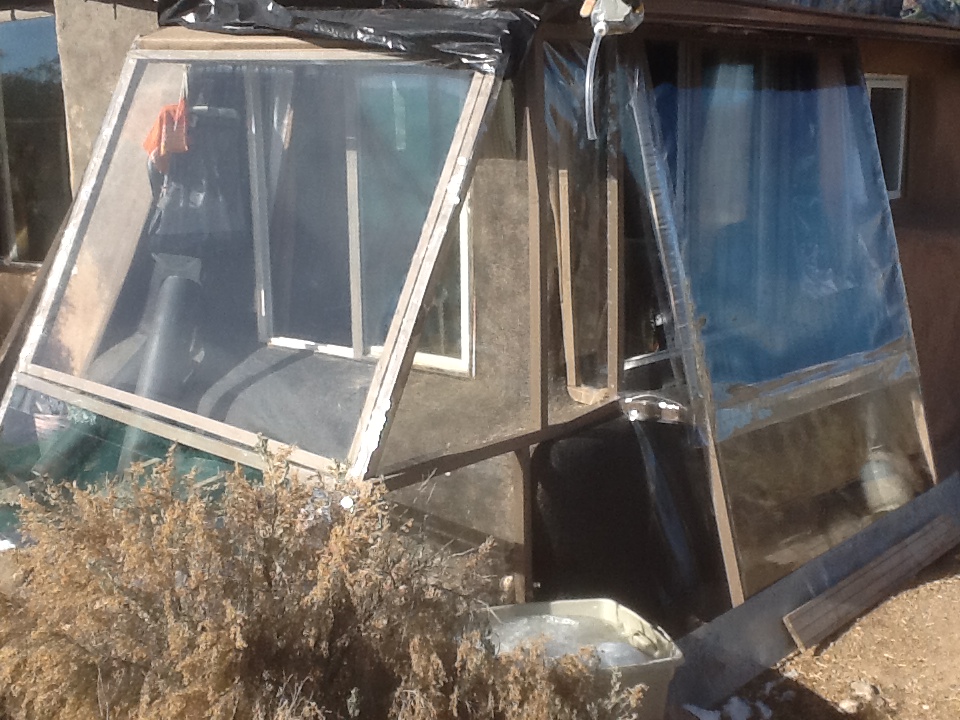 I have thermometers mounted in them and open the windows when the porch temp exceeds the indoor temp, letting the fresh solar-heated air flood in.
The Trombe Wall I installed for the C/C works fairly well but needs better weatherstripping. I made the choice to draw fresh air into the heating space, rather than to draw it in from the floor level of the toilet area as one normally would, out of concern for recycling and warming stinky air. As it turns out, though, there is no smell to concern about and a closed system air exchange would have been better, as now it simply serves to equalize the pressure when the wind blows, sometimes drawing cold air in faster than it can warm up. It still works well though in terms of keeping the room consistently warm enough to maintain bacterial activity for the composter. Still need to refine the design.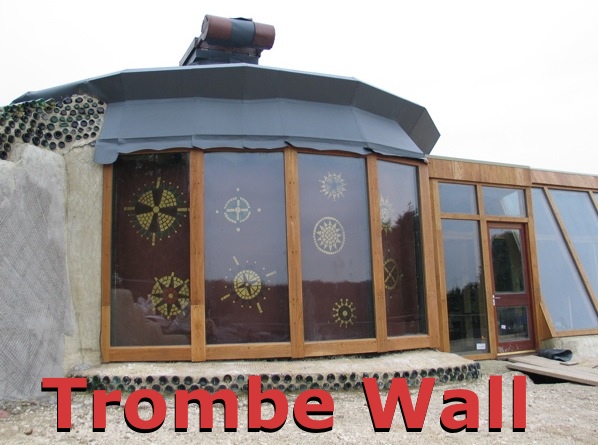
The key to having a warm house, I have discovered, is the same as the Boy Scout adage of not getting cold in the first place. Plugging drafts, covering windows and exterior doors, and upgrading insulation can make all the difference. I have installed rolls of reflective “bubble-wrap”-like insulation on the ceilings and added layers of clear bubble wrap to the “clerestory” windows which has made a vast improvement in heat retention. The place will now hold about 35 to 40 degrees warmer than outside, without adding heat. I have built a cairn of rock around and on top of the stove, which stores the heat well, releasing it gradually after the fire dies down, making it much nicer to get up in the morning.
Food Preparation and Storage
So far, I have been cooking on a two-burner Coleman propane camp stove. I finally got a larger, refillable tank so I can stop using the expensive, disposable canisters. Eventually I plan to get a regular small propane stove with an oven and a low energy microwave oven, but for now I have learned to improvise using a frying pan, dutch oven, and grandma’s pressure cooker.
The pressure cooker has become my central cooking and storage device. It not only uses less fuel to cook up batches of bachelor fare, such as stews and casseroles, but also serves splendidly as a storage system as well. Once I have removed my meal, I reseal the cooker and set it on the porch to cool down quickly. Airtight and pressurized, it is effectively canned and can last safely for days. I always bring it up to full heat and pressure each time before serving to be safe, but have never suffered any ill effects, even in the summer.
Refrigeration is one of those things that we moderns take for granted. During the summer, I have a 12 volt cooler designed for camping that makes things about twenty degrees cooler than ambient temperature, OK for veggies and such, but no good for dairy or meat. This necessitated trips to town every few days to replenish the ice for the ice chest and to restock perishables more often, an expensive nuisance. One of the things I miss most is ice cream.
There is a traditional cooling system from the deserts of the middle east that 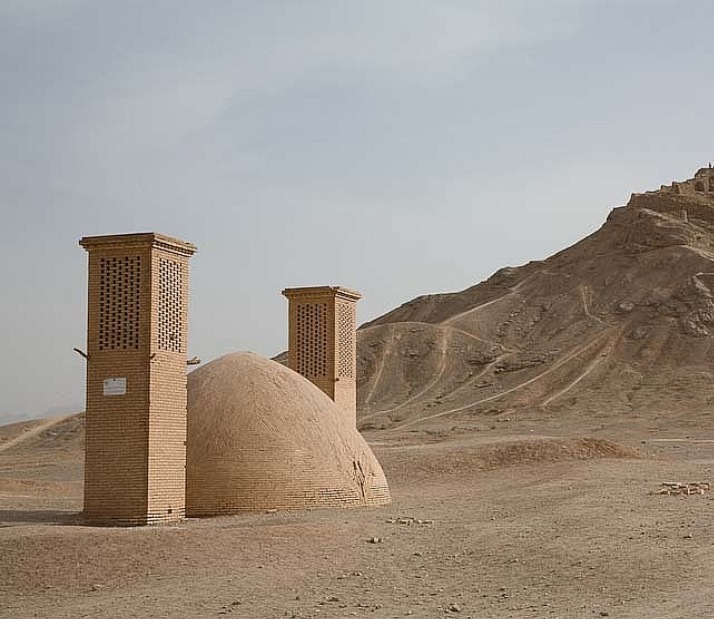 I have discovered called a Yakhchal, which I hope to adapt to my purposes here. Properly built, it can make and store ice, even in the hottest deserts.
Another traditional food storage method is a root cellar which I plan to implement, perhaps in a hybrid approach with the Yakhchal. Ah,…dreams.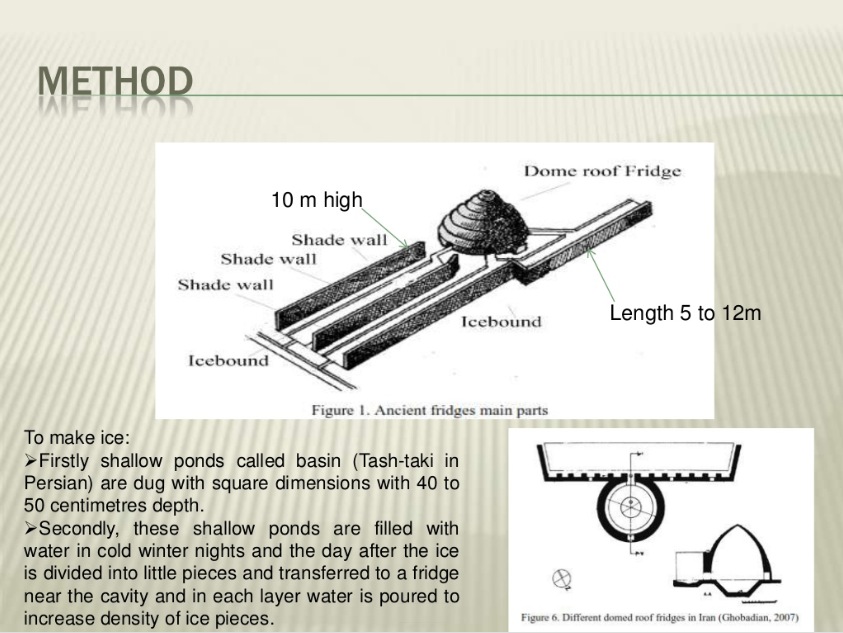
Gardening and Food Production
While not everyone will want or need to depend on “growing their own”, one has that option, whether for survival, economy or just better produce. I have discovered an excellent gardening method, especially useful in climates with short growing seasons or cold nights, both of which affect me at this elevation. 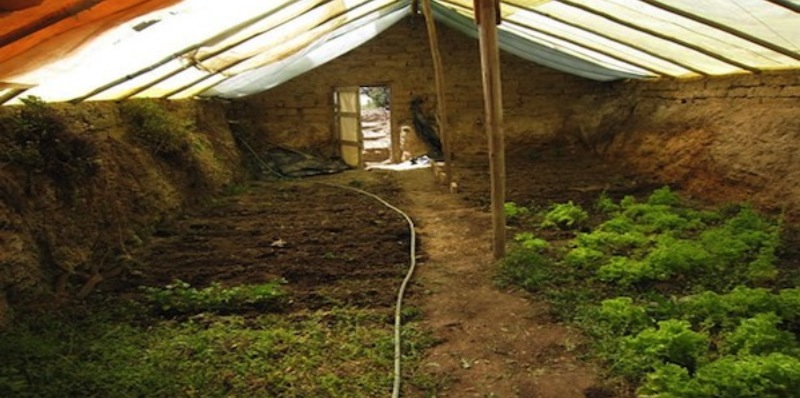 In Peru there is a simple growing house called a Walipini, which consists of a pit house covered with a translucent sheet plastic roof. Being semi-subterranean, it is sheltered from the wind and benefits from solar gain.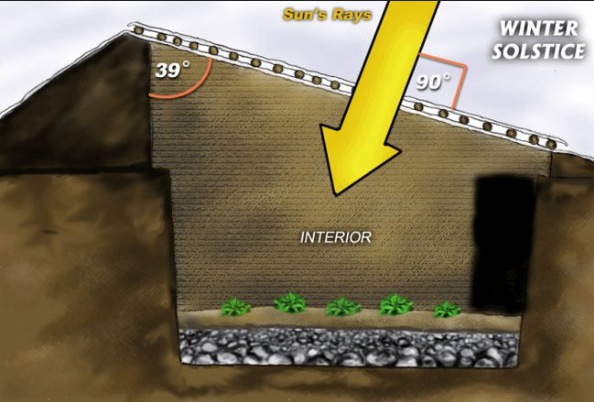
I hope to incorporate these principles in the Gully Garden this spring.
Communications
Being so isolated, establishing communications for me was vital. It was necessary for me to switch phone carriers after I arrived as there was no signal. Even then, I had to get a powered antenna to get enough signal to use the WiFi feature of my smart phone. With that I am able to go online, a burgeoning necessity in the 21st Century, though with limited data streaming capability. My dream is to get a satellite dish system and get my phone, TV, and internet bundled. That will have to wait for a stronger battery array, however, but will make a huge civilizing impact on my remote dwelling.
Home on the Range
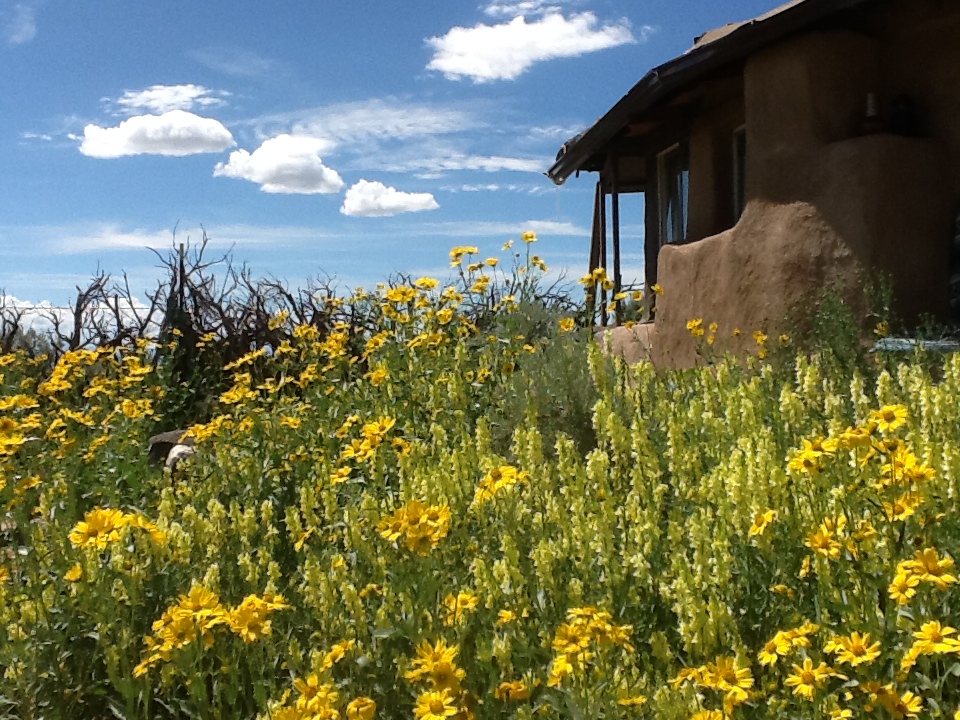 My dream of autarky has undergone many changes since I first set out. Like any good adventure it has had many surprises and plot twists, but the goal is intact. My country road to independence unexpectedly became a roller coaster ride, but once the lap bar was locked down, all I can do is hang on until it’s over. As scary and abusive as it’s been at times, though, I have had the occasion to raise my hands with abandon and laugh with the giddy free-fall. Plus everything is additive, barring renegade cows and floods. I have to remind myself how far I have come with it, and chronicling it has helped me in that regard.
Of course, I guess projects like this are rarely really finished or over. There will always be new things to do and create with other challenges, but, cows and calamity notwithstanding, the goal is worth it.
Take Back The Power
 The responsibility to create a sustainable society lies with each of us. Our world today is being increasingly corrupted by corporate greed and shortsightedness fostered by outdated or distorted cultural values. We can change that by making different choices and creating a new paradigm.
“You never change things by fighting the existing reality. To change something, build a new model that makes the existing model obsolete.” -Buckminster Fuller
To that end, I have set up a Facebook Page which offers links and posts of resources and the latest developments in alternative solutions to our increasingly challenged world resources:
Take Back The Power
http://www.facebook.com/betterworldchoices
Please share the link and feel free to post relevant links and news.
Thank you, reader, for your indulgence in my misadventures. I hope it has inspired you to making better freedom choices for yourself as we progress into a new era for, not only humankind, but all life on the planet.
Let’s choose wisely.
“Early afternoon.” I had told him, implying after lunch. It was exactly twelve as I pulled into the parking lot of DPW. My early departure to accommodate rain had gotten me in early and I wondered if 12:01 sufficiently constituted afternoon or if he would already be gone to lunch.
“Nice Day!” the guy with a grin said, emerging from the building and into the hazy sunshine.
“Yeah!” I said I climbing out of my car and peering to see his nametag, wondering if it was him. I noticed it was much warmer down here 150 miles south and 2500 feet lower.
“Best time of day, too.” he added, “It’s lunchtime !” he said smiling at the sky and striding to his car.
I lugged the heavy metal unit from the back of the Jeep and made for the entrance. As I got there, a guy who looked like he was also on his way to lunch paused to hold open the door for me, hesitating to see if I needed help.
“Hi. I’m here to see Ray.” I said to the woman at the desk.
“Oh, I think he’s already at lunch.” she apologized. “Let me check.” she said picking up the phone.
“Oh, I was hoping to finally meet him.” I explained, “He loaned me this inverter unit and I need to swap it for mine.”
“Here. Why don’t you set that there.” said the guy who had held the door, indicating a cart near the entrance. As I set the heavy thing down, I noticed its twin next to it with my work order taped to it.
“Oh, that one’s mine.” I observed. “I was still hoping to meet Ray.” I said turning back to the woman at the desk. “I was hoping to take him to lunch as a thank you.”
“He was at lunch, but he’ll be back in five minutes.” she reported.
“Are you the guy whose house got eaten by the cows?” he asked, his blue eyes sparkling with mirth.
“Yeah.” I said, the surprise that he knew the story obvious on my face. “Did you get a chance to read it?” I asked, shyly gratified.
“Oh, yeah. Have the cows been back?”
“No. They’ve been gone for the winter. But I do have a solar electric fence now, maybe you saw in the story?”
“Yeah, is that a twelve volt system?” he asked.
“Gee, I don’t know. It came as a unit that hangs on a post.” I said, measuring a shape with my hands, “ I got it at the feed store.”
And so we talked for awhile, exchanging details and histories. It turns out that Kevin is the co-owner and founder of the solar company which had been so supportive of me in my desperation back during the “Great Solar Crash of ’14”, when I was suddenly without power for most of three weeks. After he left for lunch, I swapped tales with Dora at the desk, who turned out to be the other owner’s wife and a former Taoseno, until Ray arrived.
I was glad to be able to express my gratitude to this guy who had given me a loaner inverter, without even meeting me, while he ascertained what was wrong with mine. As it turned out, nothing was wrong, gratefully, but I was reluctant to disable my system during the winter and make the long trek to Albuquerque to make the swap, shamefully putting it off for too long. Not only was he patient about the tardy return, but generously didn’t charge me for the loan or diagnostic.
He explained that he was sympathetic, having lived off grid for a time in northern Nevada and understood how important it was to get a system back up and running immediately.
“When I hear it’s an inverter problem, I always take everything I could possibly need to fix it on the spot. They need their power!” he emphasized, understanding how power dependent we are now in the 21st Century.
“Is that the same Jeep as in the story?” he asked, pointing to the lot.
Again, surprised that he knew my Jeep, too, responded, “No. That one gave up ages ago. I drove it into the ground. This is one that looks just like it, though. I got it while I was in Berkeley. I’ve put just as many miles on this one by now. It’s a good thing I have a four wheel drive now, too. Man! The roads are terrible right now.” I groused.
“I thought the rough rocky roads were bad in the summer, and then I thought the snow and ice was bad, but,” I complained, “The MUD!” Dora intoned with me.
“I KNOW!” I agreed exasperatedly. “I can’t believe how bad it is!” I lamented.
“When I was young I lived in Taos near Randall Lumber and even there the mud was so bad we couldn’t get down the road. And that was in town.” she exclaimed.
“My place is only about ¼ mile from the highway and drains pretty well, and still it’s pretty bad, but my friend John lives more than a mile off the highway on a dirt road that is like pudding right now.”
Roads are such an assumed thing in our society. The automobile saw to that. But roads represent a basic technology vital to civilization. Without a means of goods exchange and resource transport, we remain provincial hunters and gatherers and farmers with limited stimulus or growth, forever encapsulated in our local dialect and customs. Growing up as a first generation Interstate System child, I was perplexed at the importance my history teacher placed on the Appian Way. A long road…so what?
Now I get it.
My place is only a quarter mile from the highway, but sometimes the road in gets impassable. I spent a lot of time with the shovel and wheelbarrow improving it when I returned last spring. Still it was bumpy and prone to runoff erosion. The late summer monsoons can make conditions mucky, but the water comes fast and usually runs off the dry underclay without soaking in. Then the sun comes out and the persistent southwest winds firm things up pretty quickly.
Early spring is another matter.
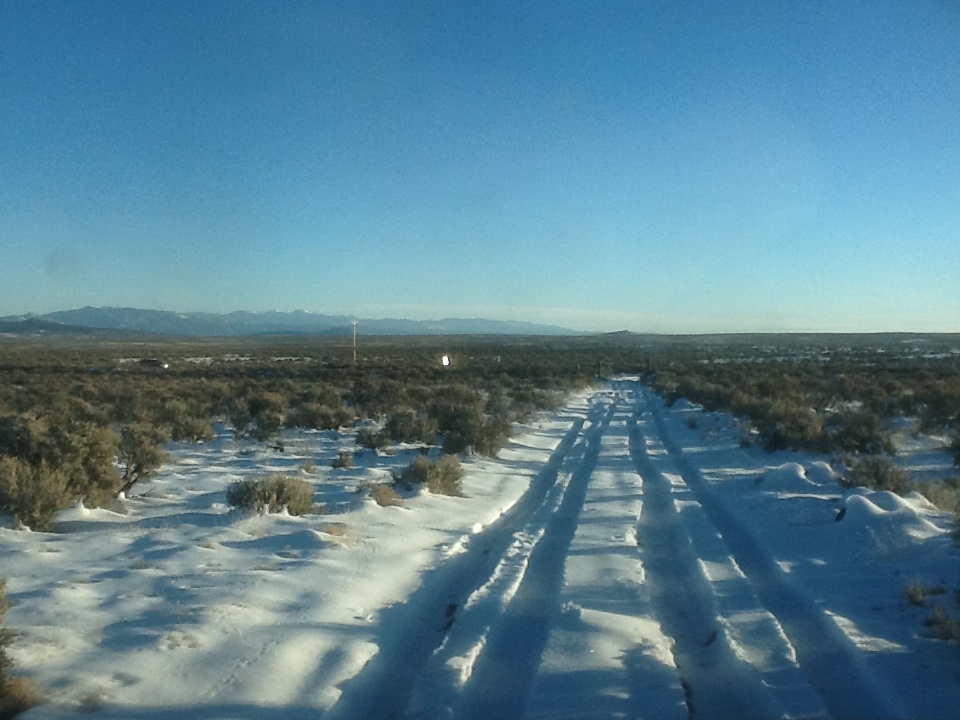
I was worried about being snowed in last winter but I was surprised to discover that a little snow actually makes for a nicer passage. The snow fills in the ruts and potholes and raises you above the oil pan munching rocks. Too much snow or icy snow are something else, of course. Still, nothing approaches the nightmare of The Pudding.
Early spring brings the rich clay saturated with snowmelt but unable to drain since the ground is still frozen underneath. A nice sunny day warms the surface enough to make a deep goop. Then it’s more like boating than driving.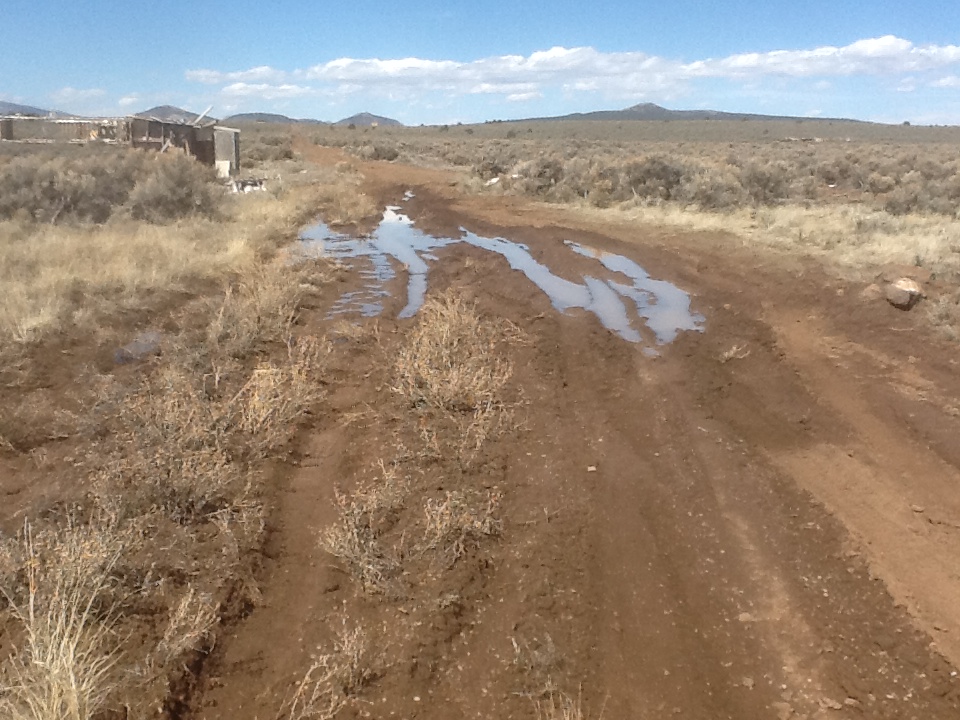
The last time I went out to John’s, I arrived early enough that the ground was still mostly frozen, though the climbing sun had already created a slight slurry on the surface. Early morning shadows preserved snowdrifts at the edges, providing firmer traction, though ugly deep tire trenches tended to grab your wheels and yank them down into their gullies. Once channeled thusly, resistance is futile and escape is impossible. It’s a lot like the Autopia at Disneyland. Periodically, one of the tires will snag a submerged boulder or sage root and you can find yourself lurching offroad into the waist-high sagebrush.
By the time I got to his place, I was a nervous wreck and was reluctant to attempt the egress, foolishly procrastinating until the sun was high and warm. In the meantime, he entertained me with stories of pulling out neighbors stuck in his path, and then getting stuck, himself. It had gotten so bad, he was starting to get phone calls at all hours for help.
“I want to be neighborly but, jeez, I’m not running a tow service!” he complained.
“Which road out of here do you recommend?” I anxiously asked when I finally worked up the nerve and stepped out into the ankle-deep mud. “I don’t want to get stuck, either.”
“Hard to say. None of them are good. Try the one just past my buildings over there. It isn’t traveled as much.”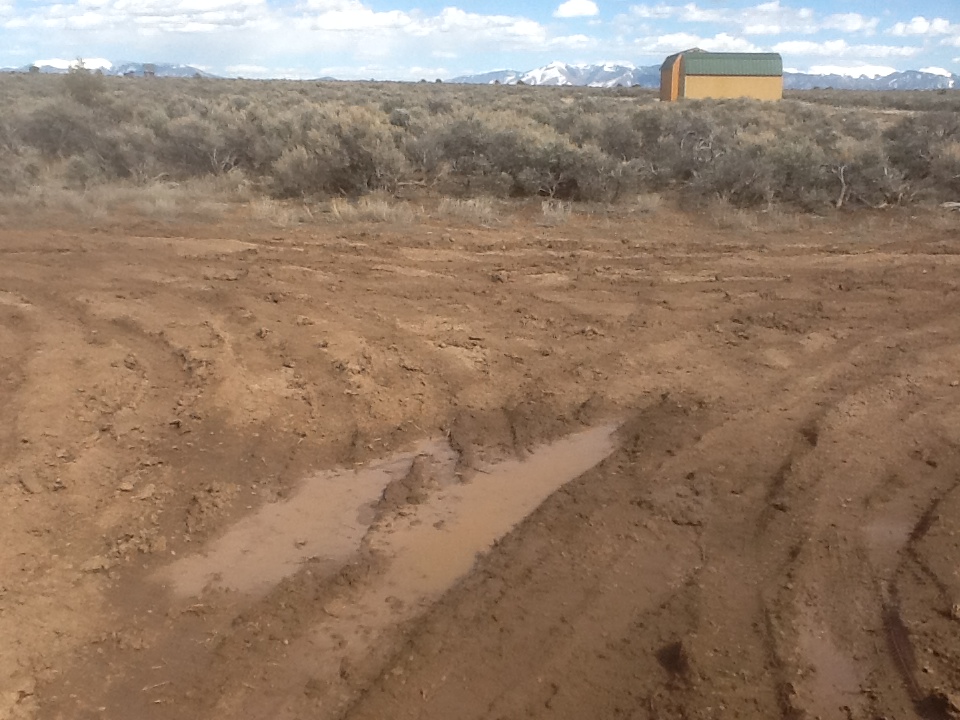
Just slogging back out to the Jeep was harrowing as the ruts and tire channels were now filled with melted snow and the clay had reconstituted into cake batter. He was right about the road being less traveled, the disappearing snow exposing brown tufts of last year’s grass and fledgling sage plants which whacked and scraped at the mud on the underside as I tried to ride the high ground. At first it was tolerable and somewhat better than the one I had come in on. The first intersection, however, was a rutty, puddled mess which I had to traverse at a right angle, splashing hard over each runnel.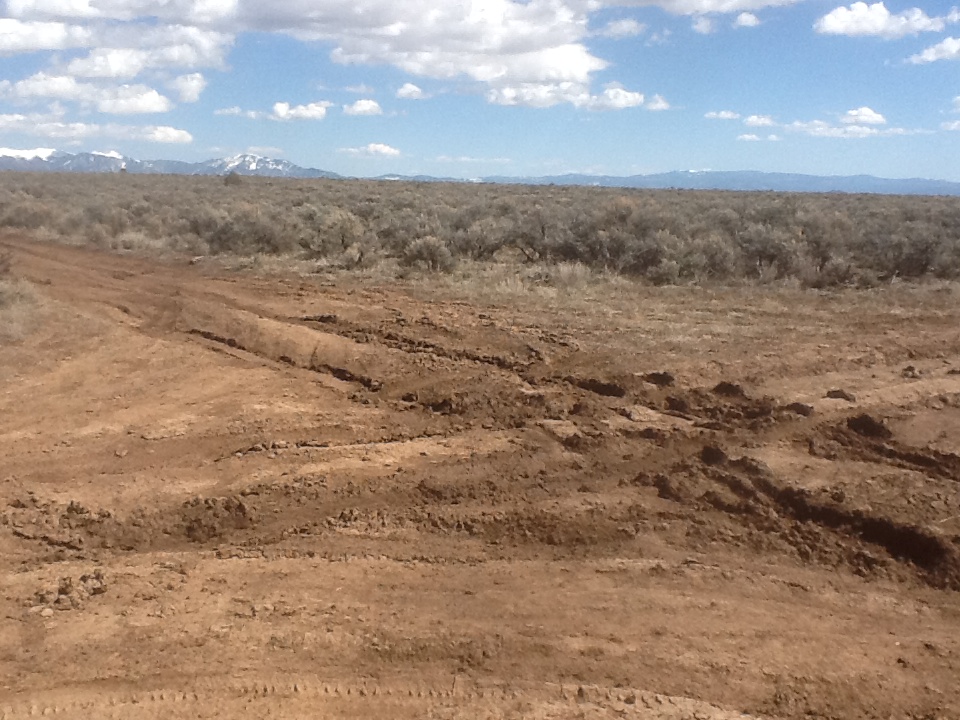
After that there was the lake. It was the low spot in the road and the wide pond gave no clue to its depth, or what dangers lurked at its bottom. I just couldn’t risk it. Backing up was even more unimaginable, though. Then I noticed the bold detour someone had bludgeoned through the sagebrush. Ordinarily I’d have been horrified at the callous destruction, but this time I gratefully took the alternative route, bumping gingerly over the sage stumps.
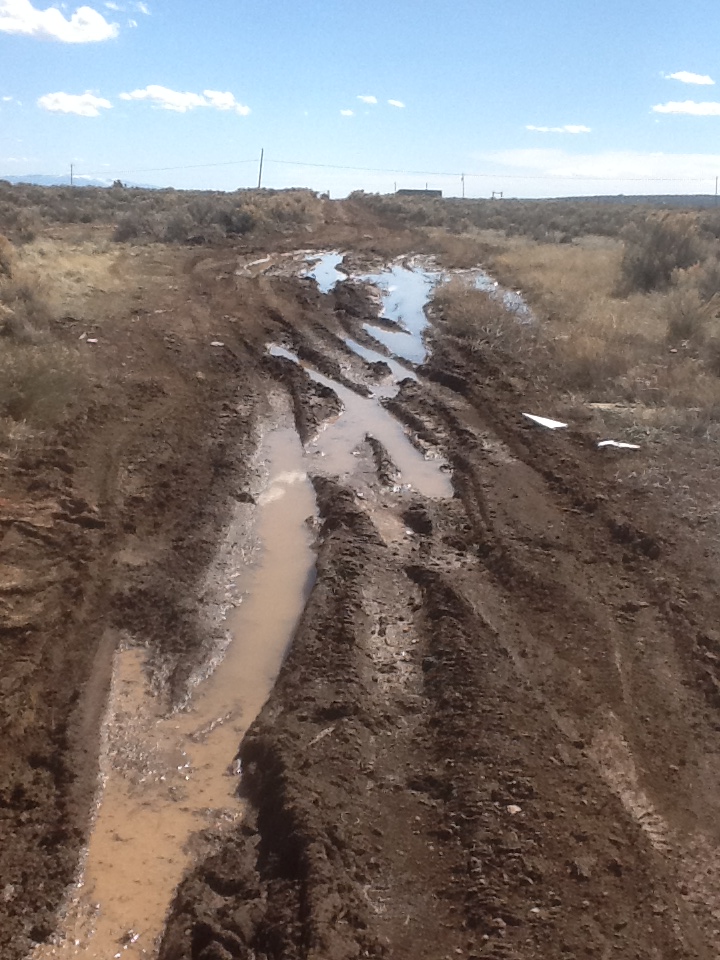 The swampy, lower areas were when the Jeep became amphibious, slithering haphazardly down the course, so much mud, sage, and rocks balled up onto the now spherical tires that steering was as effective as using those little steering wheels they put in the kiddie carts at the grocery store. You can turn the wheel any way you want but the vehicle is going where IT wants to go. The tires fling great gobs of mud onto the hood, windshield, and into my open window onto my sweatshirt and the headrest. Massive deposits of adobe mud, grass and rocks pack the undercarriage and wheelwells, closing down the clearance space of the tires, the accumulation hanging low and merging with the road below, adding drag.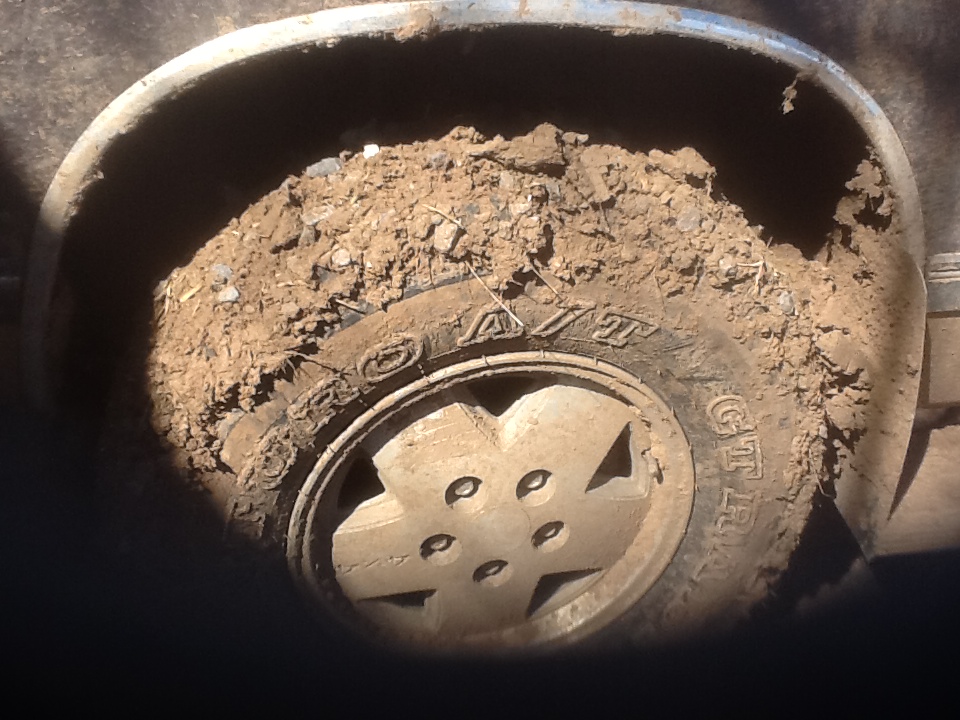
AND WHATEVER YOU DO, DON’T STOP!
Ya gotta keep those wheels a spinnin’ or you’ll sink in and have to call poor beleaguered John to pull you out.
Then there was the slithery uphill section, where there was NO traction. The wheels spun and spun and yet I barely crept along, flinging mud everywhere and billowing the stench of my overheating tranny, sliding sideways here and slipping backwards there, until, at long last, I made it to the pavement.
The blessed pavement.
My car was unrecognizable as a Jeep, exactly, encased as it was in thick, high quality adobe. It took the better part of a gallon of water and my snow brush/ice scraper to clean the windows off enough to see to drive. I dropped it back into two wheel drive and struggled onto the highway, accelerating more slowly from the extra tonnage and dropping great thundering clods which bounced and shattered, pelting a staccato rhythm on the undercarriage and scattering thousands of dancing adobe pellets across the highway, my entry course betrayed by two lengthening muddy tracks.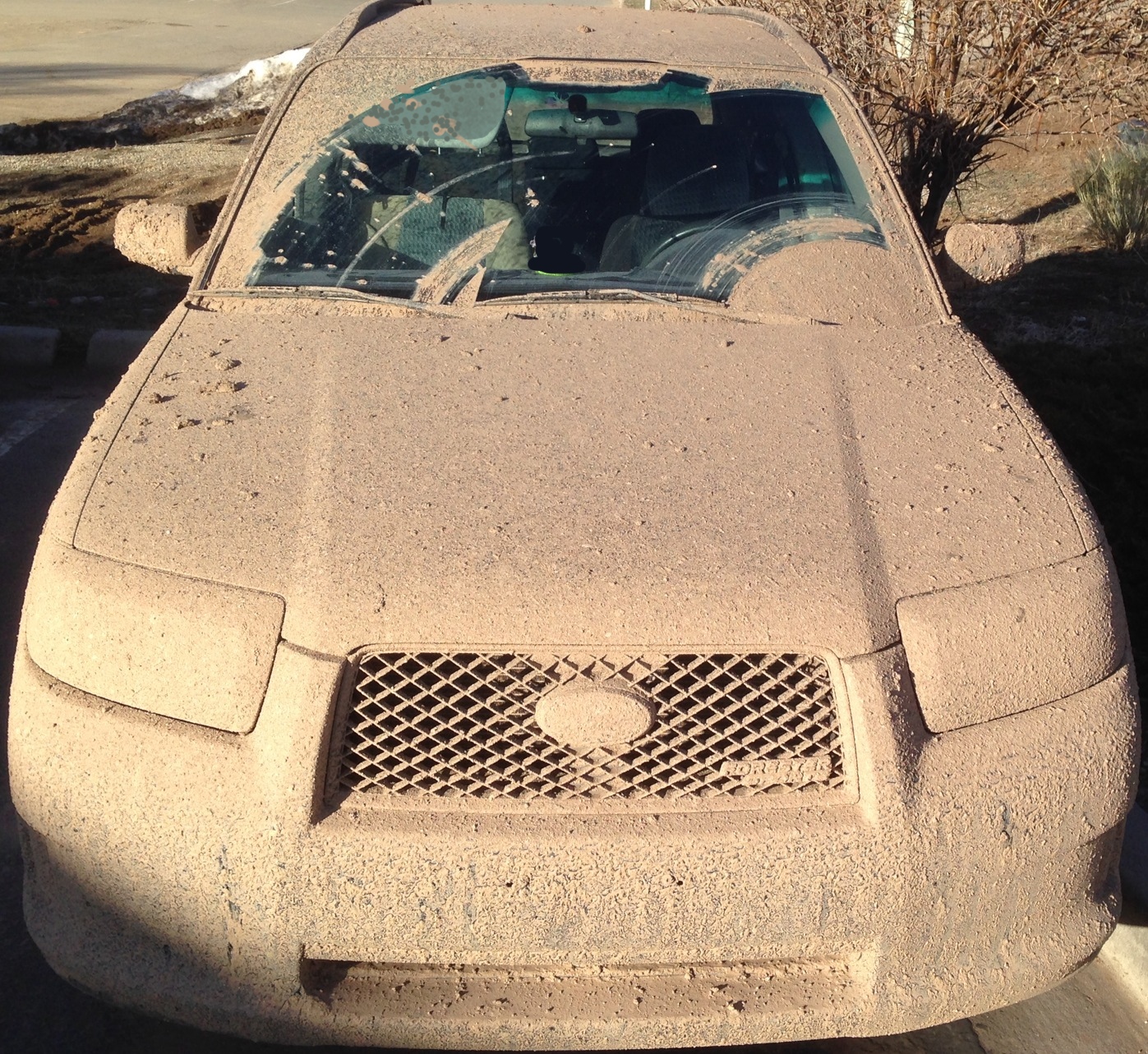
The adobe car is a common sight in Taos in the spring; an odd badge of honor respecting the distinctive local conditions to be endured by its hardy denizens. The local car washes clean up this time of year. (OK…pun intended. Sorry.) Once washed off, though, my paint looks shiny new after the fine clay polishing. Of course the deep scratches on the sides from hugging the sagebrush counterbalance the shine.
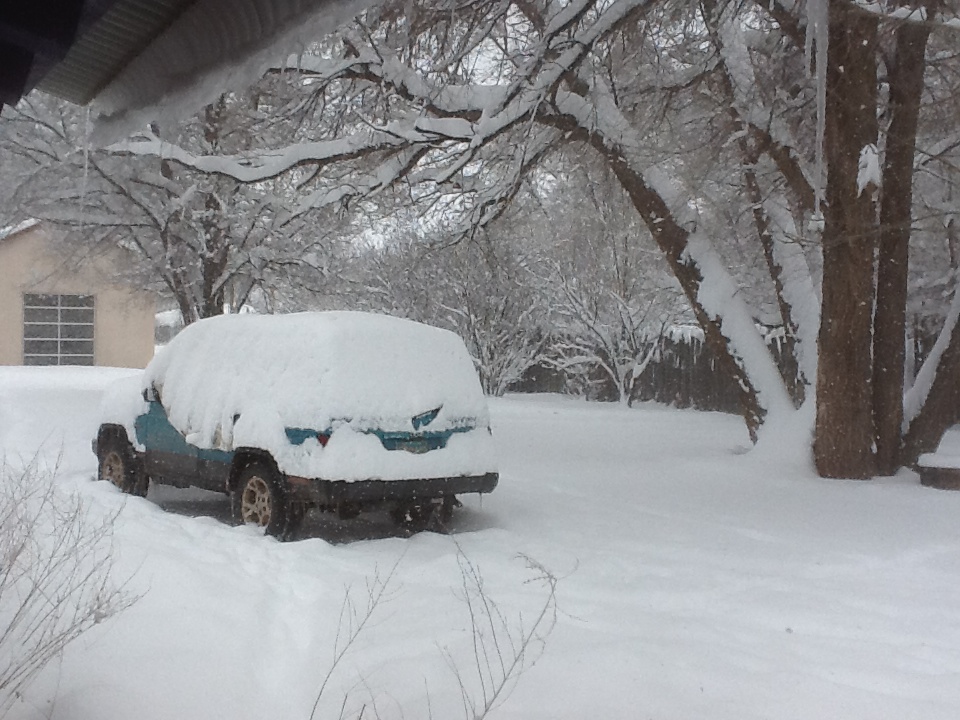
This was a heavy snow year in Taos but I managed to stay here in the area through the winter this time, though I must confess I succumbed to the gracious blessing of a house sitting opportunity in town in Taos which I have taken advantage of since the new year, thereby mercifully missing some of the worst snow and mud days.
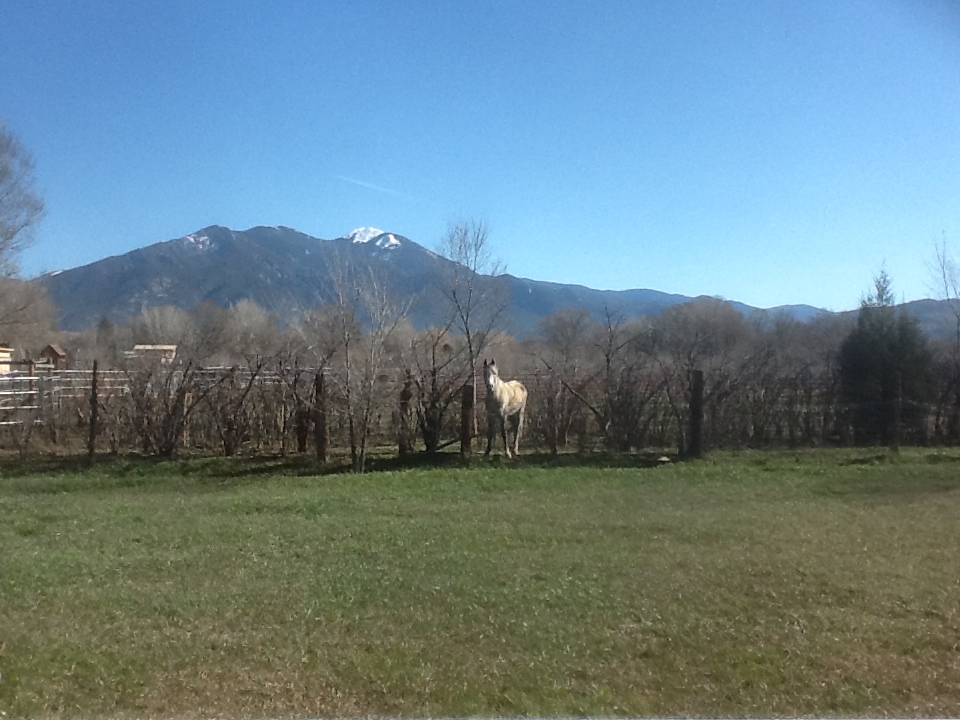 My cozy studio quarters boast a spectacular view of Taos Mountain and the neighbor’s orchard where my new equine buddy visits over the fence from time to time. I have been doing house and pet sitting gigs this winter which have offered me a variety of indoor retreats as well as canine companionship.
 Rather ironic to go from lonesome and dwelling challenged to having multiple modern residences equipped with critter company. A happy irony.
Meanwhile, spring is officially here, though wintery conditions are likely to linger, (We had snow into May last year.) and it’s time to get busy again to bring things to the next level.
Now where did I put those seeds I harvested last year?
The chilly morning breeze at my back wasn’t strong enough to disperse the cloud of dust I was chasing and, coughing and wheezing, I flipped up the collar of my hastily donned shirt. Though it was clear, the warming sun was still low in the sky as I wove a zig zag trail through the tall sagebrush, impulsively careless of what potential dangers lurked beneath, poised to strike at my stumbling boots. My stride was just short of a trot as I charged forward with angry purpose.
“YOU GO HOME! GET OUT OF HERE!”, I shouted to punctuate the frightening bursts of electrical discharge from the stun wand. They certainly recognized that sound.
They always move just a little faster than I can go, but sometimes the lead cows will get distracted and slow down to graze, causing a backup crowding of skittish trailers. A rock lobbed into the brush near them will spook them, usually, causing short stampede bursts and throwing up more dust, the air pungent with crushed sage and fresh cow crap.
A lumbering black cow with two large calves broke off from the herd, moving off to the left, away from the fence line, at first nervously eyeing me, and then smugly pausing to graze.
“NO, YOU DON’T!” I shouted at her, crashing through the brush, running wide, trying to frighten her back to the herd. She looked like the one who I had caught chewing on the stucco on my house that time, mining for the fresh straw bales beneath, but I couldn’t be sure.
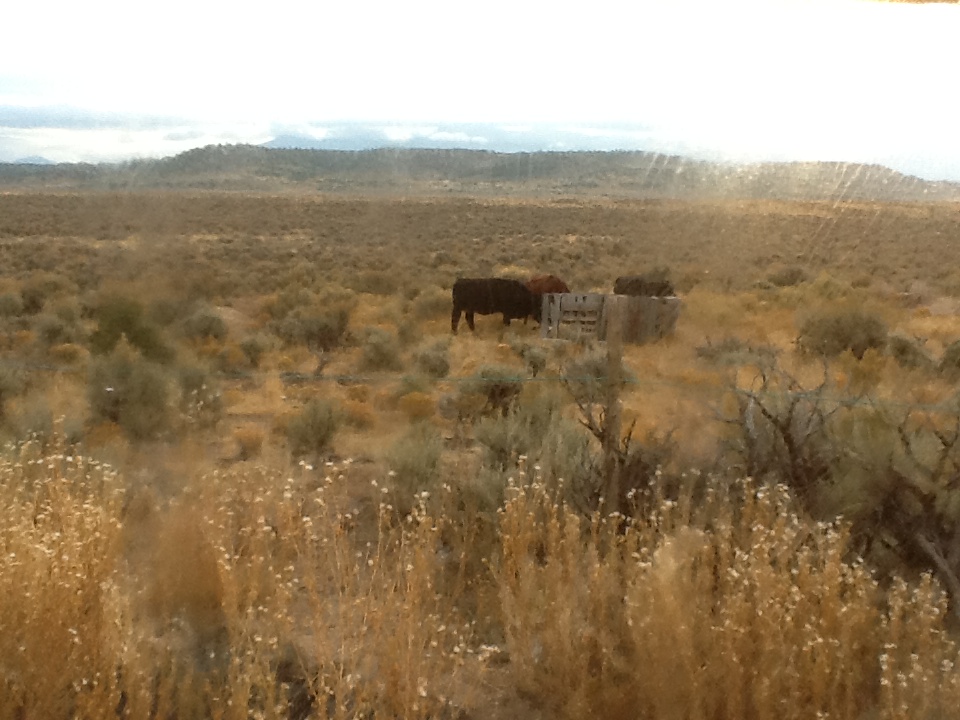 This time, the herd had knocked down what was left of the compost enclosure that Trip had left in my view. I was powered by adrenaline infused purpose to drive these marauders off my land and train them to stay away. Unfortunately, they find more reward at my place than the adjacent overgrazed field that they should be in. The damage to that fenced square mile can be seen from space, when you Google map the area.
As I rounded the northwest corner of the fenced pasture, I managed to startle them into a small stampede down the hill along the fence line heading east toward their property. That’s when I spotted the big, white pickup truck moving slowly along the dirt road that borders the fence line on the east side, creeping along on a deliberate intercept course with me at the northeast corner as I charged down the hill behind the trotting herd, the stun wand in one hand and an improvised cat-o-nine-tails in the other.
When we reached the road, the herd took it, heading north and away, and I slowed at the corner, wheezing and riled, as the shiny new pickup truck rolled to a stop and its Hispanic driver climbed down, hanging back, door still open.
“ARE THESE YOUR COWS?”, I demanded, still angry and pumped from the mile long cattle drive.
“Yes.”, he answered defensively, his own anger surfacing.
“Your cows have been causing SO MUCH damage to my place! For Thirteen years!!” I hollered, pointing in the direction I’d just come, my house not visible from here, and then put my hands on my knees, bent over struggling for my breath.
“Couldn’t have been MY cows. I’ve only been bringing them here for two years.” he retorted defensively.
Before I could respond to this new information, surprised at his attitude, and trying to understand how that forgave the last two years anyway, he continued.
“What’s your name?” he demanded. That’s when I realized that he was holding his phone, steadying it on the open door, recording the incident.
Affronted that he would have the nerve to record it, as though HE was the injured party, and simultaneously feeling a little threatened as he lingered by the truck. This IS gun country.
“What’s YOUR name?” I countered.
“I won’t tell you.”
“Well then why should I tell you mine?”
The cows continued ambling north on the dirt road while we had hit an impasse.
“Look, your cows have been causing a lot of damage.” I began, “I’m sick of chasing them off my property!”
“Get a fence,” he replied smugly, “What’s your name?” he repeated.
“Are you kidding me? Who are YOU?” I spat back and stormed to the back of his truck to memorize the license plate and then, grumbling at the whole thing, trudged back to the fence corner. “This is ridiculous.” Still wheezing from the stampede and spent from this unfortunate encounter, I plopped down on the bank and fumbled around in my pockets for my forgotten inhaler.
By now he had given up on his documentation effort and walked toward me as I tried to get my breath and considered a different approach.
“Look, I’m sorry. I’m just so mad about the years of damage and tired of running them off. I’m just a sick, old man trying to survive out here.”
“You didn’t look so sick when you were chasing my cows.” he snapped.
“Adrenaline. I was angry.” How could he not see that I was having an asthma attack? ” Look, I’m sorry but your cows have been SO destructive. But we’re neighbors and I want to get along. My name’s Dave.” I offered, still sitting at the top of the bank, extending my hand as a peace gesture.
He strode up the bank, grasped my hand tightly, and then pressed me down with it in a macho attempt to dominate me. That pissed me off and I stood, now towering over him, and returned the leverage. So THAT’S how you want to play it, eh? Bullshit!
“Hey, I’m trying to be nice here. We’re neighbors.”
“We’re not neighbors. I live someplace else. I just pay your neighbor to bring my cows here.”
New information.
“Then who DOES own this land?”
He looked at me with contempt. “You don’t know who your neighbor is?” he asked snidely.
I exaggeratedly looked around at the miles of open sagebrush, threw my arms open wide, and popped, “WHAT neighbors?! Look around! The only thing out here is MY place and YOUR cows!” How’m I supposed to know who owns any of the rest of this?
“You could go to town to City Hall and check their records.” he retorted.
We were getting off track.
“Look, I just want you to take responsibility for your cows. They’ve caused too much damage already.”
“Get a fence.” was his blunt response.
“I can’t afford to fence 17 acres. I’m broke and unemployed. I did finally get an electric fence but I had to put it on a credit card. And it’s a small area and just the wire. Not a real fence. They already knocked down the gate once and I caught them chewing on my house!”
“What? What’s your house made of.”
“Well, it’s a straw bale hybrid,” I said a little sheepishly, “but it’s covered with metal lath and stucco.”
He took a step back with a look of disgust and then just laughed…derisively at me for being so stupid as to build with cattle feed.
“They were chewing through the stucco!” I defended. “They’ve eaten all of my plantings. My trees. They’ve broken my yard lights.”
“Get a fence.” He said, dismissing the fact that they were his cows.
“Why should I have to pay for the fence?! They’re YOUR cows!”
“New Mexico state law says this is open rangeland and YOU have to fence them out.” he declared with finality.
“How would you like it if they were destroying YOUR property?” I asked, hoping for a little empathy.
“I have a fence.” he quipped, turning back to his truck.
I followed him back to his truck, feeling spent and depressed at the whole encounter. I thought maybe if I appeal to his sense of liability.
“You know, these are the same cows that got out of that gate and caused that woman’s death on the highway.” I began, pointing down the dirt road he was on. His blank look told me that was before he started bringing these cows here. “That was a few years ago. Her husband survived but has to try to sue the highway department for damages.”
“See. State law. YOU have to fence them out.” he chuckled as he clambered into the truck.
“I’m a little scared of them, too. I have found them on my porch when I opened the door. And the whole herd was all around my house.”
We both looked up the road at the milling herd and he said soberly, “Yeah, a couple of those are mean.” I got the impression that he spoke from experience and I was taken aback. I’ve been impulsively bold in my herding forays.
There was nothing more to say and in one final demonstration of faux dominance, he started up the truck and punched it, narrowly missing running over my foot and spitting up pebbles as he ground up the rutted road toward the herd.
Though I regret my raging introduction, I am more annoyed at his complete disregard for my circumstance and his flippant attitude about his non-responsibility. The irony is that if it was his dog or his child or his employee trespassing and causing damage I would have legal rights. As it is, the burden of fencing falls to me.
The walk back home is always much longer than the anger driven stampede out and I chewed on the turn of events all the way to the top of the rise, still struggling to get enough air and coughing up mud. Nothing had changed, really. Other than finally getting to confront the herd owner with my pent up hostilities, it was still my problem to make my place secure from bovine raiders. I do have an electric fence now, which seems to be working so far, but I rarely give them a chance to get close enough to test it before I chase after them. I keep hoping they are smart enough to learn to fear my area, like they might if I had a scary dog or a cougar or something. So far, they have ME trained, though, and I watch the hills in the same manner that our predecessors watched for predators, ever poised for the attack.
I crested the hill at the northwest corner of the barren and unused pasture that my neighbor charges to use. (So that’s two people who are profiting by grazing cows on my land! The outrage!)
But then, pausing to cough and wheeze, I took in the magnificent panorama of the sagebrush sea of the Mesa, perfect cinder cones serrating the distant horizon vaulted by a wide blue sky flaunting brilliant, fluffy inspiration. The Sangre de Christo range bolsters the east, a great, rugged wall extending north to the Rockies into Canada, marking the last boundary between high mountain wilderness and the great, flat, sloping plains to the east.
My place is swallowed up by this vastness and looks charming, almost magical, from this distance and I am reminded of why I moved here in the first place and why I have tried so hard to make it work.
IMPROVEMENTS
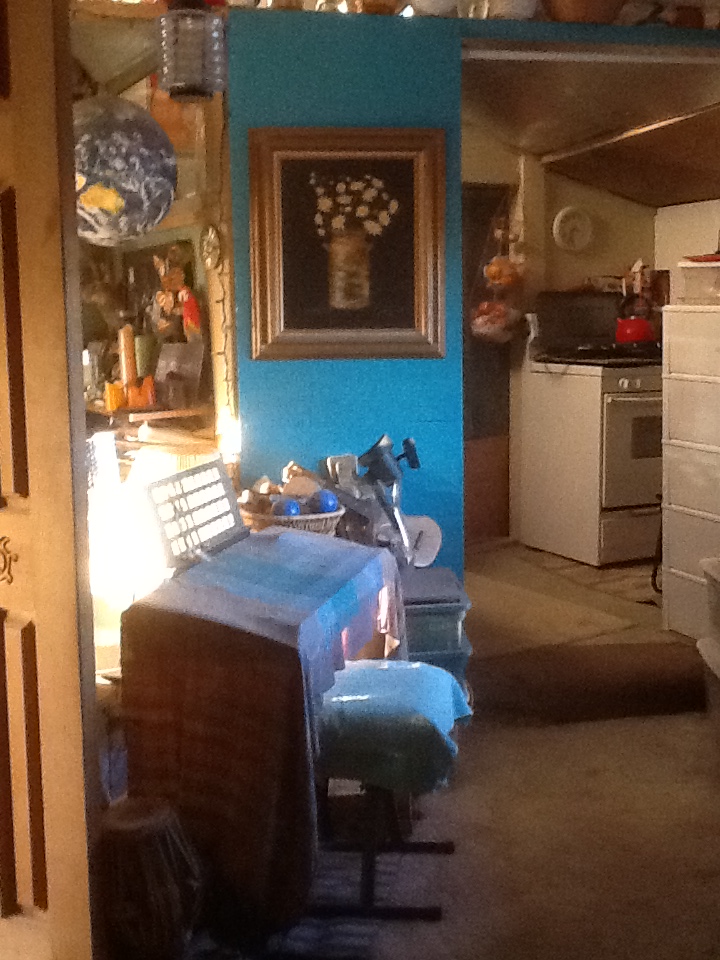 Things are much improved, too. I have to remember that. It’s kind of like watching a child grow up. The changes are so gradual, though steady, that you lose sight of how far they’ve come. While I still have moments of lament about my “third world” conditions here, I must consider the many improvements which have brought it into a more tolerable state for a 21st Century westerner.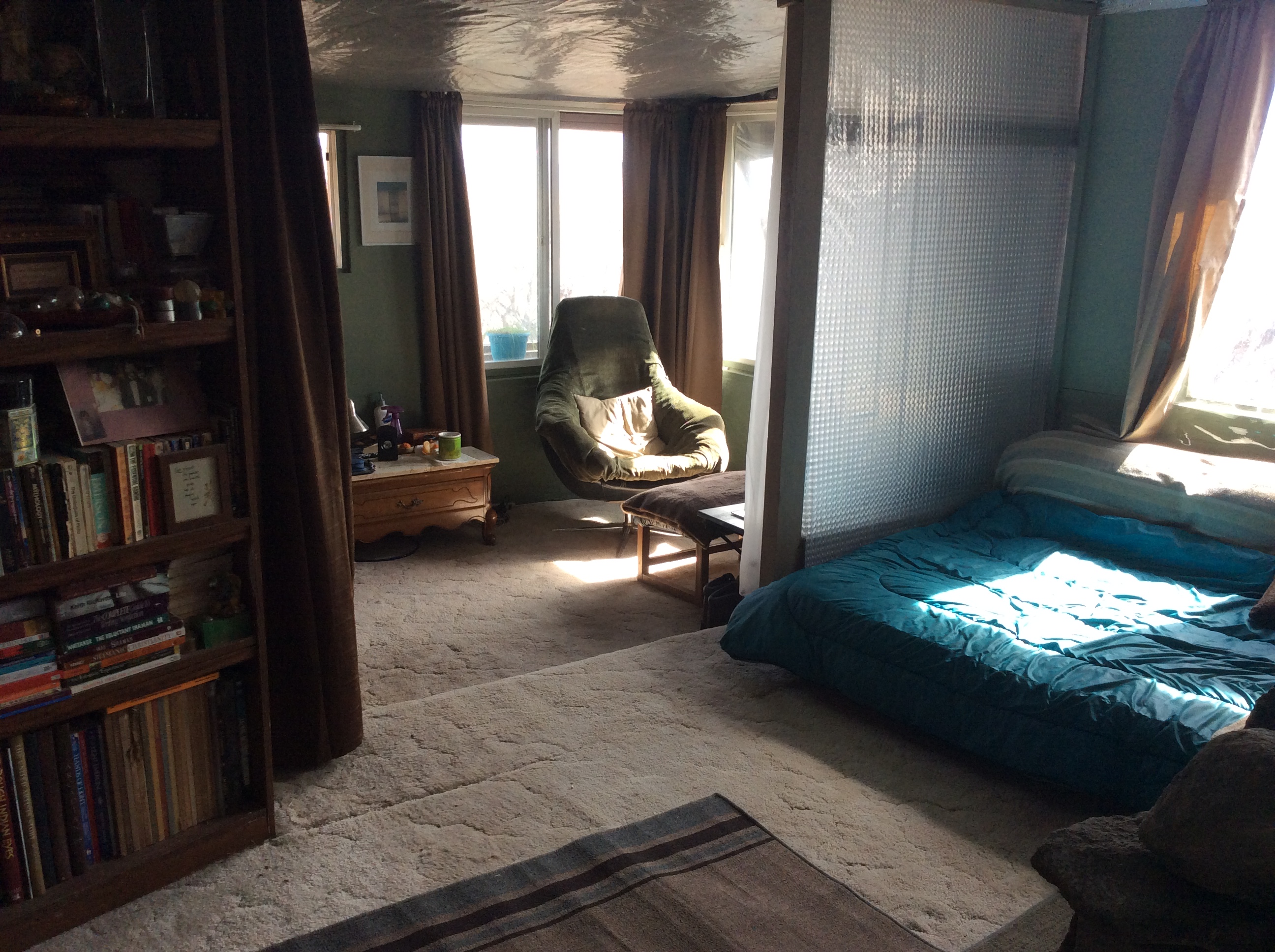
To that end, I hereby declare that my place is officially elevated from “Shack” to “Cabin” status.
(Insert fanfare here.)
FLOORS
Perhaps the most substantial improvement toward making this place more like a real house was the addition of concrete floors through most of the place. Though the hard packed clay was reasonably level and covered with plastic and several layers of rugs, which helped to keep out most of the dust, the ground was uneven with odd terraces, slopes, and dips. Combine that with highly irregular architecture denying visual clues, and you get an experience not unlike that of those mystery spots you find across the country. “Place Where Gravity Ain’t, USA”.
Eventually, you learned the course and compensated, stepping here, swinging wide there, but the sponginess of the many layers of pad and migrating rugs always made for wobbly footing.
The first area I tackled was the southeast corner, my sunny window corner, which hosted a flourishing mold colony in the damp clay under the plastic which spread up into the bales which only had a steel mesh and clear plastic covering on the interior. I could still smell the mold so last spring I experimented with spraying the bales with an anti-mold concoction and covering them with a more substantial mixture of papercrete and painted over it. Though it improved things marginally, the thriving mold under the floor continued to replenish the wall colonies.
Sectioning the room roughly into thirds with 2X2s, I excavated the top infested layer of moldy clay and the remains of Trip’s attempt at a papercrete floor in the corner area and filled the area with rock rubble and scavenged bits of rebar as much as possible for strength and to minimize concrete usage.
At this juncture, I must comment on how very labor intensive working with concrete is. Just getting the 80 pound bags into the Jeep from town and then to the work site is enough to exhaust a younger man. While I have a small electric concrete mixer, I don’t have enough power to run it, requiring hand mixing and the clouds of fine concrete dust made while mixing requires working outside. Of course adding water just makes it heavier for you to carry in.
The trick with concrete is you have to work fast to avoid cold seams. Once you start a section, you need to keep moving and finish before it starts to set. Having to do all of the stages yourself makes for a long exhausting day and progress is slow.
I like to attribute the unintended downhill slope to the south in the first section to the “Mystery Spot Effect”, though, in truth, it’s due to my inexperience with concrete. OK, so my chair leans a little now.
Gratefully, my new friend John, a fellow off-gridder who lives about five miles from me, does have experience in such matters and graciously helped my to push through most of the house. He even had a generator with enough amperage to run the mixer for awhile, but, even though we were using rainwater gleaned from the monsoons, discovered it is really water intensive to clean it out at the end of every day and we resumed hand mixing, divvying up the duties. The concrete is roughly finished and a little uneven, but it doesn’t matter with the pads and rugs over it and I don’t stumble around as much now.
Having solid floors motivated me to seal the walls then, finally having something to seal to. Half inch plywood now covers the plastic covered insulation, spackled smooth and painted sage green. Suddenly the place took on a semblance of a real house!
Sealing the floor and walls also led to solving the mystery of the house beetles. I kept finding large beetles wandering across the rugs and wondered how they were getting in. The few windows I opened had screens now and I never once saw the bugs coming in the front door. Then in the course of laying in the floor, I discovered that they had been living in the soil under the rugs and hatching out periodically. Yikes!
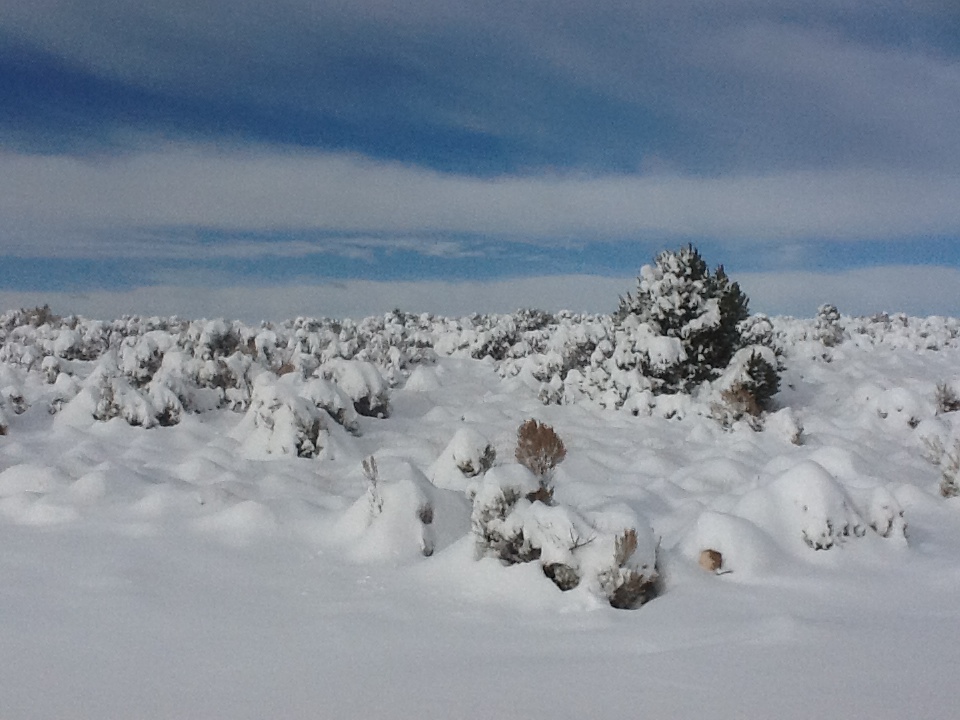 WINTER
This was the first winter that I stayed on, braving the harshness of an El Nino fed snow season, with the exception of a few local in-town pet/house sits and a four week stint in Southern California in December. (The gods of calamity attended me there, too, as I was just over the hill from the huge Porter Ranch methane gas spill which I could smell when the wind was right.)
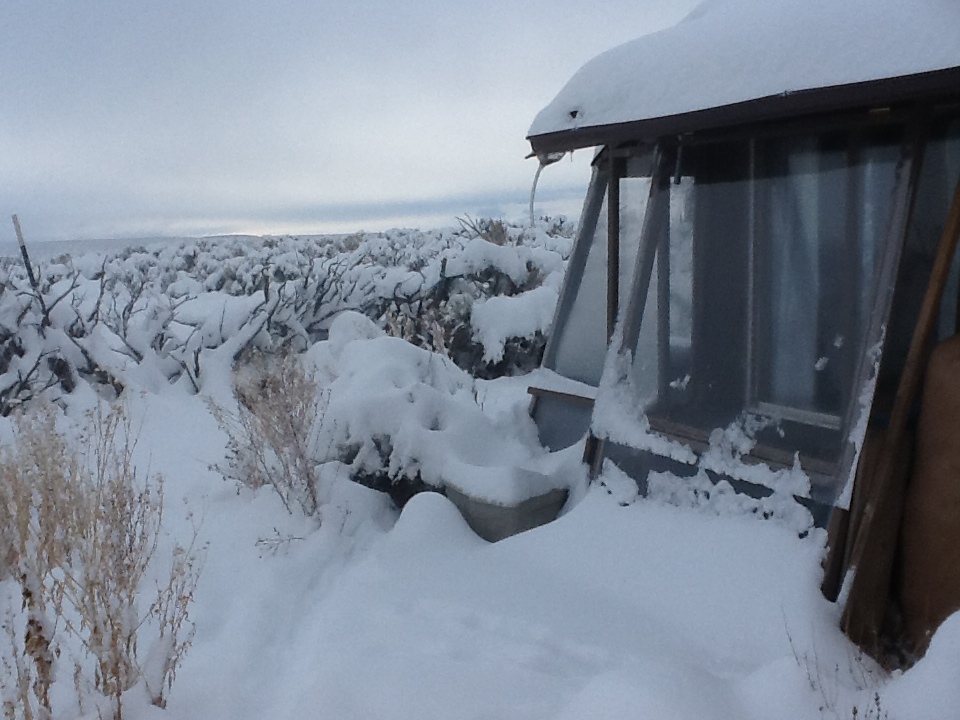 The difference between snowstorms here and those of the east is it’s drier and the sun tends to come out more often, lessening accumulation. Still, you can get dumped on and then you can’t even find the road to get out of here. I keep plenty of food on hand for such occasions.
Of course, even more immobilizing is the mud that follows when the ground is still frozen and the melt off has nowhere to go. The normally hard clay reconstitutes into a pudding slurry better suited for a swamp boat.
Another improvement that has kept me cozy this winter is reflective insulation which now covers my ceiling. It’s like stiff mylar bubble wrap and comes in 4′ X 100′ rolls. Great stuff. Not only does it reflect the heat back into the house, but also augments the ambient light and is far more pleasing than the previous black plastic stapled up to hold in the fiberglass insulation, which gave the dripping appearance of an oily black cave. Depressing. It’s still pretty cheesy looking but brighter and happier and serves well until I can put in a proper ceiling.
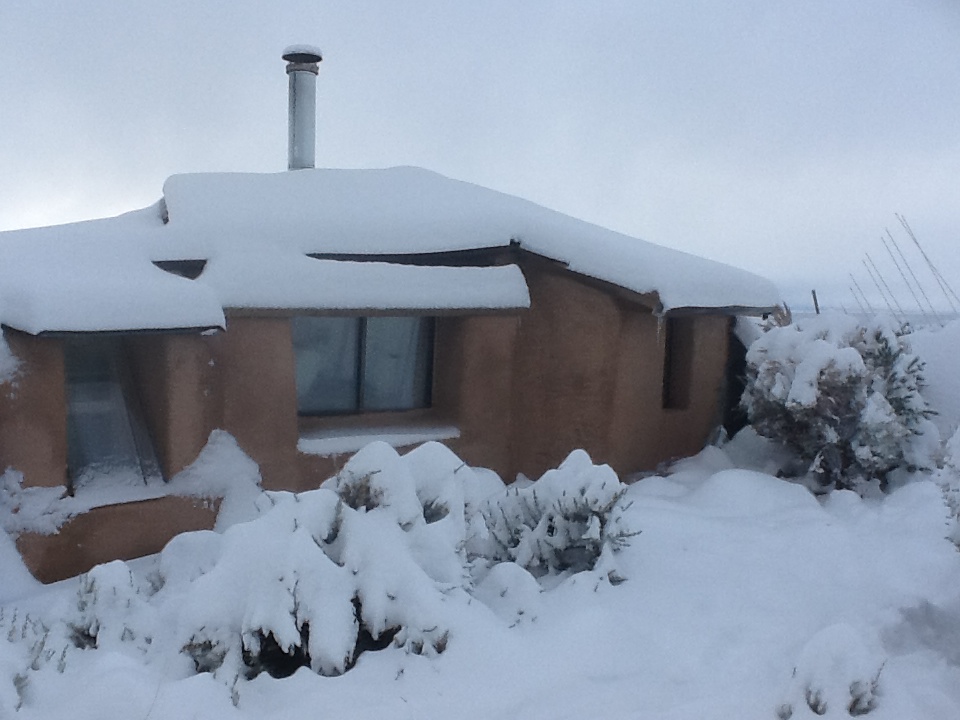 EXPANSION
At the end of one of one of my in-town petsits, the homeowner Deb offered me a small double paned window that she had replaced. I gratefully took it and used the opportunity to expand my kitchen, formerly a roughly six foot square galley, and pushed out the wall a few feet to the west, building the room around the new window. Now brighter and more open feeling, this gave me 50% more floor space and room for cupboards and an actual stove! A donated stove needs a fitting for my new propane tank and so sits idle for now with my coleman camping stove still serving atop it, redneck style.
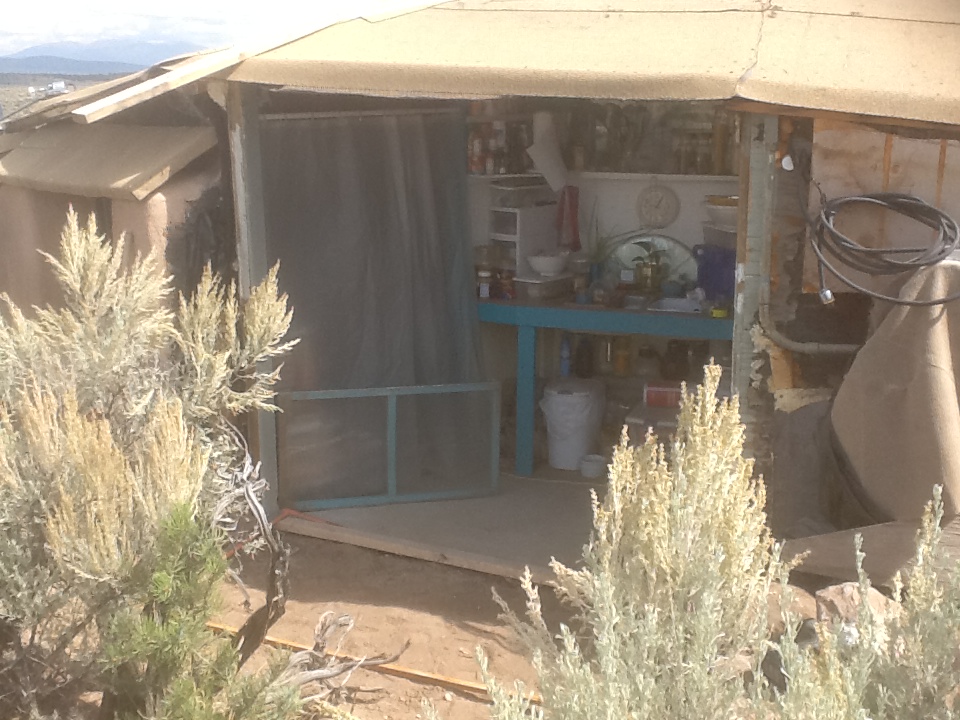
It was scary to lay the wall, the whole house, open to the elements and I pushed hard to get it closed up in one day before dark, fearing the weather, that being the windy side of the house, or worse, critter marauders in the night.
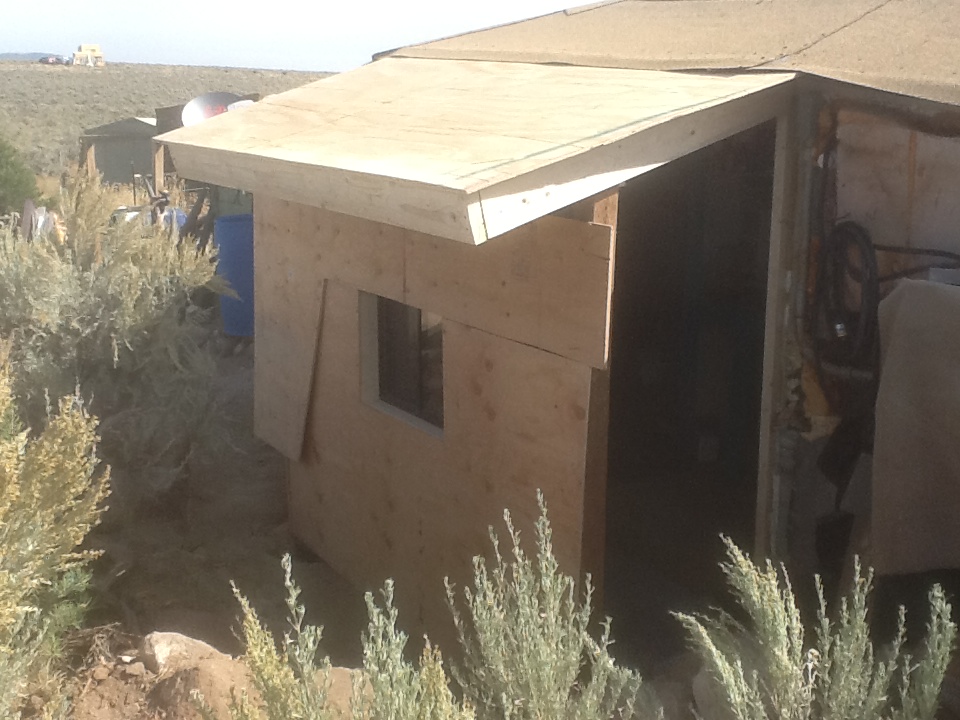
I doubted that the coyotes would risk entering but the electric fence didn’t extend that far and I didn’t want to wake to the herd in my living room.
COOLING
I barely got the exterior stuccoed before the first snow, which halted the adjacent project, an expansion of the storage room, and attached, another, smaller generator shed. I was at least able close that part in and insulate it so I can use the storage for tools and the stove propane tank. I began excavating a “root cellar” under the floor there before the season changed and the ground got too hard. More accurately, it will be a concrete ground cupboard for my fresh foodstuffs; potatoes, carrots, onions, lettuce, beans, etc. Until my power system can support refrigeration, I still have to use coolers with ice fetched from town during the warmer months. Having a perennially cool subterranean space will minimize food waste and trips to town. I have plans for a small, low energy refrigerator, that I have already sourced, to install above it once I have the power to run it.
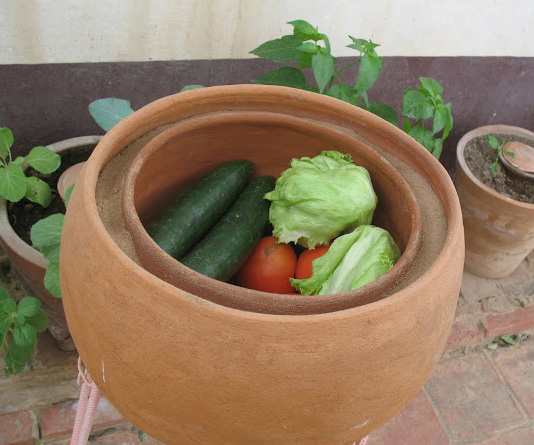 I want to explore the principle of a Zeer Pot, too, maybe modifying the basic design to create a cooling chamber. The basic Zeer Pot consists of a large baked clay pot with a smaller one nested inside. Damp sand fills the space between them and the evaporation cools the inner pot. When covered with a damp cloth, open air market merchants can store their produce with less spoilage and it is a popular method in arid regions in Africa.
This time of year, the sheltered entry porch is also the walk-in refrigerator. Well, freezer really. This winter has boasted some severely cold temperatures; the lowest I noted here was 16 below, and only achieved highs in the low twenties in the daytime for weeks. The last time I had to buy ice was last November. Before the 10 pound bag could completely melt, the temperatures dropped below freezing and stayed there until just this week. The partially melted ice refroze, encasing the condiments such as the mayo and mustard and a jar of applesauce in thick ice covering the bottom third of the cooler. I’ve just been setting things on top of the little glacier, waiting until spring to retrieve the mustard. The daytime temperatures have been in the fifties this week, though, and the ice has mostly thawed. However, I’ve been setting it out on the rain barrel every night, open to the wind, and the ice has reconstituted somewhat forestalling an ice run. It IS still only February, after all. We had snow as late as May last year.
Just as with all civilized refrigerators, mine has a light that comes on automatically when you open the door. Of course, in this case the refrigerator door is also the front door. The light was kindly donated by my friend Steve when, on a recent California visit to his house, I admired his motion sensor solar yard lights. They are a handy unit that is designed to hang from the eaves, coming on at dusk with a dim light which brightens considerably when the motion sensor is triggered. It has made coming and going at night much safer and my trips to the refrigerator more pleasant.
HEAT
In the quest to heat the house, I have discovered a couple of very useful techniques to supplement the sturdy little wood stove.
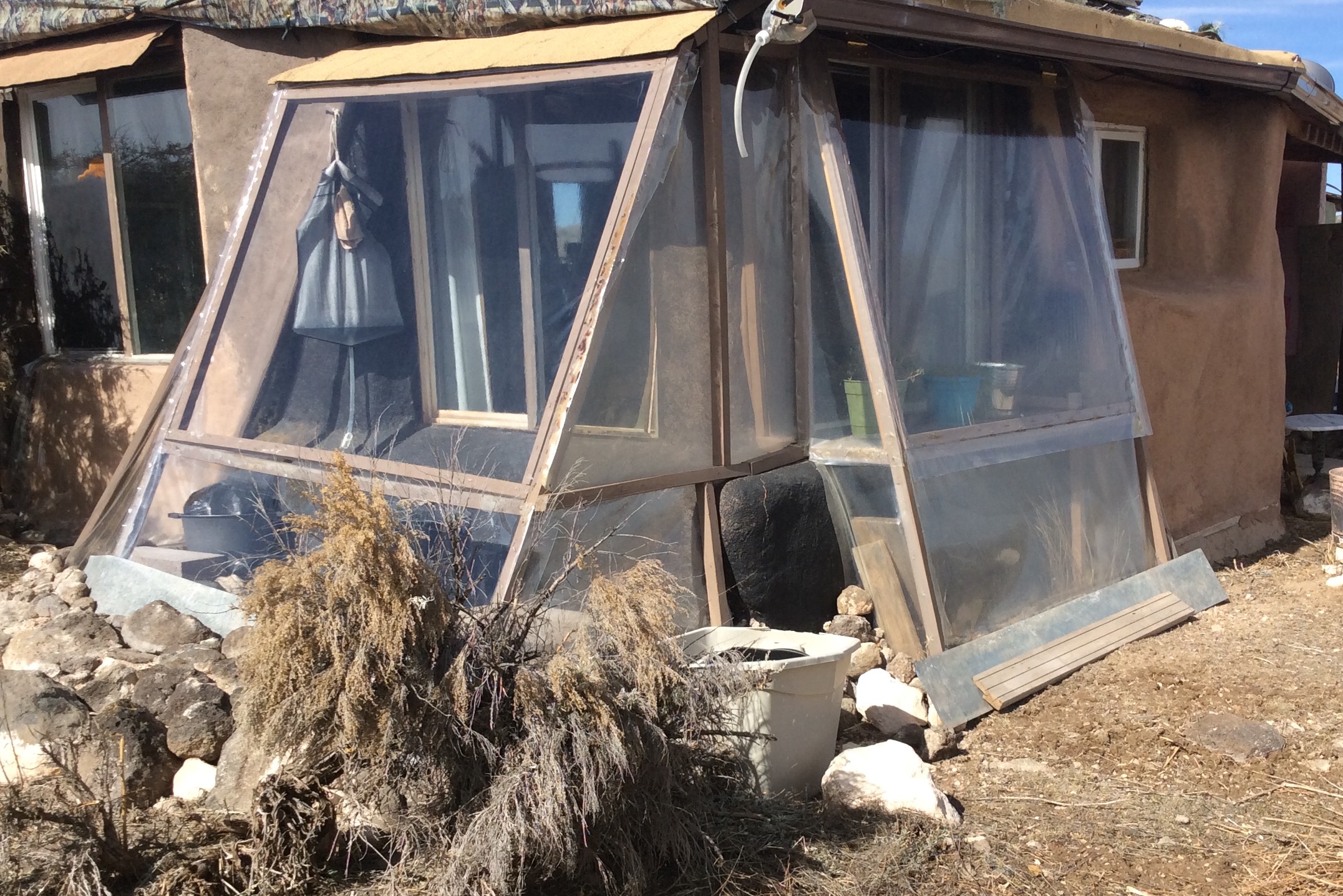 I have expanded on the trombe wall principle to create a space large enough to enter. My little sun porches can generate temperatures of up to 125 degrees Fahrenheit. After about an hour of morning sun, the thermometers in each porch tell me when its warm enough to open the window and let the solar heated air stream into the house.
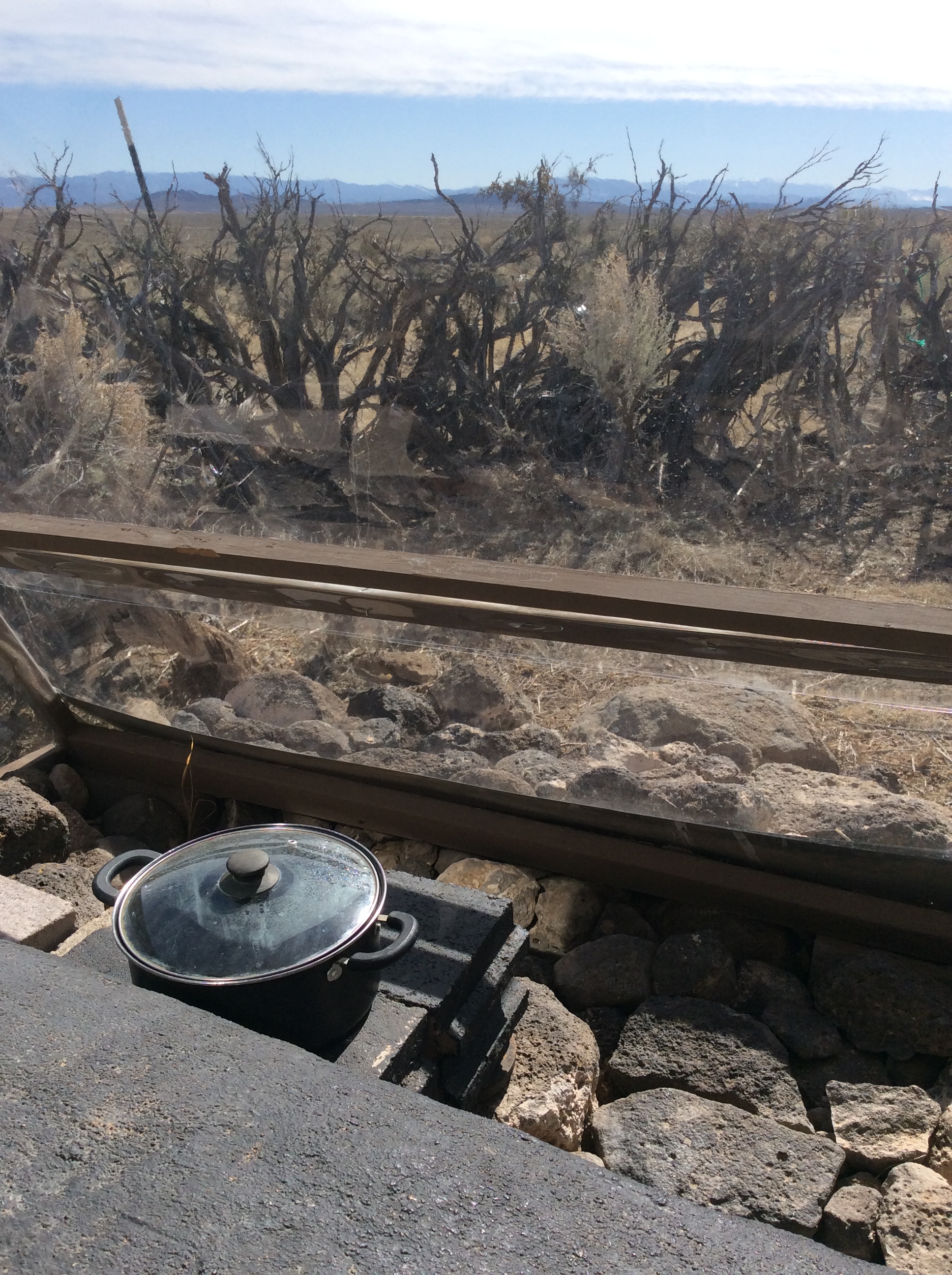 I keep my solar shower bag hanging there and sit on a pad covered stuccoed bale to shower, the water running down through the heat absorbing cairn of lava rocks at my feet. A couple of concrete blocks painted black serve as additional thermal mass and a “stovetop” for the black, glass lidded pot I leave there, thus ensuring hot water whenever the sun is shining. Dishwashing is now a daytime event.
The makeshift enclosure has proven to be so successful that I have plans for a larger, more refined structure off the storeroom, employing glass instead of the clear vinyl which, though cheap and easy to work with, gets brittle from the elements and must be replaced yearly, and also gives off fumes when it gets too hot in there.
I have discovered that, while the dense concrete and stone, once heated, will give off stored heat slowly and steadily, the straw bales covered with steel mesh and fireproof papercrete, and then skinned with a thick layer of stucco painted black, gets very hot, very fast. Insulated from the back, the stucco layer gets extremely hot becoming a radiator quickly.
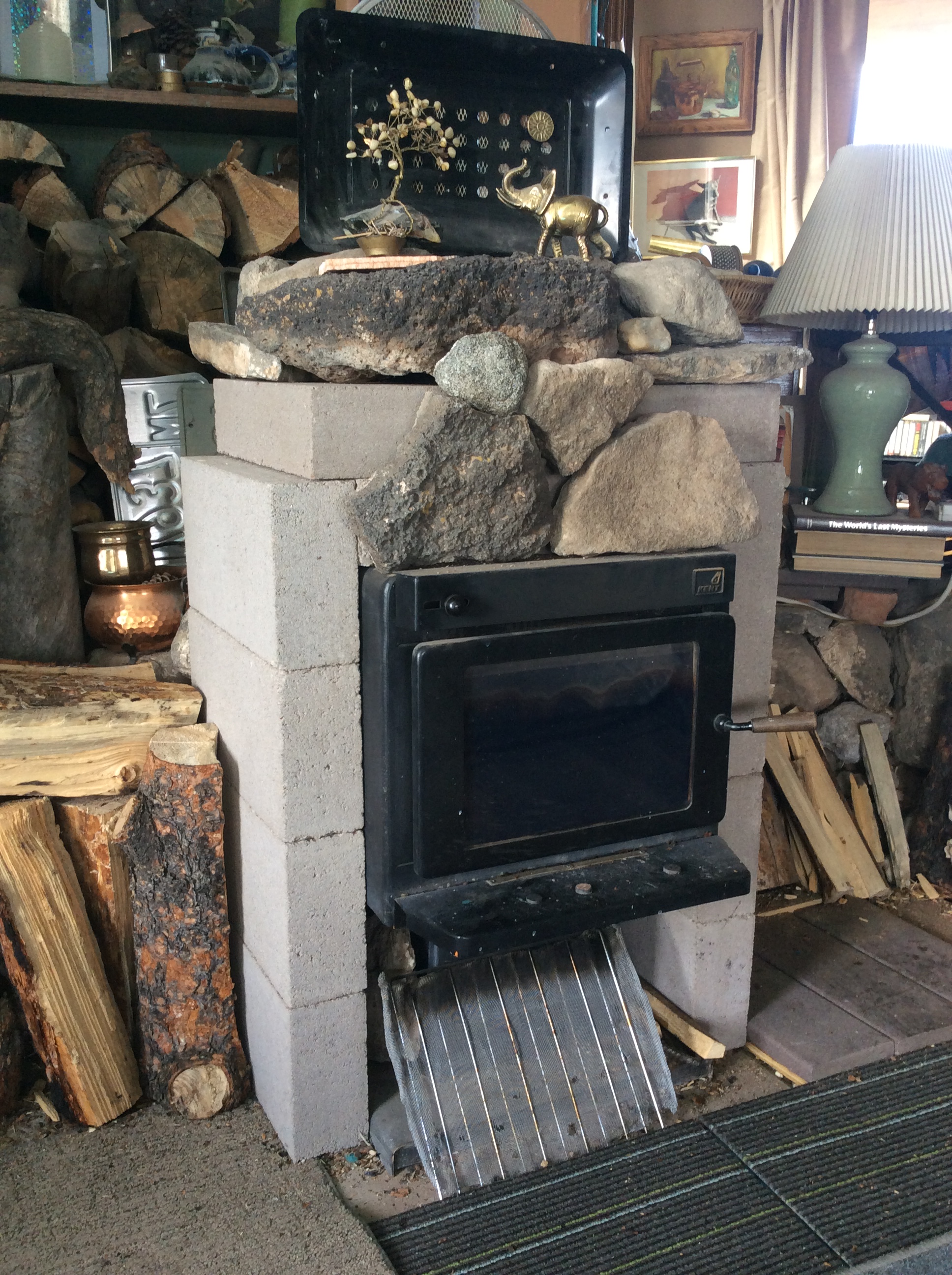 The other technique involved the addition of thermal mass to my wood stove. I stacked 4″ thick, solid concrete blocks around and on top of it, capping it with some local volcanic rock for aesthetics and leaned some assorted grilles against the stove pipe to wick off some of the wasted heat flying up the flue. The mass absorbs the heat from my evening fire, slowly releasing it overnight to keep me warm long after the fire has died. Often it will still be warm in the morning.
Chambering the house with drapes and shower curtains on expandable rods has helped maintain the heat, too, by closing off all of the outer areas I’m not using. There can be as much as a ten or fifteen degree difference in the rooms. The still-under-renovation store room is the least insulated or sealed, in the most exposed-to-the-elements corner of the house and so is generally the coolest, even in the summer, and has become the place I keep the items I want cool but don’t want to freeze, such as cheese, condiments, soda, and wine.
POWER
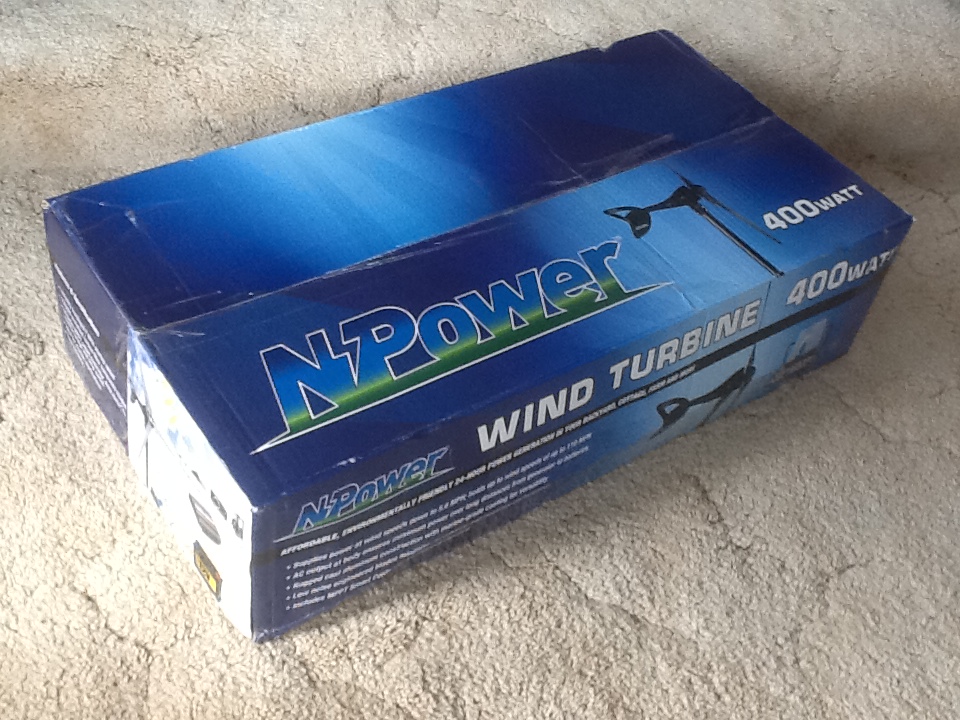 My friend John found a wind turbine kit in a catalog on sale and we both jumped at the chance to supplement our solar power systems. While the sun is out only part of the day, if at all, the wind is strong and pretty much ever present, as open as it is here. The kit comes with a power hub with a built-in charge controller and inverter which allows you to input from both solar and wind sources. It also came with two 12 volt batteries; a complete package to set up a system.
I have decided to operate it as a separate system from my existing solar system. (I still haven’t hooked it up yet.) Being a novice, I am not sure how much the turbine will generate and with only two batteries (for now) it will not store as much. However, with the hub, I can use it as a back-up system for my daily use as well as rig it for the regular utility things, such as the (wish list) water pump that kicks-on on demand, or the (wish list) refrigerator.
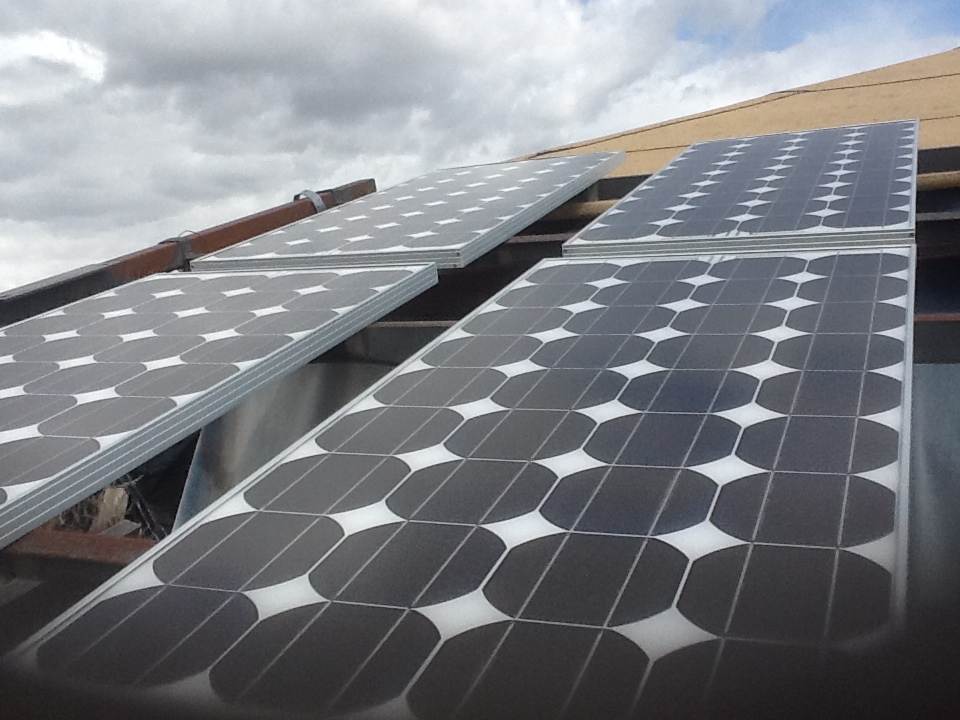 Upgrading my power system overall is my next priority. I do now have a small generator linked into the inverter panel that I can use to top off my batteries when the panels don’t do the job, so as long as I don’t run out of gas, I can have power anytime I want, not just on sunny days. I recently replaced my 8 weak, old six volt golf cart batteries with 4 twelve volt marine batteries, thinking it would offer equivalent power. Apparently that’s not how it works, and then I learned that the golf cart batteries are a better choice in the long run. Though they are more expensive up front, they will hold more charge and last much longer. Apparently the Marine batteries are only good for a couple of years. Live and learn. I’m considering getting 8 more golf cart batteries for the big inverter system and devoting the four twelve volts to the wind turbine once I get it installed.
Other than preferring not to sit in the dark, my motivation for more power is the result of another upgrade, for which I am highly grateful.
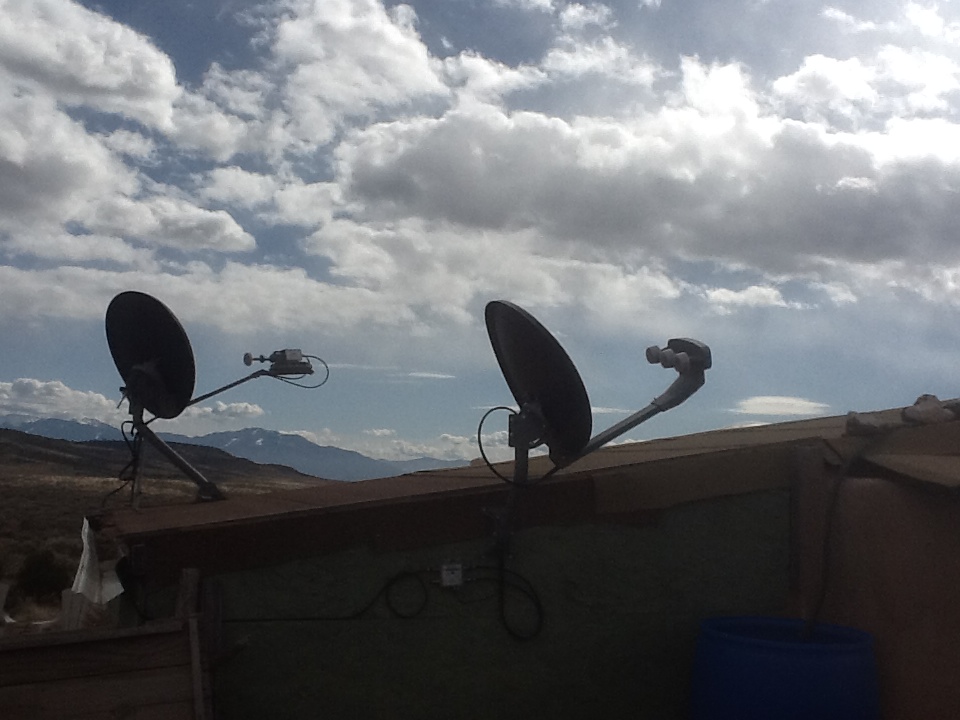 I got Dish!
Now I have not one, but two satellite dishes; one for TV and one for internet. Another huge step toward civilizing this outpost and fills some dark, lonely nights. I confess, I have become a Facebook junkie. While it is probably a real time waster for most city folks, for me it’s a lifeline to the world. From the edge of the wilderness I have regular exchange now with friends as far flung as New York, LA, Seattle, Paris, Rio, Cairo, and Kathmandu. It really lessens the sense of isolation and helps stave off the cabin fever blues, especially during the short days of winter.
THEN COMES THE SPRING
The Jeep finally gave out during my trip to California (aww) but I lucked into a nice used Chevy Trailblazer to get me home. And it has a heater! And a de-icer! I already initiated it as a ranch vehicle last week when I hauled in some straw bales for mud abatement, which left it festooned in little straw bits everywhere, ceiling to floor.
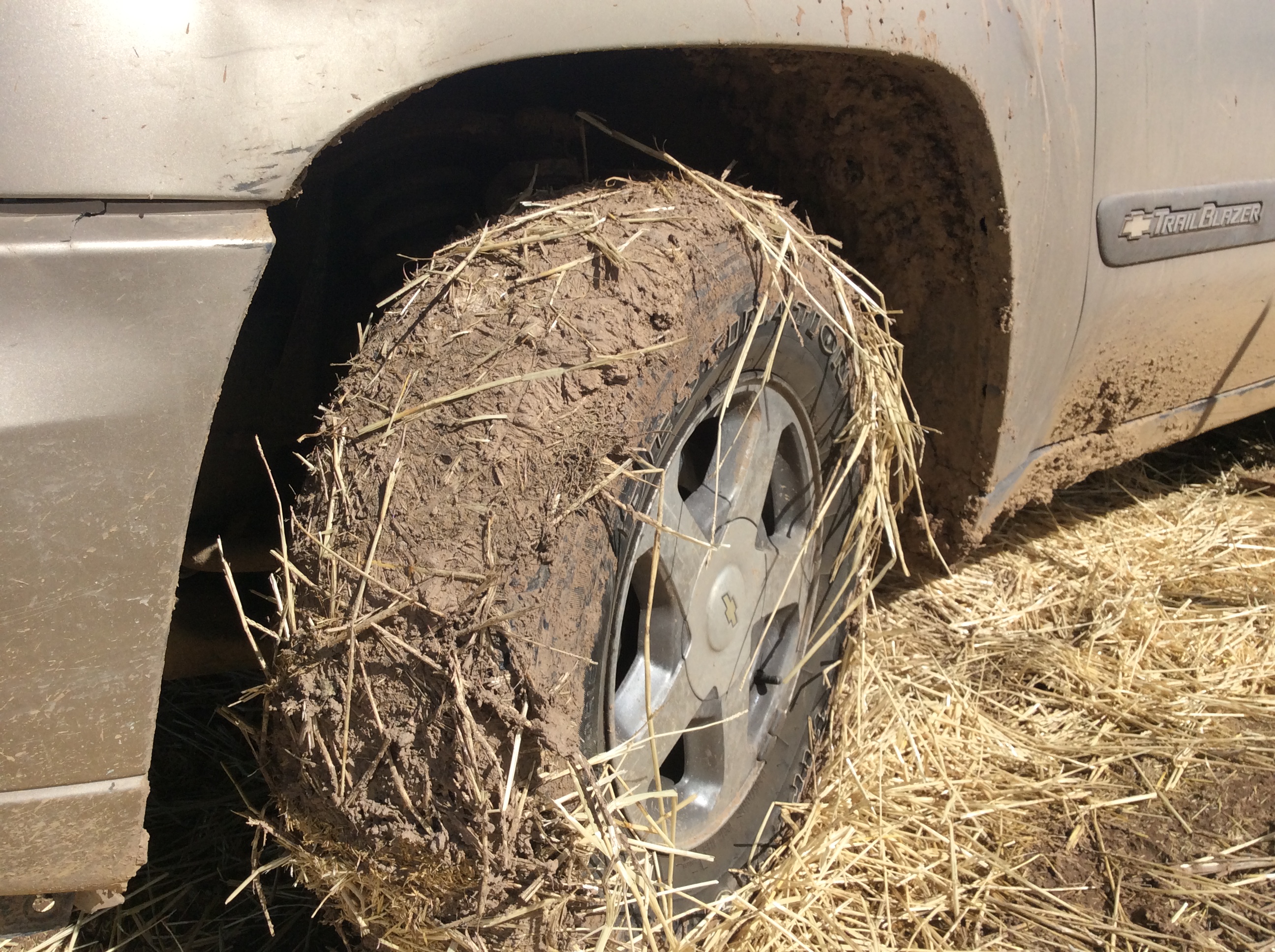 The warmer weather has made for goopy roads and I am avoiding navigating it. Next I need some offroad tires, maybe with optional pontoons. Right now they have a thick adobe tread also reinforced with straw.
As spring sets in, (likely still along way off) and the ground thaws, I need to extend the electric fence to protect the new sections from the returning herds. At least with them gone for the winter, I didn’t have to bother with the electric fence, but they could return without warning.
(Be afraid…be very afraid! Bwahaha)
Wish I had a drone equipped with stun technology, or maybe lasers, so I didn’t have to chase through the sagebrush so much. Maybe someday.
NEXT
My next installment will revisit some of things I have learned in my adventures in off-grid living; to summarize some of the more successful methods and technologies that make the “simple life” simpler.
“Range” has, at this writing, had 995 visits from 38 different countries! I have no Idea how they are finding it, let alone reading it as most are not English speaking countries. It’s big in Brazil, for example with 78 hits so far. I want to think that it resonates with people’s desire to take charge and maximize their lives, and I hope that these journeys are instructional as well as entertaining.
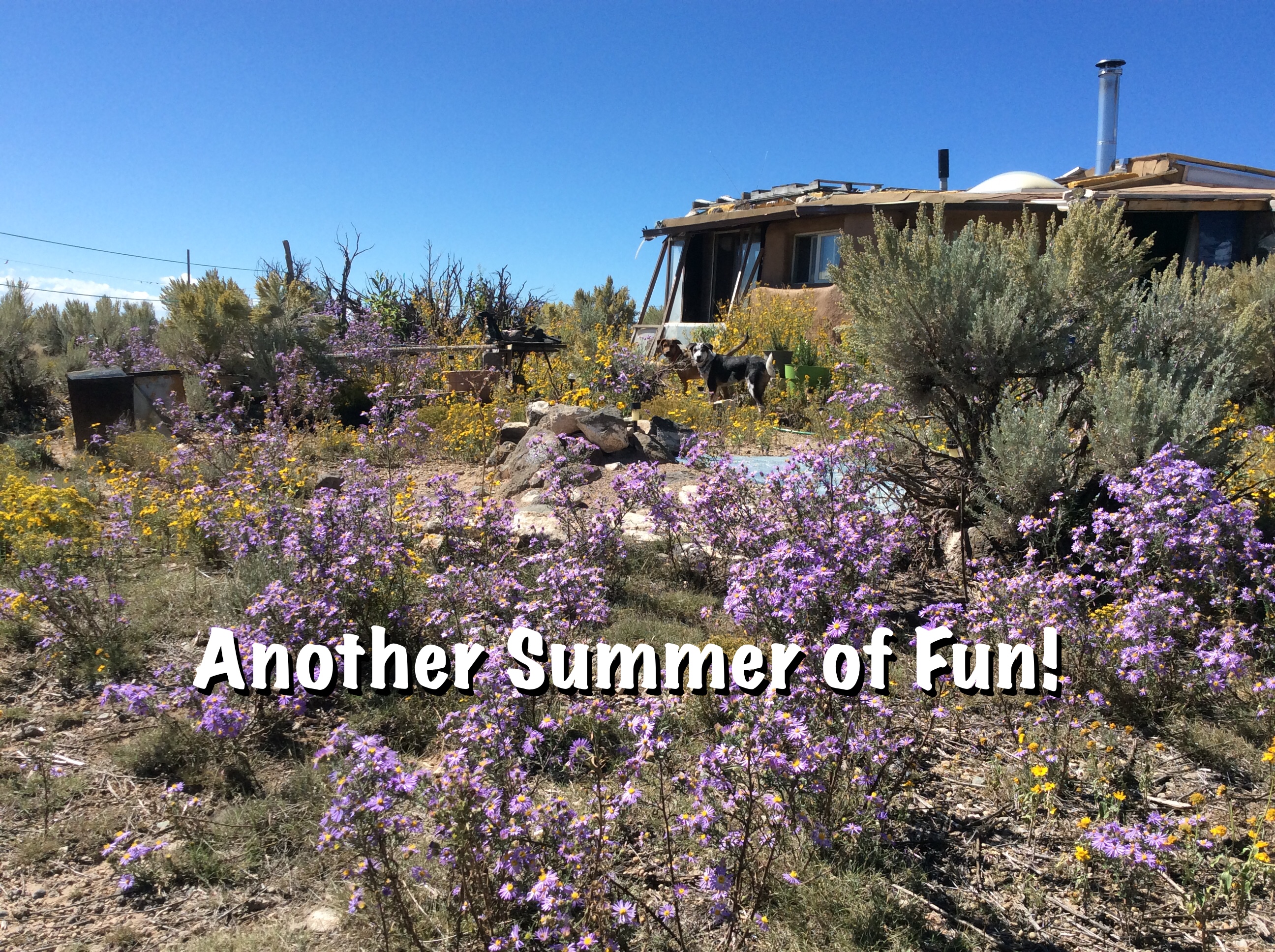
“Hi Ken,
Hi, hope your journey is progressing well.
I tried calling while I thought you’d be on your layover @ DFW but you apparently have your phone off. Thanks again for all of your help adding the sunroom. I know we both wanted to get it finished before you left, but thanks to you, I should be able to finish it on my own before the first freeze in a few weeks.
I made it back from the Santa Fe Airport around eleven AM this morning. I sure wish we had a commercial airport closer than a hundred miles away! Exhausting, so by about 11:15, I decided to lie down for awhile and fell sound asleep. About twenty minutes later, April jumped up on the bed, whining, and ran to the east window, looking out, growling and whining.
Yup…Cows all the way to my fence, all around, and I hadn’t closed the gate or turned on the fence! Good dog! Didn’t even have to train her to do that. Adrenaline pumping, I threw on my shoes, turned on the fence, grabbed the prod and the paintball gun and ran out after them. Same ones, led by that old red one. They split off, three cows and two calves went down the old stage road, so I stayed with the main herd. Naturally, the gas had drained off the CO2 canister so my first shot barely fell from the gun and I had to stop to reload. After chasing them up the hill and around the corner, I went down for the smaller herd who were grazing by the corner of the fence nearest the highway. I managed to surprise them, getting close enough to hit them with a couple of paintballs, to which they didn’t even flinch. They headed toward the corner, toward the highway, AND THEN STEPPED THROUGH. They have broken down the four-strand barbed wire fence on both sides at the corner, and now have free access to the highway! These five followed the fenceline east, back in the direction they “belong”. Now, I’m debating about reporting the breach. Not my problem, but don’t want another highway death, a hundred yards from the last one. Honestly!!! I’ve got better things to do! Why can’t these cattle owners be responsible for their herds?!
I forgot to mention to you this morning about the surprise in the dog dish last night. I went to give the girls a little milk as a bedtime treat and discovered either a very large wolf spider or a small tarantula in the dish! It was too dark to tell and I had the willies bad so I ran it outside and tossed it into the sagebrush!
As I write this, a small tornado like I described to you just hit the house and the sky is black and thundering. The temperature has dropped 15 degrees and it’s starting to rain big splashy drops. (The new room didn’t budge, BTW. Whew.) We need the rain, but hope it doesn’t hail like it did at John’s earlier.
So, same old, same old here…lol
Hope your return trip is/was pleasant and uneventful.
I really appreciate all of your help and loyal friendship!
More soon.
Love, Dave”
My good friend Ken had just flown back to Seattle after a week in mid-August of racing to complete the new sunroom, an expanded and improved version of the solar windows I found to be so effective as a heater for the house during the long, cold winter months. The summer monsoons were in full swing so afternoon thunderstorms hampered progress and the room was only mostly framed in.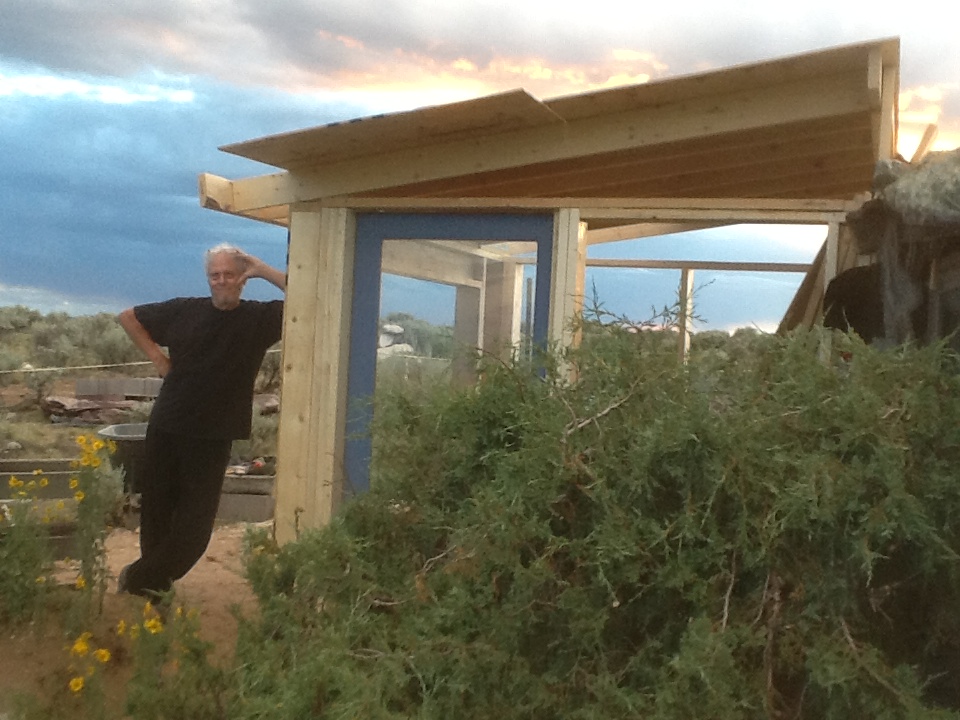
The rough terrain limited the final size of the room to an 8 foot cube, forcing the new roof line a couple of feet above the existing, strangely angled eaves. Even at that, about a fifth of the floor space is occupied by an immoveable boulder which already supports the SW corner of the house with a post that sits atop it.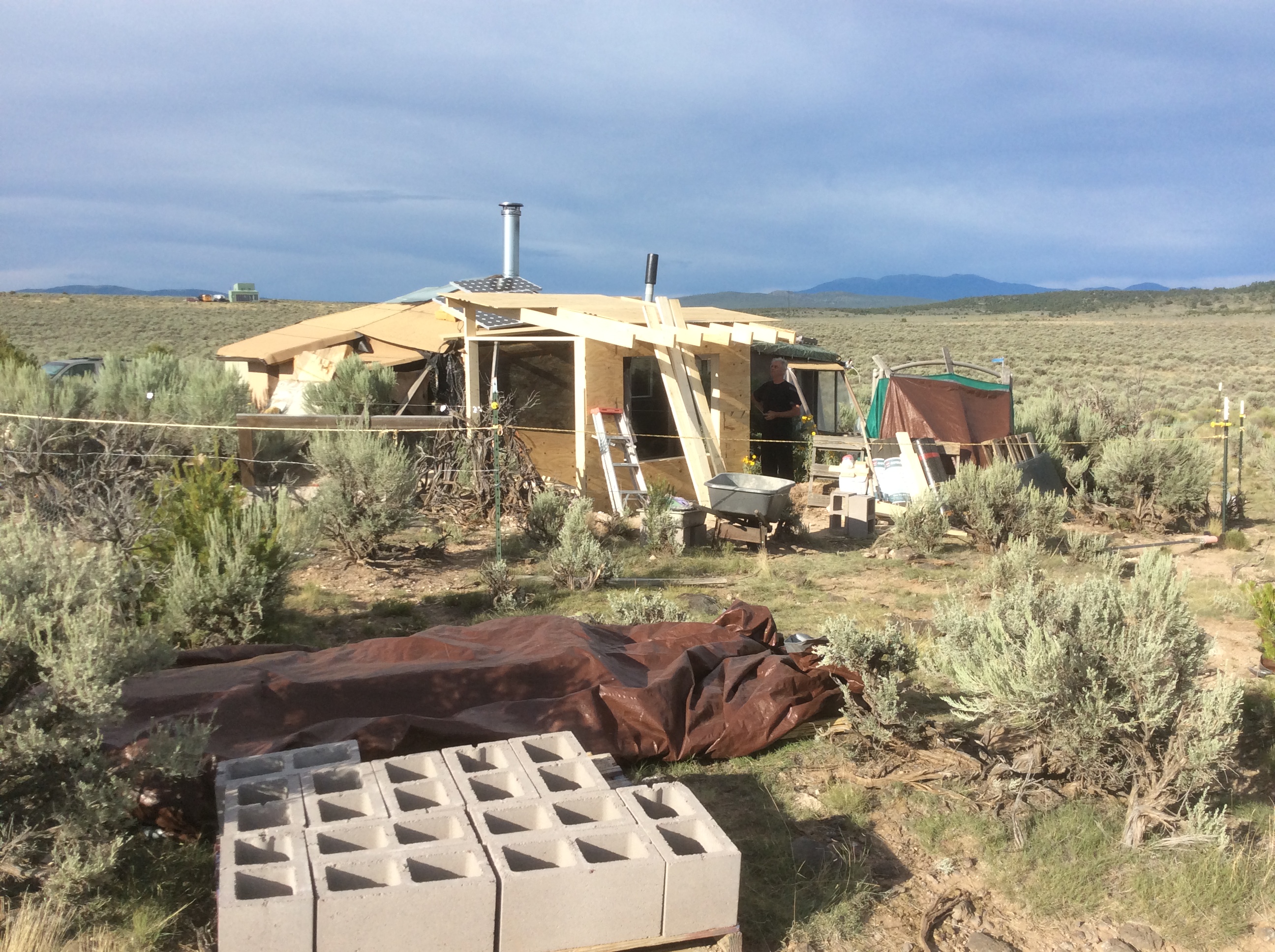 Rather than try to move it, I have decided to make it an asset and plan to build a rocket mass stove on top of it, with a water reservoir above that which will be heated by the stove. Then, either gravity or a small pump will deliver it to my adjacent shower! A proper shower finally! I can retire the camping solar shower bag! I still have to figure out the drain before I pour the concrete and rock rubble floor. I hope to tie in the kitchen sink drain, too, while I am at it as I am still employing the medieval practice of pitching the kitchen basin of gray water out of the window into the drainage channel to the sagebrush.
Even though it is still warm in the daytime, the nights are already dropping to the high forties and it will be freezing by the next full moon. That means hurrying to complete the concrete and stucco. The floors will be about eight inches of stone and concrete sitting on a caliche bed, nature’s concrete, and painted some dark color, which will absorb heat from the winter sun and release it slowly at night, thus warming the west side of the house, perhaps the whole house. The rocket mass stove will also retain heat, as will the reservoir of shower water on top. The process will be in reverse during the summer when the sun is high over the insulated roof and the shady, rocky, semi-subterranean room will be a cool retreat.
The new room will also boast a sheltered dog door leading to an enclosed run for the two, now four-month-old puppies I have adopted. 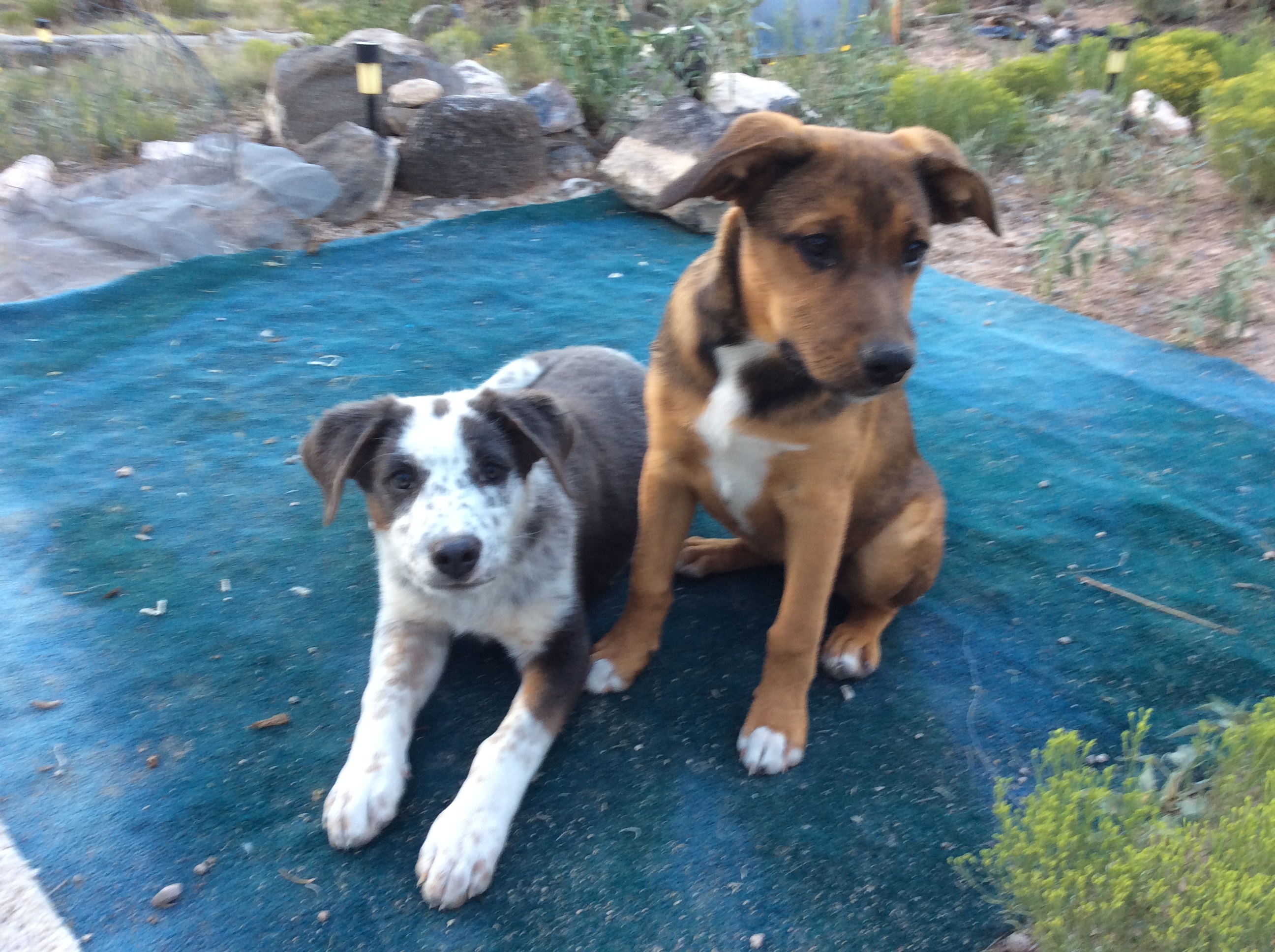 April and Sophie are two from a litter of ten born under an RV from a rescued mother that some neighbors took in from the snow last April. They are wonderful company, though perpetually underfoot, and have already proven to be effective cow alarms. Unfortunately, their destructive chewing habits aren’t limited to household items such as rugs and furniture, but extend to bringing in some of the most vile “treasures” from the fields, including the compost pile and cow dung, both fresh and seasoned!
Ahh. Puppies!
Sure is nice to have them around, though. Despite the fact that I now have the 21st Century advantage of electronic connection while my remote location provides delightful solitude from the 21st Century disadvantage of anxious urban chaos, that solitude can unfortunately lapse into loneliness when you have only houseplants and jackrabbits to share your day with. A certain carelessness ensues when you have no particular routine and only your own brain with which to interact. The bed goes unmade, dishes and laundry pile up, and your sleep pattern gets skewed for example.
But the interactive presence and responsibility of the puppies has activated the nurture gene, again, strong among my people, and I feel less isolated now. They’re not much for conversation, but communicate well nevertheless, are great fun, and help keep me on a routine, especially at mealtimes.
Ahh. Puppies!
With the exception of a four week house/pet sitting gig in Southern California in December, this was the first winter that I managed to stay here through the whole season.
Yay me!
The trip to So Cal was somewhat harrowing as my alternator gave out on a back road in the middle of nowhere, in the Mojave Desert, in the middle of the night, the engine running off the battery as the headlights grew dimmer and dimmer. I shut off the radio to save power but sped up as time was key while the headlights drained the battery. I could see the eerie grid of red
lights of the giant wind turbine array on the hills of Tehachapi as the dash lights dimmed and went off. Then, as I pulled off the freeway bypass and entered the crossroads town of Mojave, the headlights dimmed to invisible, the engine started to miss and stall, and I literally coasted into the first motel I came to as the engine died.
Whew!
A night’s stay and a 90 mile tow got me to my destination the next day. The battery was shot, the alternator was shot, then, after repairs, the starter went. (The irony was, I was expecting to be potentially stranded by the failing transmission!) Needless to say, a new vehicle was necessary to get home and I found a suitable used 4 wheel drive on Craig’s List, an old Chevy Trailblazer, and made it safely home in one 16 hour push culminating through a slight blizzard. And this one has a heater and de-icer! (You may remember that the mice nested in the Jeep’s heater. Alas, the turquoise Jeep was repaired only so I could hunt for a replacement, and then sold for junk. Sigh. Farewell loyal steed!)
The puppies have caused change in more ways than one. Pet sitting will no longer be a viable occupation or retreat. I can’t very well show up with two of my own and boarding them would be absurd. Until they arrived, this had been a winter feeding station for the bunnies and birds. I kept snow-sheltered birdseed and unfrozen water always available. The rabbits are so accustomed to me, most of whom were born here and know nothing else, that they will come running up, even while I am still putting out the seed.
There is a regular herd of eight and a few are recognizable regulars, such as Split whose right ear is split in two, giving her the appearance of having three ears. During a serious cold snap last winter, one of them crawled into the generator shed for warmth while it was running. I went out to shut off the generator and discovered it overcome from the carbon monoxide. Its eyes were open and it was panting but made no move to escape as it let me drag it by its ears onto a shoebox lid. Not sure what to do, I carried it to the feeding station for fresh air and left it in the sunny shelter by the food and water. I was relieved to come out later to find him recovered, eating, and unafraid of me from then on.
But now the puppies have scared them off and the local threat of bacterial Tularemia, Rabbit Fever, has made leaving shared water out unsafe for the dogs. To remedy this, I have created an enclosed area, accessible by the birds and rabbits but not the dogs. I see my regulars now and then but they are wary of the puppies who are discovering how fun it is to chase them.
An enclosed area for the dogs is high on the agenda now, too. Sophie needed to go outside her first week here and in the dim light just before dawn, she disappeared around the car and didn’t respond to my calls, not too surprising since she didn’t know her name yet. Motion by the front of the car caught my attention and I stepped forward and called her again when I realized that it was a coyote which turned it’s head to glare at me and then took off. Probably stalking tiny, plump, two-month old Sophie who had had the good sense to hide under the car and ignore my calls. That scared me enough to never let them out unattended at dawn or dusk, though no time is really safe until they are bigger. Within the week a coyote pack started yipping in the middle of the night really close, probably down by the stable celebrating catching one of my rabbits. I took the opportunity to make a lesson of it to the girls who were already afraid, conveying fear and warning to them. I’ll feel better once the fence and their door are in.
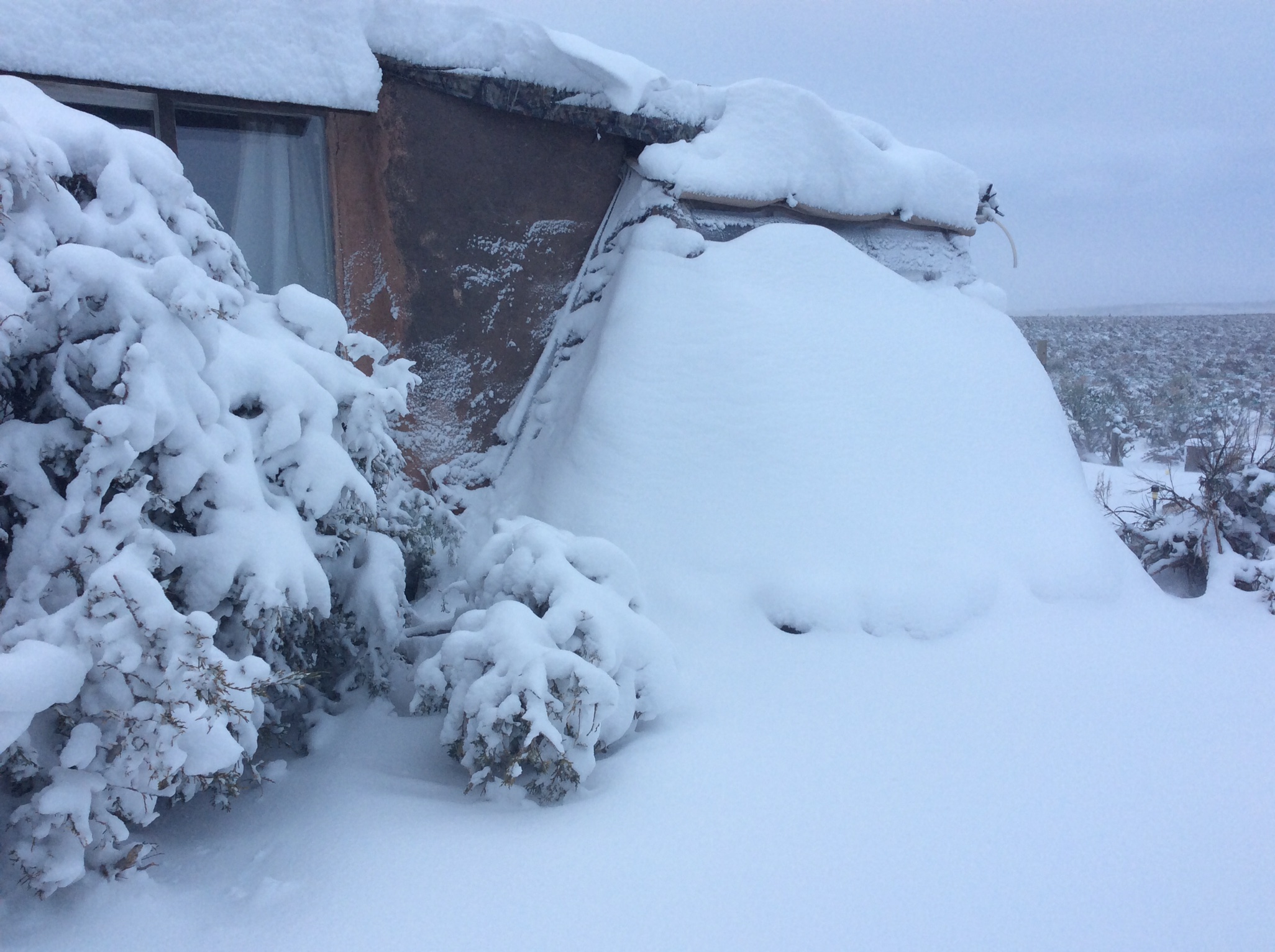 The El Nino winter held strong into May and then just slammed into summer.
 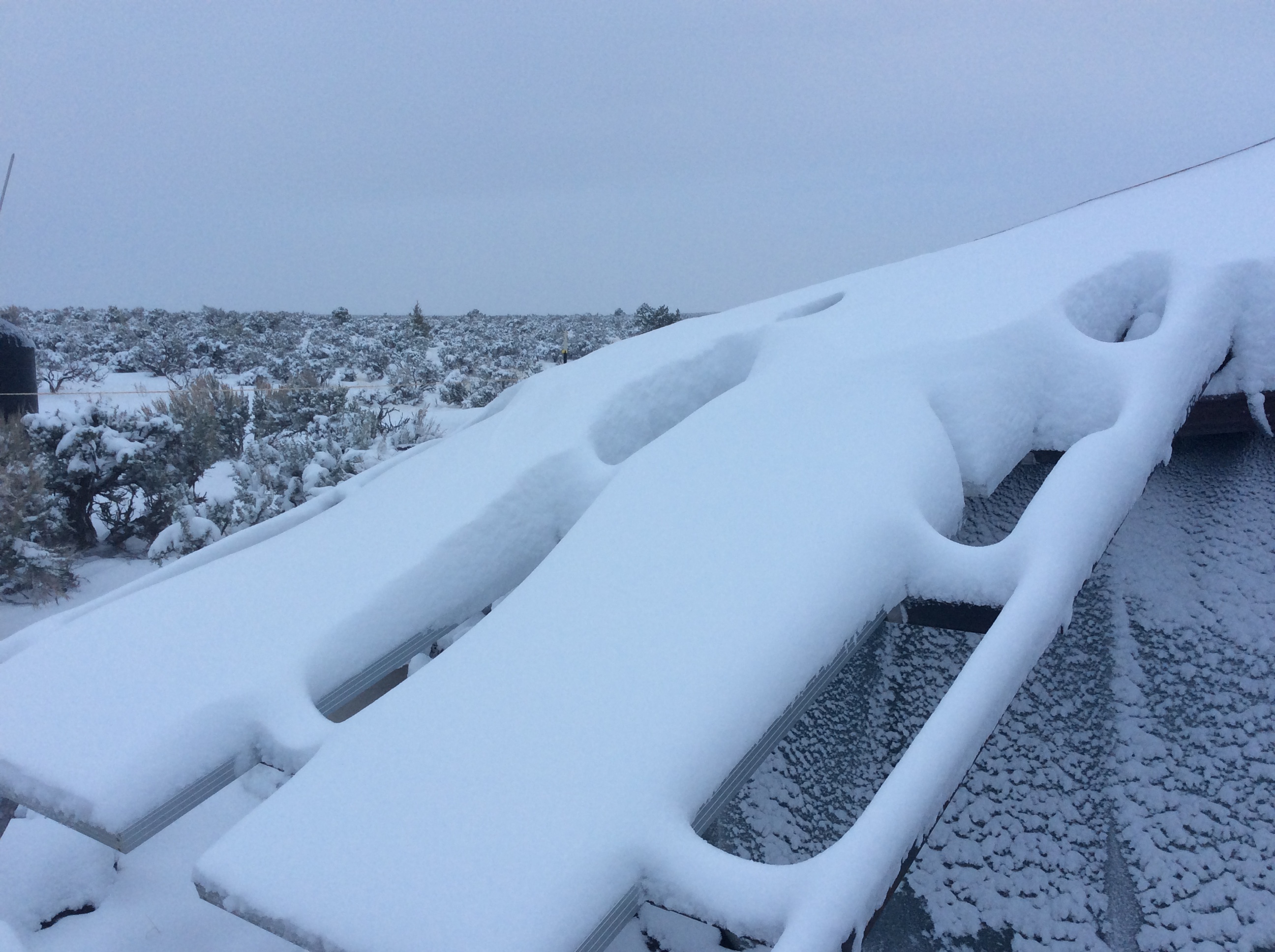 Heavy, late snows and early rains teased out seedlings and then a merciless, desiccating sun baked the clay into hard adobe, sucking the moisture from the withered sprouts.
 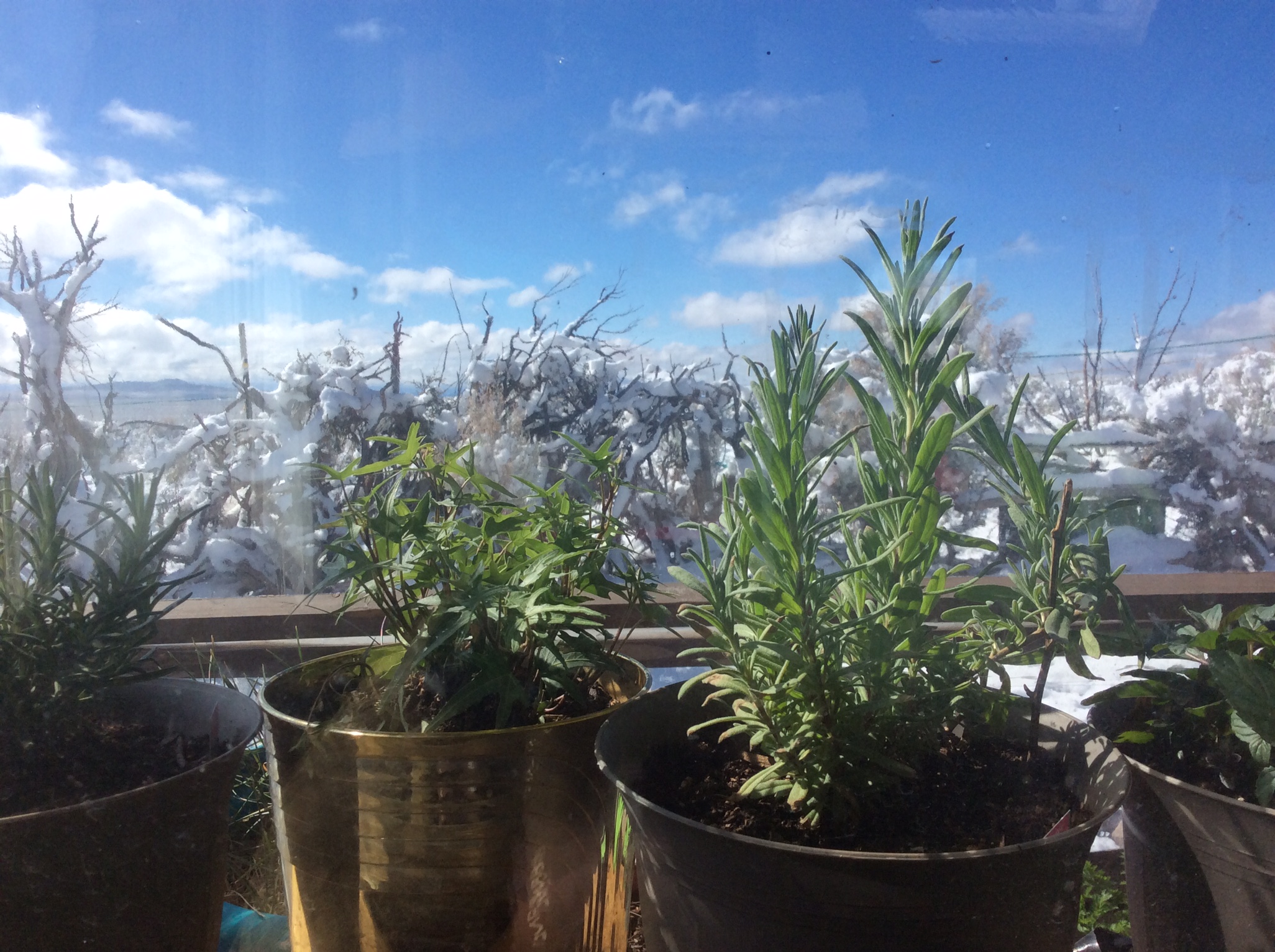 I started things in window boxes
while it was still freezing at night, transplanting them when it warmed up, but for some reason everything came in stunted this year. I have Lilliputian basil and the lavender only produced a couple of tiny blooms. The monsoon pattern came late and the clouds often withheld the needed rain, offering only shade and incendiary lightning. After depleting the winter’s accumulation from the rain barrels, I resorted to watering the garden with gravity-fed water from the main tank, ultimately depleting that, too. It costs me $180 to refill the tank, amounting to about ten cents a gallon. Though it’s treated city water, I still prefer to bring in filtered water from a dispenser in town (twenty-five cents a gallon) for drinking and cooking purposes. Better than old tank water delivered by a sun-baked hose.
The gully garden is better protected from cows and rabbits now and I planted staple crops in small raised beds; beans, peas, corn, potatoes, (sprouted volunteers from my larder) onions (also volunteers) and tomatoes. Despite regular watering and fencing, nothing of the gully garden survived this year. What didn’t shrivel was harvested by something small with sharp
teeth; mice, rats, squirrels…who knows? An unfortunate waste of water just to provide a steady salad bar for the local rodents. I also continue to water the two fruit trees that the cows lopped the tops off of last year, after which the rabbits the stripped the bark as high as they could reach. The apple tree may come back as it has some new growth at the base but I’m afraid the cherry tree is a goner. One day I will improve the gully garden with a walipini, an underground greenhouse, which will nicely keep out the critters and extend my growing time.
This morning I went to town for supplies and discovered yet another cow disaster! 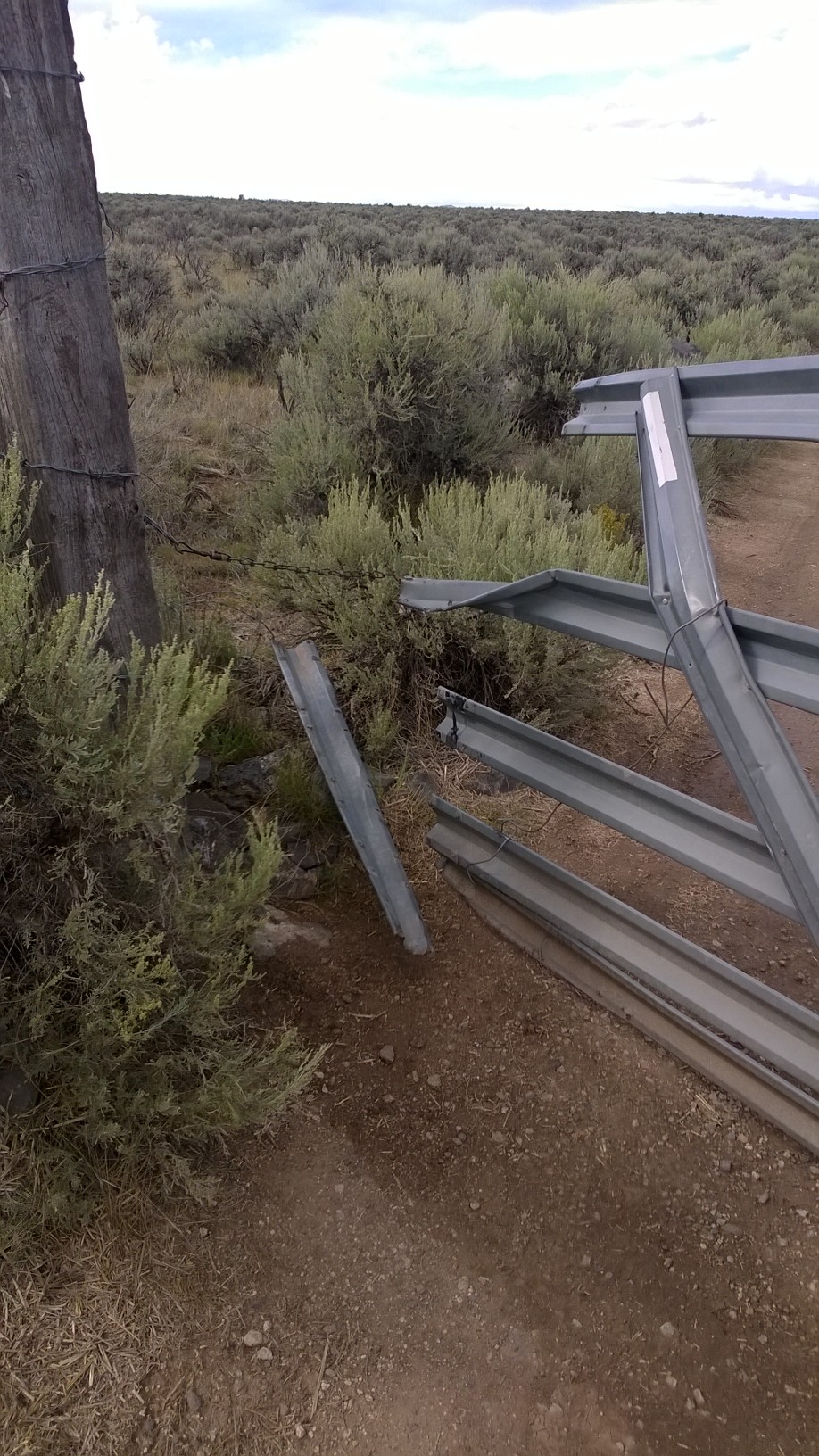 Apparently one or more of the herd got out onto the highway again and decided to force their way back in through the metal highway cattle gate, pushing through at the chain latch and then jumping the gap, ripping the end piece off and making it impossible to secure now.
 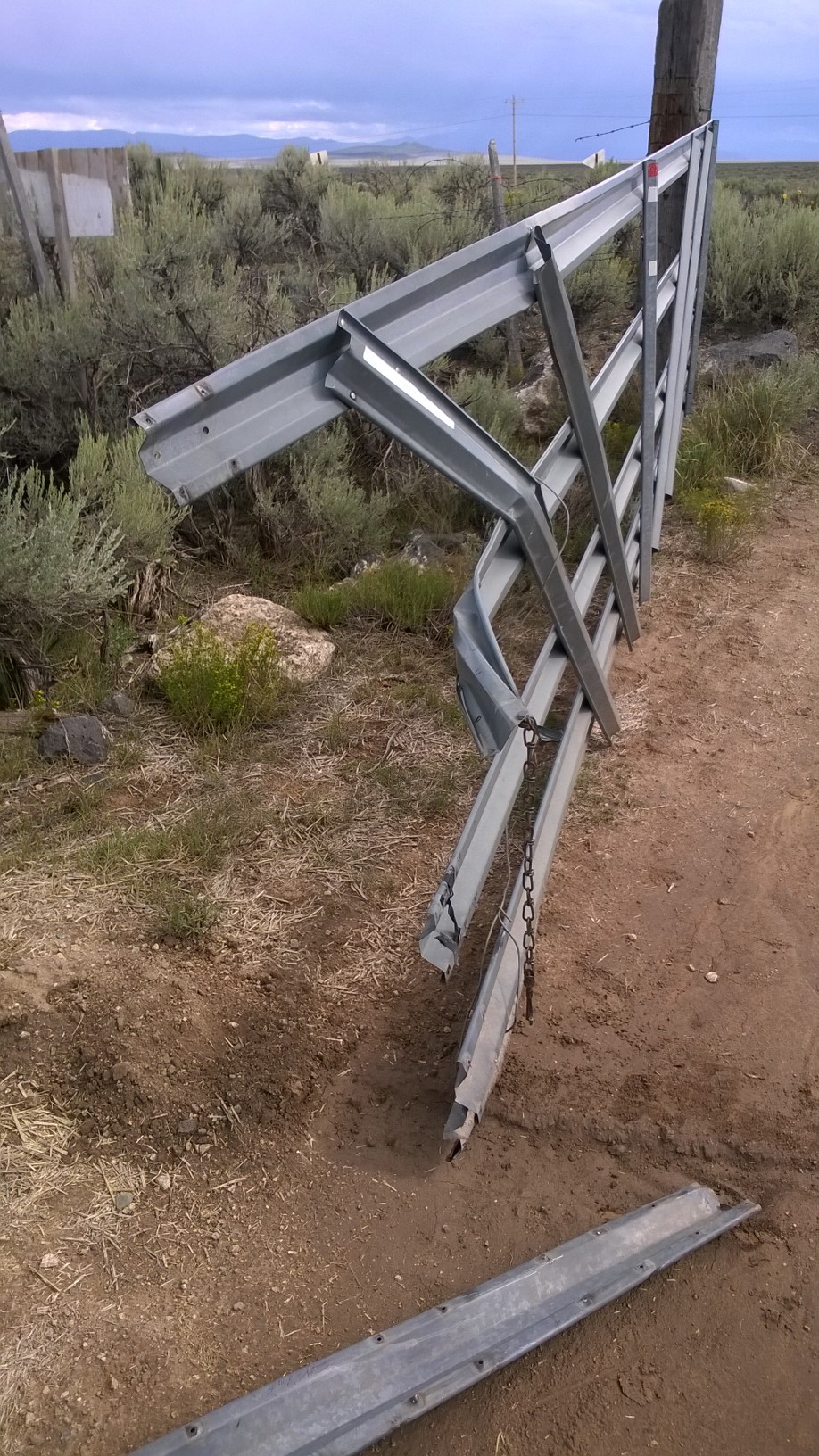 It may have been the bull I ran off yesterday. He was alone and coming from that direction, but of course there is no proof whose cow did it, as though it would matter, given the archaic laws protecting their owners. My new neighbor, Bill, has reported it to someone in the highway department but I’m afraid the gate is probably our problem. So now it’s MY responsibility to replace the gate, which I would vastly prefer NOT to have anyway, (requiring getting out in the worst weather and mud and snow to open it, drive through, then get out and close it again) just so some cattle owner can graze his cows freely on my land?! The highway department has posted a sign at the gate that it is state law to keep the gate closed. No mention of who provides the aforementioned gate.
Bill and Uva are my new neighbors about a half a mile up the hill from me. They arrived last summer with a different, more immediately successful approach to off-grid living. 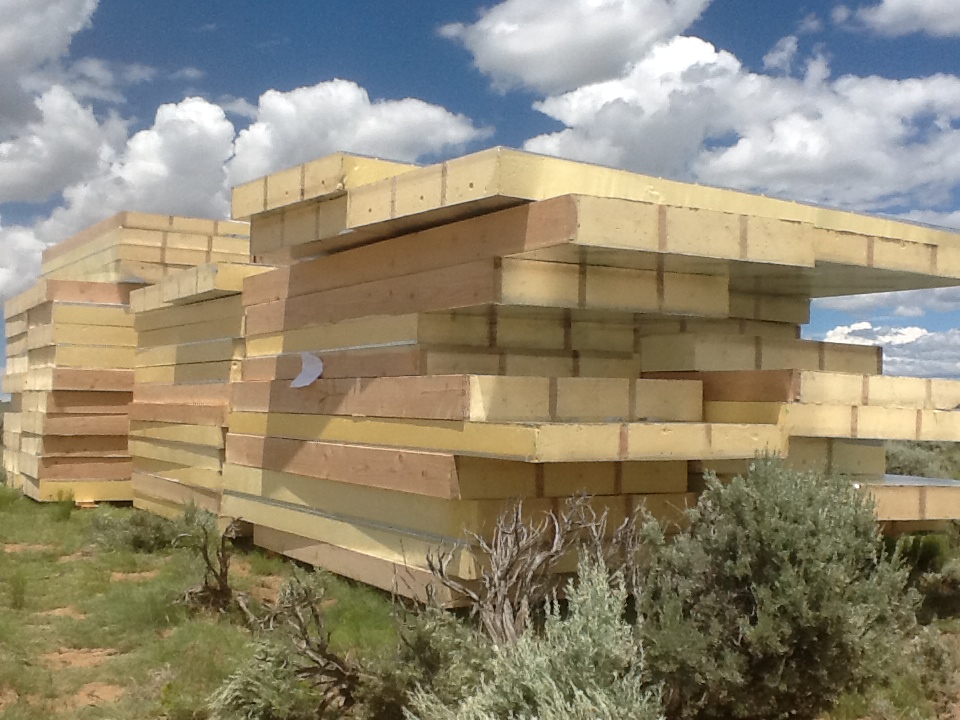 Their home came on a big flatbed semi truck in the form of prefab wood and foam panels which assembled onto a concrete foundation, immediately providing them shelter by fall.
 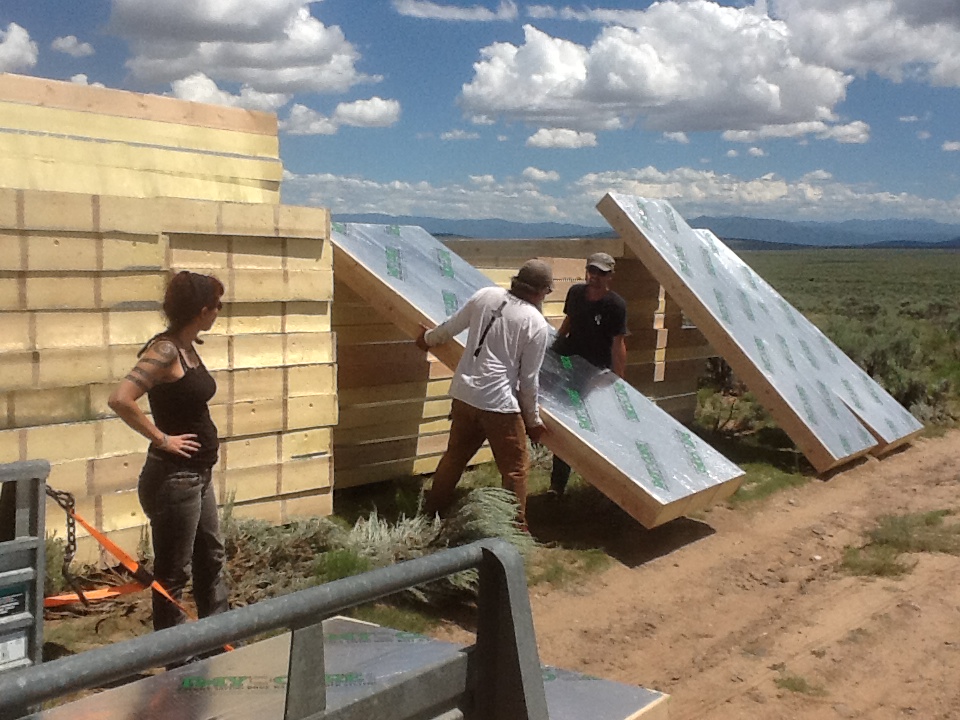 They modified the original design by adding a concrete mass wall covered with a glass panel facing south as a trombe wall. He has also begun a rocket mass stove using heavy duty industrial piping, which makes the open plan, two-story home quite toasty. The house is completely covered in a practical, green metal roofing and siding.
 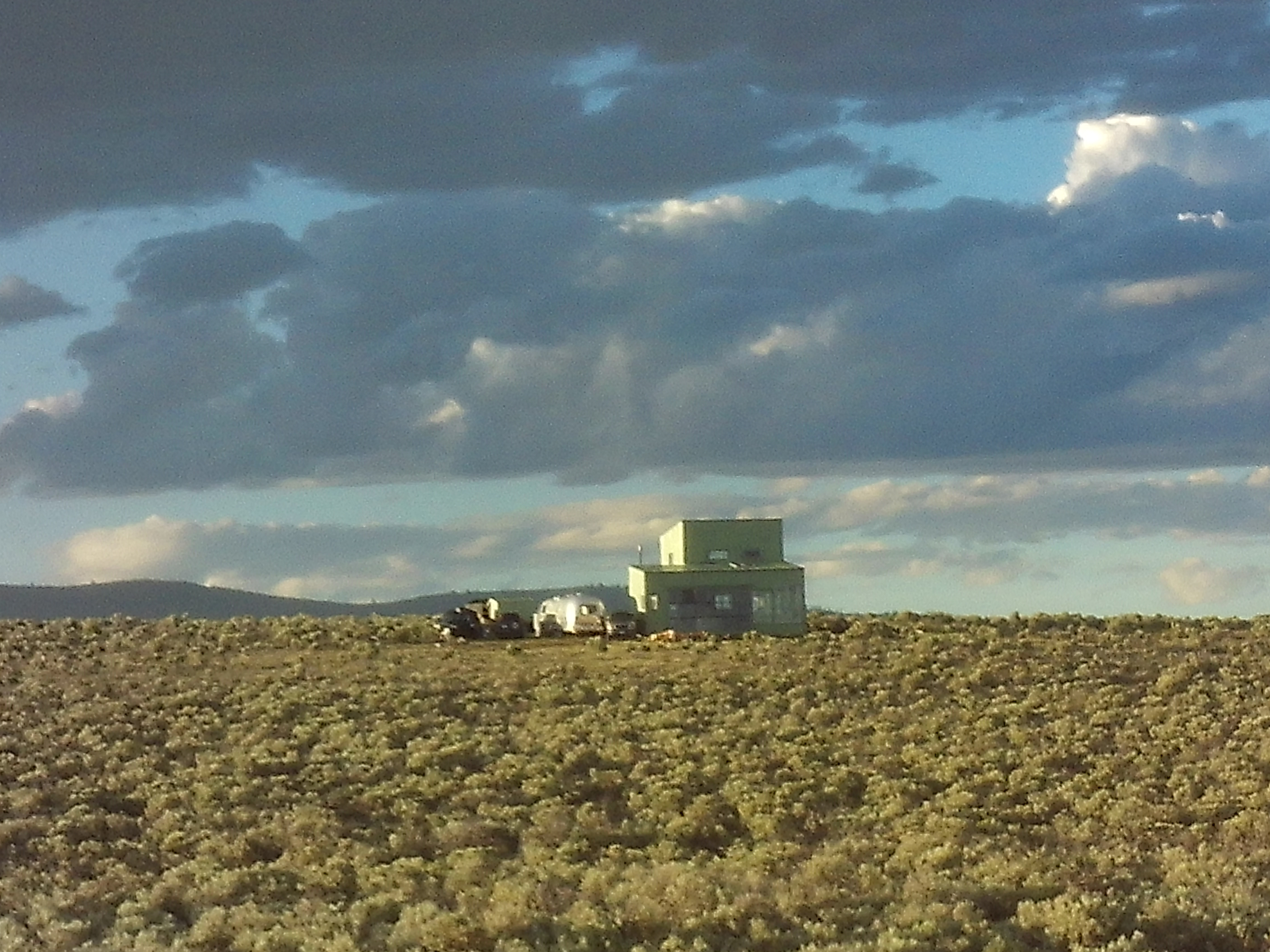 They have a large above-ground water tank like mine
and have also abandoned their outhouse for an indoor composting toilet. Solar panels and a back-up generator provide for their power needs and they have recently acquired a propane refrigerator. (I’m envious)
Another off-grid friend of mine, John, has taken yet another approach to homebuilding in a jiffy. 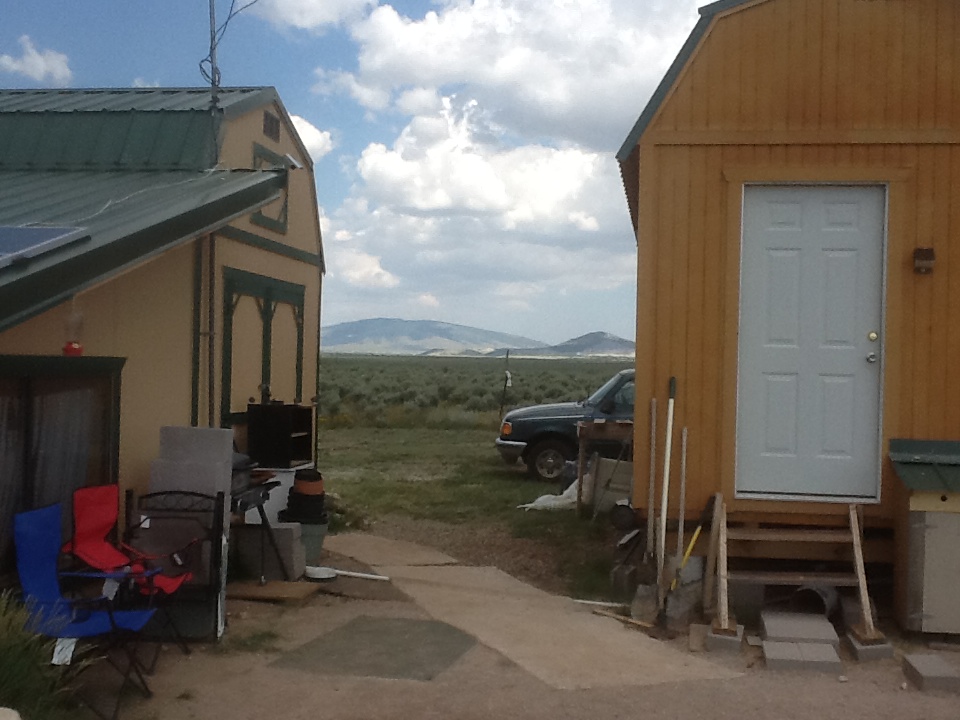 He purchased a couple of 10′ X 20′ Weatherking pre-fab utility sheds with gambrel roofs, which are delivered on a truck, prebuilt, and winched onto a foundation. He then connected them with a glassed in atrium and built a wrap-around deck.
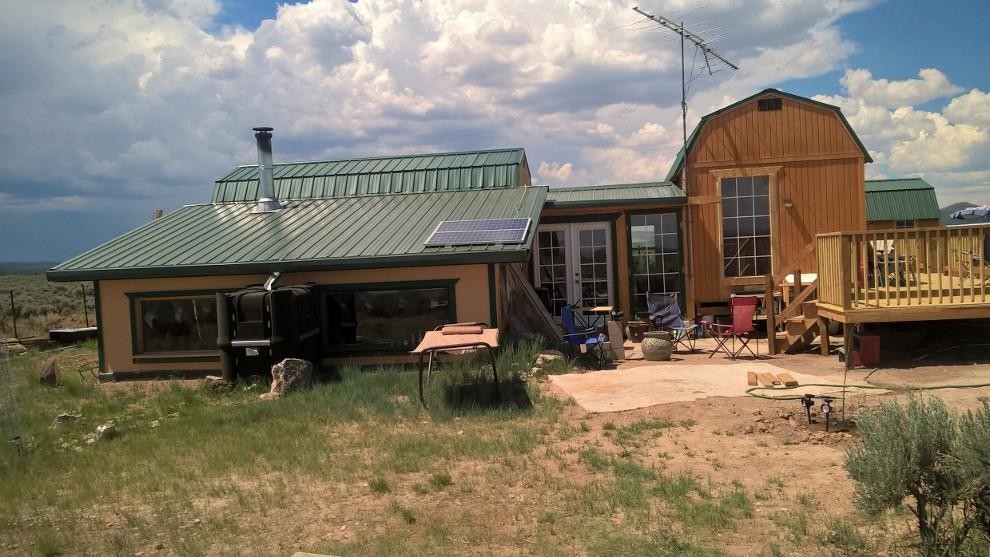 Attached on the south wall is the main living space, a semi-subterranean, glassed in room which takes good advantage of the winter sun. His approach also provided immediate shelter, which he continues to refine and improve. He, too, has opted for a composting toilet and has solar panels and the same wind turbine system that I have. His water tank is mostly buried which keeps it from fully freezing, though his pipes to the house froze and burst in the severe cold last winter. Now repaired and better insulated, a pump keeps his pressure tank full and a propane, on-demand water heater serves his kitchen sink and shower. (I’m envious.) New friends of his from Vermont who live here on the Taos Plateau and arrived only last year have followed suit, starting with a pre-fab and insulating and modifying as they go.
Last fall, I joined a community effort hurrying to complete a traditional adobe home on the Pueblo Reservation in Taos before the first snows for a young couple with three very young children. 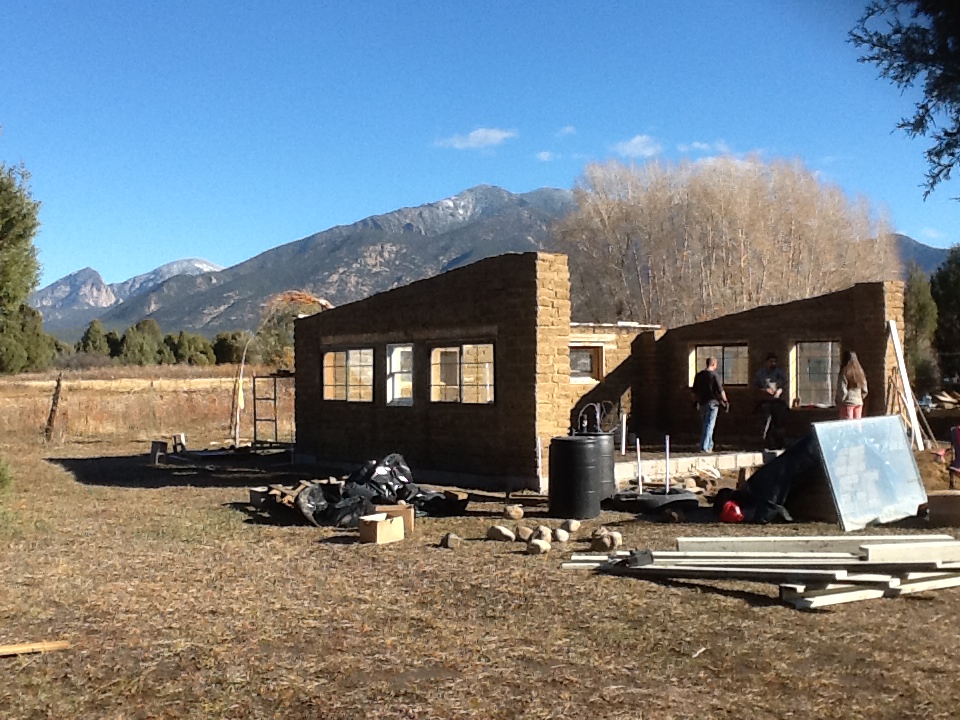 They had been granted a spectacular site bordering a wide horse pasture panorama in the shadow of Taos sacred mountain and were living in a pair of tents on site while they rushed to enclose the space before winter. This ancient type of building benefits greatly from many helping hands and I was glad for the opportunity to try my hand at this traditional construction technique in this spectacular setting, learning about the mud mixture used as mortar for the sun-dried mud and straw bricks, and various framing and roofing methods.
 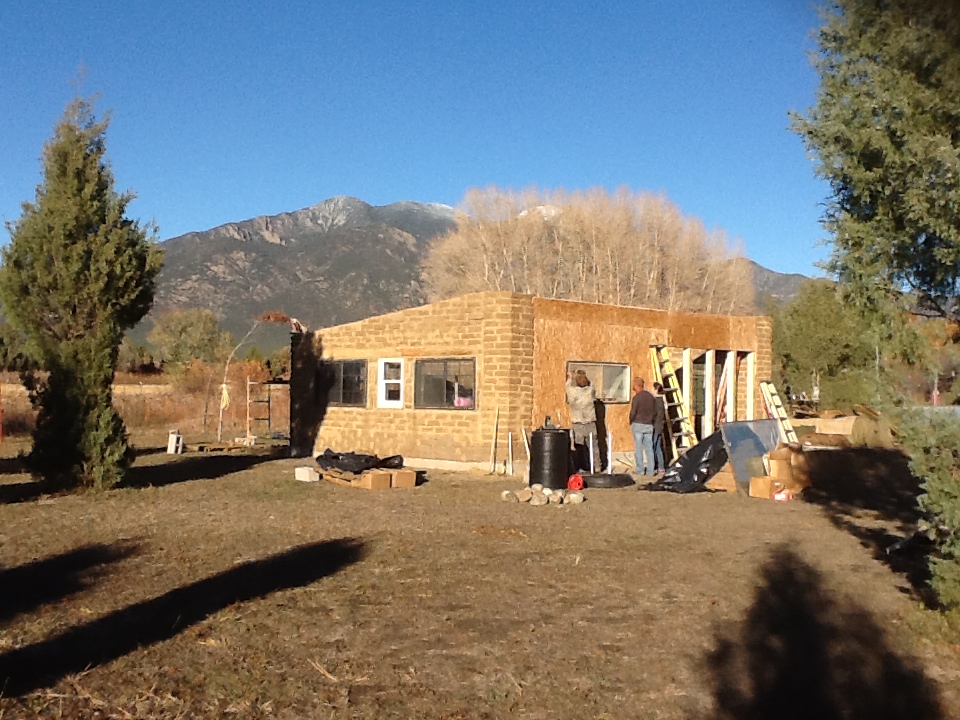 They, too, have a south facing wall of glass to capture the winter sun. Given their location, they conveniently have access to city electricity and water, and are experimenting with bio-gas systems, producing methane from compost. They were unable to complete the house by winter, but once the walls and roof were up, they moved the tents indoors, taking advantage of the dry, airtight shelter and the wood stove.
There are so many different ways to approach an off-grid lifestyle. They don’t all have to include being rural. City dwellers can still apply many or all of these methods. Solar panels and trombe walls can vastly reduce your dependence on purchased energy, for example. The principle of self-sustaining dwellings can and perhaps should be applied, not only in third-world or impoverished situations, but as a paradigm changing approach to communities in general. Dependence on a central distribution system, whether it’s the vulnerable power grid or any other system which depends on manipulable commodities such as gas or water, is an unnecessary
risk and expense.
What if every new home was built as a self-sustaining unit, such as the Earthships? Why pay a for-profit corporation for the basic necessities of life when they are freely available to you?
Take back the power!
Now I need to hurry to completion to beat the oncoming cold weather which will put a halt to exterior work. A more completed room will be featured in the the next entry, soon to follow.
Contact me: daveintaos@yahoo.com
The Sunroom
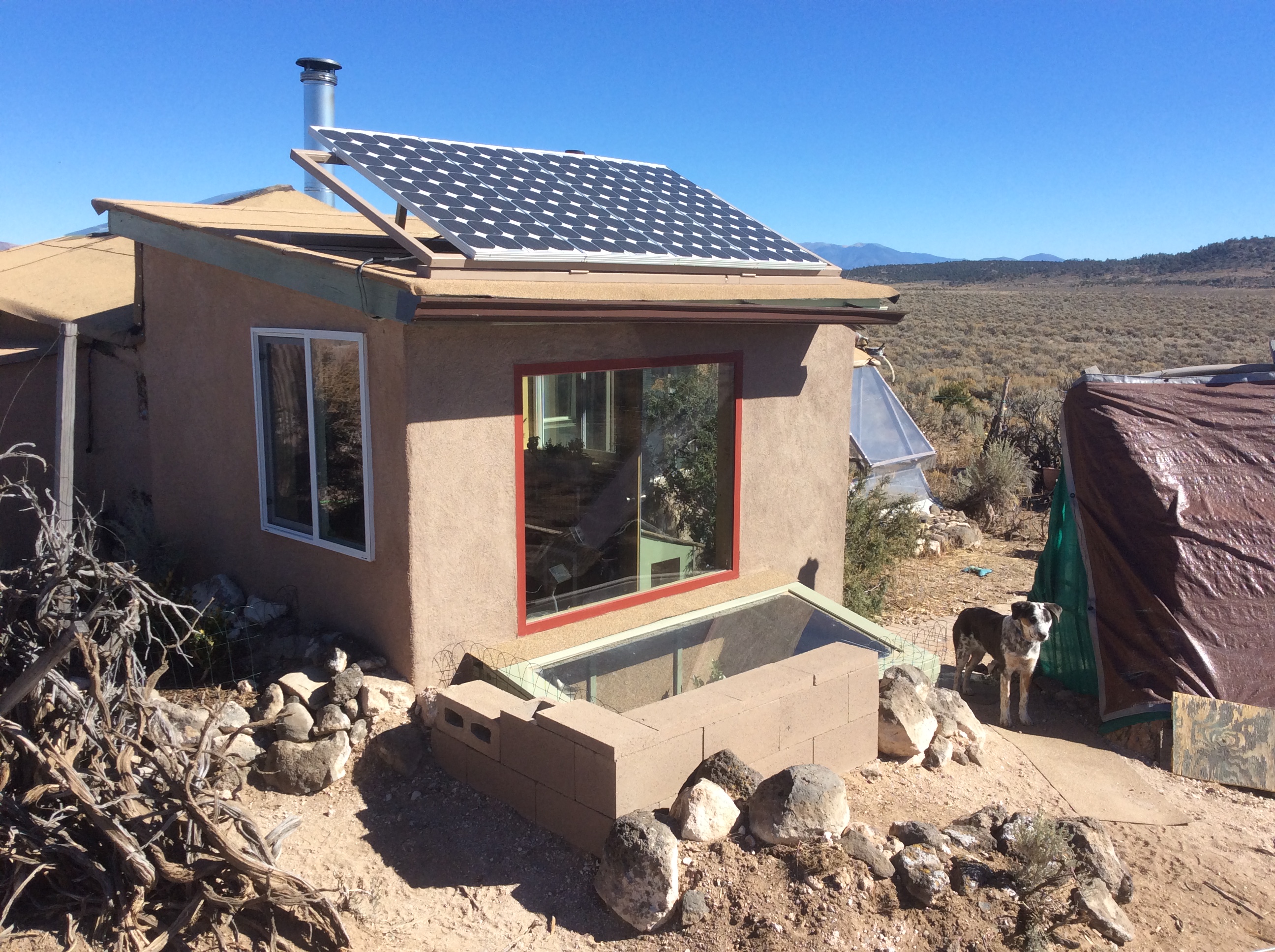
The southwest corner of the house is the most exposed to the prevailing wind so we built the original roof to that section as a low wedge to deflect it from this formerly temporary shelter. 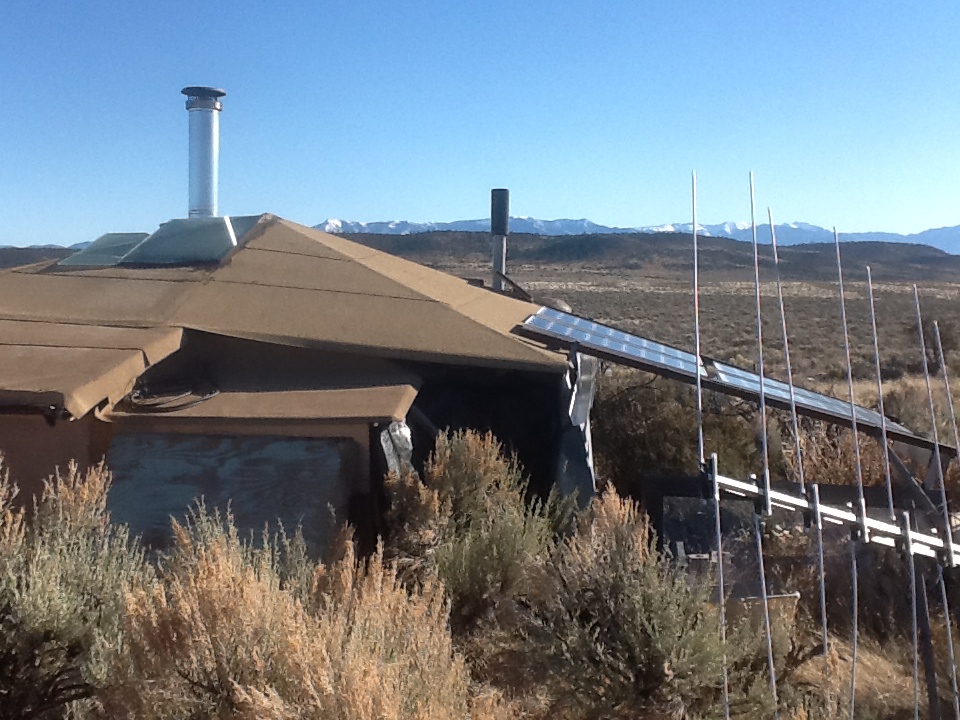 It was the windowless “hidden” storage room so the odd roofline and low ceiling didn’t matter…then. The corner post was built on a cluster of immovable boulders and the wall had no supporting structure, the plywood running horizontally, joined laterally with a single 2X4.
 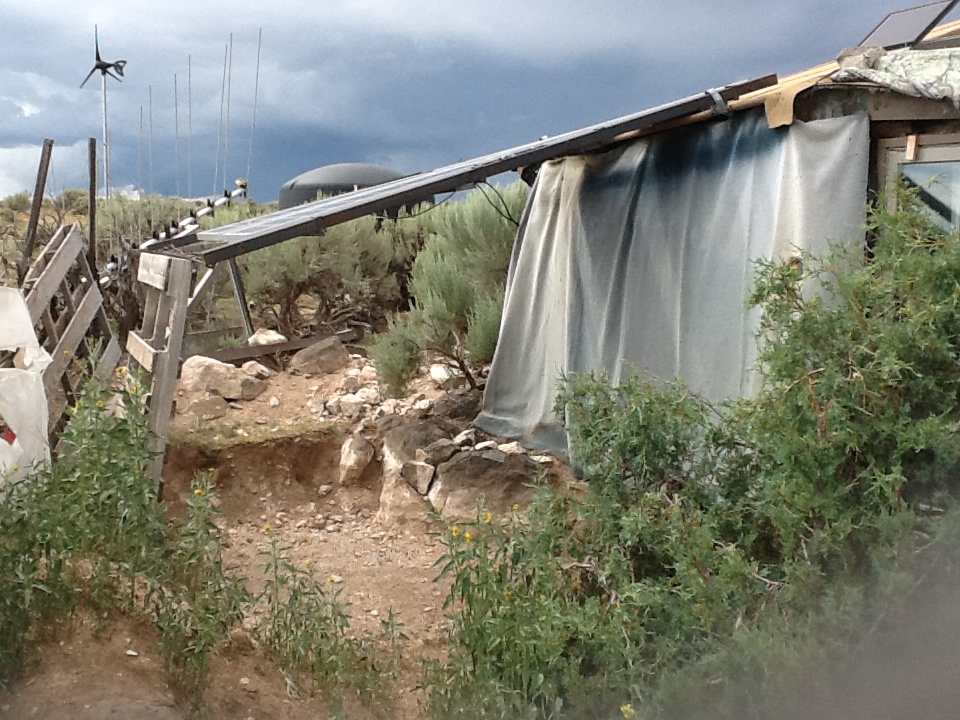 Connecting the two rooms was/is an interesting feat since not only are there two completely different rooflines, but also two floor levels, interrupted by a boulder mound. Combining the rooms has created a really interesting space, however, bringing light into the power room and doubling the size of the new sunroom. The floor of the eight foot cube addition is eight inches of volcanic rock and concrete on a solid base of caliche. When painted a dark color, it will absorb the heat from the winter sun and slowly release it at night.
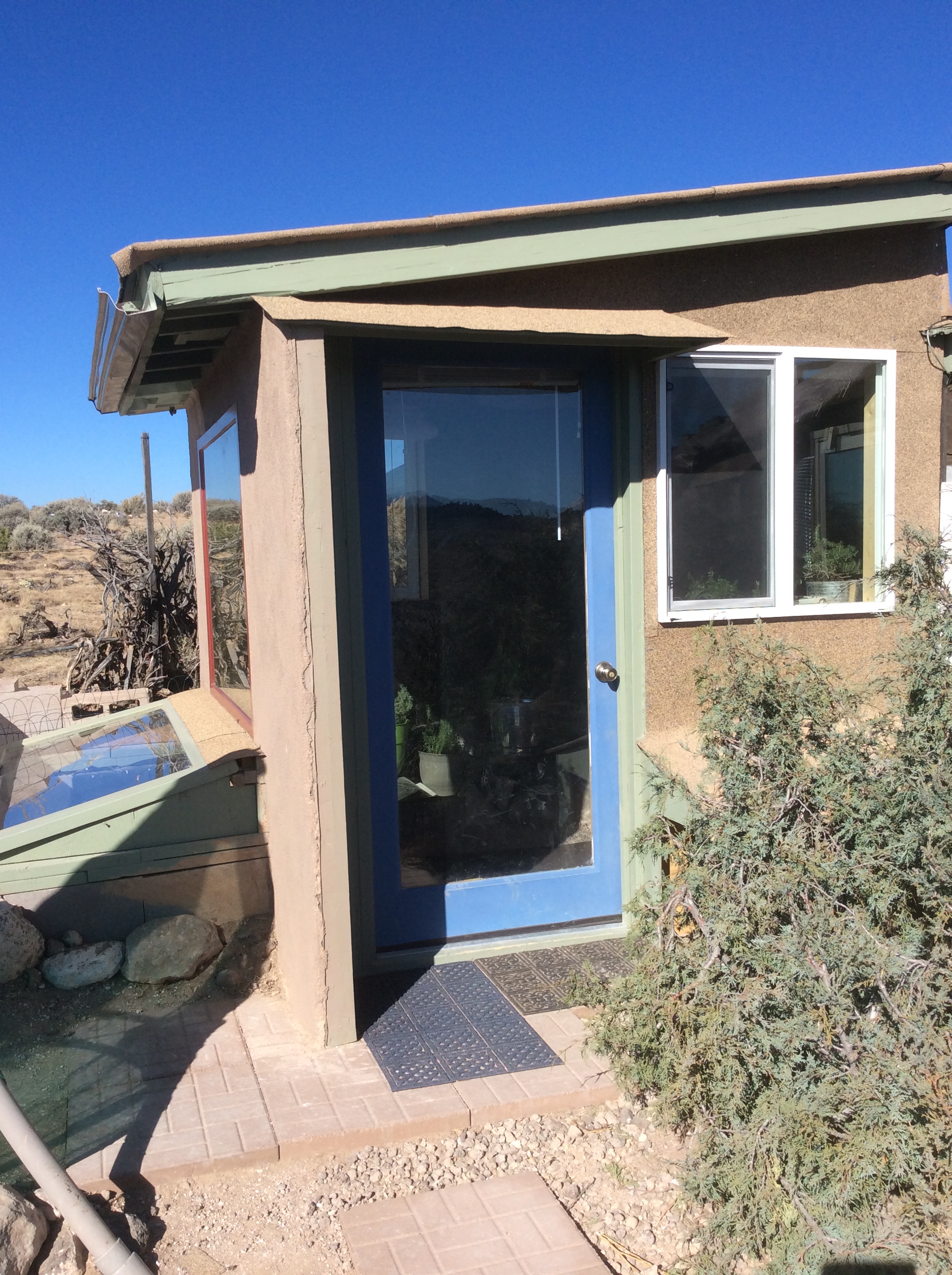 The room was built around a heavy glass door donated by one of my pet sitting clients who had replaced it with a solid one, ironically, so they could install a doggie door. I had the luxury of building the room to accommodate both doors independent of each other. Theirs opens into an attached doghouse with a doormat floor. Not sure how to get them to wipe their paws, though.
Bold April figured out how to use their door first, Sophie being intimidated by the magnetic weather flap, but now they are both slamming in and out all day, rampaging through the sagebrush and rolling in the dust.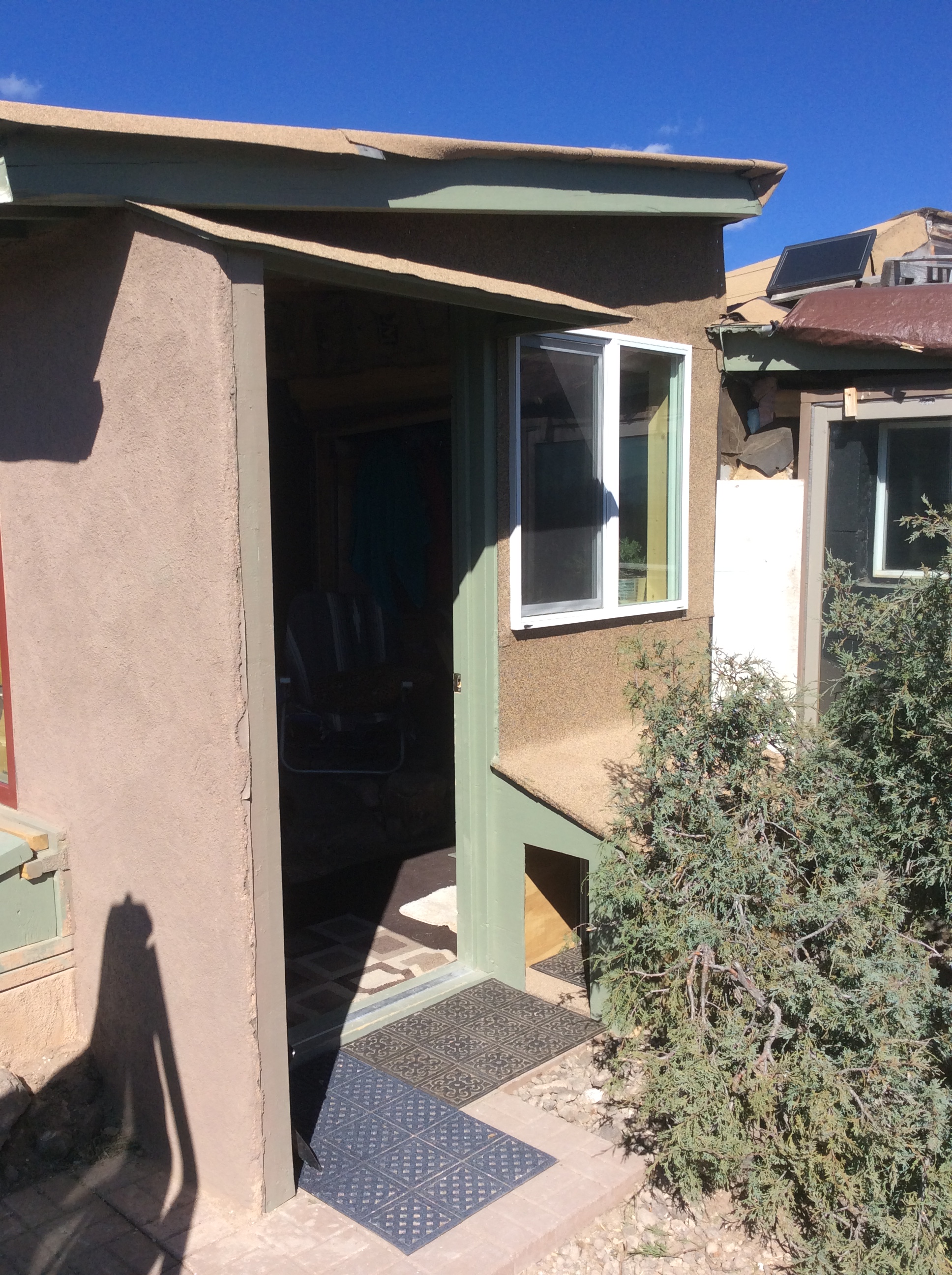 I have only partially completed the fenced in area to keep them in and the coyotes out, but am motivated as the pack has been yipping and howling at night near the house all week. I think the girls are coming into their first heat and hope that is not a factor. Luckily the doggie door has a locking panel.
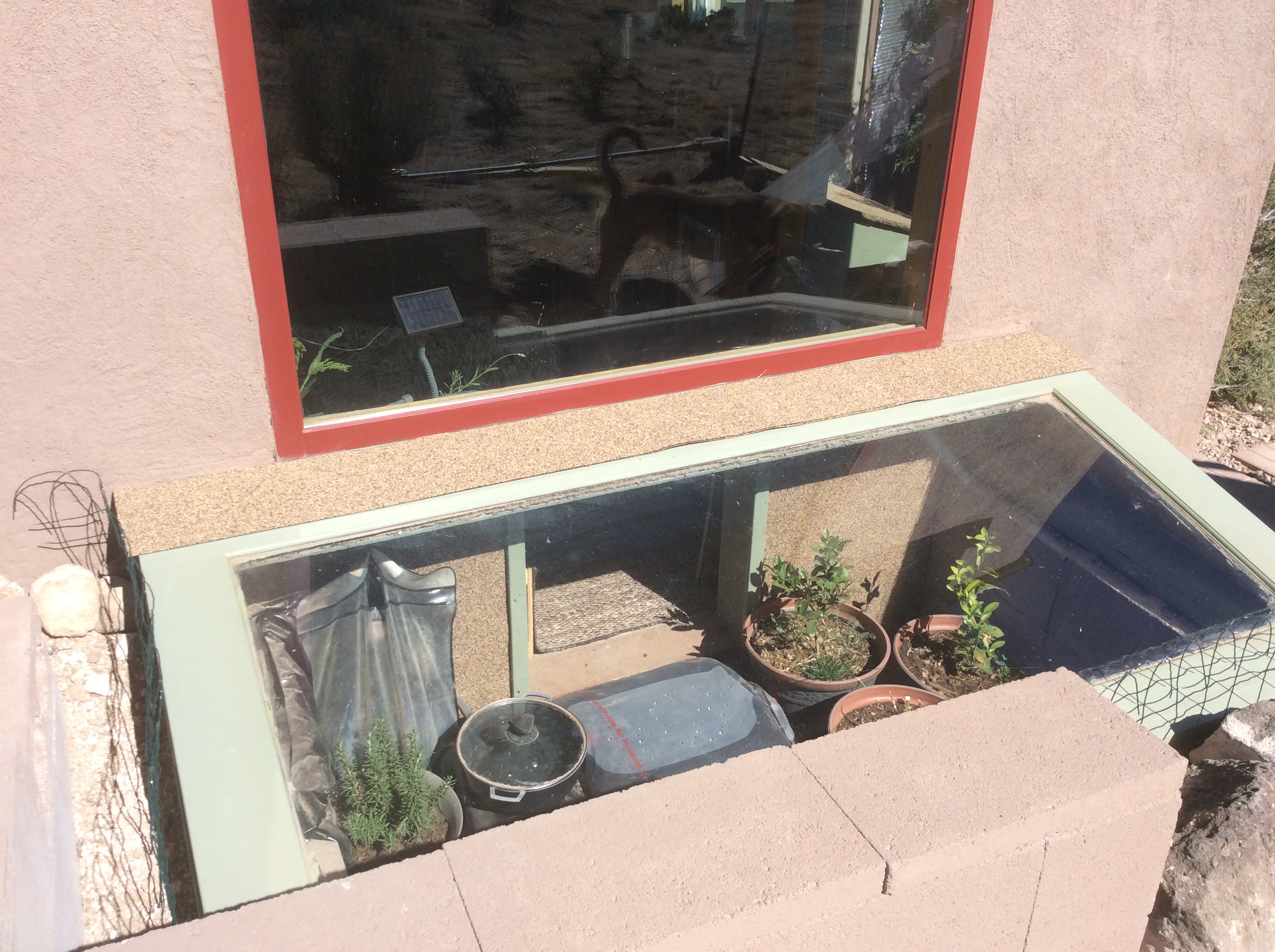
The walipini is made from another salvaged glass door, one of its double panes of tempered glass broken out, it is hinged so it can be lifted and accessed from the outside.
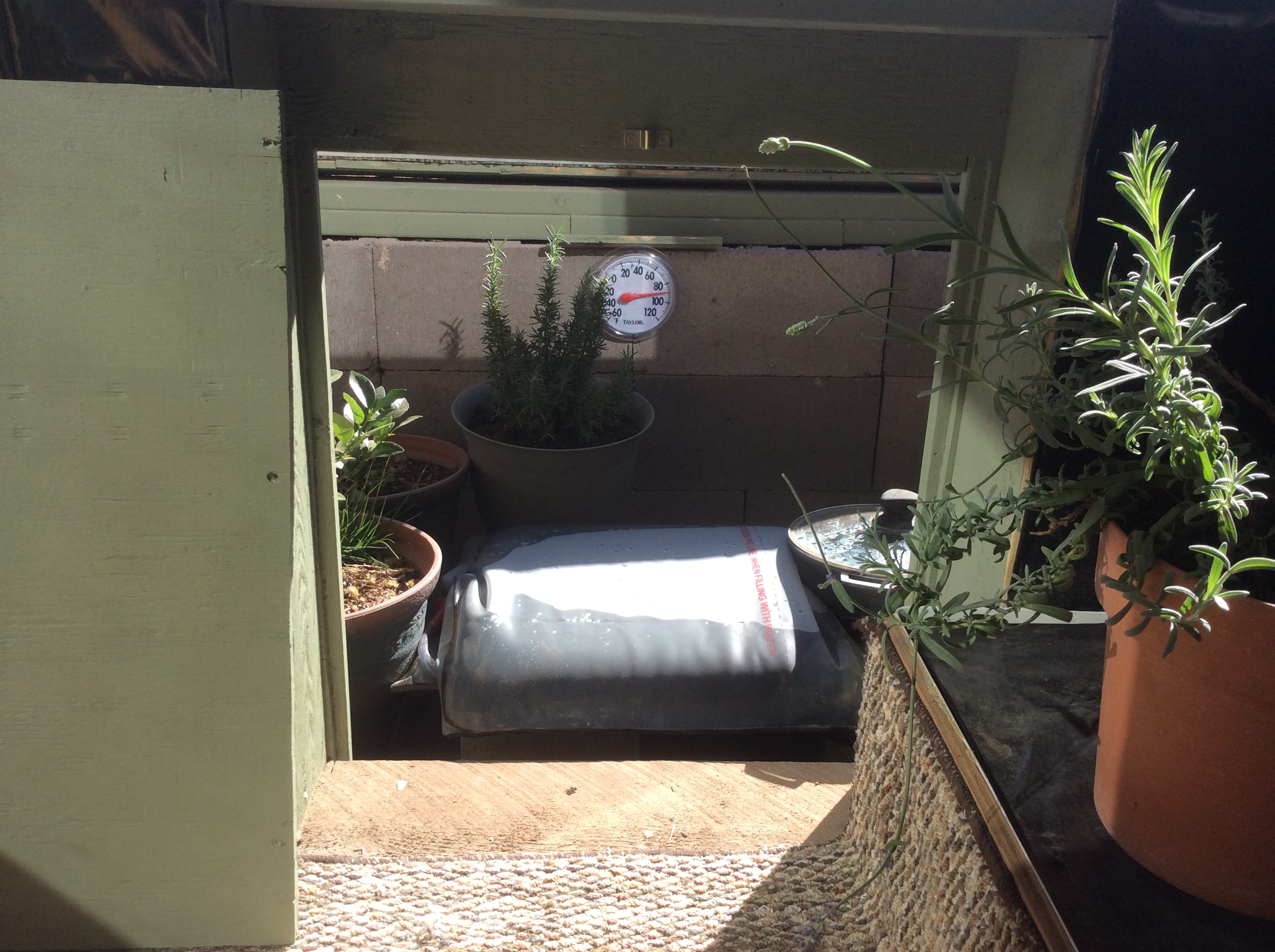
It also has a removable panel for access from inside. The low cinderblock wall serves both to shelter the glass from the perpetual SW wind and as a platform to stand on to sweep the snow from the solar panels.
(The previous arrangement was difficult to access, even with my telescoping snow squeegee.)
It gets hot in there so there are side vents when necessary. I keep the solar shower bag and a dark pot with a glass lid with water in it and always have hot water. Well, during the day, anyway.
There is a shower base installed in the corner with a drain that runs out to a buried gravel pit by the cedar tree. For now the solar shower bag will suffice until I get a water system installed. It’ll be great to be able to shower indoors, and even during the winter. Eventually there will be an indoor water tank, a pump, a pressure tank and an on demand water heater which will deliver to the shower and the kitchen sink. There will also be a rocket mass stove heated water basin with a pump and a solar water heater on the roof.
Eventually.
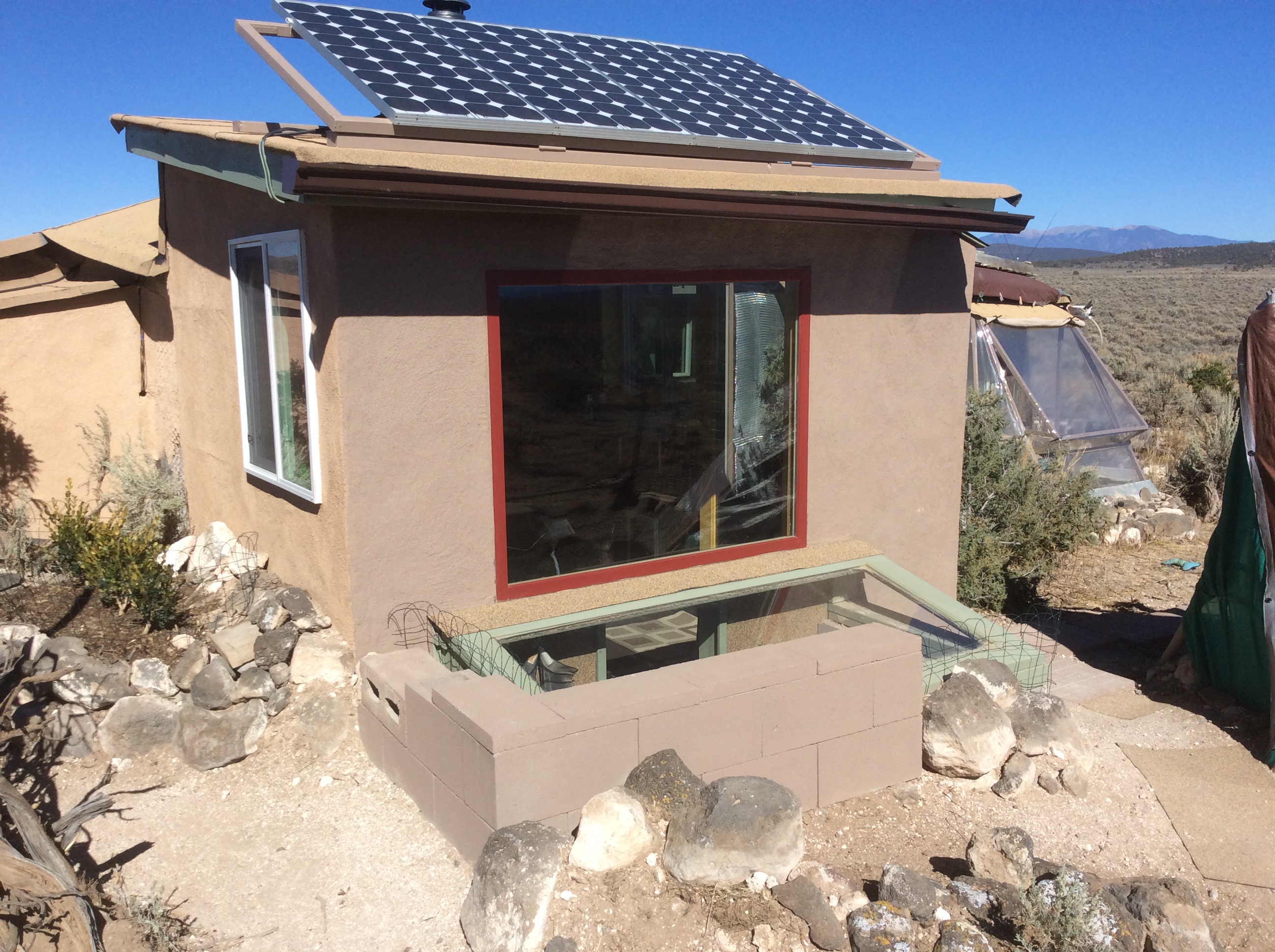
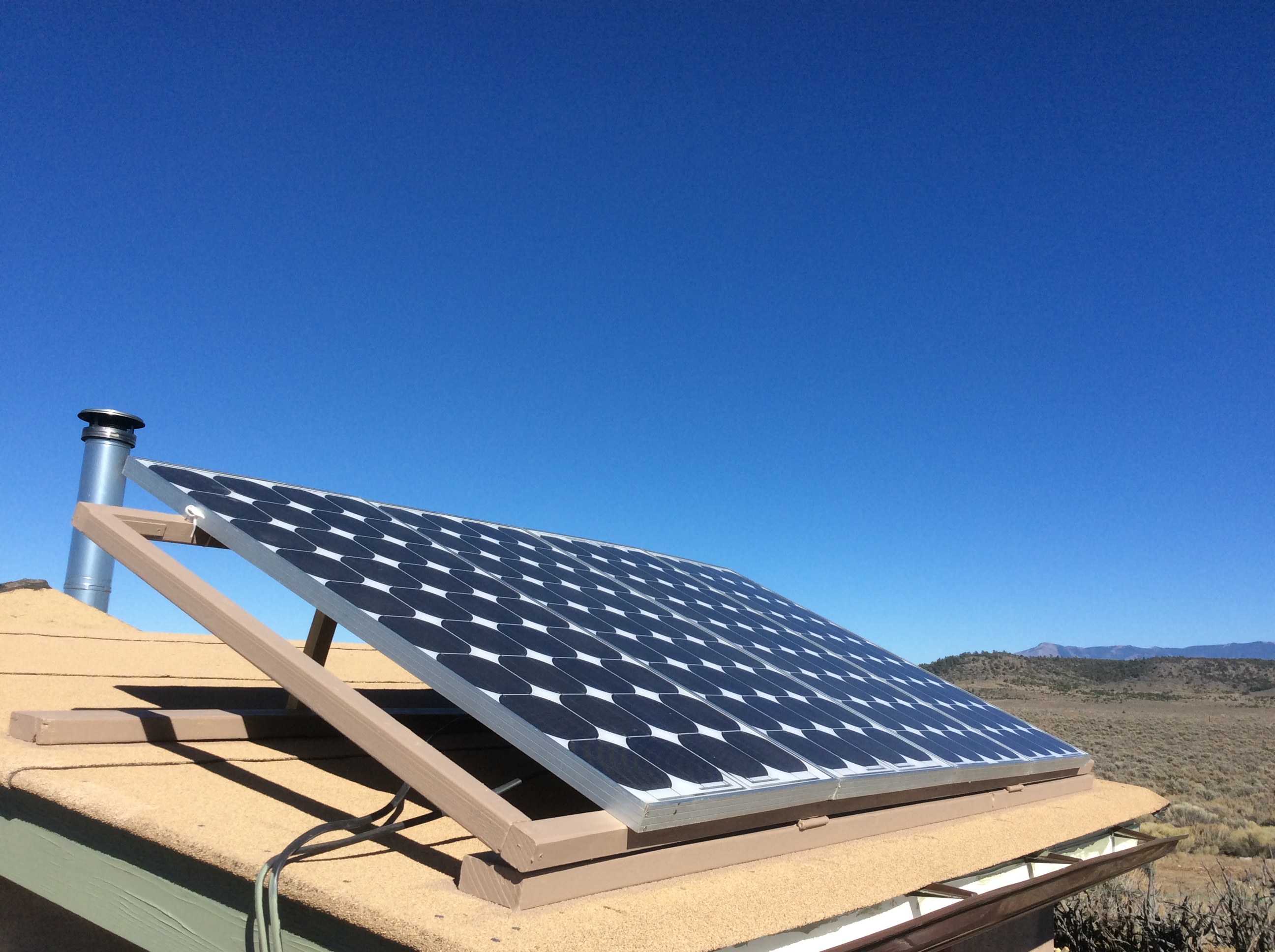 The solar panels on the roof are now on a hinged rack so I can adjust them to face the winter sun better. I have had no end of difficulties with the power systems since I got back.
Replacing the old depleted batteries still didn’t give me enough power with my four 65 watt panels. I got a small generator which I used to top off the batteries all last winter when the short, gray days hindered the panels. Then the generator quit generating so my friend John managed to fix the old heavy-duty workhorse generator I had gotten years ago which had never worked due to a carburetor problem. It was a huge, noisy thing but served for awhile until the day of the opening ceremonies of the Rio Olympics which I was determined to see, when it literally blew up, throwing a piston through the aluminum casing. (I missed the ceremonies!) Determined not to miss the Olympics, I went down the next day and bought a good generator with a respectable output.
Then the inverter quit working. The batteries would charge with the panels but I had no AC. I found an electrician to try to fix the small generator who also came out to work on the inverter. He fiddled with it and changed the grounding and suddenly it worked better than ever. Then, after three years of enduring undercharged batteries, when Ken and I pulled off the plastic covering the west wall to add the room, we discovered that what I had taken to be just a junction box between the solar panels and the charge controller was really a breaker box and one of the two from the panels was tripped! That means I have been operating with only half the panels all this time!
What a difference it has made. Coupled with the wind turbine, and backed with a dependable generator, (and the repaired one as a backup) I feel more confident about my power situation and am considering adding a small refrigerator to my upgrades.
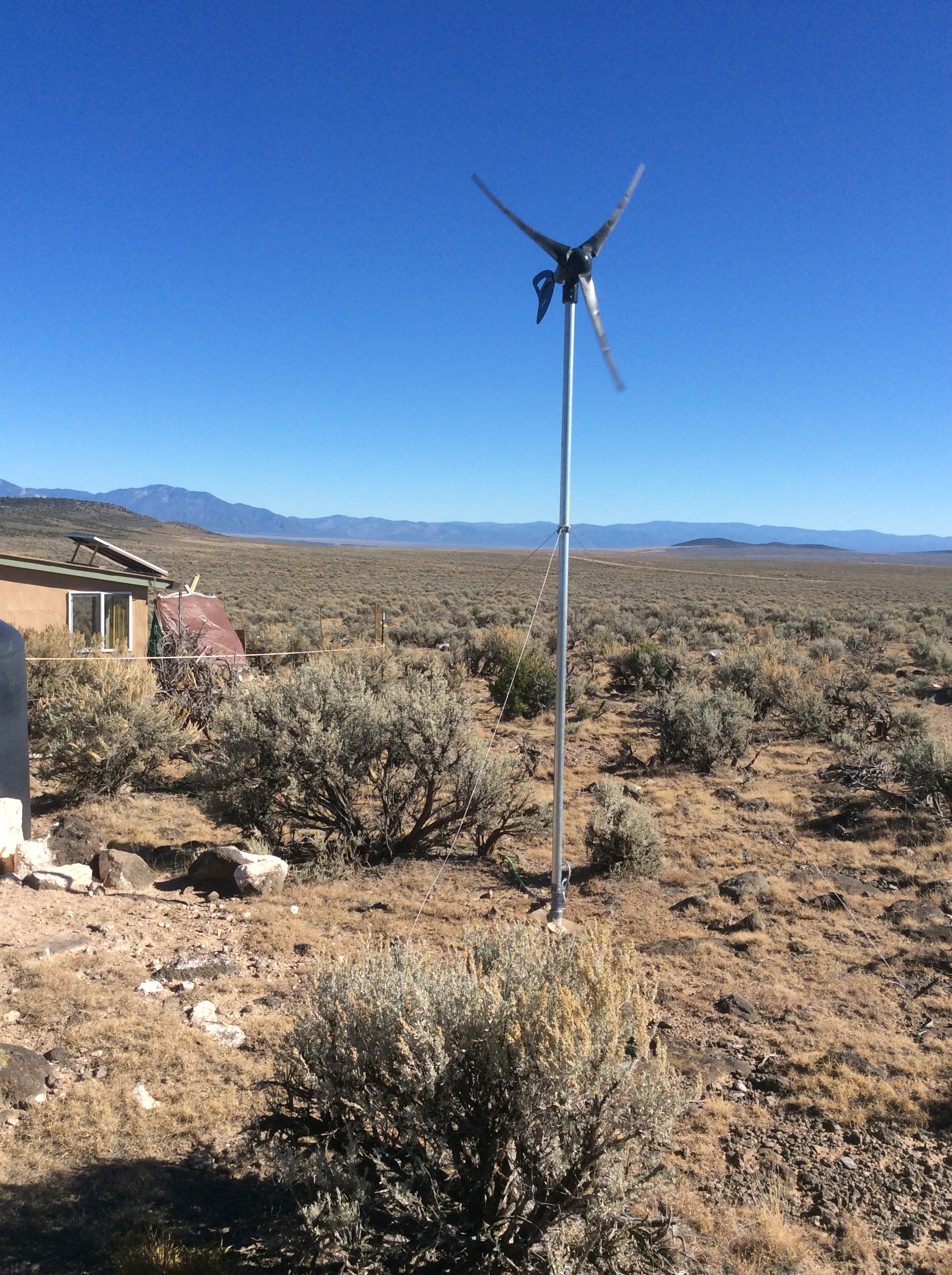 The wind turbine didn’t work after we installed it, even after replacing the charge controller and 150 feet of cable. Turns out it wasn’t sufficiently grounded either and it had burned out six bus fuses. Now remedied, the wind turbine provides an excellent backup to the solar system, though with a lesser output. It’s nice to have the wind as an asset for a change.
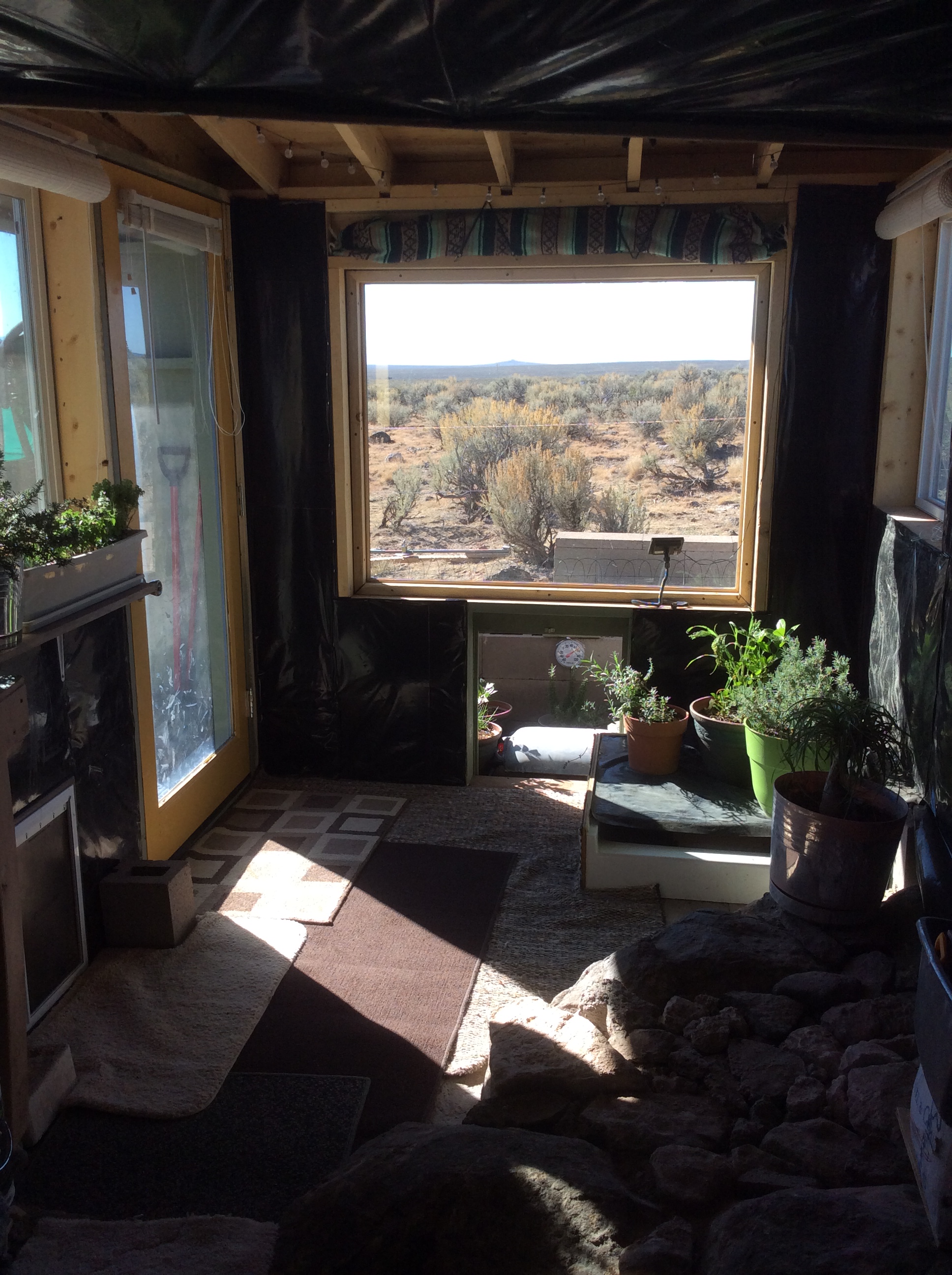 I’ve been rushing to finish the exterior before the first snow to the neglect of the interior which is only partially insulated, with the walls covered in black plastic, for example. The indoor jobs can continue after the snow blows.
 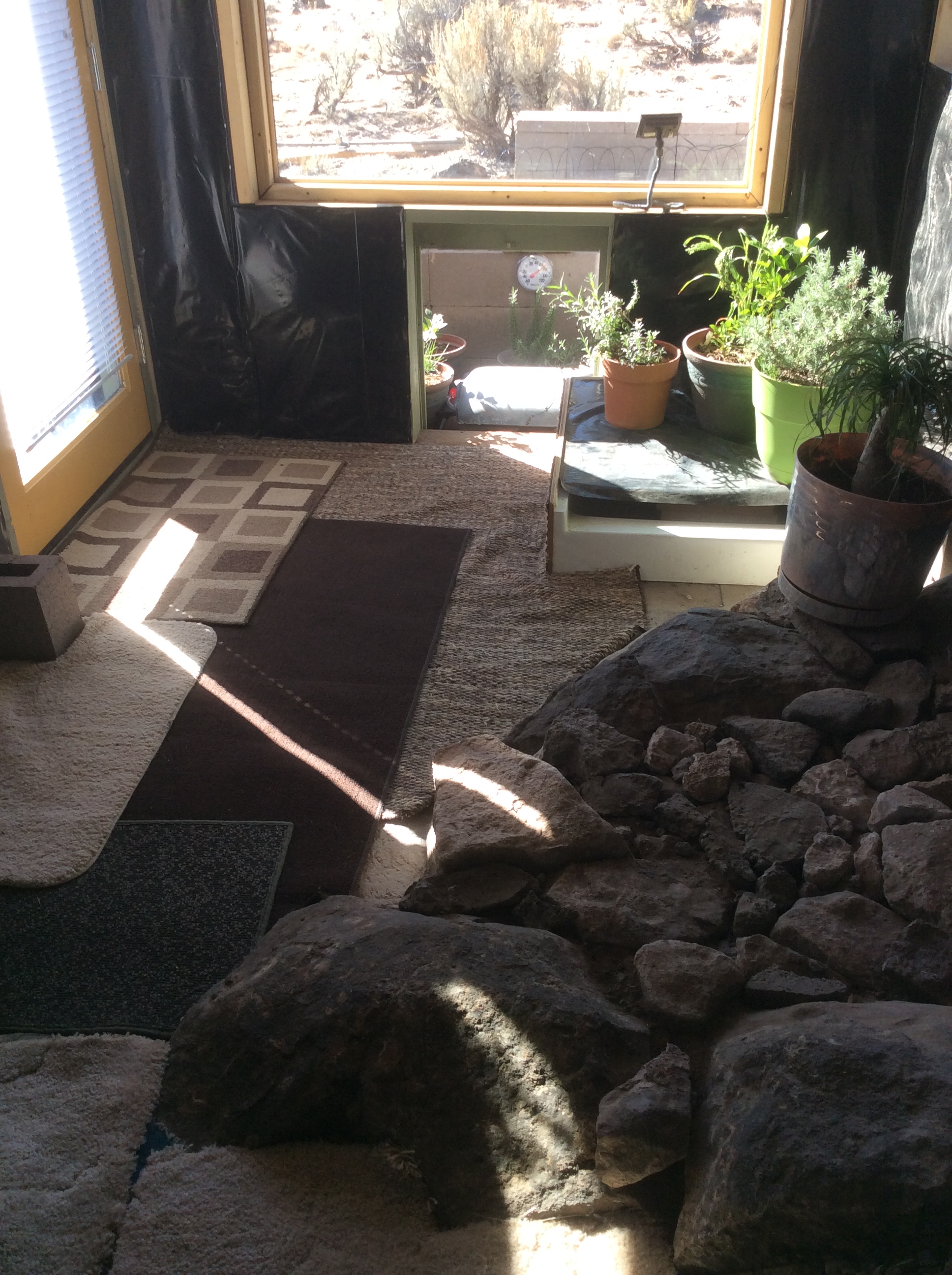 The boulder pile will become a rocket mass stove/seating area and the hardpacked dirt and gravel floor of the former storeroom will get a skin of concrete. Then the water system so I can take a proper shower, even during the winter!
It’s a long road to freedom, but I think ultimately worth it.
Here are a couple of interesting links that might inspire you.
The first is a fascinating quick guide to basic shelter:
https://www.facebook.com/ArtStudioVictorVidigal/
The other is at the opposite end of the sophistication spectrum and offers many practical, artistic, and beautiful examples of alternative architecture.
Building Naturally with Sigi Koko:
https://www.facebook.com/buildnaturally/?fref=nf
Now on to finish the interior.
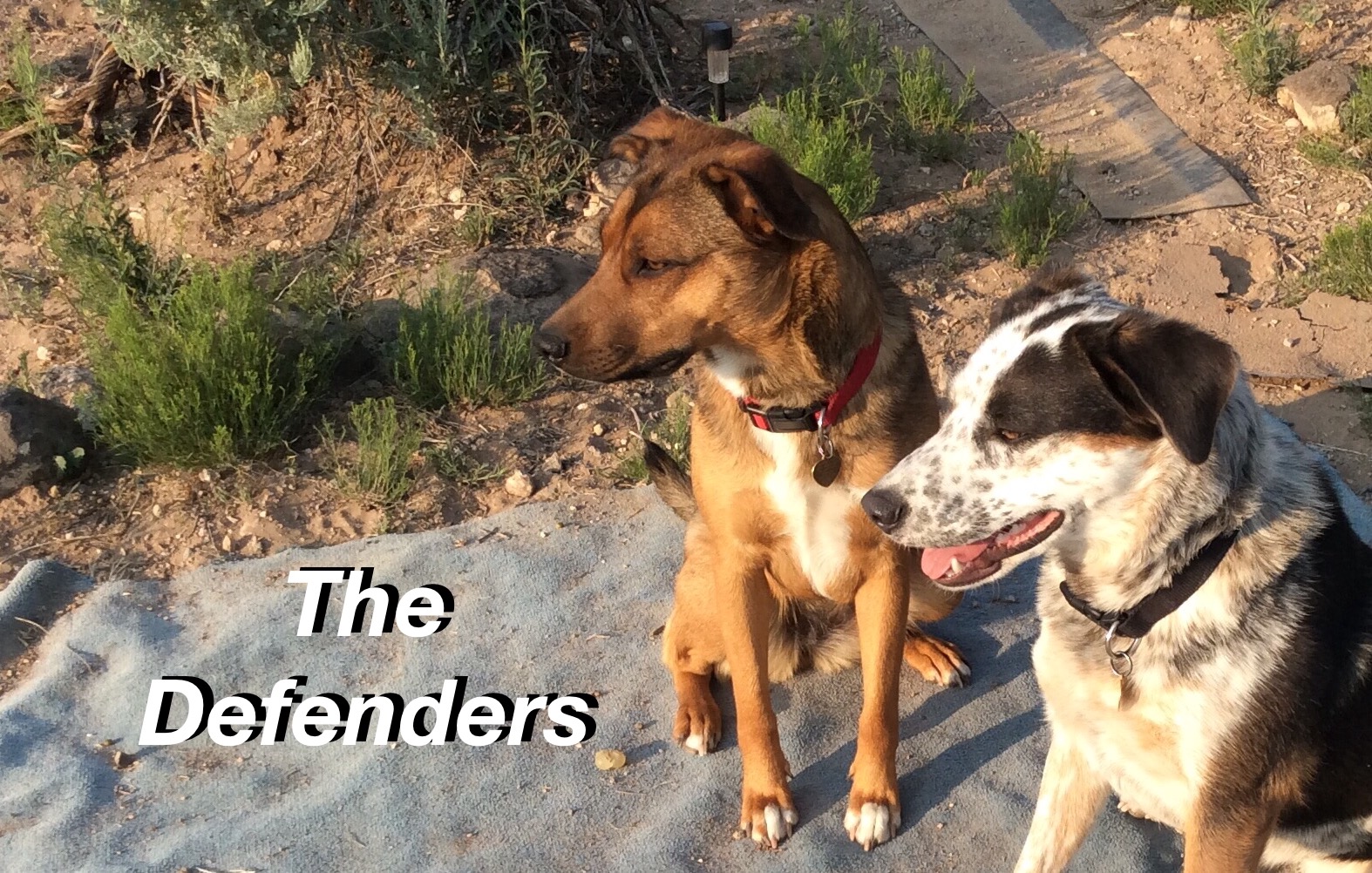
“What’s the matter, April?
She had just run in from out back, shaking and whining, looking at the window where the driveway is, and barking excitedly. Her behavior was “classic Lassie”, so I got up to look out. Sure enough, a herd of about fifteen or twenty head were just arriving from the north, several of them up to my car already, approaching the electric fence gate! Sophie was in the back yard barking.
I quickly shut the front door, adrenaline pumping, and hastily scuffed into my slipper shoes.
“Good girl! That was a good girl!” I commended her, grabbing the cheap air horn I got from the party section of Family Dollar which I keep at the front door next to the 18″, seven million volt cattle prod, and shouted, “C’MON GIRLS! LET’S GO GIT ‘EM!”, and we charged out of the front door, air horn blasting, prod zapping, dogs barking, and me shouting, “YOU GET OUT OF HERE!”. Truly a terrifying force! The startled look of the black cow nearest to us was almost comical and she almost ran into my car in her hasty retreat.
“Go get ’em girls!” I commanded as I ducked under the electric wire, stumbling a little in my inadequate slippers. As I ran around the front of the car with brazen confidence and headed up the hill, the dogs took a right turn, running behind the car in chase of the also startled rabbits, and chased them around the stable in the opposite direction. The herd stopped a short way off, reassessing the situation and rather disregarding my tirade.
“THIS WAY! APRIL! SOPHIE! COME!” I shouted until they made the full circuit around the stable and took up the chase, barking excitedly. The herd then startled off and took a right when they hit the rutty dirt access road. I blew the air horn until it ran out of gas and sparked the prod noisily, but the dogs were the clincher. Once they hit the road, the dogs urged them into a full stampede and they chased them up the hill, making the right turn dogleg and then on up the hill behind the new neighbor’s house, out of sight. I called the dogs off before they were out of hearing range, but the herd was spooked enough that they continued on at full stampede. What’s more, they didn’t come back for seven weeks!
Good Dogs!
The next time I heard them coming before they got too close and repeated the charge, but they were scattered and didn’t startle en masse as before. The dogs came running, but didn’t bark this time. Still it was enough to get the herd moving away, though more casually this time. My Stunmaster 7 Million gave one burst and then went dead (I still don’t know how many hours it takes to charge seven million volts using my solar panels, but apparently it wasn’t enough.) but the sound was enough to spur them a little more. Then the cheap plastic airhorn top snapped off and it only squealed or croaked after that. The dogs chased them up the hill through the sagebrush but the meandering paths and scattered herd made it more of a saunter, and by the time they got to the neighbor’s house, everybody, dogs included, were grazing. I had to hike most of the way up to the house before the dogs could hear me over the lowing of the cattle. Plus, they were too distracted by the abundant fresh cow plop,…which they found delicious! Ugh!
Nevertheless, I am delighted to know that the dogs serve well as both and early warning system and a deterrent! (I just can’t let them lick me now. Ever.)
Finally! Something that works!
The cows continue to command too much of my life, but things are much improved nevertheless. Another lifetime first for me is my acquisition and installation of barbed wire to bolster the flimsy electric wire and green poly rope that have served until now. I never thought I would ever purchase and install barbed wire…EVER!
PUPPIES
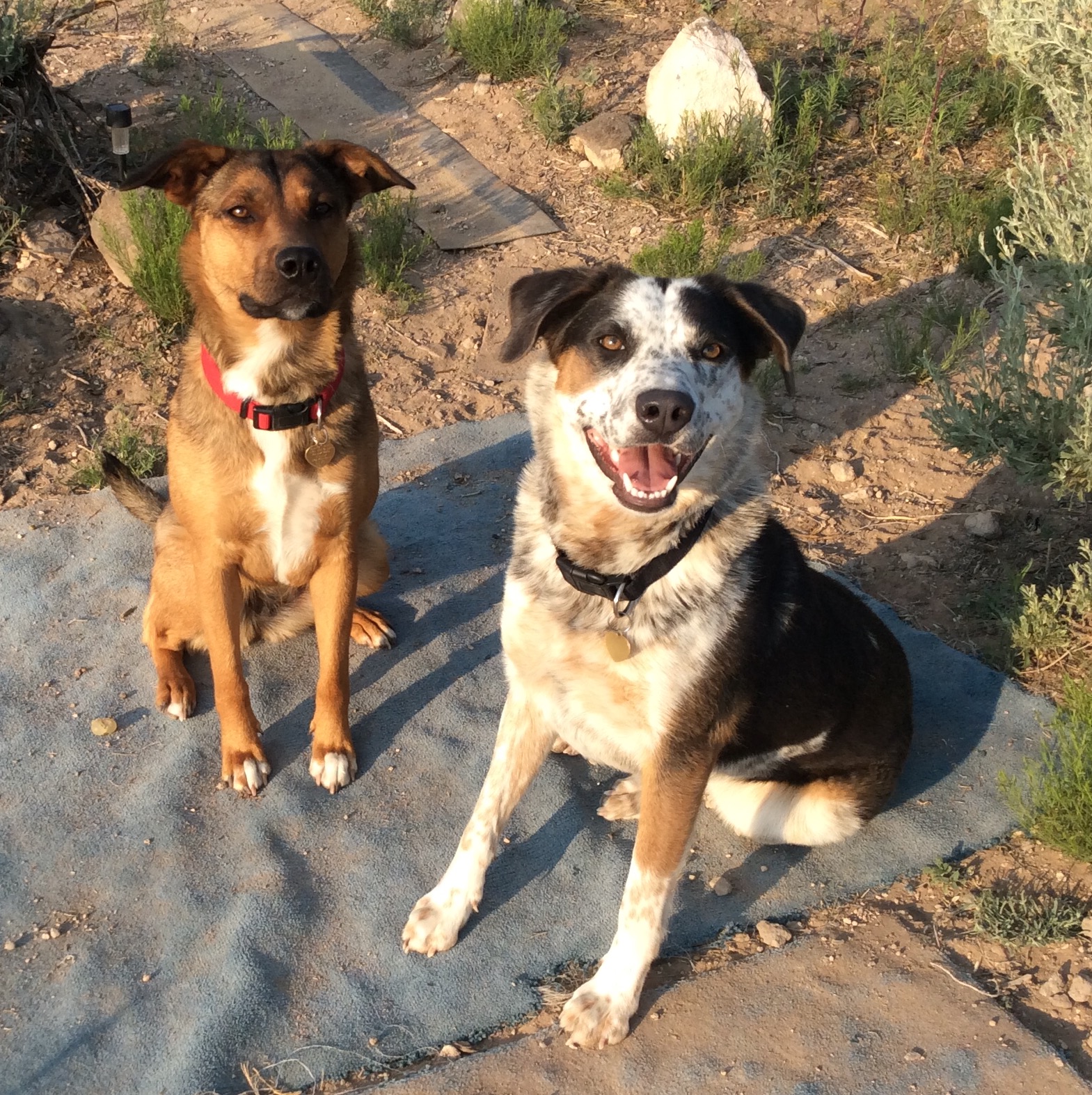
April and Sophie turned one year old on April 21 and are full grown now. While they are physically adult, their puppy shenanigans have scarcely abated and hole digging and general yard destruction is still a problem. It’ll probably be another year before they mellow out. Patience.
The new room has more or less become theirs. By closing off the door between the kitchen and the store room, they can play in the enclosed back yard, or come inside via the doggie door. It’s nice to be able to “send them to their room” when they are too rowdy. With that in mind, I am rethinking the design of the room. Last winter showed that the room heats well using solar only and holds the heat at night pretty well, too, especially with the window inserts of sheets of mylar insulation. I may opt for a miniature version of the rocket mass stove in favor of a heated platform for the dog’s beds where the immoveable boulders are.
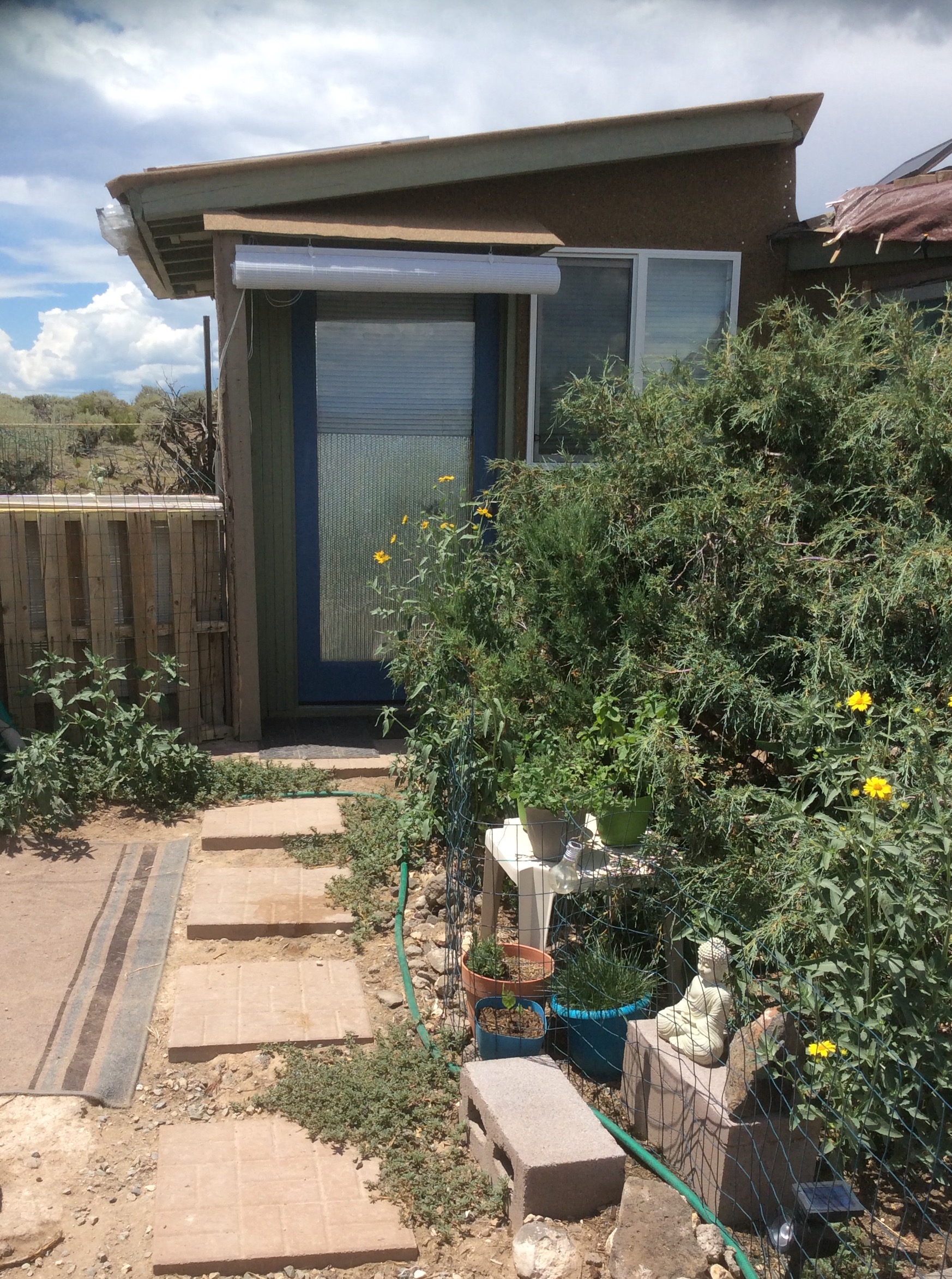 The puppies slam in and out of their doggie door all day, roughhousing, and tracking mud and debris in with them. (Hence their isolation.) They each have a bed there and I now feed and treat them there to make it a positive association, and so they stay there when I am gone to town. Unfortunately, they love to chew on anything and are constantly finding sticks and bark and ancient soup bones (remnants from Trip’s time here) and bringing them into the house, spreading splinters everywhere.
We are still training for that.
GATE
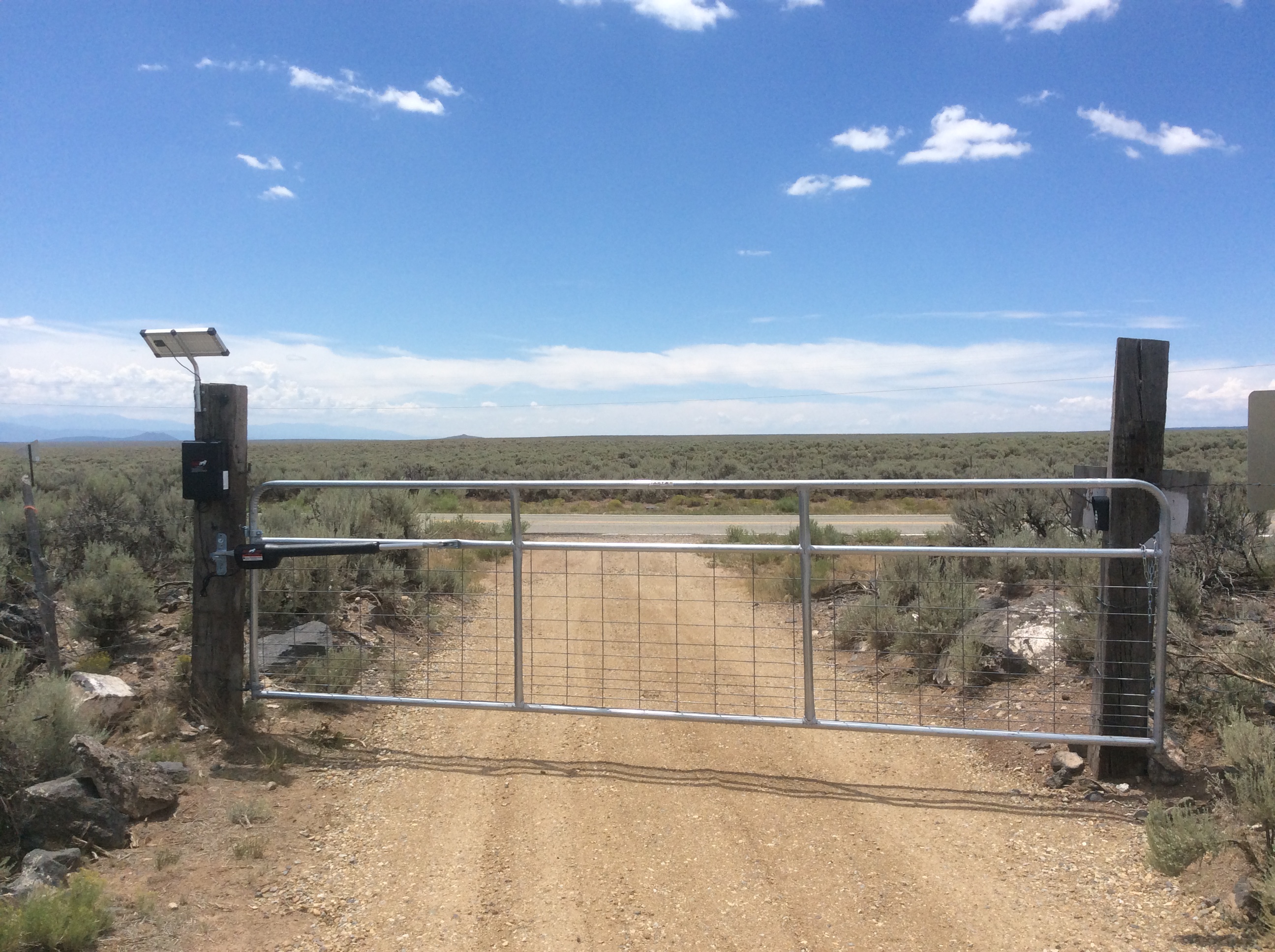
A great new improvement to my situation here was the installation of a new solar powered highway gate with a remote control and guest keypad! 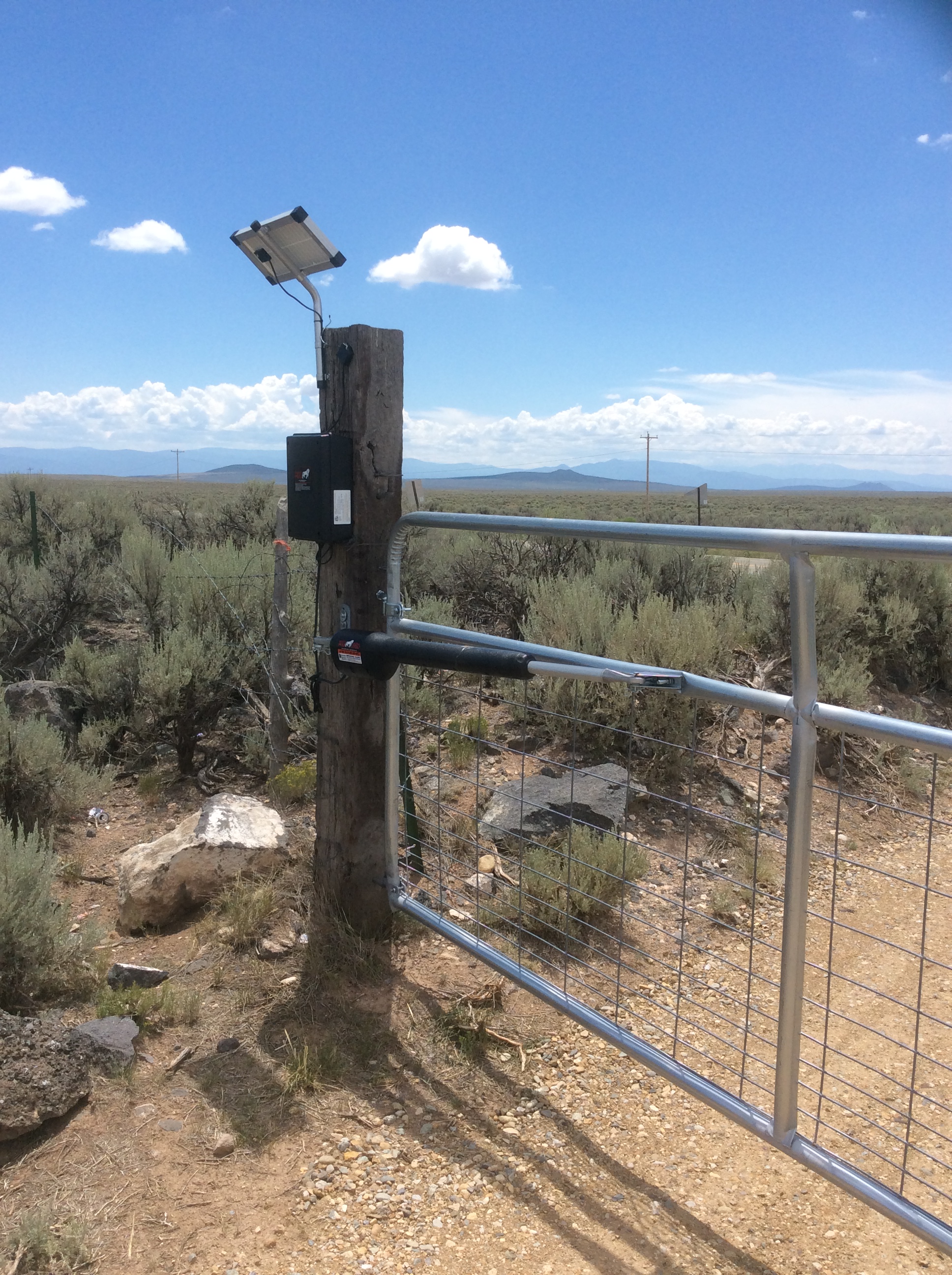 (Gratefully, my neighbor up the hill was kind enough to split the rather high cost of the system.)
The previous gate, which itself had been an improvement over the floppy barbed wire and post arrangement that was originally there, had been destroyed by a bull last year, trying to get back in off the highway to join the herd. It lies forlorn and abandoned in the sagebrush.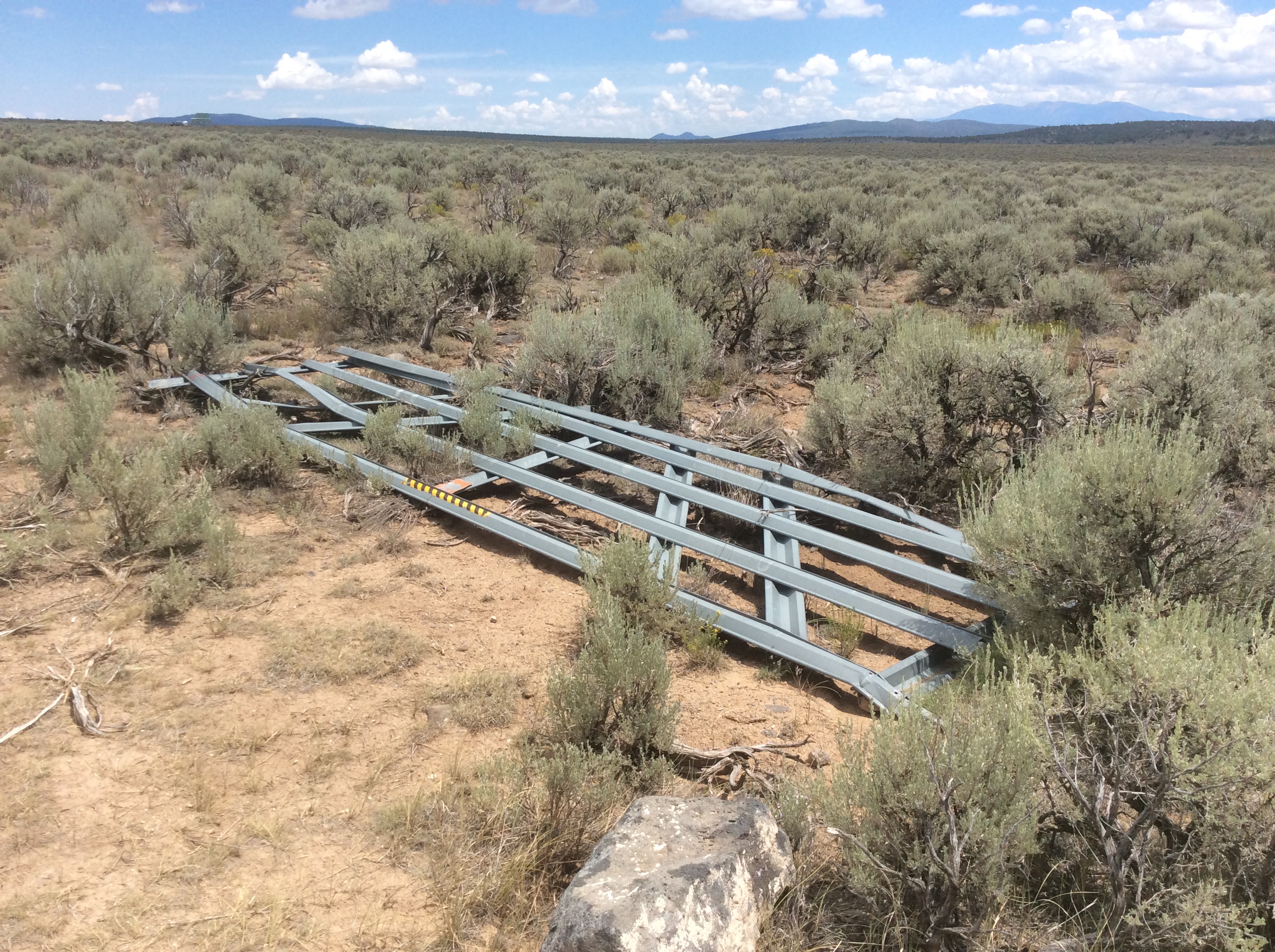
Then I had 34 TONS (literally) of grade gravel delivered over two days which I had to spread by hand and tamp down with an amusing little dance of my own creation, all the way from the gate to the turn off to my place, about a quarter mile! 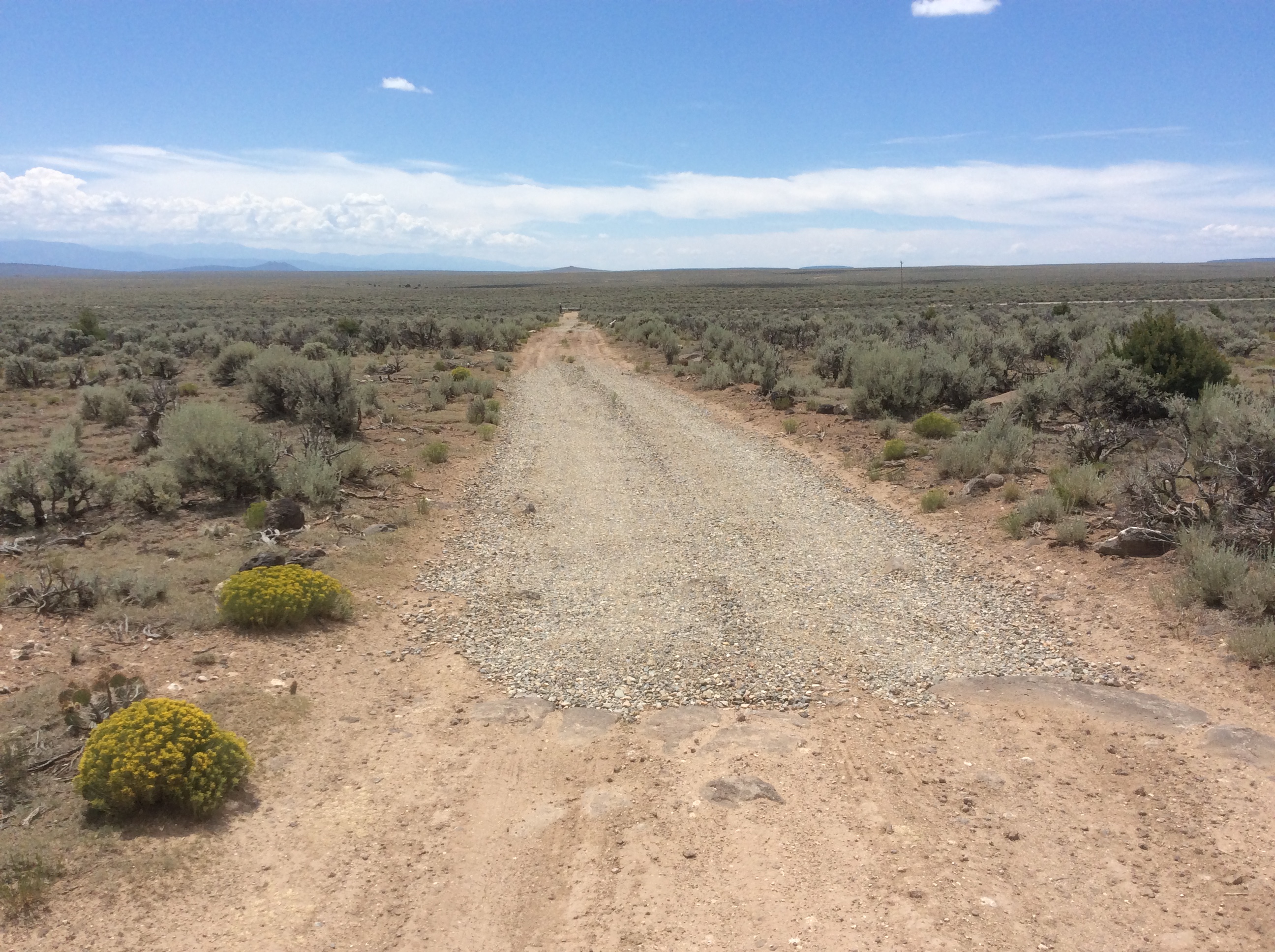
Mercifully, my neighbor up the hill was able to help me the first day, but I was on my own the next, and pretty crippled for awhile afterwards.
Previously, coming home (and leaving) too often involved putting it in park, getting out in the dark and slogging through ankle-deep mud or snow to unlatch and drag the gate open, then back to the car, tracking in mud and snow, then drive through the gate, put it in park, get out and walk back in the dark through the mud and snow to drag the gate shut and latch the chain, and then track more mud and snow back into the car, and then maneuver the bouncy course up the rutty, rocky hill, trying to avoid the damaging pointy prominences.
Now, as I approach the gate, I merely press a button on the remote, and drive through and up the smooth, well packed road, the gate automatically closing behind me!
Uptown!
I saw the state police and the road works department bullying a herd of a dozen or so cows toward town on the highway last fall just before they were all gone for the season. They were using their sirens and lights as the herd poked along and the traffic backup was extensive in both directions. Passing was unescorted, awkward and furtive. The cows really do run the show around here.
WINTER
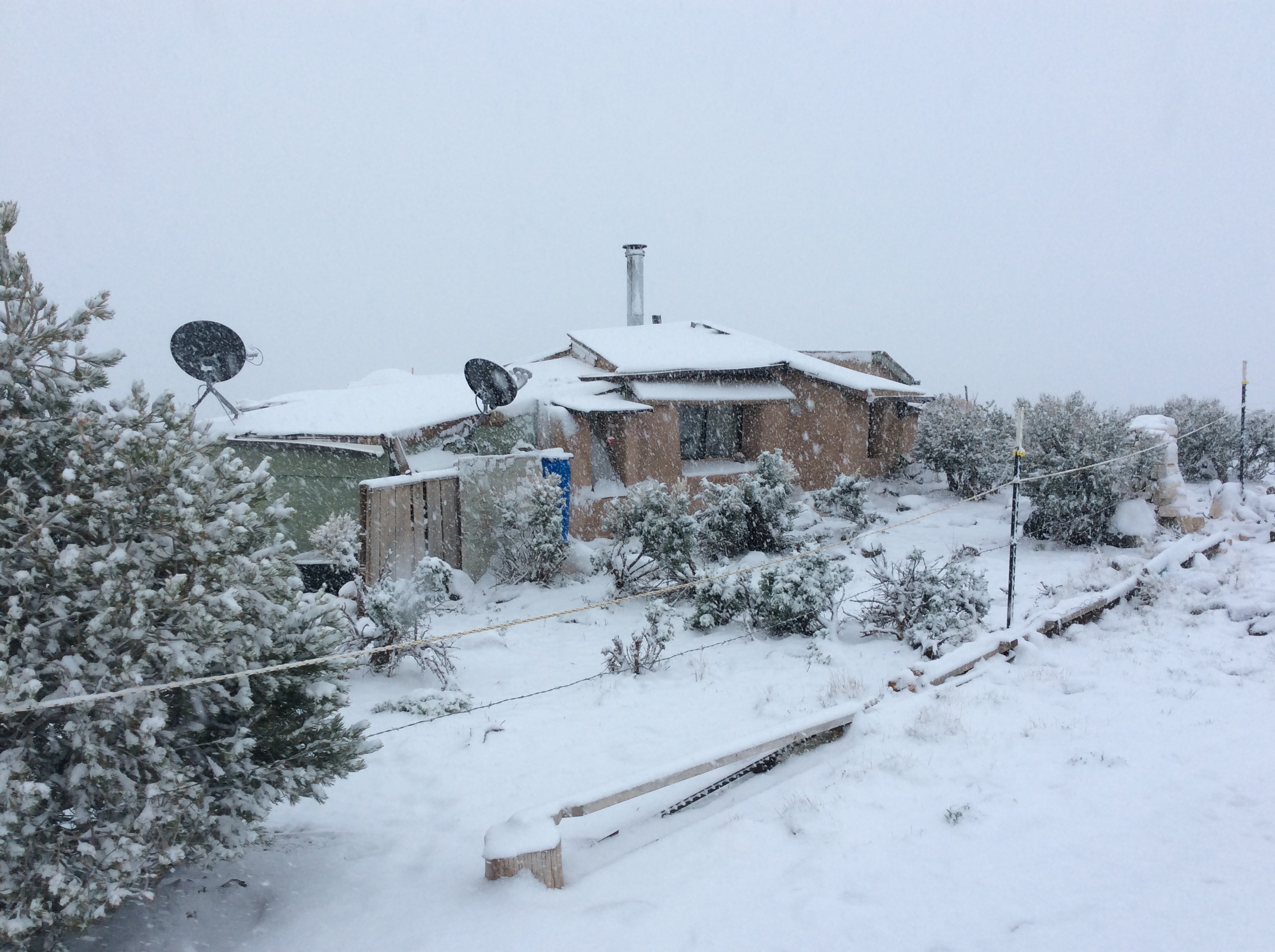
I managed to stay though the whole winter again. (Can’t leave with the puppies now anyway.) The insulation improvements coupled with more refined passive solar got me through on only one cord of wood with a little to spare, even though it got down to fifteen below for awhile at night and only in the twenties in the day. I’ve improved my fire building technique, copying a stacked, bonfire style used by the Pueblos, which vents well for the wood stove, catching fast and burning hot. The two solar windows heat very well during the day, the east one needing less than an hour to provide heat to the whole house. In fact, the system works SO well that the temperatures can often exceed a hundred degrees in there and the plastic flashing pieces that hold the glass in the window frames have now warped and deformed so badly that I will have to replace at least one of them. Live and learn, right?
Improved window coverings for night, including the same mylar “bubble wrap” sheets I have affixed to the ceiling, serve well to keep in the solar gain from the day and masonry around the stove maintains steady warmth through the night, making midnight stoking unnecessary. For the chilly times, such as gray mornings, rather than start a fire, I use the propane space heater and close off in the east room where the TV and comfy chair are.
The water tank froze by November, not solid, but at the faucet fitting at its base, which required carrying in liquid water from town all winter. (The ground is too rocky to dig a trench to pipe in from the tank to the house so I hope to get an insulated supplemental tank installed in or by the house by the next freeze.) The original 1700 gallon tank has served well for fifteen years, but once it thawed this spring, I discovered that expansion from the freeze has damaged the faucet at the base and it now leaks when turned on. That means the tank will have to be drained to replace the component.
Always something, right?
Once I got the exterior sealed, I stopped doing construction improvements after the first snow at the beginning of November. I prefer not to live in a construction zone when I’m stuck inside with it all winter, plus, I was pretty tired after the push, so I attended to the challenge of “chop wood, carry water” lifestyle instead and decided to wait until “spring crept over me windowsill” to do anything further.
It’s been really nice having a back door and semi-sheltered yard. Most of the persistent wind is blocked and it feels safer knowing the dogs won’t wander nor will I be faced with a coyote or bull when I open the door. 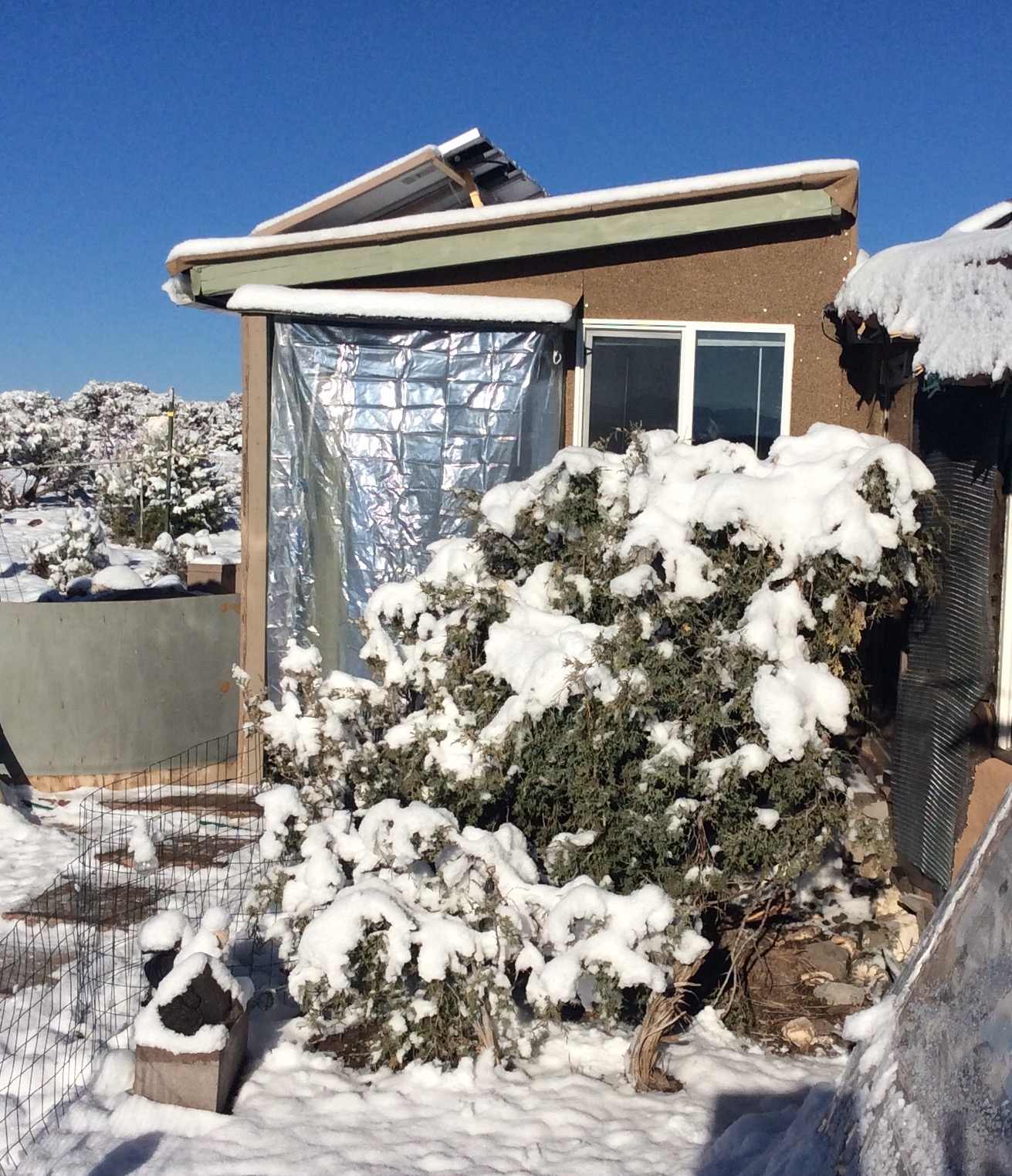 A clear PEVA shower curtain hung over the back door entry (PEVA stays more flexible during sub-freezing temperatures. The vinyl one last year was stiff and brittle.) created a sheltered entry area for both the back door and doggie door, blocking wind and snow accumulation and vastly improving heat retention for the glass door. Insulated mylar sheets over the windows, walipini, and back door made big difference, too. Another improvement from last year was the installation of drains for the kitchen sink and a shower base, eliminating the need to pitch buckets of gray water out the window into the snow.
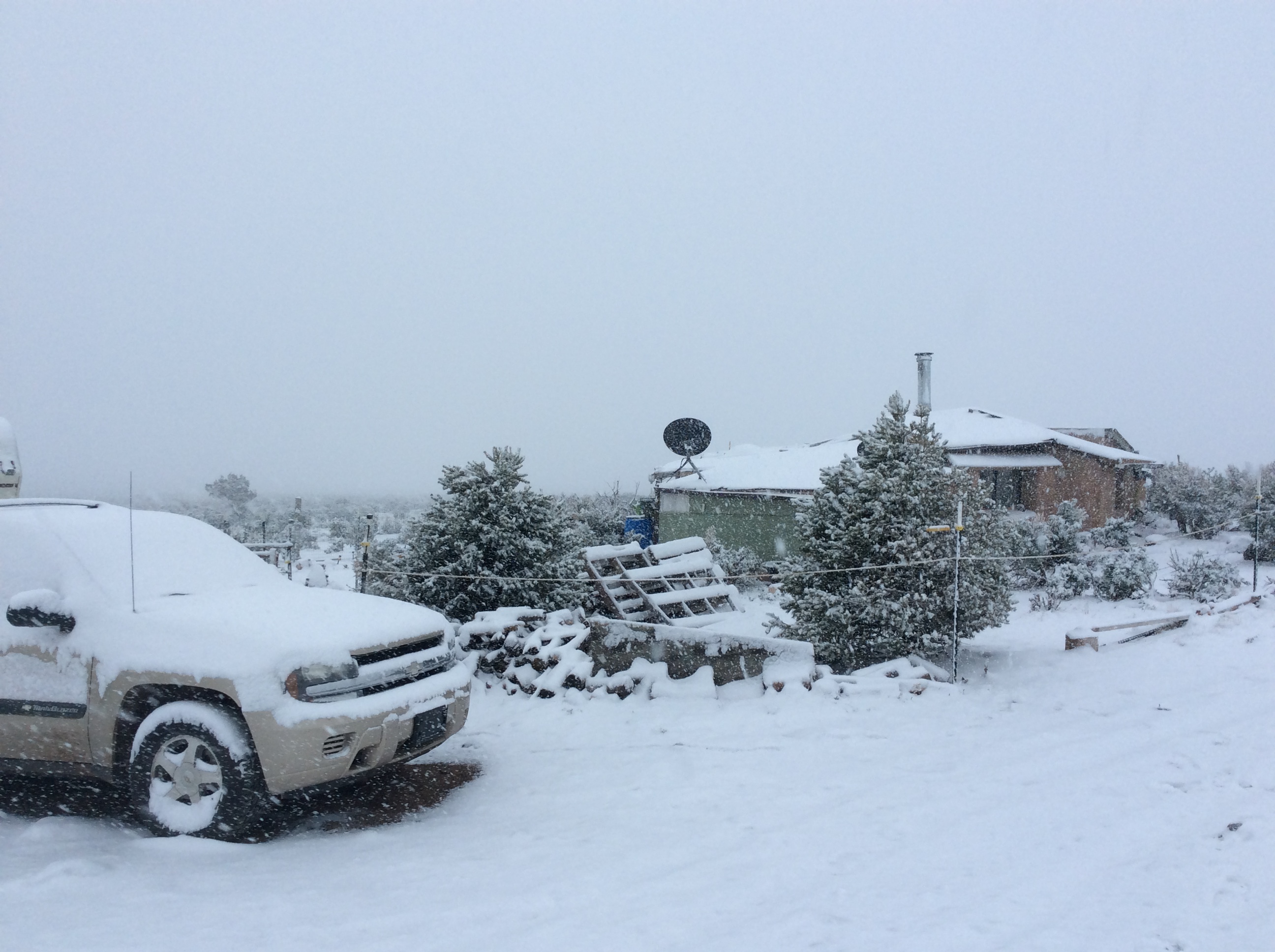 We had a lot of snow this season, often making my road impassable, despite the 4WD. ( I also never imagined that I would ever, in my life, be the proud owner of TWO snow shovels.) Knowing this, I kept well stocked with food and liquid water, and only went to town every week or two. The cold weather meant refrigeration and my meat and milk keeps indefinitely, frozen in the cooler, sitting atop a glacier reconstituted from last fall’s last bag of ice. I drove the thirty miles to town mostly only when I needed liquid water and chocolate. (A vital nutrient during the long, dark months to combat Seasonal Affective Disorder. And the rest of the year, too, of course. Heh heh.) The dogs use more water than I do as I only use it mostly for coffee and doing dishes, in that order of importance. (My shower regimen is more occasional during the chilly, winter months.) I don’t trust the tank water for drinking and prefer to bring in the 25 cent-a-gallon, uber-filtered water in five gallon containers from the vending machine in town.
Sometimes I just had to go to town and one day I got stuck in snow in my driveway and, in my effort to rock it out, the tranny froze up, the back wheels wouldn’t engage, and I had to have it towed to town, leaving me stuck at home, snowbound with no car, for days, while they tried to figure out what was wrong, and then I had to wait for a ride to pick it up as my few backups were out of town. It was daunting to feel so isolated and helpless, despite the security of my cozy cabin. (They never did figure out what was wrong as the problem corrected itself. Maybe something literally frozen?)
Despite being able to survive the winters here at 7600 feet, the challenges of toting wood and water and shoveling snow have driven me to a decision. I don’t HAVE TO stay here year round. It is perfectly permissible for me to become a snow bird and seek warmer quarters during the more difficult months. To that end, I have begun a search for new property, a smaller plot, somewhere outside of Las Vegas, NV, perhaps. I spent the twelve years prior to this project there with my family and feel a comfortable familiarity with the environs. Though it is FAR too hot there in the summer, the winters are nice and sunny, and it would be good to be near a city again, too. (such as it is) While I enjoy the quiet isolation here, I miss the stimulation, vitality, and range of choices a city has to offer. (Albuquerque, 150 miles away, is the closest thing to a big city for me here…such as it is.)
Depending on what property I am able to find, I am considering an Earthship/earthbag approach to the new dwelling, going semi-subterranean. Until THAT project materializes, I am considering parking an old Winnebago or trailer on the site to secure an immediate dwelling with amenities. (I still rather wish I had done that with THIS place.) Still just in the dreaming stage, but making the decision triggered a wave of relief, knowing that maybe I won’t have to be shoveling snow and chopping wood when I am eighty. It’s hard enough NOW.
And NOW, after fifteen years of planning and struggling, I have finally turned 65!
I have just signed up for Social Security and am officially retired! (It’s funny, but I was expecting a fanfare or some kind of earth shaking, but the birthday just came and went like any other.) Though I had intended to be much farther along with the retirement project, I am grateful that I have a paid-for home, now that I am on a minimal, fixed income. It doesn’t feel like I have crossed any finish lines yet, but I’m still in the race.
SPRING
Spring was indecisive this year and finally came late. We had our last snow on May 19, but it continued to be below freezing at night for a couple of weeks, though the days were warming. Then it abruptly slammed into hot, dry, windy June. We only had one suggestion of rain all month, with clear sunny skies and long days in the nineties. The first real monsoon thunderstorm didn’t come until July first, but the monsoonal pattern didn’t assert itself for another ten days. Consequently, seedlings that were coaxed out by the late snow and thaw were burnt, and the hot clay baked dry and blew a dust layer onto everything.
The walipini served well until it got too cold, when I would cover the glass with a mylar insulation sheet at night. But then the snows came and covered the glass, blocking the light and warmth, so the plants had to be moved into the sunroom until spring. Once it warmed up again, I planted starts in little planter cups in the walipini, but too early, unfortunately, as the freeze held through May and the monsoons came late. Many of the sprouts outgrew their containers and languished waiting to be transplanted into the gully garden. 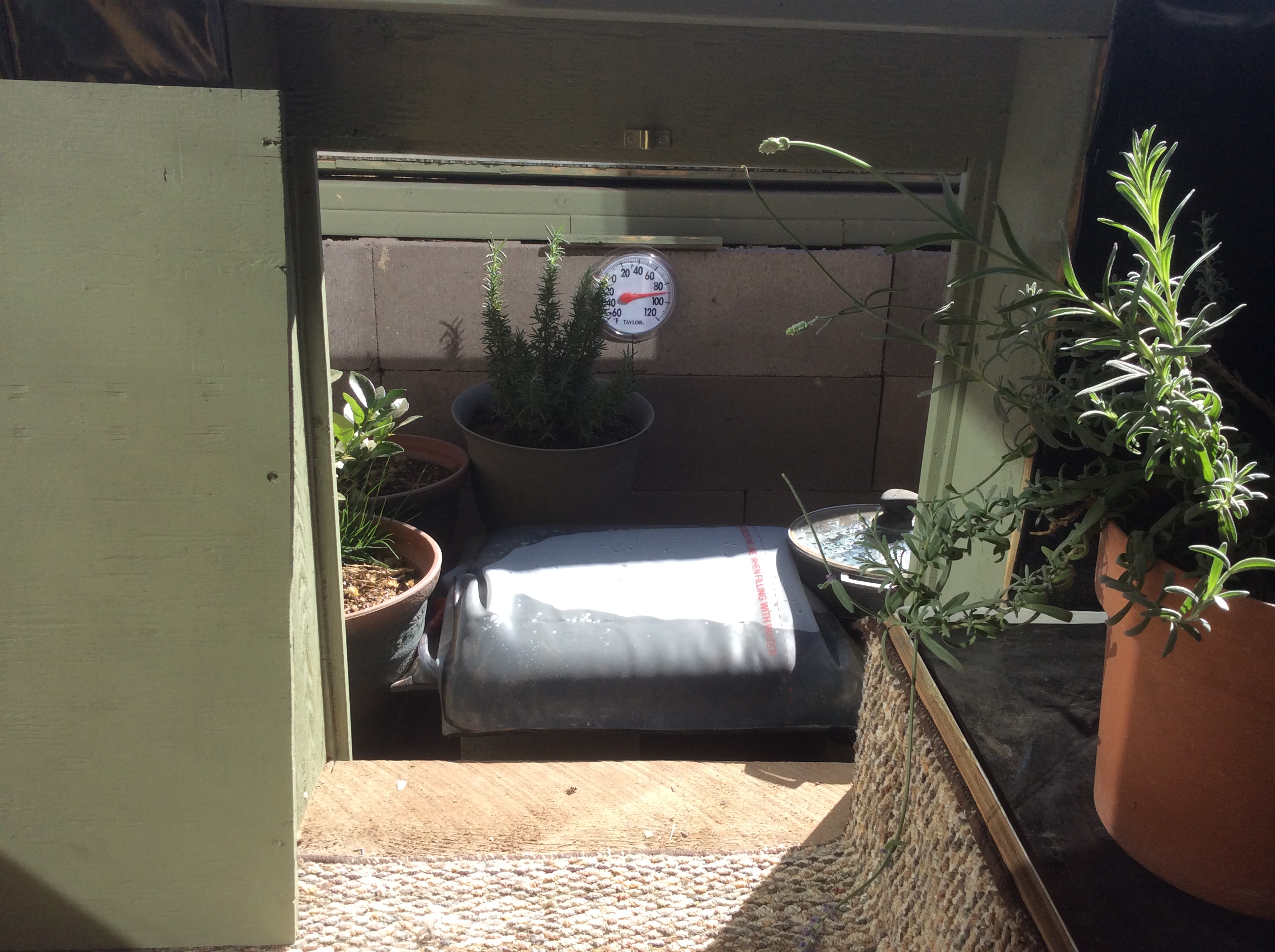 The walipini did, however, also serve well as a solar heater for the new room. Once the thermometer read hot enough, I would just open the access panel and warm air would flood in.
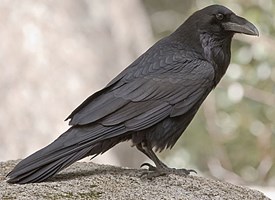
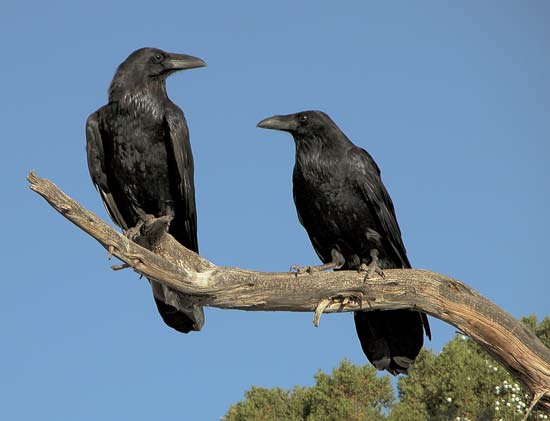
There was an unusually large, almost disturbing, flock (conspiracy) of huge ravens this spring which hung around my place for nearly a month. Maybe twenty-five of them would circle the house, squawking loudly as they rode the thermals, many swooping down to roost on my roof. Often they would assemble on the ground in open areas between the sage, milling around like leggy penguins, noisily interacting. Then abruptly one day the convention was over and their numbers reduced to the usual, resident five.
Once it stops freezing at night, the flies and bugs return in full force. While there are the usual biting flies and fire ants, there is one particularly large bug that I had seen before but never paid much attention to until it came back this spring.
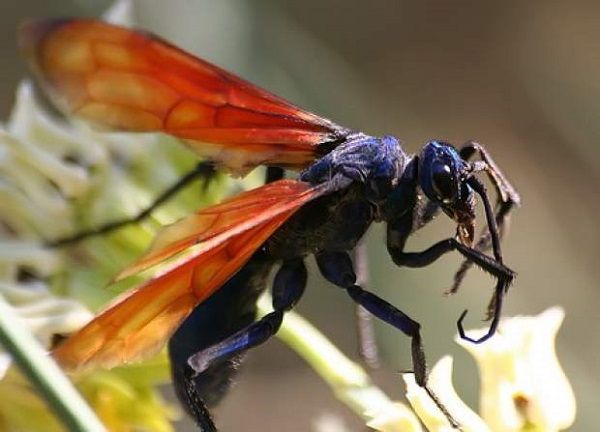
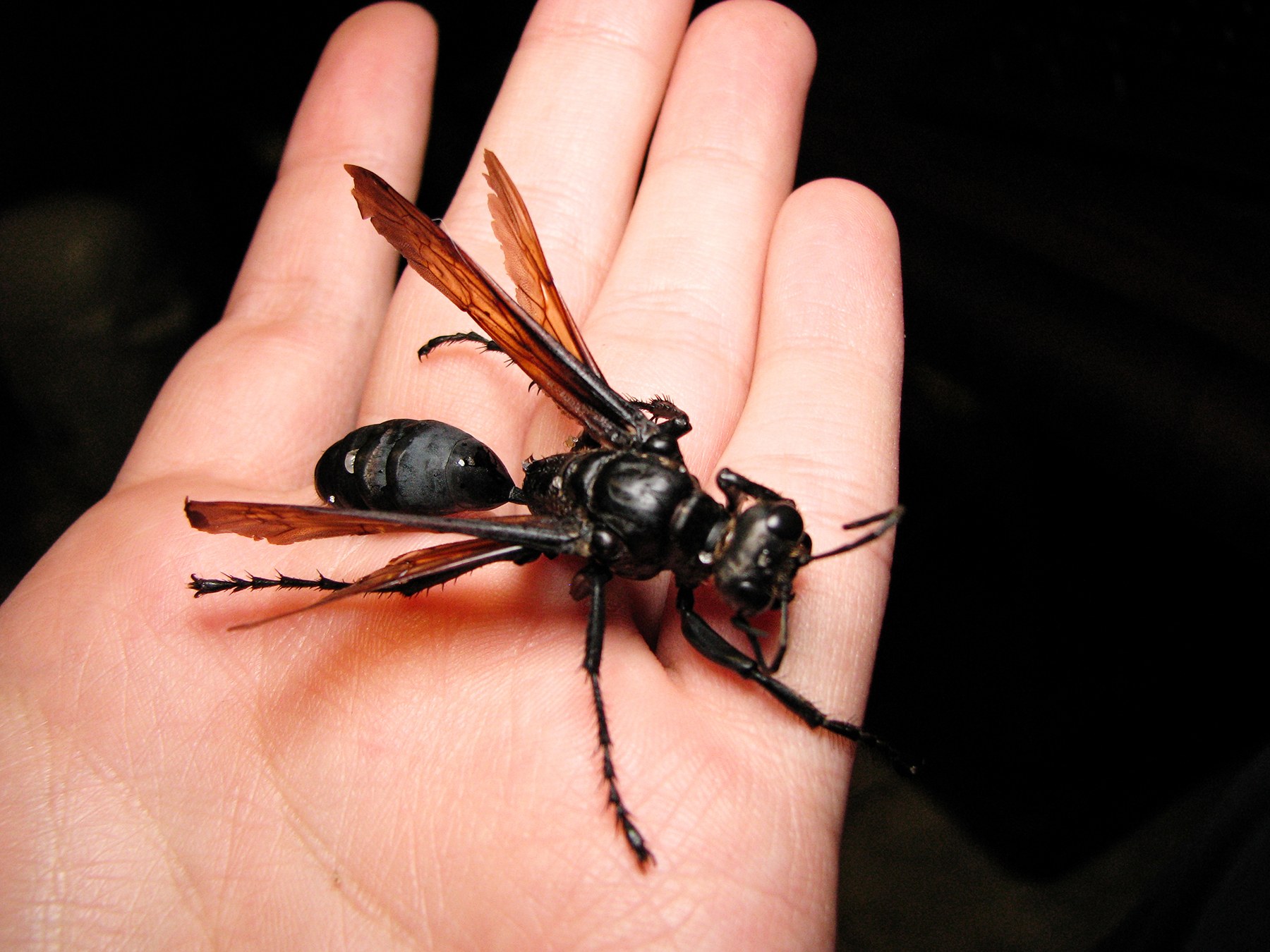
It is three to four inches long with the body of a wasp, shiny black, with bright rusty-orange wings. There were a number of them in the yard this spring.
They are scary to see, but I didn’t give them much concern until one started to buzz me, making swoops at my head.
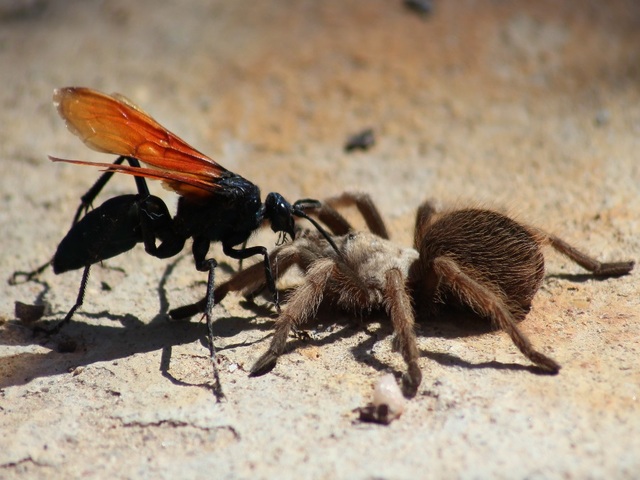
Then I saw an article online about them. They are called tarantula hawks, are aggressive, territorial, and have an excruciating sting. They hunt tarantulas, sting them, paralyzing them, and then bury them with their eggs, providing a live meal for their offspring when they hatch. I was horrified, both at the description of their potentially deadly sting, but that their territorial buzzing around my yard probably indicates I have tarantulas living here!
Yikes! Snakes I can handle, but tarantulas?! (Not for this arachnophobe, thank you.)
 Once things start growing again, of course, the herds return. In addition to the cows, my neighbors’ yak herd is back, as are the llamas.
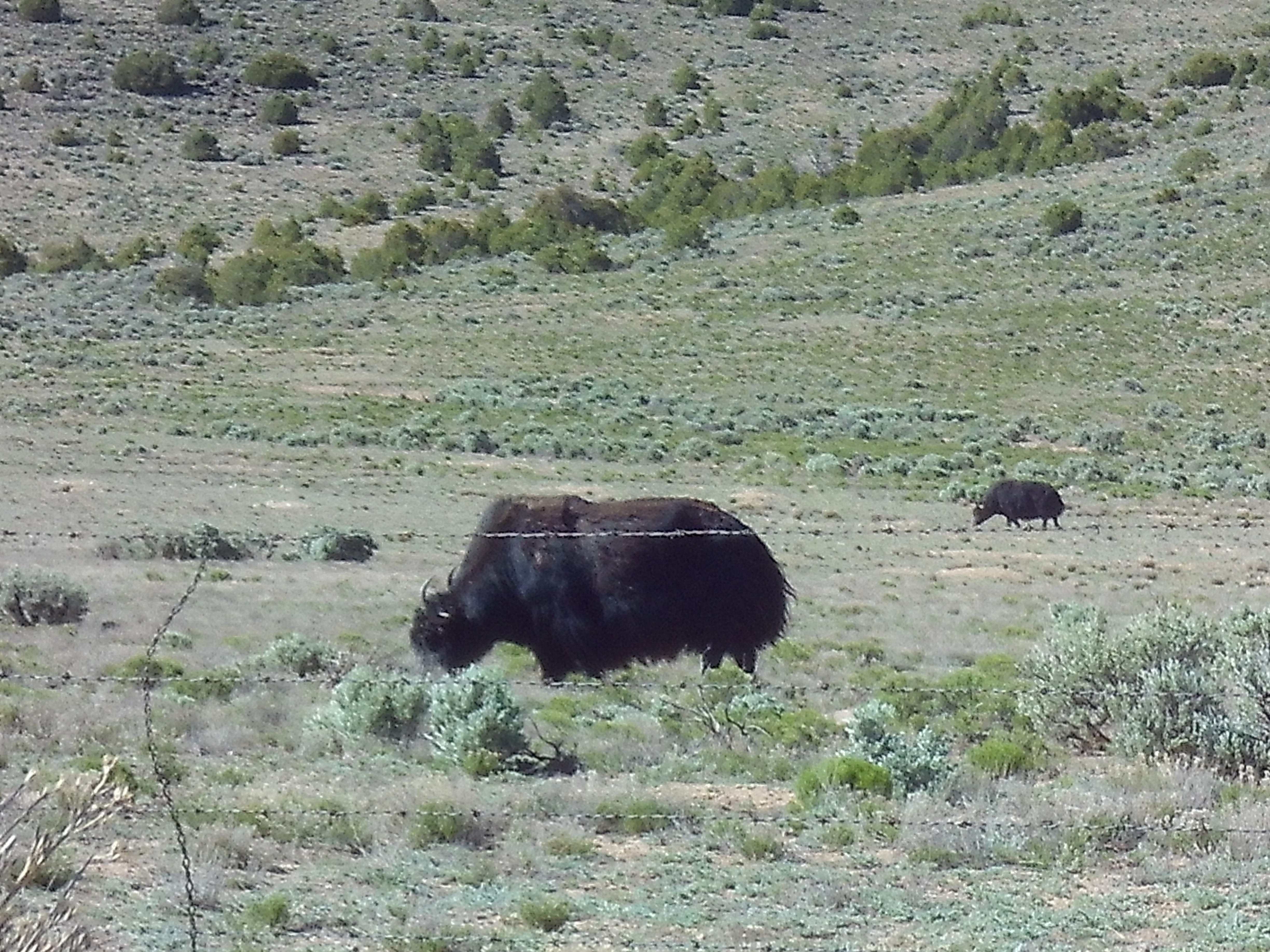
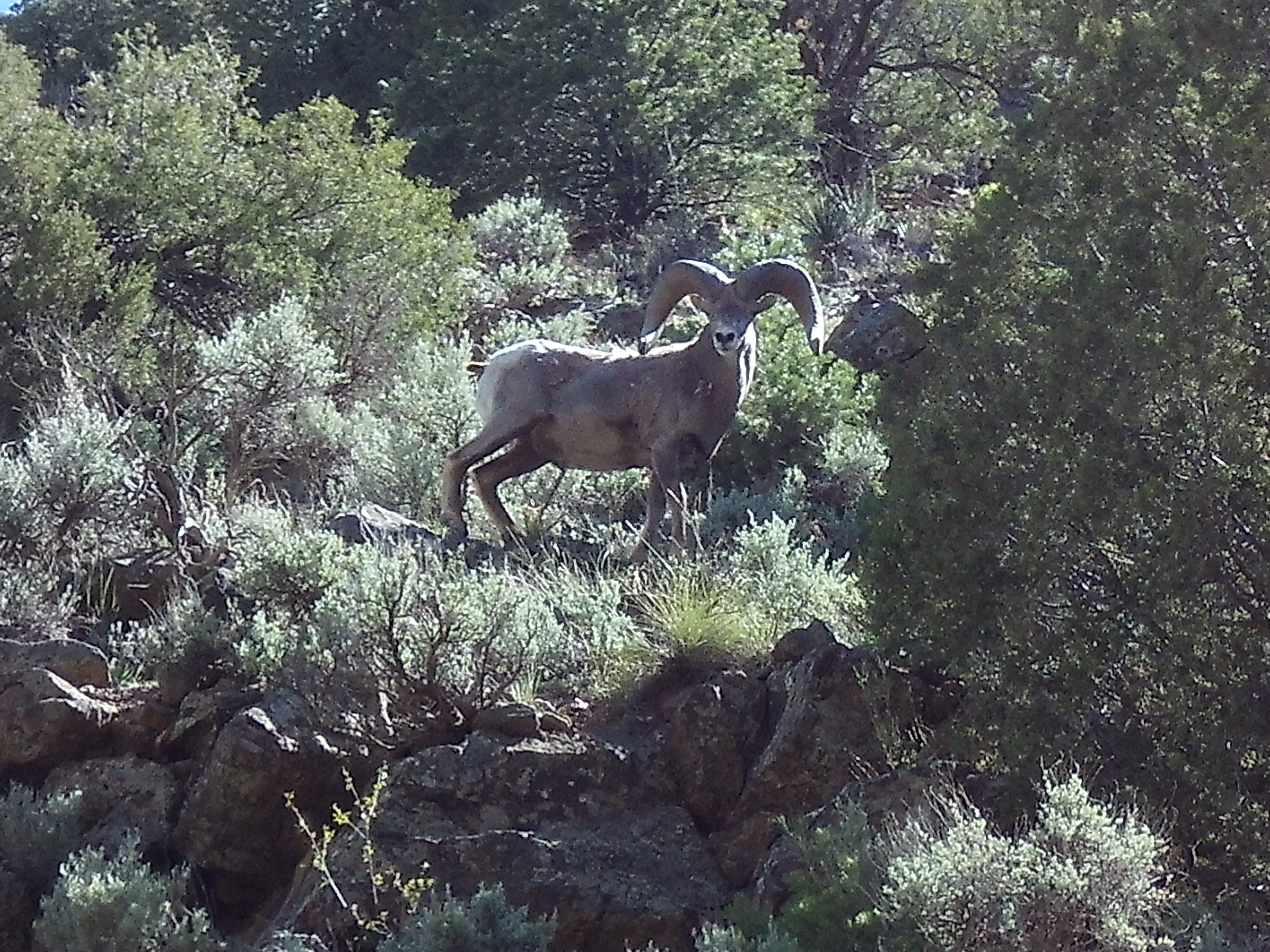
I had a delightful encounter with some bighorn sheep on the road down by the river near the John Dunn Bridge. One came jumping down right in front of me onto the dirt road from the steep canyon walls, followed by another. 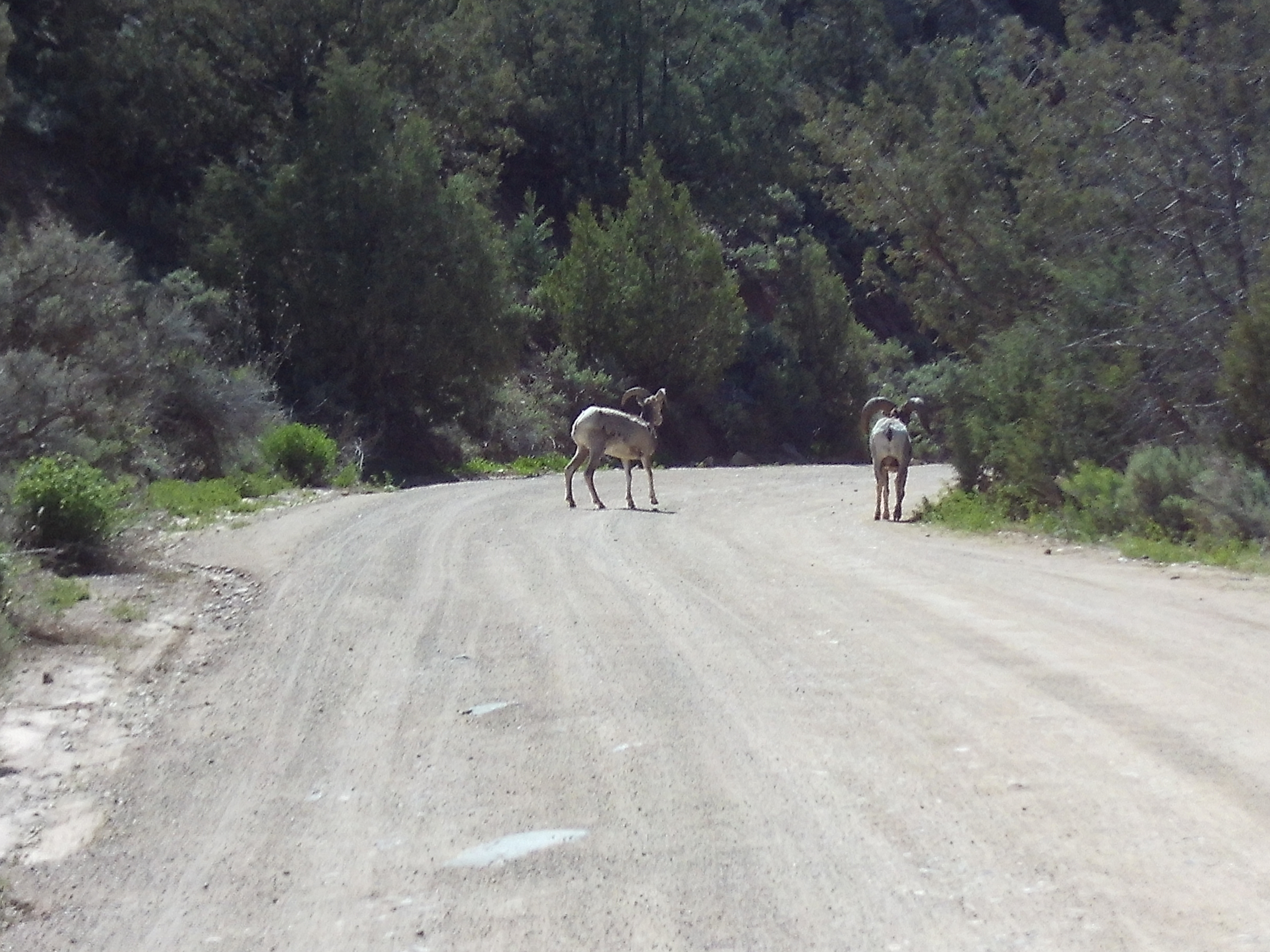
I paced them for awhile as they trotted down the road ahead of me, searching for a way back up the cliff. They are much bigger than I realized.
The coyotes are back, too, hunting my rabbits and howling in the yard, and the dogs are properly frightened by their noisy presence. (a response I have reinforced in them) Blasting the air horn out the window seems to scare them off, though, and I suspect the dogs presence has them wary, too.
There is a herd of eight or nine rabbits now, though we lost some to coyotes this winter. But there are always new babies. I have moved their winter feeding/watering station to a carpet covered pallet under the camper shell that gets the winter sun and is away from the dog area. My interaction with them is less now that I have the dogs, who only want to chase them.
I have also expanded the enclosed area to include a separate front yard where the “sacred circle” is and built a solid, latching gate at the entry, further protecting the yard from marauders and giving the girls some space to play. The fence is four feet tall and made of dark green wire whose narrow mesh is only 2” wide by 3” tall, which I assumed would keep out the ravenous bunnies, until I discovered one in the yard munching my plants. I watched to see where he got in, figuring I had missed a breach someplace, when I watched him wiggle through the mesh of the fence! So then I had to get chicken wire and re-do the whole fence at the base…and they are STILL getting in somehow.
 A wonderful harbinger of spring was the return of the nesting bluebirds who returned to their nest over the east trombe window. The roof of the window enclosure snugs up to the eaves, providing a wonderful, warm, high sheltered platform for them. They are dutiful parents and they would take turns bringing in bugs and such to feed the fluttering, cheeping babies. I loved sitting in that window in the morning sun and watch them fly in and out tending to the babies, and listening to the excitement.
Then one day, while I was out working on the fence for the new yard, I saw the birds acting strangely. They were squawking and flying to the nest and flapping their wings at it, and then retreating to their fence perch. Then the male kept flying over to me and peeping excitedly and then flying back. I wondered if maybe they were trying to coax the chicks to fly so I stopped and watched. Then, as if to validate my guess, one of the babies came tumbling out of the nest, landing on the ground too hard. I hurried to see and found the poor thing flopping weakly, too young to fly yet, without enough feathers. I gently picked him up, hoping my scent on him wouldn’t make his parents reject him and reached up to return him to the nest.
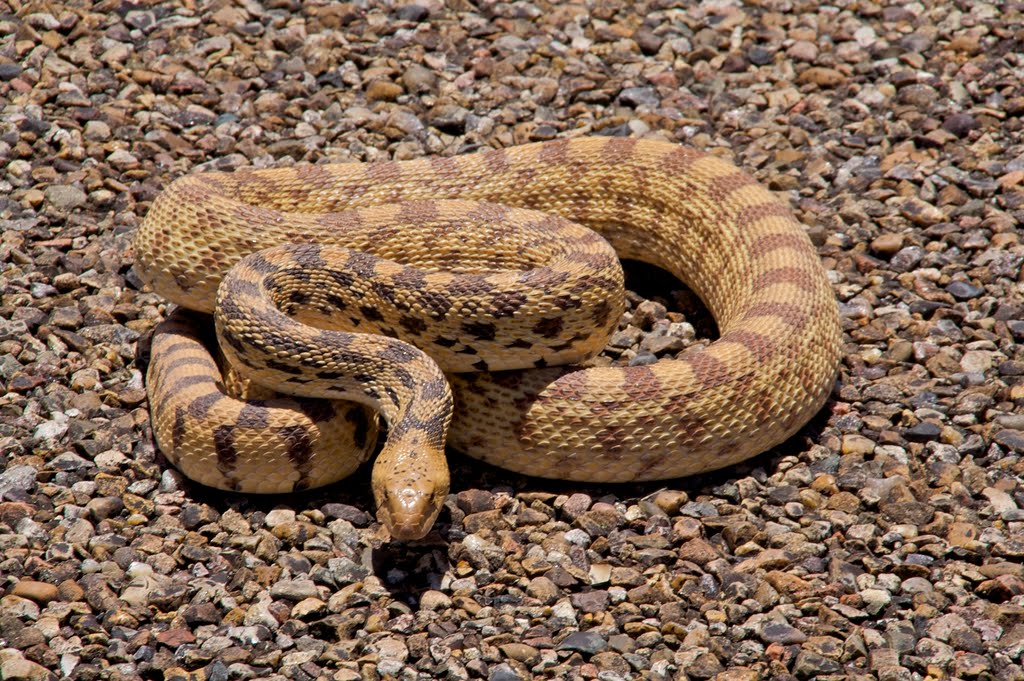 As I reached in, I was startled and horrified to see a three foot, golden brown snake as thick as my wrist, coiled up on the ledge at the nest with a baby bluebird in its mouth! Shocked, I nestled the weak bird in my hands in some weeds growing from a large flower pot and turned back to the scene. At that moment another chick came tumbling out of the nest. All the while, both parent birds were flying around in a frenzy, and raising a ruckus. The second chick was stronger and resisted being caught and placed in the pot with its sibling and immediately jumped out.
Returning to the nest, I had to resist the impulse to just grab the snake and fling him. I couldn’t be sure if it was a rattlesnake or not. 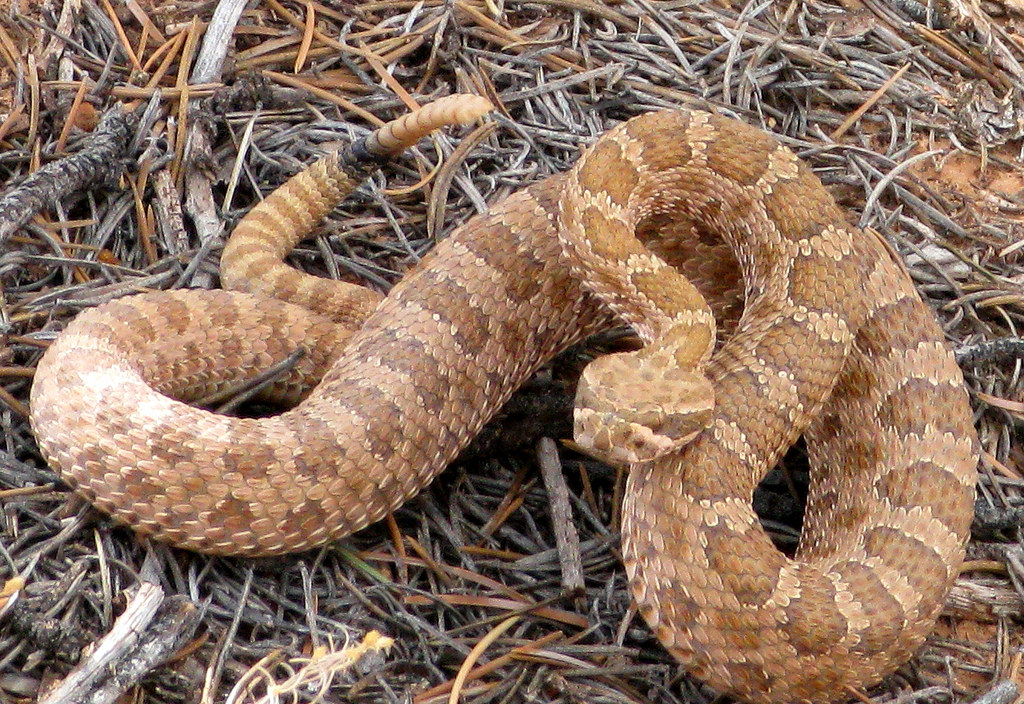 (They look very much alike but the rattler has a broad, triangle-shaped head and the bull snake’s is much narrower.) But HOW did it get up there, seven feet off the ground with slippery vinyl walls?! I ran to the wood room and found a five gallon bucket, a butterfly net I use to catch pesky airborne flies, and a broken umbrella that has a hooked handle. It dropped the bird when I started poking at it with the hook and tried to retreat, but I managed to hook it into the net and ran toward the stable. In the struggle, I could see that it was not a rattler, but a bull snake which is a beneficial (usually) snake that helps manage the rodent population. (My research showed that they can even climb trees.) The wily thing climbed out of the net and fell to the ground, quickly taking cover in a rodent hole. (Undoubtedly having already dispatched the inhabitants.) The weak bird was near death so I left it in the pot for the parents to see, but returned the stronger one to the nest and removed the dead one. There may have been others up there, but I couldn’t see and didn’t want to create any more disruption.
Then I stalked the snake, waiting for it to come out of the hole, and then caught it again as it tried to return to the nest, this time a little more confidently, knowing it wasn’t deadly, and took it down to the gully garden, gently releasing it and requesting that it stay and address the mouse problem there.
 Awhile later I was back to work on the fence when the bluebird came back, flapping at me and then flying down toward the garden, raising a fuss at something in the grass, and then back to me. I knew exactly what he meant and marveled that he understood that I was their protector. Sure enough, the bull snake was coming up the hill through the grass, making a bee-line for the nest. This time I caught it and carried it in the bucket, holding it by the neck to prevent escape. I never once felt threatened by it, nor did it seem life threatened by me, just annoyed as I walked it over the hill to a new hunting neighborhood. As much as I appreciate the vermin management, I value the bluebirds more.
I ignored the nest for awhile to give them time to recover and I did see the parents feeding again for a few days so I hope at least one survived. (A windstorm last week blew the old nest down and I found no evidence of the babies so maybe one did survive.)
Shortly after that, the parent pair abandoned the old nest and built a new nest in the eaves of the new room. I had deliberately added a few sheltered ledges in the eaves when I built the room, hoping that they would take up residence. They fostered a new brood there and I seriously doubt the snakes can get them now. (I understand that bull snakes can even climb trees. Good thing they are benign.)
My off-grid adventure has had a learning curve, but little by little, it is becoming a self-sustaining place that I can be proud of as I work the dream. One trade-off is the convenience of abundant water, requiring some adaptation. Since a flush toilet was not an option, I was grateful to discover composting toilets, thus avoiding the usual need for an outhouse in such circumstances.
A word about composting toilets, though. I was super grateful for it this winter. I just can’t imagine trudging through the snow in the dark or digging a latrine in snow covered, frozen soil and sweeping the snow off the frozen seat and dropping trou in the wind! However, I have learned that the composting action shuts down below fifty degrees. Mine is the non-electric model and recessed into the concrete floor section so it gets cold. Plus, I was gone a lot during previous winters so the house got really cold. A certain moisture content and temperature must be maintained for the microbes to stay active and do their job. Also the liquid can accumulate sometimes, stifling the aerobic bacteria. (I use a pee bottle at night to avoid adding additional liquid to the mix, a convenience of being male) I DO have a solar powered fan in the vent pipe which helps to remove methane and moisture when necessary, but the vent system works well without it. (There is never any smell from the toilet.) Also, I didn’t add enough dry mix each time as recommended since the company is in Canada and its local source is 90 miles away in Santa Fe. Result: a heavy clay cylinder, crusted on the drier outside with the peat mix and whatever active microbes there may be, and with a smelly, soggy center where the aerobic bacteria can’t survive.
So I bravely excavated most of the hideous brown clay into biodegradable plastic bags and carried them in five gallon buckets to a composting site, far from the house and downwind, full of dried tumbleweeds and other dry garden waste from last year, and mixed it in deeply, covering it with a piece of chicken wire to deter any curious digging. I have discovered that the microbes work very well outside, reducing the other, kitchen compost heap to a depression rapidly and hope it will work the same way, and quickly.
Don’t think I’ll ever have enough water for a flush system so I need to learn to manage the composter. For now, to avoid using the composter while I continue to empty it and learn to manage it, I have re-instated the toilet seat latrine box in the gully for the pleasant days, and have rigged a plastic bag lined five-gallon bucket with a specially-designed-for-camping seat and sealing lid and put it next to the composter in the CC (Composter Closet) for night time. Good thing I still have enough of the old camper spirit left in me until I get these systems more civilized. I’ve seen plans for a solar toilet that incinerates the waste, but have more pressing projects to address.
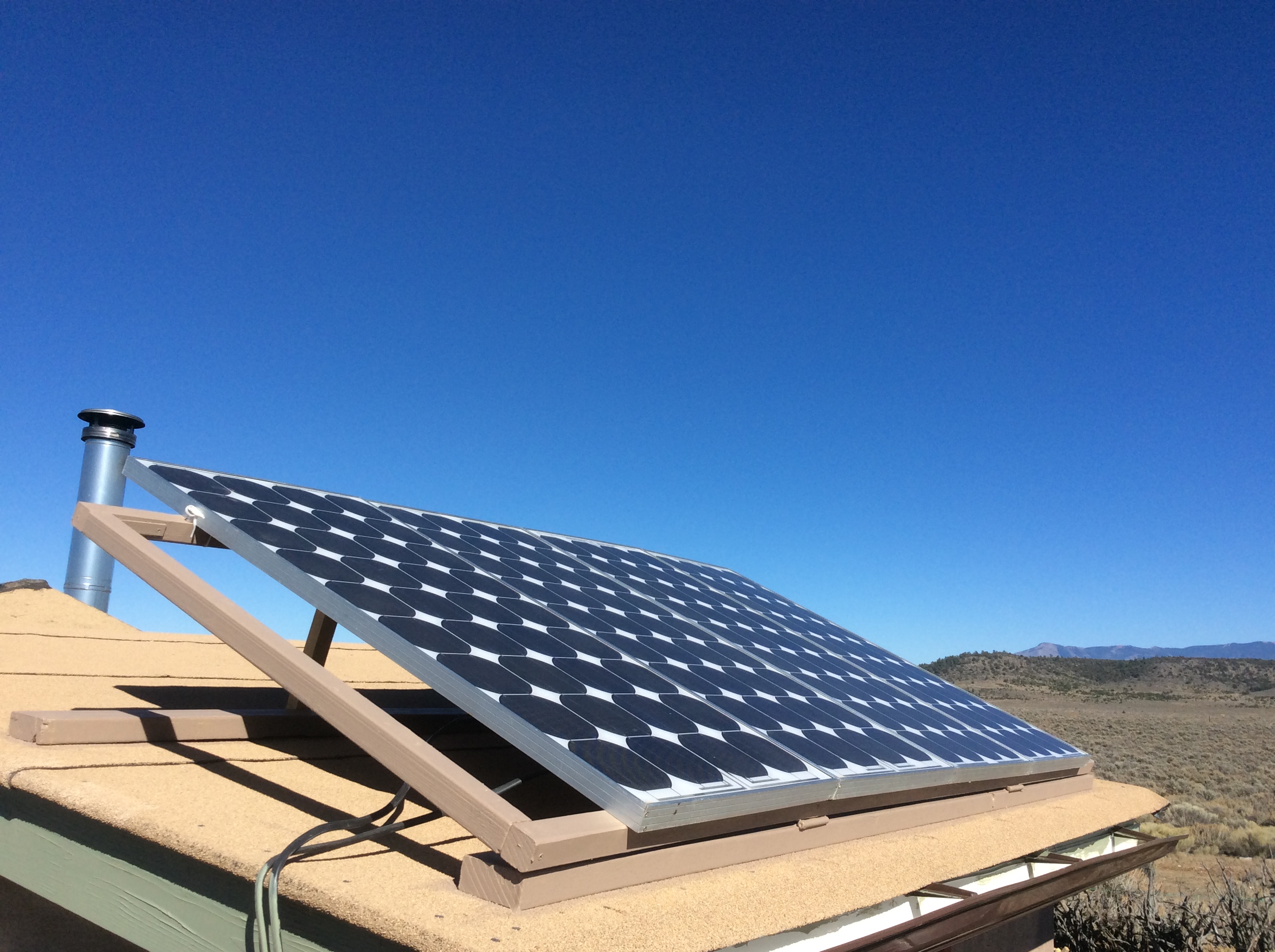 My power systems are better now. The wind turbine and inverter hub serves well as a separate backup system to the solar panels and I have hooked up the new Briggs and Stratton 1800 watt generator to it for those occasional dark, snowy, windless winter days.
 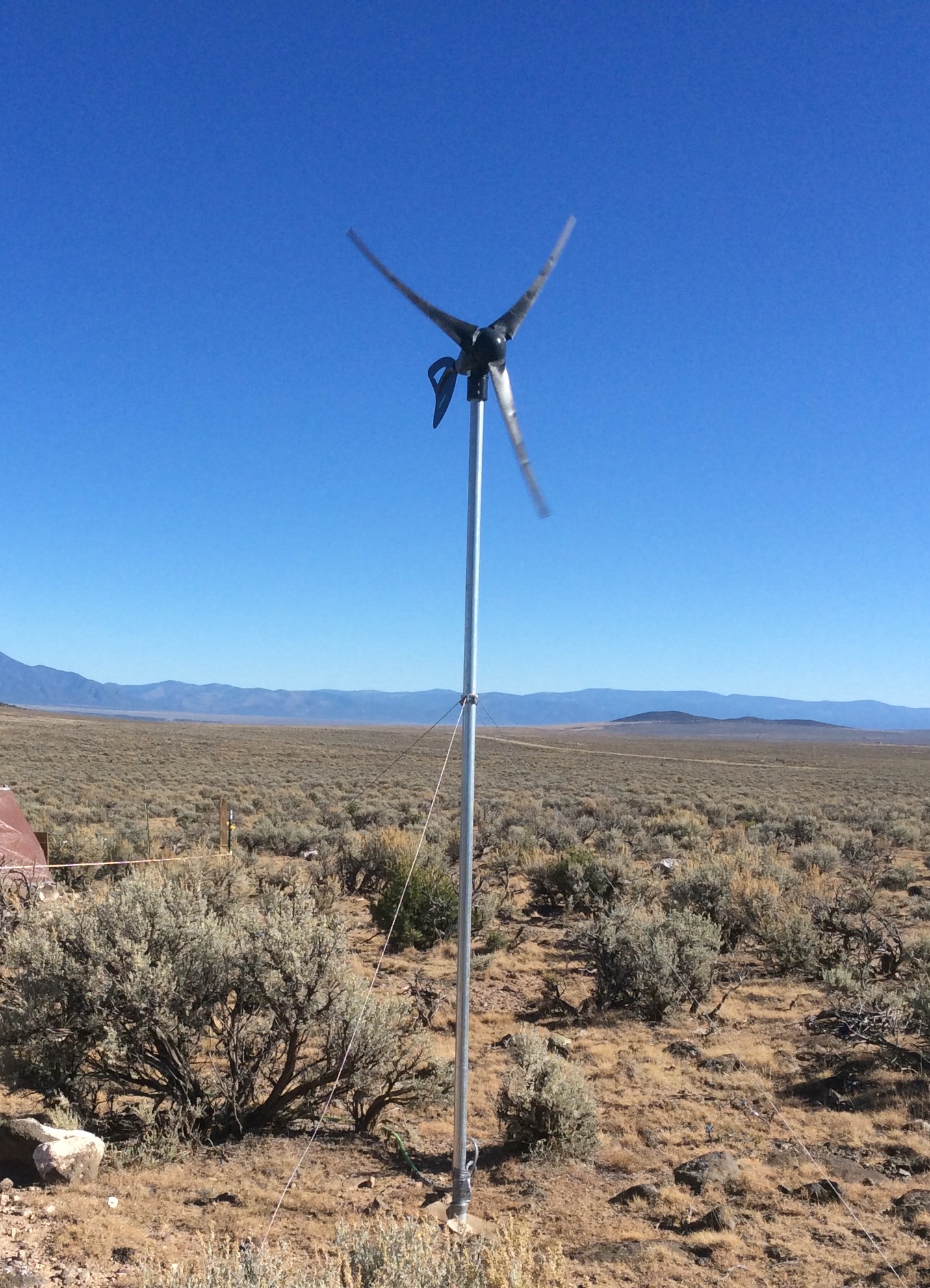 With it I can power things while charging the batteries. I have also discovered a range of LED light bulbs that use only four to six watts each, thus providing better light than the solar yard lights I continue to use without having to sacrifice satellite dish time. (The dish systems are power hungry.) Once the four twelve volt batteries I have for the solar system now are depleted, I plan to add a couple of more panels and switch back to eight six volt batteries which will offer much more storage capacity.
My neighbor has loaned me a low energy DC refrigerator designed for an RV that I still need to wire up to my batteries. Having refrigeration will be a nice step up and will save many trips to town for ice and cut down on spoilage.
Another civilizing addition is a stylish futon couch that converts to a comfy memory-foam bed. It’s in the narrow east room, which can be isolated for privacy with a drawn drape, and it boasts a TV, stereo, and WiFi, so now I have a comfortable guest space.
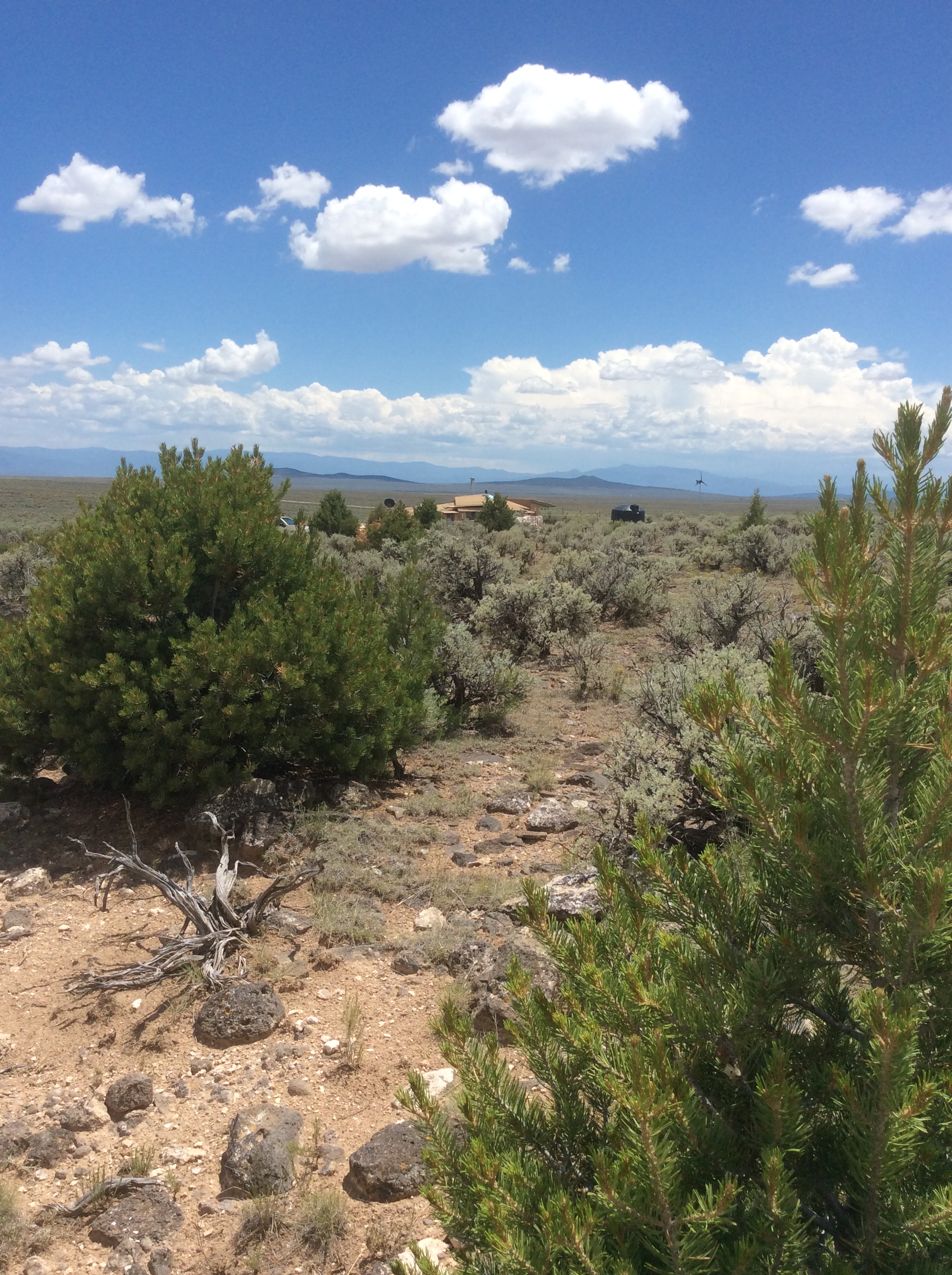 New forest of pinon pine is popping up all around the place, creating a fledgling forest, probably the offspring of the old, larger tree up the hill where the old stagecoach road crosses the dirt access road. When they first carved the access road mid-last century, the road worker bulldozed around the sole, young tree. Its cones have since been washed down the former stagecoach road, now my gully garden, and several other trees took hold along the new wash.
 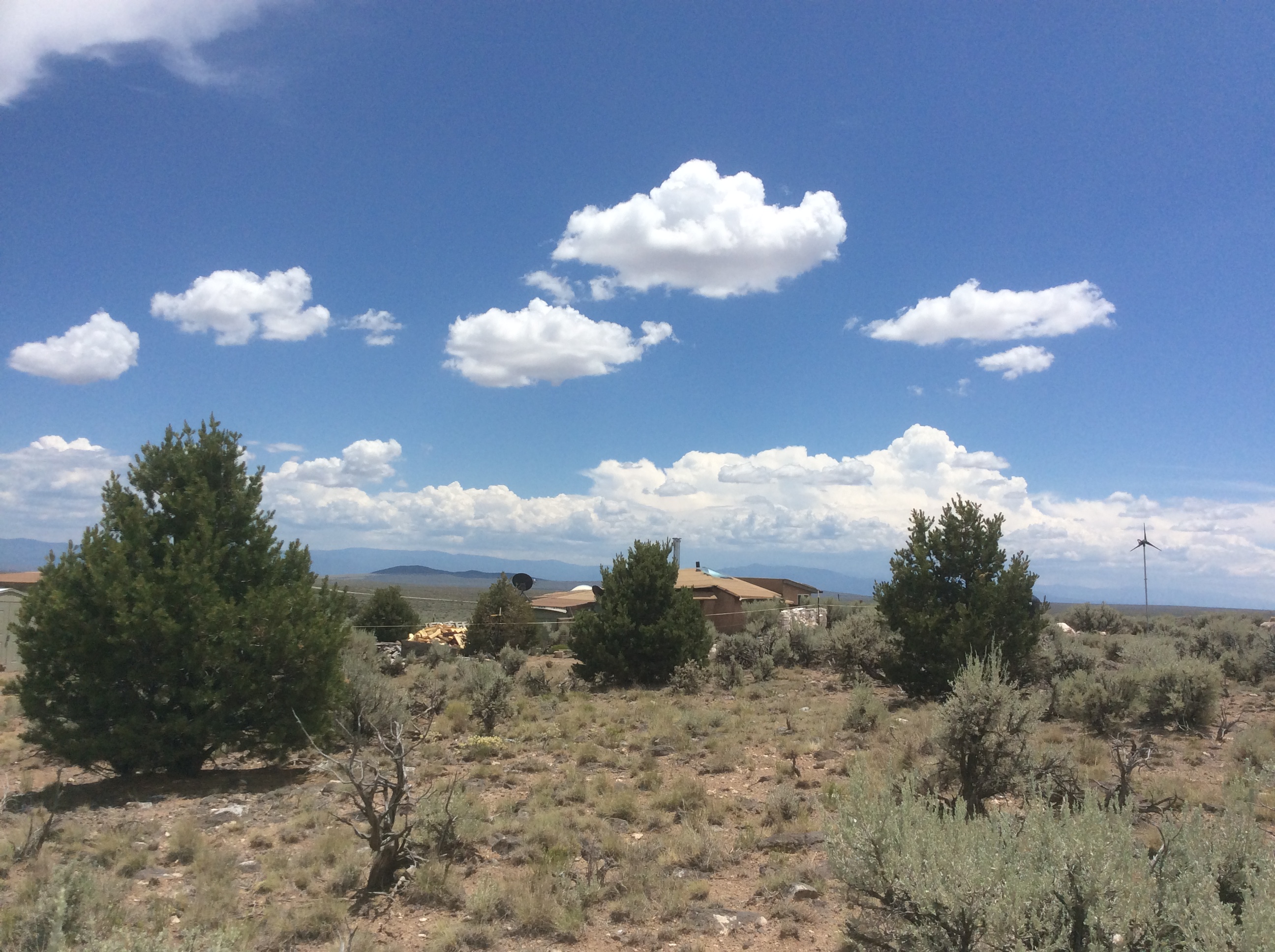 When I arrived fifteen years ago, there were only a few. But now that I have created a habitat, ground squirrels, rats, and mice have harvested the seeds and buried them in caches for the winter, resulting in a swath of baby trees all around my place! My original intention was to be in the trees and am glad that sometimes things work out the way you hope.
They say that it’s the journey, not the destination, that is the key to life. I began this journey to retirement fifteen years ago, and though have now finally reached retirement, have yet to realize the destination of my intended retirement home. 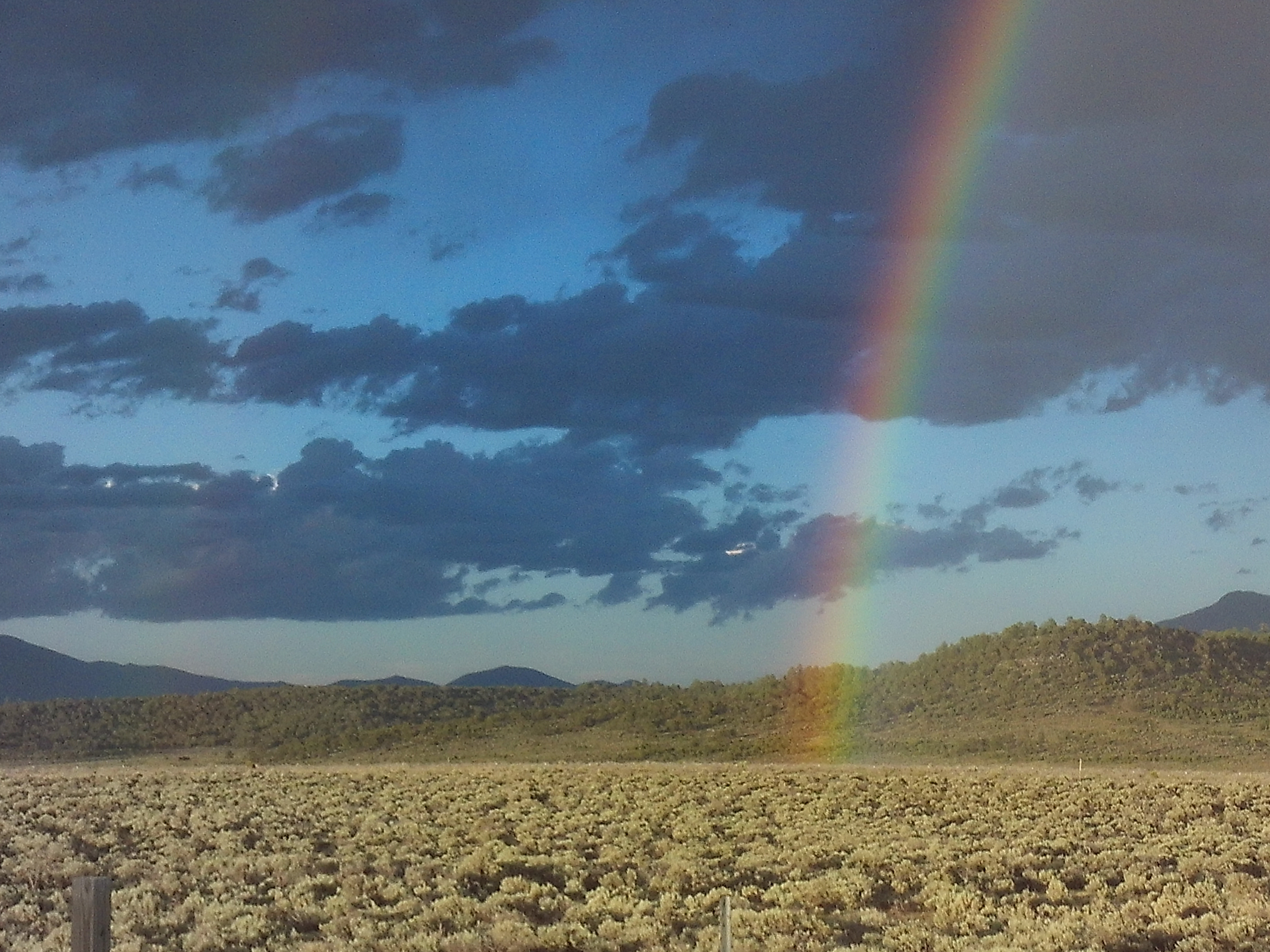 But, despite all of the side-trips and set-backs, I must remember that I AM living in an off-grid, paid-for homestead on seventeen acres of pristine sagebrush in the center of the country, in a high mountain valley with broad, dramatic skies featuring spectacular sunsets, rainbows, and the thin air and remoteness offers dark skies with more stars than you can imagine.
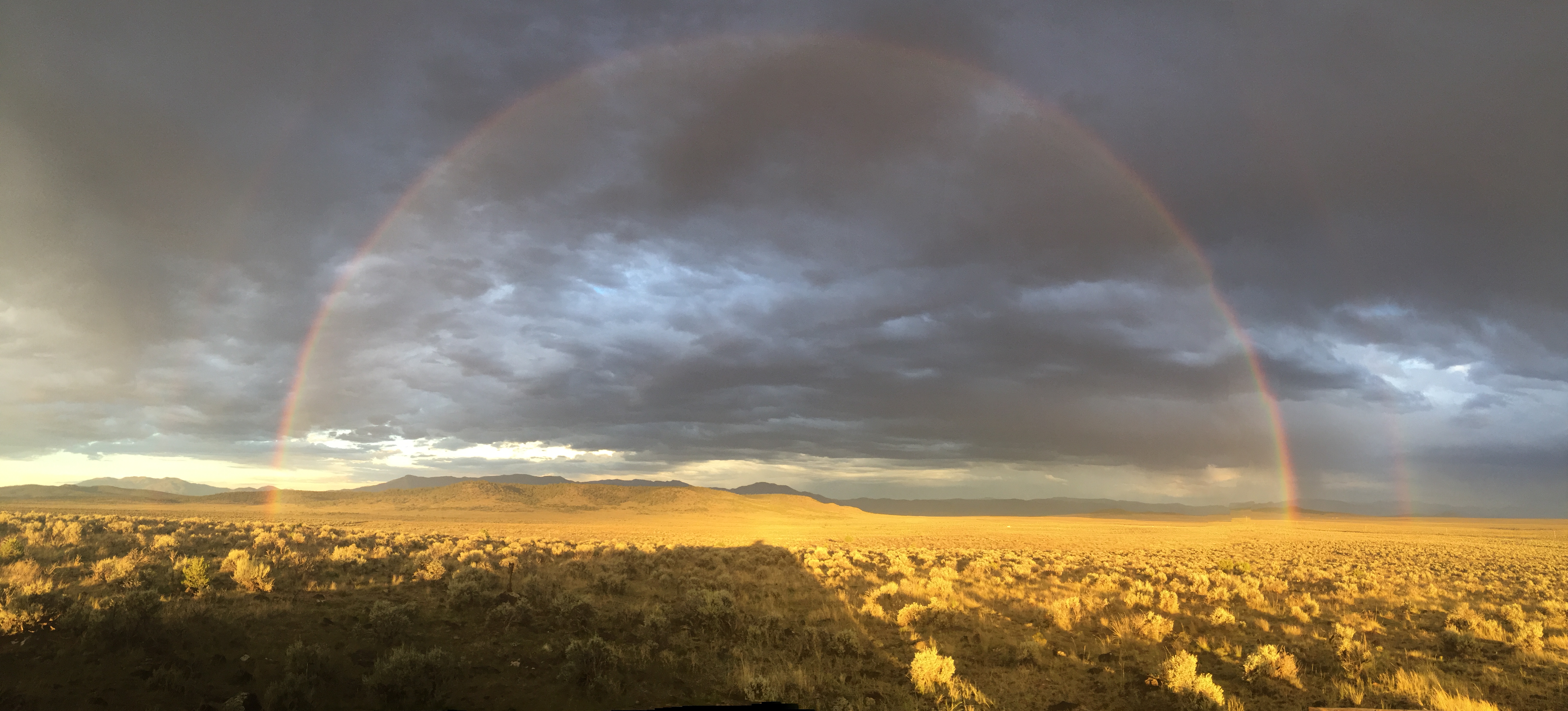 The view out my window is of the Sangre de Cristo mountains and Taos Sacred Mountain, at the base of which is the Taos Pueblo, the oldest continuously inhabited community in North America, and Wheeler Peak, the highest point in New Mexico. My neighbors are cows and coyotes, yaks and llamas.
So, retirement doesn’t mean that now I stop working. Now my profession is to eke out my dream, without having to punch somebody else’s clock. At my own pace.
I like that.
Watch for the new adventures of Desert Dave as I seek land in Nevada for a winter quarters project. While I can almost guarantee that there will be NO cows involved, living to be 65 has taught me that it’s always gonna be something.
I guess it all comes down to attitude.
Editor’s note: Range has, at this writing, had nearly 1400 visits from 44 countries and six of the seven continents. STILL don’t know how they are finding it, but I’m delighted and hope that some of this “cautionary tale” has been helpful/useful to others pursuing the paradigm shift of autarky.


 Range (...or "The Cows Ate My House")
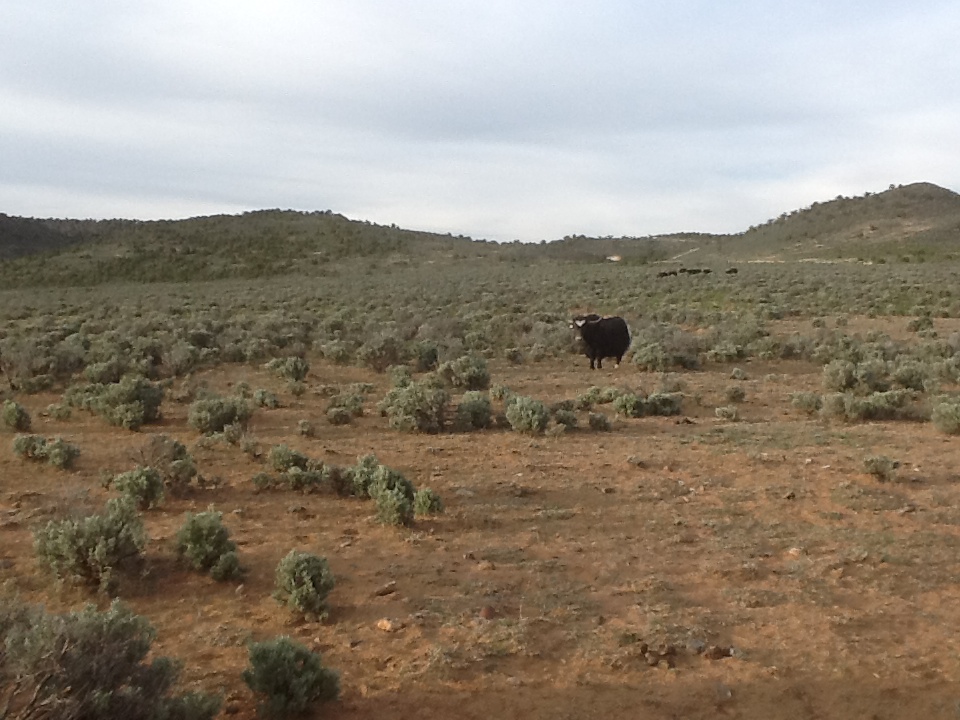
Dear Dave , Hope you are well and that things are looking up for your house Still in Florida and enjoying NOT WORKING 😃😃‼️‼️ Keep on keep in’ on ❤️❤️❤️😘‼️🐬🐬🐬🐬
Wow! That was a good read, and here I thought I had it rough!
David … I’ll message you on FB, too, but thought I’d leave a note here.
My admiration for your grit and determination is unending. That said, reading this saga just made me so tired I felt like crawling back in bed. Your quest is 180° from mine. I don’t want to own much of anything, don’t want to be responsible for much of anything … just want time to think, create, and read, and with limitations on those activities to avoid “rabbit holes” of responsibility.
My mantra about living in the material world kept ringing in my ears as I read “Cows”: What you own, owns you. … Got a garden? Gotta tend it. Got a house? Gotta maintain it. Got walls made of hay? Gotta fight off a herd of cows. …
I hope you find satisfaction in this process and that there are days when you can sit down in at Adirondack chair (without being bitten by flies) and just look out over the expanse of New Mexico desert as the sun goes down and sip something alcoholic and melt into a form of peace!